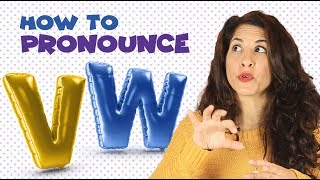
A short instructional YouTube tutorial by Hadar Shemesh explaining how to pronounce the English sounds V (as in "vet") and W (as in "wet") and how to avoid confusing them in speech. The speaker contrasts articulatory positions (V: bottom lip touches top teeth with voiced friction; W: rounded lips and tongue pulled back, no lip-tooth contact), offers word and phrase practice (minimal pairs, connected phrases), and gives learning tips (lip-strength exercises, record yourself, focus on transitions like "of which").
Chapters
Hey, everyone, it's Hadar. And this is the accent Sway. Today we're going to talk about how to pronounce the V as in vet versus the W, as in wet. V and W. V versus W. Some speakers tend to confuse those two sounds and then use a W when they need to use a V and vice versa. And some people just struggle with pronouncing one of those sounds. So today we're going to learn how to pronounce each of them and also how not to confuse them, which is sometimes more important because, okay, I know how to pronounce it, but how do I make sure that I don't mispronounce it when speaking? Because in practice it's all great, but then in real speech, totally different thing. So let's begin with the difference between those two sounds. Now, both sounds are formed with the lips. Okay. The W is produced as the lips go forward and the tongue pulls back a bit. W pushes down W. W. And the V sound is created by bringing the bottom lip to touch the top teeth. You're releasing air with sound. So the vocal cords are vibrating and creating this friction sound, which is the V as in the word very vicious and 7v v v. Now let's practice it in words. The V sound. First, you want to feel vibrations. Notice that it's just like the F sound, F, V. Only that the voice is activated, creating this new sound, the V. Very. When you pronounce the W sound, you want to make sure that nothing touches the lips. The lips move, move closer. W. You need to use the muscles here. So if you don't tend to round your lips a lot in your native tongue, you definitely want to do some lip push ups and, you know, strengthen the muscles here so it's easier for you to pronounce this sound. W. W. The lips don't touch anything. W. Y And, and when. And yes, when you have an H after the W, it is pronounced with a regular W sound. Some people add this sound, this H sound, when pronouncing the W in WH spelling patterns like when and why. But I highly recommend you to keep it simple and just pronounce the W sound unless you want to sound really, really sophisticated. Now, while this may be a little easier for you so you know what to do for each word, it gets tricky when it comes to phrases. For example, the phrase very well, try saying it very well. Probably if you tend to confuse these two sounds, something like very well comes out. Right? Right. Am I right very well or very well? Maybe two V's or two W's. Or perhaps you're just mixing the two things and saying something like very well instead of very well. So start. Make sure that for the V. And usually when you have a V in the spelling, it means that you do bring the bottom lip to touch the top teeth. Usually V. Very, very. And then for the W, make sure nothing touches very well. So always use words in context, because when you use them separately, it's all bells and whistles. And then whistles, by the way, with a W. And then when you need to use it in a sentence, you always go back to old habits unless you become hyper aware. Aware with a W. Hyper aware of the sound, making sure that you don't mispronounce it. So, again, I'm doing very well, thank you. Very well. White windows. Round your lips. Nothing touching. White windows. Vicious wedding. Vicious wedding. Vibrations. Vicious wedding. Go slowly here. Viking warriors. Yeah, I know. I added a few R's in there just for fun. Viking warriors. Warriors. Viking warriors. Save the world. Save the world. Save the world. Right. We want to make sure that the bottom lip touches the top teeth and then a th sound and then a W sound. Okay? So practice it in words, then practice it in phrases. And then to make sure that you're actually using it in real speech when you actually speak, then either record yourself. Okay. And listen to the recording and only focus on the things that we talked about, the substitution of the W and the V, or speak to yourself and make a point of using all the words that you practiced. Okay. Notice in particular, words that have both W and V's together, and even more specifically, V's and W's connected, like of which. Right. When you need to shift from the V to the W, of which this is where it blends in. And then you usually drop one sound, like a which or of which. Of which. Right? And then merging the two sounds, you have to make this distinction. Now let's practice it in minimal pairs. Words that are almost the same except this one sound and that one sound changes the meaning while vile. West. Vest. Wet. Vet. Wine. Vine. Okay? So go ahead and practice. Make a list of words that you use on a regular basis with V's and W's, and make sure that you don't mispronounce them. It's all about being focused and knowing what you're doing and also about being cool with making mistakes, because that's the only way to learn. You know that. Okay, that's it. I hope this was helpful. Let me know in the comments below what is your struggle and if you have any other words that you struggle with or sounds so I can make videos and help you pronounce them correctly. Thank you so much for watching. Please share it with your non native speaking friends and come on over to my website. Check it out. Fun stuff there. Take care and I'll see you next week in the next video. Bye.