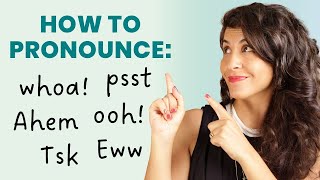
A short instructional YouTube video by Hadar Shemesh (June 11, 2024) that teaches how to pronounce common English interjections. The presenter defines interjections as short sounds/expressions that convey emotion and then walks through many examples (e.g., ugh, uh-huh, nuh-nuh, aha, ew, oh/oo, wow, whoa, phew, tsk, mmm, hm, uh, psst, yay), demonstrating pronunciation, typical attitudes, and brief usage contexts.
Chapters
Whoa. Yay. Aha. Oh. Huh. Phew. Wow. Hey, everyone, Today we're gonna learn how to pronounce interjections, which are all the different sounds that I made at the beginning of this video. Now, it's funny that I want to teach you how to pronounce interjections because these are basically sounds. And usually we hear sounds and then we just imitate sounds. But here's the rub. For each sound, there is a very common spelling. And a lot of times we see the spellings of these interjections, whether it's in comics or in books or in texts. And sometimes we don't know to associate the sound to the written word because each interjection is actually a word that has its own spelling. And again, like, sometimes we don't know exactly what it means or how it's supposed to sound. So when a character says we don't know if it's uhuh or which actually means two different things. Now, these sounds are kind of universal. So I'm not going to so much talk about the meaning of these interjections or sounds. I think it's going to be pretty intuitive. If not, I will explain, but I want to connect the sound and attitude to the spelling of the word. And just to clarify, interjections are expressions or sounds that we make that are used to convey a feeling or an emotion. So the first one, and my personal favorite, is this. The pronunciation is. So for me, the sound is really easy to pronounce. For some people, it's not that easy. So you might hear something like or. But usually it's like when you're frustrated or when something is disgusting. Can't believe they just kissed. Or this yogurt is spoiled. Ugh, these are old. Okay, you get the point. The next one is huh, huh, huh. Which is used to agree with someone. Huh. Yeah, I'm going there. Uh huh. Uh huh. All right, the next one is nuh, nuh. To disagree with someone. Oh, you love him. Nuh, nuh. Or you can also go further back in your pronunciation, more of an ah sound. Nuh. Either one is fine, and that's how it's pronounced. This one is huh, huh. Right? You can use it for different attitudes. It could be like huh, funny. Or huh, interesting. Ah. That is so cute. Aha. And you realize something. That was an aha moment. Aha. That's it. Aha. Aha. Ew, Ew. I don't like it so much. Ew. Eww, ew, ew. I don't like it. Ew. Ew. I don't like wasabi ice cream. Ew. All right, this one is easy. Oh. Oh, so you do like me. Oh, okay. So you are coming. Oh, fine. O. And this one is OO. Interesting. Tell me more. Oo. So two O's is Oo. One O is O. Oh. Oh. He's coming with the pitch. Oh, I made a mistake. Uh. Oh. I. I messed up. Uh oh. Oh. Now the next two are fun. This one is. Wow. Wow. This should be in a museum. Wow. I can't believe you did it. Wow. And this one is. Whoa, whoa, whoa, whoa. Hold up, hold up. I don't think so. Different pronunciation. Can you hear? It's not. I see it a lot in comic books. Whoa. Wait a minute. What are you saying? Really? Wow. You're excited about it? You're impressed. Wow. This is great. Whoa. This is overwhelming. Let me process it. Whoa, whoa. Hold on just a minute. Whoa. Just a minute. Whoa, wait. Whoa. Phew. Phew. That's where that horrible odor comes from. I'm saved. That was hard. This pronunciation was hard. Yeah, that's how you pronounce it. And this is. This is how you pronounce it. It's kind of like when you disagree with something. When you're or you're unhappy and you're, like, being condescending is like, can't believe they're doing it. And it's also an impolite way to say no. And you call it a tisk. Don't tisk me. Right? I remember when I was in third grade, we had to do a role play of a Bible story, and I was supposed to play God, and there was this other girl who was playing Moses, and this girl was asking me a question and asked God. I was supposed to say no. And I was. I went like. And my teacher got so angry, she's like, what? Tisk? What? What's tisk? And I was like, what do you want? What is tisk? Anyway? I was like. So that was kind of funny. But that's how you make this sound. If you see the word tisk in a comic book or in a book, then know it's a. This one is. You remember our friend Doug? When you want to interrupt someone, it's like clearing out your throat. I'm here. Hi. And the next one is pretty good, right? Just like when you want to agree with someone, it's like, huh? But with closed mouth. And when you see it without the dash, like, mmm. It's more of a. When something's tasty. Thank you. So good. And then we have. Hm. Let me think about it. Just thinking. The next one is. Average. You might be very familiar with this one. When you are trying to fill in the silence or you're looking for a word, that's it. A simple, uh, sound. This one is. Psst. Let me tell you something. When you're trying to get someone's attention. And the last one is, Yay. We are done with this episode. Yay. All those amazing interjections. Yay. All right, that's it. Thank you so much for interjecting with me. I hope you enjoyed learning the pronunciation of all those interjections that I'm sure you've seen in books and text messages and videos. Now you know how to pronounce them so you can practice with me. Have a beautiful, beautiful rest of the day. If you enjoyed this video, please consider sharing and subscribing and I will see you next week in the next video. Bye.