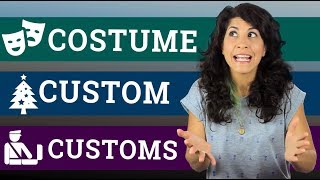
A short YouTube pronunciation lesson by Hadar Shemesh that explains the differences between three similar-looking English words: "costume," "custom," and "customs." The speaker defines each word, gives real-world examples (Halloween, Purim, cultural practices, airport customs), and contrasts their pronunciations using phonetic descriptions (e.g., "ah as in father" vs. schwa, long "oo" vs. schwa, final /s/ realized as /z/). The video ends with a brief conclusion and channel call-to-action.
Chapters
Hello, everyone. It's Hadar. And this is the accents way. Today we are going to talk about three words that look the same but pronounced differently, and they mean different things. And those words are costume, custom, and customs. Now let's begin with costume. Costume is the outfit you wear for Halloween or Purim, if you are Jewish. It's a dress when you dress up, okay, as something. So a costume is pronounced with a k sound, and then it's the ah as in father, ca. And then there is an s. The second syllable is tum. A T sound, the U as in food, and an m. Tum. You can also say tum with the y sound right before the U. Tum. So it's either costume or costume. Both are. Okay, so that's costume. Then we have custom. Custom is behavior or things that you do that are very specific to a place or a society. So for example, singing Christmas carols during Christmas is a custom. We also use it in custom made. So when something is tailored into the specific needs of an individual or custom settings, when you are changing the basic settings of a system to fit to your needs, to accommodate your needs. Okay, so that's custom. It's also the root of the word customer. Okay, to pronounce the word custom and customer, you start with a cup sound, cus, right? So it's very similar to costume. But here it's not the ah as in father. So it's not. It's kus. Kus. A cup sound is like a stressed schwa. The jaw is relaxed, the tongue is relaxed, and the lips are not rounded at all. The second syllable is. It's a t sound, a schwa, and an m. So the first word has tum. It's a long oo sound. And this word has a. A schwa. Custom. The cup sound and the schwa are very, very similar. You can even say it's the same sound, only that the first syllable is stressed. Custom. And if you want to add the er at the end, customer, that's just another schwa with an r. Customer. Costume. Customer. The third word is customs. Customs is an authority or agency in a country that is responsible for the flow of goods into and outside of the country. So you all know this. When you were walking out of the airport, you're walking out of the plane and you just want to get into a cab and explore the city. But then you have customs, and you have to think if you have something to declare or not. I always freak out, although I never have something to declare. But I'm afraid that Someone is going to catch me and start searching my bags. Yeah. So that's customs. I'm sure you all know what it is now that I've described this experience. So customs is basically the word custom with an S. Okay? So same exact pronunciation. Cus. A cup sound. Cus and then tim with a schwa. Custom. And then the S is pronounced as a Z. Customs. The fact that there is an s here doesn't mean it's plural. Okay? It's not the plural form. Actually, customs is the singular form. The plural form of customs, and I had to look it up, is customs. Duties with an S. So it's not custom. Duty. Custom. Duties. So that's the plural form. Okay, so to conclude, the first word is costume, as in father. Drop your jaw, relax your lips. Costume. And then long oo as in food. Think like there is an extra W there. Costume. Then we have custom. Don't drop your jaw, close your mouth, relax your lips. Custom. And lastly, customs with a Z. Okay, that's it. Now, do you have an interesting story or an interesting customs experience? Let me know in the comments below if it was frightening or funny. I love custom stories. I have a ton of them to tell you about. And if you found this video helpful, please share it with your friends. And do not forget to subscribe to my YouTube channel and click on the bell to get notifications so you'll know when I upload a new video. Thank you so much for watching. Have a lovely, lovely week and I'll see you next week in the next video. Bye.