Learn American Rhythm With Reese Witherspoon (Speech Analysis + PDF)
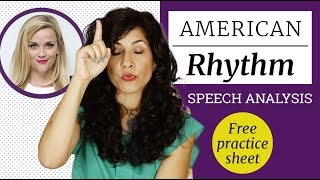
Hadar Shemesh breaks down Reese Witherspoon's speech to teach American rhythm and intonation. The analysis covers stress, pitch, and speech patterns in English, with a downloadable PDF guide included.
Chapters
Hey, guys, it's hadar. And this is the accent's way. And today we're gonna talk about American rhythm. We already said that American rhythm is derived from the content, which means words that are stressed are usually longer and higher in pitch. For example, content words like verbs, nouns, adjectives, and adverbs in comparison to words that are less stressed, that are shorter and lower in pitch and so softer. And these are function words like on and at. Could. What should m is are fur of this. Now, if in your language, you have specific stress patterns, meaning maybe you stress every other word, or maybe you only stress things at the beginning and drop at the end. This is a challenge for you. And this is why you need to change your mindset and start recognizing the words that you want to stress. And these are the words that you.
Want to go for.
And by go for, I mean prolong the main vowel in them and raise the pitch for them. And to demonstrate this idea of American intonation and rhythm even further, I chose to analyze with you this wonderful speech by Reese Witherspoon. Let's take a look.
What do we do now?
Seriously? I'm not kidding. Go back and watch any movie and.
You will see this.
What do we do now?
Here. Here, she's talking about the fact that almost in every movie, there is a point where the woman turns to the man asking, what do we do now? Okay, so let's analyze this question for a sec. What do we do now? The two words that stick out the most are what and now. And then we also have do.
What do we do now? What do we do now?
So we have what that is really high in pitch. Notice that she's not pushing her voice to say the what. And. And then now she just goes higher in pitch.
What do we do now?
Right now, of course she's exaggerating, and I'm not expecting it to go this high in pitch.
What do we do now?
But just try to get the essence of the way she stresses things.
What do we do now?
So what are we? The we. It's not what do we. What do we. What do we. The we is not reduced. But she's saying it really, really quickly. What do we do? Right. She's not going higher in pitch, but it's longer. Da da da da da da da da da da. It's not what do we do now? Da da da da da.
What do we do now? What do we do now?
So if you don't want to exaggerate it so much, you can just ask.
What do we do now? What do we do now?
Da, da, da, da, ta.
What do we do now?
Right now is really long. What is kind of long? Do is right there in the middle. Ta da da da da. But the do we is short and somewhat reduced.
What do we do now?
Let's look at the next sentence.
What do we do now?
Seriously, I'm not kidding. Go back and watch any movie and.
You will see the Seriously, I'm not kidding. Go back and watch any movie. Seriously, not kidding. Any movie. These are the stress words. Seriously, not kidding. Any movie. Seriously, I'm not kidding. Go back and watch any movie. So she really slows down hitting those stressed words. This is not too speechy. That's how people actually speak. Right? It's a comment that she's adding. It's not planned, I think. Right? Seriously, I'm not kidding. Seriously. That's higher in pitch than the c, which is the primary stress is longer than the rest of the syllables. Ta da, da, da. And I'm not kidding. Both the not and the kidding are stressed. Kidding is a little more stressed than not. So it's going to be a little higher in pitch. Seriously, I'm not kidding. Go back and watch. Go back and watch. Go back and watch. Go back, watch. These are three content words, but they're not as stressed. They're not reduced. So we don't reduce the vowel there to a schwa, but they're said quickly and softly and with very little effort. Go back and watch any movie.
Right?
Slow, slow. Go back and watch any movie. I'm not pushing it. I'm not stressing it. I'm not necessarily saying it a lot louder. It's just slower. Go back and watch any movie. And it's the distinction between the fast part and the slow part that makes it different, that helps it stick out. So it's not just about saying it slowly or strongly or higher in pitch. It's also about what I did just before, which is I kind of, like, reduced it, or she did.
I can watch any movie. And you will see this line over and over again.
You're gonna see it now. And you will see this line over and over again. And you will see this line over and over again. And you will see this line. So first of all, listen to the melody. Every syllable has a different note. And you will see this line. And you will. She didn't reduce it to yule. And you will see this line. But it's said quickly and effortlessly. And you will see this line. Line is longer. Over and over again. Right? Again is reduced over and over again. Because it's not about the repetition, it's about how it happens every single time. This is why she chooses to stress over and over, over and over again. And you will see this line over and over again. You're going to see it now. You're going to see it now. You're going to see it now. Now, she's not saying you're going to see it now. You're going to. You're going to. She's not just reducing it, she's going higher in pitch. But in this case, that doesn't mean that it's stressed. This. This is a common pattern where a sentence starts with higher notes. You're going to see it now. But see is the word that sticks out that is longer. You're going to see it now. You're going to see it now. See it. It's reduced, right? It's not. See it, see it. You're going to see it now. You're going to see it now. I'm always playing with my head voice and my chest voice. I'm going up. I'm not pushing my voice. You're gonna see it now, right? I'm not using more energy to stress. I'm just raising my pitch slightly. And if you're not comfortable with going really high in pitch because you go really high in pitch, when you really want to stress something, you can go a little lower in pitch or you can just prolong the word. You're gonna see it now. You're gonna see it now. And that's also okay, but it is different. Then. You are going to see it now. You are going to see it now or you're going to see it now? Right? You're going to see it now. That's the rhythm, that's the melody, and that's the feel of American English. Let's skip to the end of the speech.
Ladies and gentlemen, I think we are in a cultural crisis.
Ladies and gentlemen, I think we are in a cultural crisis. Now, again, look at this constant distinction between the fact that fast and the slow, the reduced, and the stress, Ladies and gentlemen. Right? That's not that important, obviously. She's talking to the ladies and the gentlemen in the audience. Ladies and gentlemen, I think we are. I think we are thinking stress, it's a little longer. I is a bit more reduced. I think we are in a cultural crisis. Right? So she slows down on the two words. Cultural crisis. I think we are in a cultural crisis. Right? When you really Want to stress your point, Slow down towards the end of the point and then prolong the words that you are stressing. I think we are think is also stressed. So the words are prolonged but also the pace slows down towards the end. Ladies and gentlemen, I think we are in a cultural crisis.
In every field, in every industry.
In every field. In every industry. Now, notice the word in turns into a schwa. She's reducing it in every field. So in is reduced, every is a little longer. And field, that's the stressed word. This word is higher in pitch and longer in every field in every industry. Every field. She places it here in every industry. So industry is a little higher in pitch. It's a little longer because she's starting to build up her argument in every field in every industry. And again she slows down to get her point across to indicate that it's an important part. Like I just did now it's an important part. You slow down when you reach the important part.
Women are underrepresented and underpaid in leadership positions.
Women are underrepresented and underpaid in leadership positions. So a lot of words are stressed here. Women underrepresented. Underpaid leadership positions. Right. This is an important sentence. So more words are naturally going to be stressed. But here I really want you to see how they come across in comparison to the function words that barely get noticed. Women are underrepresented. Er, er, er. Women are. Women are. It's not. Women are underrepresented. Women are underrepresented. Underrepresented. And even in the word underrepresented, there is a distinction between the more important and the less important. Under is less important. Under, underrepresented. And then the ze is the primary source. So it's going to be higher in pitch and longer than the rest. Women are underrepresented and underpaid and then in leadership positions. So in is really, really short and reduced. It feels like it's part of the word leadership. Leadership. In leadership. In leadership. So you go from the N to the L, you connect them in leadership positions. Notice there is no O in the word positions. In leadership positions.
And the reason we're all talking about it tonight.
And the reason we're all talking about it tonight. Right? And the reason. Reason is higher in pitch and longer. And the reason we're all. We're all. It's not we are all we are turns into we're. And it's low in pitch and so soft and quick. We're all. And then you connect it to all. So eventually what you get is we roll. We raw. We're all. It's not even we. It's like we're all right, we're all. And the reason we're all talking about it tonight. Talking about it tonight. The talking is important. So that's going to be the peak in terms of the pitch. Talking about it tonight. So talking and tonight are important. About it is less important. So it's going to be fast and short and kind of reduced. Talking about it tonight. Talking about it. It's not talking about it. Talking about it tonight.
Under 5% of CEOs of Fortune 500 companies are women.
Under 5% of CEOs of fortune 500 companies are women. So there are the stressed words, there are the reduced words. There are the stressed words, and among them, there are words that are more stressed and less stressed. So let's look into it. Under 5% that's stressed because it's slower and higher in pitch. Under 5% of CEOs that's also stressed, but it's reduced. Under. That's also reduced under 5% of CEOs. Notice that in the word CEO, the stress falls on the last letter. CEO. CEO. Under 5% of CEOs of Fortune 500 companies. Right? These are all content words, but they're less important, right? So here there are no reductions, but you need to practice saying it quickly or Fortune 500 companies. And again, connected speech is important because it feels like it's one big word. Fortune 500 companies. Fortune 500 companies. The secret to getting it right is to really soften your consonants. Say your consonants really softly. Don't push every consonant. Fortune 500. No, say these consonants softly. Don't push your voice and say it softly. Fortune 500 companies. Fortune 500 companies. And if it's difficult, say it 50 times in a row. Fortune 500 companies. And it doesn't matter that you need to be saying this phrase properly or not. When you practice something that is challenging and you manage to master it, you improve a little more. You are able to do other things that are also challenging. Okay? So even if you're saying to yourself, I don't need this speech, I don't need this phrase, this is not a good practice. Then forget about these bad voices in your head. Just practice it. Because every time you practice something and you improve in it, you improve in English as well.
So Fortune 500 companies are women.
Under 5% of CEOs of Fortune 500 companies are women. So it's not. Are women. It's not super stressed. Okay? That's how she manages to get to her point nicely. Are women. Are women.
Only 19% of Congress is women.
Only 19% of Congress Is women. Ta da, ta da, ta ta, ta, ta da, ta ta da. Right. Short, long, short, long. Only 19%. So this is stress. It's longer, Deliberately longer. Congress of Congress. Right. It's not of Congress. The con is the primary stress. It's one syllable. It doesn't have the same length as of. There's also one syllable because of is reduced and it's not important. So it's pronounced quickly. Of Congress is women. Is women. Right. And again, notice what she does. It's not of congress is women. Not everything is connected. It is her. There is a mini break of Congress is women. Right? Like a mini clap right there in the middle. Only 19% of Congress is women. These are the phrases. It's kind of like a mental break that you're taking, allowing you to speed up in the next race. Only 19% of Congress is women.
No wonder we don't have the health care we deserve.
No wonder we don't have. That's like a common intonation pattern of this particular phrase. No wonder you're tired. You haven't been getting enough sleep. No wonder she's acting out. She's been eating candies all afternoon. No wonder we don't have wonder is the stressed words. We don't have. We don't have is reduced.
The health care we deserve.
The health care we deserve. The health care we deserve. The health care we deserve. Right. So health care is important and we deserve. It is a little less, although it's important. So we deserve is pronounced fully. It is not reduced, but it's lower in pitch. The health care we deserve. Notice how people speak around you. This is a very common speech pattern. No wonder we don't have the health care we deserve.
Or paid family leave or public access to early childhood education.
Or paid family leave or public access to early childhood education. So she's listing things, and every time she lists something else, it is going to be higher in pitch. No wonder we don't have the health care we deserve. Or paid family leave or public access to early childhood education. Or public access. Right. Again, she's building it up. Health care we deserve paid family leave, public access to early childhood education. And then she keeps going down in her low tone, in her lower range, Right. In her chest voice or paid axis. Right. So this perception of women only talking up here is not right. They go to their head voice and Men as well. By the way, it's not just women. They go to head voice when they stress words in parts of the sentence, and then parts of the sentence are also really, really low in pitch. And we need to balance the between the highs and the low, the head voice and the chest voice, the long and the short, the fast and the slow.
And that really worries me.
And that really worries me. And that and that and that that's reduced and that's short. And that going down, really stressed. The word really is usually stressed, really worries me. But whatever comes after is usually more stress, and that really worries me. And pronunciation aside, that really worries me too. Okay, this was an example of how you can take a speech and interview at TED Talk that you like and analyze it according to the things we learned. I hope that this video helped you notice these things a little more. Things that your brain usually filters out, things like rhythm, the pitch difference, voice difference, length, and pace. So a good way to practice is to take a text, underline the stressed words, cross out the reduced words, and try to imitate what you're hearing, knowing what words you're going for. And by going for, I mean going higher in pitch, prolonging them, and reducing, softening, and going lower in pitch for everything else that is not stressed. Okay, that's it. Thank you so much for watching. Now let me know in the comments below what is the most important thing that you've learned about American intonation or rhythm in this video? And also tell me what you think about the content of the speech that we analyzed. Have a wonderful week full of music and melody and rhythm, and I will see you next week in the next video. Bye.
More from Hadar











Read Out Loud with me! Dare to Lead by Brené Brown | Pronunciation & Vocabulary practice