Learn Intonation, Stress, and Connected Speech with Taylor Swift
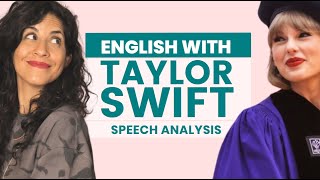
Hadar Shemesh breaks down Taylor Swift's NYU commencement speech to teach English pronunciation: intonation, stress, and connected speech. Learn how pitch changes, linking sounds, and the flap T make speech flow naturally, with a free PDF of phonetic transcriptions to practice.
Questions this video answers
About 20 minutes.
Chapters
Hey everyone, it's Sadar. Thank you so much for joining me. Today we are going to practice and learn intonation, rhythm, stress connected speech and a little bit of vocabulary with Taylor Swift. Recently, Taylor Swift gave a commencement speech at NYU University. The speech is so awesome. I highly recommend for you to watch it. It's not short 20 minutes and you can easily find the script as well. I'm going to link to it below. But I also noticed that there are a lot of great things and nuances and places where we can look at and talk about all the things that I mentioned, like the pitch and the melody, the music, how we use stronger words or more emphasized words versus how we reduce some words and ultimately what makes a good speech a good speech. So I've taken a few parts from the speech. I also created for you a PDF that's totally free where I wrote the script phonetically, like how it sounds rather than how you write it, which might be a little helpful for you as you're practicing along with the video. So you can just click the link below or somewhere here and download it right away. All right, so let's get started with the first part.
My experience has been that my mistakes led to the best things in my life.
Well, this sentence comes right after. When she talks about how, when she just started out, everyone really warned her about making the wrong move and making mistakes, because the way she learned it, mistakes lead to failure. Now, if you're not new to my channel, you know that I always talk about finding freedom in English by giving yourself the permission to make mistakes. Because mistakes is the only way to learn and reach freedom. Mistakes is the currency you pay to finally get to the freedom or get the freedom that you want. Which is why I really related to that part where she talked about it. And this is why she says that my experience. So let's listen to it again.
This has not been my experience. My experience has been.
My experience has been. The sentence right before that she says, this has not been my experience. And now she stresses, my experience has been. Because she's talking about this experience, my experience versus another experience. My experience has been right, that my.
Mistakes led to the best things in my life.
My mistakes led to the best things in my life. Notice how she slows down when she says best and she changes her voice a little bit to emphasize the word. So when you want to emphasize a part in your speech, you tend to do something slightly differently so. So that people pay attention. Now, in this case, best experience, she changes her voice a little bit and she says it really slowly. So slowing down is a way for you to emphasize words in English.
And being embarrassed when you mess up. It's part of the human experience.
And being embarrassed when you mess up. Notice how she goes high in pitch. And being embarrassed when you mess up. Right? It's like a comment or she's starting a new idea. And this is usually what happens to your voice when you start a new idea. Right? I call it the pitch wave. That happens at the beginning. And being embarrassed when you mess up. Now, let's talk about the phrase mess up. Mess up is a phrasal verb. And notice how she pronounces it. Mess up. Mess up. So the stress falls on the word up. But here we see the connected speech. The S of the word mess becomes the beginning of the next syllable, which is up. And then that's what we hear. Being embarrassed when you mess up is part of the human experience. Right? It's part of the human experience. Now again, listen to the melody. Da da da da da da da da da da da da da da da da. Right? So we really hear how she plays with her pitch, even though that's not what we hear throughout the entire speech. Right? But there are parts where the pitch changes, the melody changes. And I really encourage you to listen to the entire speech and pay attention to when it changes and try to guess why it changes. Why now? And changing the pitch, it's kind of like keeping you on your guard, right? So that it's not repetitive. It's not the same is what makes it interesting.
Getting back up. Dusting yourself off.
Getting back up. Notice again, the connected speech. Getting back, as in cat up. Right? But the K of back becomes the beginning of the word up. Getting back up.
Getting back up. Dusting yourself off.
Dusting yourself off. Another phrasal verb. Dusting off. Dusting yourself off. Now, see how this entire phrase, if you want to visualize it, you want to think about it as if it's a phrase within two commas, a clause. Dusting yourself off. It feels like it's one phrase. You want to connect it. You don't want to separate the words inside this phrase. Dusting yourself off. Keep your voice going as you're saying that phrase.
And seeing who still wants to hang out with you afterward and laugh about it.
And seeing who wants to hang out with you. Hang out with you. Hang out. Another phrasal verb, hang out. Now, notice that she doesn't pop the G sound because there isn't. It's an ng sound. Hang Out. But the ng sound becomes the beginning of the word out. Hang out, hang out. And seeing who wants to hang out with you afterward. And laugh about it. Notice how we connect the words here. And laugh about it. And laugh about it. We have a flap T. When the T is between two vowels, it becomes a flap T so it sounds closer to a D. And laugh about it. And notice what happens to the pitch. It goes up. And laugh about it. Right. Duh. When that happens, it means that something else is coming up. Right? She hasn't closed the idea.
That's a gift.
Now she did. That's a gift. That's a gift. That's a gift. Connected speech. That's a gift. That's a gift. And the pitch goes from high to low. That means I've ended the thought. All right, let's move on to another part of the speech where we can look at the connected speech and her pitch.
How will you know?
What did she just say? How will you know? Right. An entire phrase, how will you know? Is pronounced as if it's one word. How will you know? How will you know? How will you know? Right. Ha. Will you know what the right choice is? How will you know? Right. Notice that I'm kind of like, lifting up. Something else is coming up. What the right choice is in these crucial moments. Notice how it ends as if it's the end of the sentence, even though it's a question. Because when we ask a question that requires more than just a simple yes or no, it does sound like a statement. Right? It does sound like I'm ending it. Rising, falling, intonation. The pitch falls at the end in these crucial moments. So let's practice it again. How will you know what the right choice is in these crucial moments? And the answer is, you won't, you won't, you won't. Period. Ta da. Right. There is a lot of certainty here, Right? If she were to say it like, you won't, it makes it a little less powerful, right? You won't. This is the beauty of the rising, falling pitch that fits in certain situations, like in this one, the won't is a long O, as in go, you won't. And even though we don't hear the T very clearly, it is there. All right, let's look at the last part.
We are led by our gut instincts, our intuition.
We are led by our gut instincts. Right? So gut instincts is a phrase that you want to put together. Gut instincts, stress on instincts. We are led, comma. The phrase before that is totally connected. We are led we are led, stress on lead, by our gut instincts, right? And by our is connected is reduced because that's the less important part. By our gut instincts or our intuition.
We are led by our gut instincts, our intuition, our. Our desires and fears, our scars and our dreams.
Our desires and fears are scars and our dreams. Now, I actually want you to pay attention to the reduced words, to the function words. Our desires and fears, our scars and our dreams. Our desires are desires, right? So the word our reduces to R. Sounds like the word R or the letter R. Our desires, low, high, and fears and reduces to an and fears, our scars. R is reduced again. And our dreams and are and are and are reduced, right? And by reducing those small words, those less important words, those function words, we allow the important words to stick out. Desires, fears, scars, dreams. And notice when she hits each one of those stressed words, it hits a different note. Desires, fears, scars, dreams. Otherwise it would feel redundant or repetitive or monotone. And that's what makes it interesting and almost like music. And you don't have to be Taylor Swift or any singer to be able to do that. We use pitch all the time with our voice. We just need to be able to a bit more attentive and aware of how to use our voice and how to use our pitch to express something in a way that gets people to listen and gets people to feel.
And you will screw it up sometimes.
And to remember that, too. And you will screw it up. Screw it up. Another phrasal verb and connected speech here. Screw it up. Screw it up. Right, we have like a W sound there. That is what happens when you connect a back vowel with a schwa. Screw it up. Screw it up. Screw it up. Screw it up. And you will screw it up sometimes, but the most important thing is to keep on trying. All right, that's it. Now, I know it was just like a little bit of what this speech has to offer. And this is why I created a PDF for you with actually more parts from the speech that I've analyzed and written it in my phonetic language. Like, it actually looks how it needs to sound with different fonts and reductions. So it's going to be a lot of fun for you to look at it and practice with it. This speech. Thank you so much for watching. Let me know what was your favorite word or your favorite part of this video or this speech in the comments. And thank you so much for watching. Have a beautiful, beautiful rest of the day and I'll see you next week in the next video.
More from Hadar











Read Out Loud with me! Dare to Lead by Brené Brown | Pronunciation & Vocabulary practice