Practice shadowing with me!
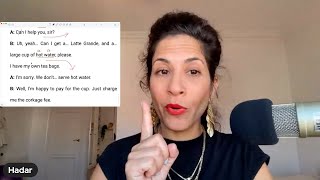
Hadar Shemesh walks through shadowing a scene from Loudermilk, focusing on intonation, stress, and two vowel sounds: the "ah" in father and the "o" diphthong. You practice line by line, matching the speaker's melody and tone.
Chapters
Hello, everyone. Welcome to our live class. And today we're gonna practice shadowing together like I usually do in my recent live classes. So thank you so much for joining me live. And if you're watching the replay, thank you for clicking play on the replay. What we are going to do today is we're going to practice shadowing. We're going to look at a scene and we are going to shadow it. But I'm going to speak a little slower because I see that people haven't joined just yet because it takes a hot minute for people to join. So I'm just going to say that shadowing is one of my favorite, favorite ways to practice. I think it's so effective. And the reason why it's effective, it's because, first of all, there is the element of fun. You tap into your inner actor. You work with scenes or monologues that you like. A lot of times it makes you feel things. And when you do something that gets you excited and that gets you to feel things, you are more likely to remember what you're doing and you're more likely to retain information. So this is why I always believe that learning and practicing English has to have an element of fun, and it has to be a significant one. Shadowing is a great way to do that also. The reason why I like it is because even though you might focus on specific things, and in a second I'll tell you how to do it in an effective way, and we're going to work on doing that together today. But even if you focus on one specific things, even if it's just like repeating after the person speaking, your brain senses and recognizes a lot of elements because you're in a learning phase and you're listening and you're trying to repeat. And if, even if you don't process logically, everything that you notice, your subconscious notices those things. And it's really hard to do it when speaking to someone. So even if you do use English on a regular basis and you speak to a lot of people, when you speak to people, it's a little different. You're not in the mindset of listening and absorbing information. And because you're just paying attention, you want to understand and you want to be understood. So you're also focused on what you're going to say. And when shadowing, there is an active element because there is the repetition. So it's not just you listening like you would listen to an audiobook or a podcast or a TV show. But when you're shadowing, there is the passive element that you are receiving the language, but you're also producing the language. So there is an active element. So it's the closest thing to speaking without speaking, and it's the closest thing to producing language without the effort of producing language. Now, just practicing shadowing is not going to necessarily make you more fluent because you do need to create the language as well to improve. So speaking as much as possible is still the number one way to get fluent. But it's a great way to help you with a package, to understand the rhythm, to improve pronunciation, to improve and understand tone of voice, to improve your listening abilities, to improve your vocabulary, to improve your grammar, consciously or subconsciously. So all of that happens within a shadowing practice. Today we're gonna, we're gonna shadow a scene called a hot water scene from Loudermilk and we're gonna focus. Today I'm gonna teach you how to do intentional shadowing. I already have a video about that and I would recommend for you to go check it out. It's me shadowing Wednesday Addams, but also teaching you how to do intentional shadowing. So today we're going to do the same thing. Today we're going to focus on a few things. So we layer it. We're going to focus on melody, intonation because it's like a nice ping pong scene of two people speaking. So I think it would be interesting to listen to the different pitch. But also I want to focus on. Usually I do reductions. This time maybe I'll explain it. But I want to be intentional about the pronunciation of two important vowel sounds. The first one is the ah as in father, a very open vowel sound that, that exists in American English. In British English, it's a bit more rounded. But we are shadowing in a scene in American English. And o as in go, another very important, very common vowel sound in English. All right, so we're going to start noticing when these vowels are being used and we're going to make sure that we are nailing them every time we get to those sounds. So intonation is the focus and those open vowel sounds. So the ah as in father, ah, you want to drop your jaw and pull the tongue in. And the O as in go, is a changing vowel that starts with an o and ends with an oo within the same syllable. Go, low show. Okay, good. So now it's a, it's somewhat of a longer scene. Let me.
Water.
Okay, let me just organize it here on the screen and I'm going to show you a small part of it. Then we're going to shadow it and then we're going to look at the rest. Are you ready? Let's go.
Can I help you, sir?
Yeah, can I get a latte grande and a large cup of hot water, please? I have my own tea bags.
I'm sorry, we don't serve hot water.
Well, I'm happy to pay for the cup. Just charge me a corkage fee.
I can't. It's against our store policy to serve hot water.
Why?
Well, someone can throw it in somebody else's face.
Well, I can get tea, right? Okay, so just get me the tea and don't put the tea bags in it.
No, we'd have to put the tea bags in the tea.
Okay, so I have my own tea bags. It's yerba mate because you guys don't carry it. So how about I give them to you and then you can put them in?
I would really like to help you, sir, but we just don't take tea bags over the counter.
It's like they keep finding new ways to. Okay, I could get.
Okay, let's do up to here. I'm sure that it was a little hard to understand some parts because they were speaking lower and reducing a lot of words, and sometimes it felt unclear. So we're going to have the text in front of us, and that's going to be a good opportunity to improve listening. So here we go. Nope, Let's go ahead and listen to the beginning again. This is the text, and I'm going to play with the text. I'm going to mark all the specific. All the. The specific vowels that we talked about. Remember, we talked about always. And go in Oz and father and especially sentence ending. I'm gonna have to.
Yeah, can I get a latte grande and a large cup of hot water, please?
Okay, so he starts with. What do you think? How does the intonation end at the end? Is it going up or is it going down? Listen again.
Can I help you, sir?
Yeah, can I get a latte grande and a large cup of hot water, please? I have my own.
Okay, so this is like a typical server versus customer conversation. Slash, pitch. Can I help you, sir? Can I help you, sir? Right, so we hear that pitch going up. We usually hear that when people ask a yes, no question. Right. Can I help you, sir? And we have somewhat of a reduction here. And then he responds, yeah, can I get a. So when people think and they don't necessarily know what they're going to say, it's not very certain. You feel like the intonation stays up there. Can I get a latte grande and a reduction, large cup of hot water, please? So I want you to pay attention to this phrase. I know this is a common phrase that we use. This is the ah as in father, hot. And if we're thinking of west coast pronunciation, the water would have the same sound, water. On the east coast, you'll hear it more rounded. Water, wa. And in some dialects, you'll hear something a bit more open water. In British English, it's a lot more rounded O. Okay, something like that. Now he says, I have my own tea bag. So we definitely see that that's it. Like he said a sentence. We feel we hear the period at the end. I have my own tea bags. So there is a period at the end. Say it with me. I have my own tea bags. I have my own tea bags. So it ends, it drops at the end. That's a signal to the other person that I'm done. If I were to say, I have my own tea bags, you're expecting to hear, and I would like you to put it inside the hot water. Right. But he doesn't say that. He just ends it like that. All also, remember we talked about the ah as in father and the O as in go. So this is the O as in go. So it's not on, but it's own. Own. I have my own tea bags. So even though this word is said quickly, we're going to hear the full O sound, even though it's done fast. All right, let's listen to how he says next sentence. Okay, I'm sorry, we don't serve hot water. Okay, so now he's like being a little apologetic and notice that it doesn't have like that friendly up pitch tone anymore. So it's a little lower in pitch. I'm sorry, we don't serve hot water. Right, so we hear that pitch dropping down. Do it with me. I'm sorry, we don't serve hot water. And where do we see those vowels that we said we're going to pay attention to write it in the chat. Where do we see the ah as in father or the o as in go? I'm going to say it again. I'm sorry, we don't serve hot water. So we have four different places where these owls appear. Let's see if you know where that is. So I'm sorry. That's I as in father. And let me make it a little bigger for you. I'm sorry. And then he says, we don't always and go, don't, don't, don't. We don't serve hot water. Now. Notice what we're doing. It's not like we can't learn or practice or teach other elements. I can talk about the flap T. I can talk about the the r and the word serve. I can talk about phrasing and connected speech. And when you do a shadowing practice, you might want to do all of it, but it's really hard to do well if you pay attention to everything. If you know the phrase to stretch yourself too thin, trying, that means like, doing a lot of things but not putting a lot of focus or attention or effort into each one of them. Because there's only one you, and there's a limited amount of energy that you have. So when you're focusing on too many things, you're actually focusing on nothing. And if you just say, okay, in this shadowing practice, I'm going to pay attention to intonation and these two vowels, you're going to get a lot more for the effort. Your ROI return on investment is going to be a lot bigger because you're going to be able to nail those sounds consistently and not miss them. Okay? So, sorry, don't hot water. Let's do it again together. Sorry, don't hot water. Good. Let's listen to the rest.
Well, I'm happy to pay for the cup.
That was a little quick. Did you hear what they said? What he said? Let's look at the script. Well, I'm happy to pay for the cup. Well, I'm happy to pay for the cup. There is no dim. There is no intonation of pleading. He's not asking, he's just telling him, okay, well, I'm happy to pay for the cup. So you can notice how the pitch goes down at the end also, if you listen to it. And I'm going to say it again, notice that his pitch goes up a little bit for every word that he stresses. So he's doing something like, well, I'm happy to pay for the cup. That's what we're saying. Well, I'm happy to pay for the cup. I'm happy to pay for the cup. I'm happy to pay for the cup. No open vowels here. Okay? And then he says again, he's saying it a little quietly. So if you don't understand, that totally makes sense. He says, just charge me the corkage fee. Do you guys know what a corkage fee is? If yes, let me know in the chat. Corkage fee, corkage fee. Corkage fee. Corkage fee is. It comes from. It's like a restaurant term. When you go in a restaurant and you bring your own wine, usually when you bring a really expensive wine that is not on the list that you bring from your own cellar. And because you bring your own wine and the restaurant accepts that, they just charge you a corkage free just to cork the wine. Right? Like to take out the cork and to pour it in the glasses. So restaurants charge a certain corkage fee for people bringing in their own wine. So he's using that term when it comes to using something that belongs to the restaurant, that doesn't cost the restaurant anything. But because I'm bringing my own thing, but I want to use your cups or your water. So this is why he referred to it as corkage fee. And he didn't say, you know, I'm going to pay for the water, because it's kind of like ridiculous. Okay, next up, restore policy to serve hot water. Okay, now he says, I can't write again, something a little apologetic here. It's against their store policy to serve hot water. So again, notice the intonation. We go down at the end. Policy, policy. So where else do we see this? Ah, sound policy, policy. And of course, we have it again for hot water. It's not hot water. It's in American English, hot water. If you round your lips, it's not a mistake. Everyone would still understand you. But if we're trying to shadow and try out new sounds, that is the sound hot water. I can't. It's against our sore policy to serve hot water. Why? Why? Listen to that intonation. Why? It's. There is like a sense of sarcasm there, like, of. Of disbelief of what are you talking about? That is so stupid. Like, that is the intonation that I'm hearing. So it's like it's called a rising, falling, rising intonation. I tried to draw it, but it didn't work quite well. Let me do it again. Why? And notice this is also tone of voice. So it's not just the intonation. It's not just why. Right. Why? When he does that sound and it's not exactly his voice, it changes a little bit. It's just like, what are you talking about? So sometimes the tone of voice tells us more about the attitude of a person. And we need to know what's culturally considered as sarcastic, ironic, patronizing. Because in each language and each culture, it might be a different sound and a different attitude. So what you're used to from your own language may not be relevant. For English. And what you hear in English may be patronizing, sarcastic, rude, friendly. And you might not notice it because this is not like a code that you're used to from your own language. So this is why it's really nice to explore or shadow it. Thinking about those things as well. All right. Okay. So now he says, well, well, someone can throw it in somebody else's face. Well, someone can throw it in someone. Somebody else's face. Right? He's being like, well, we use the word apologetic. I would say he's also, like, trying to make a case for himself here. Well, you know, like, I wouldn't say defensive. What's the word I'm looking for? You guys help me out. Like when someone is being. Is trying to reason for what they're doing. What they're doing. So in terms of intonation, we're seeing someone can throw it in somebody. Oops. Else's. And then we have face. Sorry, I don't have. Like, I'm just using my finger to draw this. And forgive me for the. For the bad drawing. I'm going to do it again. So we have again. Well, someone can throw it in somebody else's face. We have that pitch going down again. And then we have a lift here. And then we have Elsa's again, another lift. So I want you to pay attention to the pitch. When it goes up, it goes up. For stressed words, for content words, Usually we call them operative words. When there is a word that moves the idea forward, it's. It has a lift. Well, somebody can throw it in somebody else's face. Okay, so notice those pitch changes because these are clues for what words you need to pay attention to. No O's and no odds. So as you can see, we have a lot of O letters, like the letter oh, but it's not an O sound and it's not an ah sound. So the O here is ah. In policy, it's ah. The O here is ah, as in hot. We have the O in don't. That is a long O as in go. We have these O's, but that's like a cup sound. Someone, Someone, somebody. Right. So the letter O has. Has quite a few different pronunciations. Something to notice. Today we're talking about two. Okay, let me look at the chat. Good. Well done. And every time I play something, a good exercise for you would be to write it in the chat immediately or write it to yourself because it's. And then I'm going to show you the script. So it's a good opportunity to Test your listening skills that way.
T. Right.
Okay. So now he says, well, I can get tea. Right? A lot of playfulness with a pitch. Right. I'm just being creative here. Right, Well, I can get tea. Right. Trying to be pseudo polite, like, fake polite. Well, I can get tea. Right? And then there is, like this lift up. Yes. No question. Remember? Again, like. And if it's a ping pong, then when the pitch goes up, it's like you're actually passing the ball to someone else to catch. And you're not kind of like, you know, banging it on the floor.
So just get me the tea and don't put the tea bags in it.
No.
Okay, so, well, I can get tea, right? And then he comes up with a solution so we can hear it in the voice that it's a bit more certain. Okay, just get me the tea and don't put the tea bags in. Pitch goes down at the end. Now let's look at our vowels. We have. Okay, even though it's a quick word, it's still the O as in go. So it's not okay. Okay, but it's okay. Oh, Practice it with me. Okay. Okay. Okay. Right, and then we have it here as well. So, so, so. And then we have also. Don't, don't, don't forgive my writing. And that's it. So we have three O's here. So let's read this sentence again. Me first, then you. Paying close attention to the pitch at the end. And the O is in go. Okay, so just get me the tea and don't put the tea bags in it. Bad example. I'm gonna do it again. Okay, so just. Okay, so just get me the tea and don't put the tea bag in it. Bags in it. Apparently, I can't read. Hold on. Let's do it again. Okay, just get me the tea and don't put the tea bags in it. Now you can repeat. Okay, so paying attention to the O. I don't know. I have too many things on my screen. Screens. I got distracted. Good. Let's move on to the next sentence. Let's play it again. So it's good.
Now we'd have to put the tea bags in the tea.
Okay, so something about the tone of voice is like, I don't have any more patience for you right now. And. No, you. Like, you're just being ridiculous now. No, we'd have to put the tea bags in the tea. So I want you to be playful and play with your voice and try to get the same tone of Voice. No, we'd have to put the tea bags in the tea. No, you're going to have to do your homework today. No, you're going to have to brush your teeth. No, you're going to have to pay me the money that you owe me. No, we'd have to put the tea bags in the tea. So you get the idea of this intonation. It's kind of like. No, you can't mess around with this. That is the tone of voice. So I want you to play with it. Gain like a little bit of ownership into your. In your voice. And we have no right. We'd have to put the teabags in the tea. This is another O is and go. So pay attention to it. No, no, no, no. We'd have to put the tea bags in the tea. Next.
I have my own tea bags. It's your.
Okay, so let's do this. Oh, okay. Oh, oh, oh, oh. That's our sound. And also so. Right. Another O isn't go. I'm gonna get normal pen soon. I have my own tea bags. I have my own tea bags. Right? That's like. Notice the intonation. There is a comma here. And remember that we said that rising. Rising intonation at the end of a sentence is usually like a question. Specifically. Yes. No question. And if it's in the middle of a sentence, it means. It kind of like simple signals a comma. Right. I have my own tea bags. Something else is coming up.
Guys don't carry it. So how about I give them to you and then you can put them in?
I would really.
Okay, I'm gonna play that again so you can listen.
I have my own tea bags. It's yerba mate. Because you guys don't carry it. So how about I give them to you and then you can put them in?
I would.
Okay, so I have my own tea bags. I have an idea. It's yerba mate. Mate. Right? He puts a little bit of stress on these words because you guys don't carry it. Notice that when we hear some kind of an explanation or like a. Like a clause that explains something. It's your bamate. Because you guys don't carry it. We notice that people usually go a little faster and lower in pitch. So how about I give them to you and then you can put them in? Let's see if we have. So we have the. So we don't have any Oz and father here, but one more O sound. So. So. So how about I give them to you and then you can put them in let's listen to the next part.
We just don't take tea bags over the counter.
Okay, again, back to that apologetic sound. I would really like to help you, sir, but we just don't take teabags over the counter. Over, over, over, over, over, over. So I would really like to help you, sir. Notice again the rising, rising intonation. This is a good, good opportunity to practice your pitch and voice. But we just don't, don't, don't, don't long O's and go. As you can see, it's a very common vowel sound. Teabags, over the counter, counter. He doesn't pronounce a T. Okay. He says counter. You can say counter. It's not a mistake. But especially when people speak fast. When the T appears after an N, it is often dropped. Counter, over the counter, over the counter. By the way, we use that phrase when we talk about drugs that are not prescribed. So non prescription drugs. So drugs that you can go to the drugstore and get, like Tylenol or certain creams where you don't need a doctor's prescription to buy them. And on the other hand, like, if you need antibiotics. These are not. These are prescription drugs. These are not over the counter drugs. Drugs. So the use of this phrase is a little off because you use it when we talk about drugs, but it's also a pun because it's. There is a counter there. There's like literally a counter. So he's, you know, he's referring to that. And. And yeah, so it's. I just wanted to point out this, this specific phrase. And now he's saying something. Okay, and we're gonna end with that, and we're gonna do it again from the top. Now he's like, saying to her something in secret. So his pitch goes down. It's like they keep finding new ways to. Okay. Until here. It's like they keep finding new ways to. You know, he's like, a little angry, but he's trying to hide it. Let's put it in our voice. Let's do it together. It's like they keep finding new ways to. What do you think he was about to say, by the way? It's like they keep finding new ways to. I'm gonna leave it to your imagination. Okay, so let's do it again from the top. I'm gonna play a line, and then I'm gonna. I'm gonna try to do it smoothly. I'm gonna play a line, show it to you, show you the text, and we're gonna read it together. All right, Any questions before we do it? All right, if you have questions, please ask them in. Ooh. In the chat. Okay, I help you, sir? So, first sentence. Can I help you, sir? Can I help you, sir? Can I help you, sir? Let's do this.
Yeah, can I get a latte grande and a large cup of hot water?
Yeah, can I get latte grande and large cup of hot water, please? Scroll it up.
I'm sorry, we don't serve hot water.
Okay, back to the answer. I'm sorry, we don't serve hot water. Don't forget the vowels. I'm sorry, we don't serve hot water.
I'm happy to pay for the cup.
Well, I'm happy to pay for the cup. I'm happy to pay for the cup. Just charge me the corkage fee. Just charge me the corkage fee. I hope you're repeating with me.
Start policy to serve hot water.
Okay, so the next sentence. I can't. It's against. It's against. Notice this reduction against our store policy. Ah, to serve hot water. Ah. Ah. I can't. It's against our store policy to serve hot water.
Throw it in somebody else's face.
Why? Why? Well, someone can throw it in somebody else's face. Let's do it together. Why? Well, somebody can throw it in somebody else's face.
Well, I can get tea, right?
Well, I can get. Wait, where is that? Well, I can get tea, right? Now play with your pitch here. Well. Well, I can get tea, right? Well, I can get tea, right?
Well, I can get tea, right? Okay, so just get me the tea and don't put the tea bags in it.
Okay? So just get me the tea and don't put the tea bags in it. Okay, just. So, just get me the tea. So. So. So. And don't put the tea bags in it. So, answer. No, we'd have to put the tea bags in the tea. No, we'd have to put the tea bags in the tea. Let's do it again. One more time. Listen to the rhythm as well. No, we'd have to put the tea bags in the tea. No, we'd have to put the teabags in the tea. It's like a song. It's like a very specific musical pattern here. All right, A long sentence ahead of us. Brace yourself.
Okay, so I have my own tea bags. It's yerba mate, because you guys don't carry it. So how about I give them to you and then you can put them in?
I would really like to help you, sir.
Okay, okay. So I have my own tea bags. It's your bamate. Because you guys don't carry it. So how about I give them to you and then you can put them in? Or I think he says put them in. Put them in. Gonna play it again. Or at least a small part of.
It because you guys don't carry it. So how about I give them to you and then you can put them in.
I would really like to help you, sir, but we just don't take tea bags over the counter.
Okay, So I would really like to help you, sir. Do it again with me. I would really like to help you, sir. Break, dot, dot, dot. But we just don't take teabags over the counter. Don't over, don't over, don't over, don't over. We just don't take teabags over the counter. Let's put it together. We just don't take teabags over the counter. We just don't take teabags over the counter.
They keep finding new ways to.
Okay. It's like they keep finding new ways to. It's like they keep finding new ways to. Now, when you. Hear someone or when you speak quickly or when you hear someone speaking quickly, for them to sound clear, it's really important that they articulate their consonants well. Because at the end of the day, if he does this reduction and he speaks really low and the consonants are not clear, that's when it would be really hard for us to understand because vowels are reduced a little bit. And like vowels, A, ah, o, ah, Vowels are. You can modify them, you can make them longer, you can make them shorter. Consonants they have, they usually. They're very straight. They cut the vowels. And if your consonants are not necessarily clear, when you speak fast, it might make you sound overall less clear. If you reduce some of your vowels, it might maybe change the quality of the word, but you might still be clear or clearer because vowels are, you know, different dialects use different vowels and people can make that distinction or they can understand that you're. You just made a vowel a little shorter. You said don't instead of don't. But consonants are really important. And I think the reason why he's clear even though he speaks slow and fast is because his consonants are fairly clear. Like it's really clear when he articulates the consonants. Okay, Adriana, I know that over the counter is a strange expression. I explained it a little earlier. And usually it refers to non prescription drugs. It's not about the tea. We don't use them in restaurants, for example. So we learned about over the counter and we learned the phrase or the term correct. Corkage fee. For those of you who've been here from the beginning, tell me in the chat, what is cork? A corkage fee. And that's it, I think. All right, that's it. So here is what's gonna happen. First of all, thank you so much for joining me live. I'm still here if you have any questions, and if not, I recommend for you to practice. I'm going to link to the full script and the link to the video in the description below. So you don't need to put in your email or download anything. Not right now, but in a few minutes after the live, I'm going to put a link. If you're watching the replay, it should be there as well with all my. So you have access to the script and a link to the video where it's not on YouTube so you can watch it and just practice along. Okay, good. And Ilaria, thank you so, so much for your compliment. I'm glad that you are learning from my videos. Can we drop the tea in antibiotics instead of antibiotics? The answer is yes. Antibiotics. Antibiotics. You do hear people saying that. You can also say antibiotics. And the rule is that when the. The T appears after an N in unstressed syllables, you are likely to drop them. Now, antibiotics is a. Like, it comes before a secondary stress. So you're less likely to hear it than, you know, in counter. Counter is easier to drop in antibiotics. You'll hear. Maybe you. You'll hear it done less. But definitely this is a valid way of pronouncing this word antibiotics. Antisocial. Right? Anything with anti. Yes. So I will upload the script. Probably not with my notes because, well, maybe with. I'll think about it. I'll check and see. Like I said, I didn't have my pen here, so was a little, you know, not very. Not very clean. Okay, so come back in a little bit. Let me just see if I have any more questions here. Read my comment and pronounce. Okay. Patrick, I'm not sure what you're asking me to do, but if you just wanted me to say Patrick, then. Hi, Patrick. Let's see. Sorry, I'm just. I think I missed a question here. Erica, would. Oh, just wondering when the next round of new sound. Erica? Yes. The next round of new sound is going to be at the beginning of 2025, but we have other exciting things coming up, so stay tuned, my friends, if you want to continue learning with me. And by the way, if you're new to this and this is the first time you're watching one of my videos or maybe second or third. First of all, make sure to subscribe to my YouTube chann. Also know that I have a podcast called the Influency podcast. So go to your favorite podcast platform and make sure you subscribe to get my updates. And on my website, hadarshamish.com which is basically my name.com when you go to hadar shemesh.com you'll find a ton of free resources for for you. So I have an accent crash course there waiting for you for free. I have a PDF with an audio of the 50 most mispronounced words and we also have a free community on Facebook that you can access for free with a speaking club and video activities. And it's absolutely free. All the things that I shared is are absolutely free. And you have hundreds and hundreds of available lessons for you again for free. So go to my website had our shemish.com there's probably a link somewhere in the description and check it out. Subscribe so you can get the free gifts and email updates every single week. You'll get the weekly SEC lesson into your inbox. Okay, good. All right, my friends. So thank you. Okay. I want to buy and study every course you have, but I don't know from where to start. That is so heartwarming. So first of all, let me tell you where you can start. First of all, subscribe to our free community. It's called the influency community and it's a great way to meet people and to become a little bit more active and to get out of your comfort zone. And again, that's absolutely free. If you struggle with confidence and you want confident, a confidence boost. So this is not an English practice type of course. I have a course called My English mindset and that program is 30 days and every day you get a lesson that tackles one of the challenges and obstacles that we face as non native speakers. Mental, psychological obstacles. And I suggest a lot of solutions so you can step into the right mindset, create a healthy mindset and thinking pattern so you can show up confidently in English. So that is always available on my website. If you go to Hadar shemish.com, you can go to my courses and get that. I also have new sound that is my pronunciation signature program where we do a lot of shadowing. We talk about intonation, rhythm, stress and pronunciation. That will open in February of 2025 and I also have a membership called Beyond. It's not open now but we will open doors in September. It's an incredible program that allows you to connect with an incredible community but also get daily English classes and level up personally and professionally. This is why it's called beyond because it's also beyond English. So if that sounds interesting and it's a really, you know, like it's an easy ass and you do get so much from the membership, then make sure you get on my email list to my website, sign up for the newsletter or get on the email list for beyond. So you can be the first to know when we open doors in September because that's the first thing that is coming up. But getting started with the free community is a really, really good idea. So that was to answer your question on how where you should get started. All right, my friends, thank you so, so much. I love you all. Have a beautiful, beautiful day and I will see you soon. Bye.
More from Hadar











Read Out Loud with me! Dare to Lead by Brené Brown | Pronunciation & Vocabulary practice