Practice your English with a Play Reading
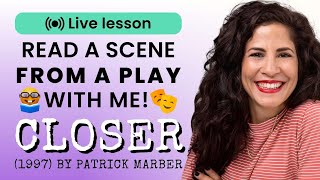
A live YouTube English lesson (hosted by Hadar Shemesh) using scenes from the play Closer to teach pronunciation, intonation, rhythm, emotion, and scene-reading techniques. The host reads two short nonconsecutive scenes aloud, analyzes stress, reductions, subtext, and emotional intention, invites viewers to perform lines, and closes with a membership call-to-action for extended practice.
Chapters
Hello, everyone. What is going on? How are you doing? Welcome to my live. Every Tuesday we share video, and today our video is live because I'm going to teach you a lesson live. Why? Because it's fun and we can interact and you can ask questions and I can answer your questions. So I really love the live interaction. And this is why I wanted to teach you today a few things about pronunciation, intonation, rhythm, intention, tone of voice, and all of that while reading a play or a scene from a play. Two scenes. I'm going to give it another minute because I see that people are still joining. I'm going to wait for everyone to join. So say hi in the comments when you do and then in a little bit I'll tell you why I chose the scene that I have for you today. So I'm gonna wait. Okay, there we go. Now I see the comments say hi if you're here. So I see you. And if you're watching the replay, we're gonna get started in just one minute. You can already see that the script is right next to me on the side of the screen. I'm gonna, I'm gonna make it a little bigger when we start reading through it. Okay, there you are. Good. So for today, I wanted to do something a little different. You know that I usually do shadowing. We practice shadowing speech analysis, and we always refer to an audio or script and or a scene. And today I want to do something different because I want to actually do it while reading from the text. So we're going to practice reading. We're going to practice putting emotion and intention into your reading. And specifically, we're going to read from a play, a theater play that was adapted to a film a while back. So let me just make sure. Yes, I can see everyone. Good. This specific play called Closer was super popular when I was in acting school. So if you don't know my story, back when I was 21, I. No, I think it was already when I was 22, I studied acting in New York City and it was like very, very theater focused. So we had to read a lot of plays and to choose different scenes from contemporary plays or classical plays. And it was really a great time. Like, I had the best two years ever. It was also really hard. And we've studied voice and, and pronunciation and speech and Shakespeare and so much. But I remember one particular class called scene study where we just had to select scenes from plays and to just bring them. Like we would practice it with a, with another, with a partner from our class. And we would go and stand there in front of the entire class. Usually we would have to tell a personal story associated with. With what the character is going through to make it personal and make it specific. And then we would go ahead and do the scene and then get usually butchered by the teacher in front of the entire class. But it was always really insightful. Now, this scene, I've never done it in class, to be honest. I've never selected it. But it was one of the most popular scenes that most popular plays that students would pick to choose a scene from, to perform in front of the entire class or to practice. So when I was thinking about plays to share with you today, I was like, oh, I remember this. And I vaguely remembered the story behind it. I remembered it out. Two couples, and they're like. There is, like this intertwined love story between the two couples. Very complicated, very raw. And I was like, maybe. Maybe that would be a good opportunity to practice a scene together. So that is what we're gonna do today. I'm gonna share with you two scenes. They're not consecutive, so actually there is a scene in between, but these are two scenes, and I'm not gonna tell you what it's about. We're gonna read it together first. So these are two characters. Then I'm going to ask you what you think was happening to see if you can understand what's happening just from the scene. Now, when you read a scene without seeing it on the screen, we're used to always having it visualized in front of us. When we read a scene without seeing it on the screen, we need to put in a lot of information. We need to use our brain and our imagination to put in a lot of information to explain what's happening. Because sometimes the playwright has a certain intention and it's not explicit meaning, it's not super clear from the text. It's not written in the words that the character is saying. So you have to imagine what's happening while the characters are saying something through. So there is a lot of room for imagination. So in a play or a screenplay, when an actor, or even just a normal reader like us comes across the play, there is a lot of input. Like there is a different interpretation that I might have than what you might have. And this is why when a director comes to direct a play, we might see very different versions of a certain play or even a scene based on what the director brings, based on what the actors bring. So as we read it now, and I'll try to make it as neutral as possible. In the first read, try to imagine the scene behind it. What's happening? What are the characters feeling? What are they doing? What are they thinking? What is their intention? Okay, so once we read it, you can tell me what you think it's about, or you can share your thoughts about it. And then I will tell you a bit more about the play itself. Okay. Are we ready? Let me know. And let me go ahead and share it with you. So do you want the text to be bigger and me smaller, or do you prefer for me to be bigger and the text Smaller text small or big? This is big. This is smaller. This is big. This. This is small. We. What do you prefer for the text to be big or small? Let me know. I'm curious. I never know. Like, I always play around with. Between the. The. The different layouts. Text big. Okay, good. All right. So I can make more faces and you won't notice. Got it. Bigger text. I think it's unanimous. We're going to go with a bigger text. I'm not going to take it personally. Don't worry. Okay. Closer. Scene one. That's not the first scene of the play. I just selected two scenes from the middle of the play. So there are things happening before. Okay. Okay. Scene one. The two characters are Alice and Dan. So in a play, you'll usually see sentences like setting up the tone, usually in italic. And this is like the comments from the screenwriter for the director or for the actors. So Alice is sleeping on his couch, right? So he comes back home and Alice is sleeping on his couch. That is the scene. That is all we know. Alice. Where have you been? Dan? Work thing. Had a drink with Harry. You'll never have one drink with Harry. Alice. You know he's in love with you, Dan. No, he's not. Is he? Did you eat? I'll make you something. Dan. I'm not hungry. Alice. What? Dan? This will hurt. I've been with Anna. I'm in love with her. We've been seeing each other for a year. It began at her opening. Alice gets up and walks past him. That's the end of the scene. All right. So what is the scene? Who are they? What do you already know about the couple? In a minute we're going to read it again. And then I'm going to give you some intonation and pronunciation notes. And then we're going to go into the next scene. So what is happening in the scene? How does that make you feel? What do you think the characters are feeling? So these are Questions, forgive me, These are questions that I want you to think about as we go into reading it more closely, talking more about intonation and rhythm, okay? Because usually there is a delay when you answer. It takes me a long time to see it, so I'm going to go back to reading it. So scene one, Alice is sleeping on the couch. Alice probably surprised, right? Because she was looking for him. So we want to put it in. In. In her voice in a way, right? Where have you been? Because it's a question. Where have you been? Where have you been? I would also say that the stressed words are where and been. Where have you been? Where, via reductions. Been. Now what I want you to do is just repeat after me. Intonation, rhythm, intention, okay? Where have you been? In response, he says work thing. Just to kind of like blow it off, right? Had a drink with Harry. You never have one drink with Harry. Is he telling the truth or is he lying? What do you think? Now you know the end of the scene. So when someone tells a lie, how to. How do they sound like? How do they look like, right? Is their voice strong? Is it softer? Work thing. How to drink with Harry. Had a. Had a. Had a. Had a drink. Notice also when D and R are connected, we say, drink, had a drink with Harry. You never have one drink with Harry. What does that mean? Do you know what that means? So when he says, you never have one drink with Harry, that means that the reason why it took so long is because you start with one drink. Because he says, I had a drink with Harry. So it sounds like he had one drink. But then he said, like me, that was my intention. But, you know, he gets you to drink so much. So like, you never have one drink with Harry. In a way, the subtext, and we always want to look at the subtext, what's behind the words. But beneath the words, beneath the message is, this is why I'm late. It took me a long time because we were drinking a lot. Alice changes the mood, the, the, the direction. Now he's in love with you. You know he's in love with you. What is the stress word here? If you were to say it, what would you stress? You know, he's in love. In love with you. I stress the word love and also know a little bit. So she's teasing him a little bit about it because probably Dan says that he sees Harry a lot because he's obviously having an affair, right? So Alice suspects that he's in love with him. Dan says no, he's not dismissing it Right. How would you sound if you were to dismiss something? No, he's not, is he? Maybe he's doubting it. Alice changes the subject again. Did you eat? Did you? Did you? Did you? Did you? And then, actually, to be honest, if there was a vowel right after, we would pronounce it more like, oo. Did you? Did you? Did you eat? Question. Intonation goes up. Not waiting for a response. I'll make you something. Or potentially he responds, we don't see it. That's the thing about plays or scripts. We read it. We need to imagine. Maybe he says, no, maybe he's not responding. How would that be perceived, whether he responds or not? And then she says, I'll make you something. I'm not hungry. That's what he says. Okay. And then Alice says, what? Why does she say it like that? What's happening here? That makes her say, what? Because if I were to just read it like that, I'm not hungry. What? Right. You can also read it like that, that the what is in response to what he just said. I'm not hungry. What? You're not hungry? But obviously we know that there is more to it because we know it's coming up. So probably Dan is doing something here that gets her to ask, what? I ate Harry. Maybe that's the face he's making. I ate Harry. Or maybe he is lying. Or maybe he admits to be lying to. To that he lied. This will hurt. He prepares her. Prepares her for it. This will hurt. Hurt, hurt. Notice the pronunciation. And then he tells her, not waiting for a response, I've been with Anna. Setting up the tone. Okay? When he says that, she hears, okay, I've been with Anna. Maybe he had an affair with her. But then he adds to it. Look at how it builds up. And what do we do with our voice to create that tension? I'm in love with her. Escalation in the content. But there is something more serious coming up. We've been seeing each other for a year. Okay, so he's kind of like breaking her the news, you know, step by step, not trying to overwhelm her. It began at her opening. Probably something happened there. When you read the play, you have more context. Something happened there, which makes it be like the most intense part of the sentence. So escalation. Let's do it again together. I've been with Anna. I'm in love with her. We've been seeing each other for a year. It began at her opening. Good. What we're going to do now is we're Going to play it together. I'm going to play Alice, and you are going to play Dan. So I'm going to say the sentence, and you are going to say Dan's lines. Okay, ready? As you prepare. Let me see some of the comments. So Ivana says there are partners and they're having a lot of problems. Now that he reveals his affair with Anna, Alice is starting to get mad. Right? She's been waiting for him, and now he wants a divorce. This is sad for me, Lourdes. I know. It's a very intense play. It's about two couples that, like their. Their relationships, intertwine. Alice with Dan, Larry with. With Anne, and then they switch. And then Alice becomes partners with Larry. So it's a big mess. Okay, so are you ready? I'm gonna play Alice. You are going to play Dan. Let's go. Alice. Where have you been? You know he's in love with you. Did you eat? I'll make you something. What? All right, good. Did you do it with me? Did you enact the scene with me? Let me know. All right, let's move on to the next scene that is slightly longer. Okay, so this is. This happens right after the scene. So just to remind you how it is in the play. We see this scene, then there is something else happening between Larry and Ann, the other couple, and we go back to the same scene, like the continuation of the scene. I'm going. I'm sorry. Irrelevant. What are you sorry for? Everything. Why didn't you tell me before? Cowardice. Is it because she's successful? No. It's because she doesn't need me. Did you bring her here? Yes. Didn't she get married? She stopped seeing me. Was that when we went to the country to celebrate our third anniversary? Did you phone her? Beg her to come back? When you went for lovely walks? Yes. You're a piece of shit. Deception is brutal. I'm not pretending otherwise. How. How does it work? How do you do this to someone? Dan's. Dan tries to think of an excuse. Not good enough. I fell in love with her, Alice. Oh, as if you had no choice. There's a moment. There's always a moment. I can do this. I can give in to this, or I can resist it. And I don't know when your moment was, but I bet there was one. I'm gone. Dan blocks her exit. Dan, it's not safe out there. Oh, and it's safe in here? What about your things? I don't need things. Where will you go? Disappear. All right. If you had to put an emotion to Dan and an emotion to Alice, what would it be? What is the emotion that you think Dan is experiencing and what is the emotion that you think Alice is experiencing? I'm reading your comments. L. You made me laugh with your comment. Okay. The play, by the way, is called Closer by Patrick Marver. Okay, so let's go back to the scene. Dan is feeling guilty and Alice is so upset. Okay, Lara, great. Try to think of even a more specific emotion than upset. Because it's, like, general. Right? Like, think of an emotion that you can think about. If it's hard for you to think of it as in English, maybe you can think of it in your first language and then see how that translates. Like, what happens when someone tells you that they lied to you, that they're not who you think they are? What is the experience? So for Dana's guilt, Alex is upset. But what is the emotion that gets her to feel upset? Alice has anxiety. Mad. Angry. Yeah, could be angry. But I believe that anger is a result of a deeper feeling that happens. Right. When you think of the fear that people have, they're not afraid of being angry. They're. They're afraid of being what? Maybe. Okay, disappointed, maybe abandoned, Maybe rejected. Betrayed. Right. He betrayed her. The feeling is betrayal. And betrayal can make you upset. Right. But if we try. And again, it's a good vocabulary lesson as well. If we try to identify and be more specific and fr. Find the right words to describe such a tricky situation. So the character is feeling betrayal or abandonment or rejection, and that can make her respond in anger. Right. Irritated. Being irritated. Mad. Deception. Disturbed. Disappointed. Great. Yeah. All of this. The feel that she had lost. Yes. Okay. Experiencing jealousy. Yeah, could be jealousy. Okay. So all of it is relevant. And I think that if we. And remember, like, when we read, you know, as an actress and let me. You know, the work that we did around making a text specific to us or the line of another person specific to us, then, for example, if we believe that what she experiences is jealousy, we would probably tap into experiences where we felt jealousy to remember what that feels like and to make it super specific for us. And this is what I want to encourage you to do when you're reading those lines. Okay. She feels betrayed. And remember, it's a choice, right? Like, you can make her angry. You can make her indifferent in how she speaks. It's all about your interpretation as the reader slash the actor, because you're acting today. Okay, let's read it and analyze it together, and then we'll play it together. This time. I'm going to be Dan, and you are going to be Alice. All right? Short sentences mean, usually in a dialogue, that there is some kind of a ping pong between the characters. Tum, tum, tum, tum. I'm going. I'm sorry. The verb is stressed. Irrelevant. Not relevant. Right? This. It doesn't matter. I don't care. That's the bottom line. Irrelevant. And then maybe she wants to understand what he feels sorry for. Maybe she doesn't know it anymore. Is he sorry for lying to her? For doing it? For leaving her? What are you sorry for? What are you. When it's reduced, which is in this case, because the stress falls on sorry. It actually sounds like this. What are you sorry for? What are you. What do you. What do you. What do you. What do you. What do you. What are you sorry for? If you want to slow down, you can say something like what are you sorry for? But usually this is what you're going to hear when people say it fast. Everything. Stick the tongue out for the th. The pronunciation teacher has emerged. Everything. And now she's curious. She wants to know, why didn't you tell me before? Now look at how the meaning changes depending on where we put this stress. So for example, if I were to put the stress on you, which is completely inappropriate in this case, why didn't you tell me before? Do you feel like it actually indicates that someone else told her that? Why didn't you tell me before? Right, and this is why I wouldn't want to stress you. You is actually super reduced. And look at how changing the stress impacts the meaning. Why didn't you tell me before? Okay, if I were to stress tell, it might imply that he hasn't told her at all. So maybe that would not be a good fit as well. Why didn't you tell me before? Okay, because he did tell her now. He just didn't tell her before. So if I were to choose to say it, I would say, why didn't you tell me before? You're telling me now, a year later. Why didn't you tell me before? You see how that matters? And then he answers, cowardice. Do you guys know what. What is what? What word derives from cowardice? Or what does it remind you of? Cowardice. Cowardice is someone who is experiencing, being, or who is a coward. Afraid, petrified to confront someone. Okay, A chicken. And slang. Be a chicken, don't be a coward. Don't be a scaredy cat. Other ways to say. To refer to someone who is a Coward. It's a derogatory word, right? Like, it's not. It's not a. It. It's not representing it in a. In an objective way, right? It's being said to diminish someone's behavior. So he's saying it about himself. Cowardice. Cowardice. And then she asks, is it because she's successful? Because. Because. Because you can reduce it. Is it? Is it? Is it. Is it because she's successful? Yes. No. Question going up in pitch. Try it with me. Is it because she's successful? Question, response. No, it's because she doesn't need me. Intonation goes down at the end. Notice the difference? If I were to say, no, it's because she doesn't need me. Right? It doesn't feel as strong. It doesn't feel like a right dialogue back and forth. No, it's because she doesn't need me. Stress. Implying again, what is the subtext? If he says that to his partner, to his girlfriend, what does that mean about her? Okay. And how would she respond if she understands the underlying meaning? Because he's not saying it just for the sake of talking about Ann. He's saying it as some sort of criticism about Alice. Did you bring her here? Did you? Did you. Did you. Did you bring her here? Did you bring her here? Let's practice this. Did you bring her here? Did you bring her here? Yes. Didn't she get married? Didn't she? Didn't she. Didn't she. Almost like you're saying chi. Like achoo, sneezing. Didn't she get married? Confirming what she said. She stopped seeing me. Again, you need to fill in a lot of information here. Oh, she got married. Then she stopped seeing him. Then he did something about it. Because Alice remembers when she got married. Was that when we went to the country to celebrate our third anniversary? Our is reduced to R. And again, think of what that means when she recalls that. Think of what happens to her emotionally when she realizes what he did on their third anniversary. She already. Now everything makes sense, right? She doesn't need him to tell her. Yes. No. What happened? She knows it. Did you phone her? Beg her to come back? When you went for lovely walks, right? You probably wondered, why is he going for all his walks? And now she understood. Yes, you're a piece of. Okay, the first time she responds and says something, right? In. In response to what? What he said. Deception is brutal. I'm not pretending otherwise. Deception. Primary stress is on set. Not this one. Deception is brutal. In American English. This is a flap T and a dark L. Brutal. Brutal. Deception is brutal. I'm not pretending otherwise. Alice, how. How does it work? How do you do this to someone? Right, so these are. These questions are charged. If you ever had to ask a profound question. Ask someone a profound question. Okay. What happened to your voice? How did that sound like? Try to put it in those words. How. How does it work? How do you do this to someone? Dan tries to think of an excuse. So we do get some directions here. She answers, not good enough. Not Oz and father. Good enough. Good enough. Good enough. I fell in love with her. Alice. Okay, and now her. Her longest monologue in the scene. Oh, as if you had no choice. There's a moment. Long. O as in go. There's a. There's a. There's a. There's a moment. I'm gonna break it down for you. There's a moment. Emphasize those bolded words. I can do this. I can give in to this, or I can resist it. Do you guys know what she's talking about? Have you ever had that feeling of being on. On the verge of doing something that you shouldn't be doing? And there is a moment where you say to yourself, I can do this, I can give in to this, or I can resist it. And usually human nature gets us to actually do it instead of resisting it. This is where you build strength and work on your mindset when you resist the things that you don't want to do. So this is what she confronts him with. And I think this is such a universal experience which he talks about. And I don't know when your moment was, but I bet. But I bet you there was one. I'm gone. Dan blocks her exit. It's not safe out there. Oh, it's safe in here. Question. It's not safe out there. Statement. Oh, and it's safe in here. Question. What about your things? I don't need things. Right, so we have repetition of a certain word here, so we want to highlight it with our voice. What about your things? I don't need things. Where will you go? Disappear. End of scene. All right. Questions, Thoughts? So what we're gonna do. I'm actually gonna let you read Alice's part because it's better. It's written better. So you're gonna be Alice, I'm gonna be Dan. I think it works because last time I was Alice. Okay, you're gonna be Alice, I'm gonna be Dan, and we're gonna do this together. Are you ready? Let's do it. And. And. And. Sorry. Don't get tangled up on the words. If you get stuck saying a word, just move on to the next word. The idea is for us to have, like, this back and forth interaction as much as we can, and for you to deliver an idea, deliver an emotion in the text, even if you don't get the. The. All the words. Yes. I can explain the reduction of the word Didn't. Didn't. De. N. So it's kind of like you're saying D and then a D and an N. You don't necessarily pronounce the T. Didn't. Didn't. Now, in the phrase she says didn't chew. So here the T actually becomes the beginning of the next part. Part didn't chew. So we have a ch sound. I'm going to write it. Why didn't chew? You don't even have to pronounce the Y. Why didn't you tell me? Be. Why didn't you tell me before? Didn't you? Didn't you? Didn't you? If that's hard, you can say didn't you? Didn't you? It doesn't matter if you pronounce every single sound here. The idea is to put it together. Okay. In American pronunciation, general American, this is how it's going to sound like. Didn't you? Didn't chew. Didn't you? All right. You're Alice. I'm Dan. Go. I'm sorry. Everything. Cowardice. No. It's because she doesn't need me. Yes. She stopped seeing me. Yes. Deception is brutal. I'm not pretending otherwise. I fell in love with her. Al. It's not safe out there. What about your things? Where will you go? Seen. Okay. The end. Good. All right, I'm gonna share the script below the video in the description, so you can play around with it, but you can also download the. The play or excerpt of the play in a PDF format so you can read it. Well done. Great acting, you guys. You really put your emotions into the text. I was deeply moved. I hope the rhythm was okay. I was trying to imagine you responding. I hope I gave you enough space. Lara, thank you for doing the scene with me. I'm. I'm so happy that you enjoyed it. Ivana, Ivana, next time we do a community meetup, we should play the scene in front of everyone. All right? So thank you, Sylvia. Thank you. Razier. Thank you. Thank you. Thank you. I'm glad you enjoyed it. So really use good work, good text. Whether it's a book or a play or a screenplay, it's so inspiring to Practice with good content, you know, because there is a big difference between something like that that really crystallizes the human experience or human emotions or a specific situation versus just like a, you know, a general dialogue that is produced by Chat GPT. Right. And I think it activates us in a different way. And I'm all about making it meaningful, you know, like, I'm all about making our English practice meaningful, where we engage ourselves and everything in. In what we do. And by the way, maybe it would be a good opportunity to tell you if you like this kind of work and you like to go beyond, you know, just the practice and just the script or understanding the words, and you want, like a more holistic experience. I do have beyond, which is my English membership, community and community practice membership open now. We haven't opened it since January. We've made a lot of great changes, and some of the changes is that you're gonna find acting classes in beyond as well. So we have acting classes and grammar and vocabulary and debate and real scenes that we play out there. Improv classes and workshops around other topics, not just about English, but in English. And a lot of conversation groups, daily sprints. All of that is available inside my membership. I'm gonna. I'm gonna make a video just about that in a few days, but it's open. So if you want to learn more about how you could work with me and do this in a more closed community and do a lot of shadowing and listening and practice your skills and your acting skills, then please join us. I'm muted. Okay, so I'm going to put a link. Let me see if I can. I'm going to put a link. You can go check it out. If you want to find out more about beyond and how you can, you can do this work with us. Okay, so go to hadar shemesh.com forward/beyond. And I hope to see you inside and to keep doing those exciting things with you. And if not, I will see you next week in the next video. Thank you so much, everyone, for your awesome participation. Bye.
More from Hadar











Read Out Loud with me! Dare to Lead by Brené Brown | Pronunciation & Vocabulary practice