Pronunciation Practice: Consonant Clusters in English
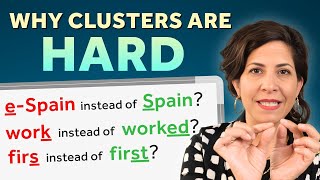
Hadar Shemesh teaches consonant clusters, those tricky two-or-more-consonant combinations that trip up speakers whose native languages don't have them. She shows initial, medial, and final clusters with drills at the word, phrase, and sentence level, plus how -ed endings actually sound in connected speech.
Chapters
Worked strength texts. All of these words have clusters. And clusters can be hard, especially for speakers who don't have clusters in their first language. In this video, I'm going to teach you what clusters are and how to practice them effectively so you pronounce all words correctly and seamlessly and effortlessly. If you're new to my channel, then hello, my name is Hadar. I'm a non native speaker of English and I am here to help you speak English with clarity, confidence, and freedom. Check out my website for a lot of free videos and resources and also you can also follow me on social media for daily lessons and drills and practice exercises. Okay, so let's define a cluster. A cluster is a sequence of more than one consonant. A consonant is a sound that is stopped, partially stopped, or interrupted. Like so a sequence of two or more consonants in a word without a vowel in between. So it's within the same syllable without a vowel in between, one after the other. For example, plain. It's not plain. Plain. Or for example, text. See, we have three sounds here, K, S, T. And all of them are connected. We don't want to put a vowel in between. Clusters can appear at the beginning, middle, or end of a word. We're going to practice all of them today. Many languages don't allow clusters, meaning there is no such thing as 2, 3 consonants at the beginning of the word without a vowel before, or 2, 3 consonants at the end of the word without a vowel in between. Like, it's not something that happens. So if this is how your language is built, and here you are trying to speak English as a second language, your brain might be like, wait, this is weird. This is not correct. I'm going to solve this. And the way for your brain to solve it in your mouth is to drop sounds. So there are no clusters. So a word like texts might end up sounding like tech. Just one, one sound, not three. And a word like plain might end up sounding like plain, and a word like blow might end up sounding like below, which actually means something else. So when you drop sounds or add vowels to to solve that challenge of a cluster, the challenge your brain thinks there is, what ends up happening is that you're going to become unclear. Because dropping sounds or adding vowels is a high priority challenge, means it's going to affect your clarity more than other pronunciation challenges. So if clusters are difficult for you, you definitely want to practice and listen. And even if clusters are not difficult for you, you should definitely practice along with us to practice all the different sounds of English together. Okay, so now that we have established why clusters are important, let's look at a few examples. Let's start with initial clusters, clusters that appear at the beginning of words. For example, blue clusters with L. Place, Glow, clap. Now, if this is challenging for you, here's a little tip. Pronounce each sound slowly and separately. B. Loo. So you identify the sounds that need to go in B, L. And then you want to connect the two sounds together. Blue. Almost like you're already anticipating the next sound as you're pronouncing the first. Blue. Now really go slowly. Your mouth knows how to pronounce the B and knows how to pronounce the L. It's just that combining them might sometimes feel challenging. Also strange. S, T, R, str. By the way, for a lot of speakers, especially Spanish speakers and Portuguese speakers, that might be challenging for you. Now that st Er. But just starting the word with that. Strange. And you might add a vowel before estrange, meaning that you're changing the word a little bit. And we want to focus on not adding sounds, not reducing sounds. So start with a cluster. S. Strange. And hold out sounds and practice it slowly until your brain understands what you need to do and you don't let the habit kick in. Strange. Stretch. Straight. Do it slowly. Not a straight. Straight. Good. Let's talk about another cluster that could be challenging. Thr. Very good. T, H, R. Not the re. Right. You want to connect them. Throw threat. Good. So these are initial clusters, by the way. At the end, we'll practice some phrases and sentences. So it's going to be like one big tongue twister party, which you know, I love. Okay. Mid clusters. When you have a cluster in the middle of the word, accent. Accent. So that K is kind of held. And then you shift into the S. Acc. The S sound right spelled with a C, but it's a s sound. Accent. You want to connect them, not accent. Don't add a vowel. Accent. Practice. Practice. Distribution. Distra. So we have three sounds in the middle of the word. We want to make sure that we connect them together. Distribution. Good. Very good. Now, let's talk about final clusters. I find that these are the hardest for most people who struggle with clusters. So that means that you might struggle with clusters, but only at the end. In the beginning, clusters are going to be hard. And. But if you struggle with clusters at the beginning, you are also likely to struggle with clusters in the middle and at the end, if that makes sense. Okay, so clusters that are created when you add the ed suffix. So the ed suffix. I Have a video about it. But the ed suffix is pronounced either as T, d or id. And when it's just and D, we want to connect it to the sound before. For example, picked. Okay, it's not picked. It's picked. KT Kissed. So do it slowly. Kissed. Picked. Helped. Teased. This is a D sound after a Z. Teased. Changed. Now changed. Changed. That's a cluster. If you notice that, you break it into two sounds. Changed. No, you want to connect it. Changed. Hugged. Good. Now let's look at other clusters at the end. Like text. KST Text. If it's hard for you and you hear something like tex or tec, then really focus on the three sounds. S, T, K. Do it slowly. Connect it. Do it slowly again. Focus on each sound. K. This is what my mouth is doing for the K. S. This is what my mouth is doing for the S. T. This is what my mouth is doing for the T. Okay, so focus on all these three positions and now connect them. Put very little effort into the pronunciation so there is not a lot of friction. Text. Text. Mind. Mind. Depth. P, T, H. Depth. Not dep. Okay, get to that th. Depth. Strength. Let's try to add an S at the end. Strength. Right. Strength. Look at all these different consonants at the end of one word. Strengths. Good. All right, good. So now that we've learned what initial clusters are, mid clusters and final clusters, let's put it into practice and practice phrases and sentences. Let's begin with Streamline the process. Not a stream. Stream. Soft. Don't put a lot of effort into pronouncing these sounds. Stream. But make sure you hit every single sound here. Streamline the process. Street smart. Street smart. Spring break. Spur. Sp. Sp. Sp. Not a spring. Sp. Spring break. And actually, when you think of connected speech in English, where a word, all the words within a phrase are connected, feels like we're adding a lot of a lot more consonants together, right? Spring break. Because the NG of spring connects to the BR of break. Spring break. Drive me crazy. Drive, drive, drive. Drive me crazy. First things first. First things first. First things first. So a lot of consonants here. And by the way, here's a little tip. When the T appears between two consonants, it's okay to drop it. So instead of saying first thing, you can just say first thing. I'm just saying you can drop the T or the d when it's between two consonants. That is one thing I can. Like you can drop in a cluster or when you connect words together. World class. World. Ld. Ld. Rd. Three consonants in a row. World. Class. Some people might say that this R is not a full consonant, but for our purposes, if you need to pronounce it and then shift to another sound, it's a consonant. World class. Good. Connect it. Arts and crafts. Arts. Arts and crafts. All right, great. Now let's do a few sentences. Brian dropped the plate and swept the floor before anyone noticed. Gonna say it again? Brian dropped the plate and swept the floor before anyone noticed. Go slowly. The queen plucked a flower from the garden and smiled at the scent. The queen plucked a flower from the garden and smiled. A descent. Nt. Nt. The dragon. It's a little hack here. The doctor Is pronounced as a J. The dragon blinked and laughed. Blinked and laughed when the dwarf. Dw Dwarf tripped. Tripped on his belt. Belt. The dragon blinked and laughed when the dwarf tripped on his belt. The snow melted fast and soaked the ground around the front steps. Snow cluster at the beginning. Melted Melt lt. LT melted fast. St and soaked the ground. GR Ground around the front steps. Front steps. Remember what I told you about the t. Listen. Front steps. Front steps. The snow melted fast and soaked the ground around the front steps. If this is hard, you gotta slow down. The snow melted fast and soaked the ground around the front steps. Yay. You did it. If it's frustrating, then just so you know that practice makes better, you just need to practice it again and again. Train your tongue, tell your mouth to chill, to relax, to follow instructions and you are going to do great. So if you want to get that 14 day plan, click on the link below. If you're listening to the podcast, make sure to click the link in the description and that's it. Have a beautiful, beautiful rest of the day. Thank you for practicing with me and I'll see you next week in the next video. Bye.
More from Hadar











Read Out Loud with me! Dare to Lead by Brené Brown | Pronunciation & Vocabulary practice