Read along and practice your vocabulary and pronunciation: Harry Potter and the Deathly Hallows
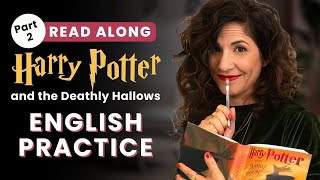
A read-along episode (YouTube/podcast) by Hadar Shemesh in which she reads an excerpt from Chapter 25, “Shell Cottage,” of Harry Potter and the Deathly Hallows while teaching vocabulary and American pronunciation tips for English learners. The host explains word meanings, phonetics (vowel/reduction examples), phrasal verbs, and contextual usage, and provides a downloadable PDF with the script and notes.
Chapters
Hey everyone, it's Adar. Thank you so much for joining me. Today we have a read along episode where I will be reading an excerpt from a Harry Potter book, Harry Potter and the Deathly Hallows, and you will be reading along with me. You can either listen to me read it while I explain tricky words, or you can actually shadow me and focus on pronunciation, rhythm and stress. However you choose to use this episode, you will definitely benefit from it. And I know this because you all absolutely loved the previous episode I recorded where I read a different excerpt from a different Harry Potter book and you asked me to make another one. So here it is. Now if you're new to my channel, then. Hi, my name is Hadar. I'm a non native speaker of English and I am here to help you speak English with clarity, confidence and freedom. So don't forget to check out my website, hadar shemesh.com and and also follow me on social media where I share daily tips to improve your pronunciation and your confidence in English. Also, if you want the script of the text that I'm going to be reading in this episode and all the definitions to continue practicing on your own, just click the link below because I have created a PDF with all the notes and it's absolutely free. So click on the link below this episode if you're listening to the podcast in the show notes and download the free resource to help you practice English with Harry Potter. All right, let's not wait any longer and let's get started with the Excerpt from Chapter 25 called Shell Cottage of the book Harry Potter and the Deathly Hallows. Something that I said at the beginning, when I talk about Harry Potter, the name I'm going to use the American pronunciation. And the word Harry or the name Harry is pron bit with an e sound. Harry. And it's not Harry in British English, it's Harry. I say Harry because I use American pronunciation. However, if you want to stick to the British pronunciation, keep it A as in cat. Ha ha, Harry. All right, let's go. Bill and Fleurs Cottage stood alone on a cliff overlooking the sea, its walls embedded with shells and whitewashed. So stood has the lax sound. Stood. Stood. And try to say the phrase stood alone. Alone has the long O as in go. Stood alone. The name Fleur has the er as in stir sound in American English. Of course in French that's a different pronunciation. Also, I read the word embedded. Embedded is firmly fixed into something embedded. And also the word whitewashed means covered with a white coating and it's often used for building. Okay, let's continue. It was a lonely and beautiful place. Low. Lonely. It was a lonely and beautiful place. Wherever Harry went inside the tiny cottage or its garden he could hear the constant ebb and flow of the sea like the breathing of some great slumbering creature. So ebb and flow is a regular movement back and forth. And it's also used for situations that change regularly. So, for example, you can say his motivation to study has an ebb and flow. Some days he feels very focused while on others he finds it hard to concentrate. Ebb and flow. Ebb and flow. Think of a sentence where you can use the phrase ebb and flow and slumbering. That's another word we used, is sleeping or being in a restful state. Okay, now, one more thing about pronunciation. First of all, the word wherever. Wherever. That's a little tricky because of the W and the R. So just. If it's hard, just say it a few times. Wherever. Wherever. Wherever. Wherever. Harry went inside the tiny cottage or its garden. Cottage. All right, so let's continue. He spent much of the next few days making excuses to escape the crowded cottage. Craving the clifftop view of open sky and wide empty sea and the feel of cold, salty wind on his face. Cold. Long O, as in go cold. Now, the word craving means a strong desire for something. A lot of times we use it when we talk about food but it doesn't always have to be. Let's continue. The enormity of his decision not to race Voldemort to the wand. Still scared, Harry. Now, I know that in the movie they say Voldemort with a T but apparently the author, J.K. rowling, has confirmed that the T is not pronounced. So we are not going to pronounce it. Okay? And then. Wand. Even though it has an A, it's an ah. Sound. Wand. Wand. Wand. Now, enormity is the extreme scale of something. And usually we talk about it when we talk about something in a negative way. Okay. The enormity of his decision not to race Voldemort to the wand. Still scared Harry. He could not remember ever before choosing not to act. He was full of doubts. No, B. Doubts. Full. Not full. He was full of doubts. Doubts that Ron could not help voicing whenever they were together. Now, voicing means expressing something out loud. Okay? You need to voice your opinion. What if Dumbledore wanted us to work out the symbol in time to get the wand? Now, to work out is a phrasal verb that means to figure out which means that's another phrasal verb to understand or to solve something. So think about it. What if working out what the symbol meant made you worthy to get the Hollows? Harry, if that really is the Elder Wand how the hell are we supposed to finish off? You know who. You know who to finish off is to kill or to defeat. Let's continue. Harry had no answers. There were moments where he wondered whether it had been outright madness not to try to prevent Voldemort from breaking open the tomb. So there were moments. This is a tricky pronunciation phrase. There were. There were. There were moments Long oh, as in go. Now there was the word outright there. So outright means completely or entirely. In other words, I could have said it had been a complete madness. Outright madness not to try to prevent Voldemort from breaking open the tomb. Tense U. No B. A tomb is a structure or space often made of stone where a dead person is buried. He could not even explain satisfactorily why he had decided against it. Satisfactorily is in a satisfying way. Satisfaction. He could not even explain satisfactorily why he had decided against it. Every time he tried to reconstruct the internal argument that had led to his decision they sounded feebler to him. So let's explain some words here. Reconstruct is go back and put together like to rebuild and feebler is weaker or less convincing. The odd thing was that Hermione's support made him feel just as confused as Ron's doubts. No, B Doubts, doubts, doubts. Now forced to accept that the Elder Wand was real she maintained that it was an evil object and that the way Voldemort had taken possession of it was repellent. Not to be considered. Let's explain a few words here. Maintained is firmly insisted on a belief or opinion. In this case, Hermione strongly argued or held the view that the Elder Wand was an evil object. And the word repellent means disgusting and unacceptable. And here it means that the way Voldemort took the wand was horrible and morally unacceptable. You could never have done that, Harry. She said again and again. You couldn't have broken into Dumbledore's grave. You could never have done that. That's a lot of words. Let's reduce it a little bit. You could never have done that. You could never have done that. You could never have done that, Harry. And then you couldn't have broken. You couldn't have broken. You couldn't have broken. You couldn't have broken into Dumbledore's grave. But the idea of Dumbledore's corpse frightened Harry much less than the possibility that he might have misunderstood the living Dumbledore's intentions. He felt that he was still groping in the dark. He had chosen his path, but kept looking back wondering whether he had misread the signs, whether he should not have taken the other way. So corpse is a dead body. And not to be confused with Cor, like the Peace Corps, because then it's pronounced as Cor but spelled very similarly. So corpse is pronounced like that corpse. And that means the dead body. And core, like the peace core, is pronounced without the P and without the S. Groping is to feel around blindly looking for something, right? Like when you're searching for a light switch in the dark room. Groping. And by the way, it could also mean inappropriately touching someone without their consent to grope someone. Let's continue. From time to time, anger at Dumbledore crashed over him again powerful as the waves slamming themselves against the cliff beneath the cottage. Anger that Dumbledore had not explained before he died. Crashed over is surrounded him or overwhelming feeling. Crashed over. For example, a feeling of sadness crashed over me. So imagine a wave crashing over you. Slamming is hitting next. But is he dead? Said Ron three days after they had arrived at the cottage. Is he? Is he? Is he? But is he? But is he? But is he? Look at those reductions. And the H is not pronounced when it's connected. But is he dead? Said Ron three days after they had arrived at the cottage. Harry had been staring out over the wall that separated the cottage garden from the cliff. When Ron and Hermione had found him, he wished for they had not, having no wish to join in with their argument. Wished. Laxed. I wished. Wished. Wished. Yes, he is Ron. Please don't start that again. Look at the facts, Hermione, said Ron, speaking across Harry, who continued to gaze at the horizon. Some explanations. To gaze is to look steadily and intently. To gaze. And horizon is the line where the earth and sky meet. Gaze. Gaze at the horizon. Horizon. Not horizon, but horizon. Gaze at the horizon. The silver doe. The sword. The eye Harry saw in the mirror. So doe is a female deer. Doe. Doe. Doe. And the word sword is pronounced without the w. Sword. Sword. The silver doe. The sword. The eye Harry saw in the mirror. Harry admits he could have imagined the eye, don't you, Harry? I could have said Harry, without looking at her. But you don't think you did, do you? This is a tag question where there is a statement and then a question where you kind of like Paraphrase the last part. But you don't think you did, do you? And this is the intonation that you usually hear a statement with falling intonation. But you don't think you did, do you? But you can also say it like that. But you don't think you did, do you? So the first do you? Sounds like a genuine question, right? Like I'm really asking. And do you? Sounds as if I'm more certain or maybe even doubting what he's saying. It really depends on the intention and the tone of voice. But there is a different meaning to how I ask it. But you don't think you did, do you, astronaut? No, I don't, said Harry. There you go, said Ron quickly, before Hermione could carry on. If it wasn't Dumbledore, explain how Dobby knew we were in the cellar, Hermione. So carry on is to continue. And cellar is a basement or a room below the house and usually used to store food or wine. I can't. But can you explain how Dumbledore sent him to us if he's lying in a tomb at Hogwarts? I don't know. It could have been his ghost. Could have been, could have been, could have been. It could have been his ghost. Dumbledore wouldn't come back as a ghost, said Harry. There was little about Dumbledore he was sure of now, but he knew that much. He would have gone on. Would have gone. Would have gone. Would have Gone on? What do you mean, gone on? Asked Ron. But before Harry could say any more a voice behind them said, okay, the next part I'm going to read with my best French accent because the character is French and it's written as if it's pronounced with a French accent. Eric Repourc would like to speak to you. He's in the smallest bedroom. He says he does not want to be overheard. So the text is Now I'm going to do it with my natural accent. Harry, Griphook would like to speak to you. He's in the smallest bedroom. He says he does not want to be overheard. Overheard. Now we pronounce the H. Her dislike of the goblin sending her to deliver messages was clear. She looked irritable and she walked back around the house. Irritable is angry or upset. Irritable. Irritable. You can say it with an angry tone. Irritable. She walked back around the house. Griphook was waiting for them, as Fleur had said, in the tiniest of the cottage's three bedrooms. Cottages. Cottages of the cottage. Cottages. Three bedrooms in which Hermione and Luna slept. By night he had drawn the red cotton curtains against the bright cloudy sky, which gave the room a fiery glow at odds with the rest of the airy light cottage. Fiery is like fire. Firey fiery. At odds with means in contrast to or not matching with the opposite okay, not in contrast with or not matching with something. I have reached my decision. Harry Potter, said the goblin who was sitting cross legged in a low chair, drumming its arms with his spindly fingers. So cross legged is sitting with legs folded over each other at the ankles or knees. For example, the child sat cross legged on the floor while listening to the story and drumming is tapping fingers or hands repeatedly on a surface. I like this. And spindly is thin and long in a way that looks weak or fragile, like a spider. Spindly though the goblins of Gringotts will consider it base treachery. I have decided to help you. Treachery is a particularly low, dishonorable and shameful act of betrayal. Treachery. That's great, said Harry. Relief surging through him. By the way, surging is rushing or increasing suddenly and powerfully. Surging er as in stir. Surging, surging, surging in return, said the goblin firmly. Same er as in stir firmly for payment. Slightly taken aback, Harry hesitated. How much do you want? I've got gold. Taken aback is shocked or surprised? I was taken aback. Not gold. Long O is and go. Not gold, said Griphook. I have gold. His black eyes glittered. There were no whites to his eyes. I want the sword. The sword of Godric Gryffindor glittered as sparkled or shined. And sword. Remember that there is no w sword. Harry's spirits plummeted. You can't have that, he said. I'm sorry. Plummeted is to fall suddenly and far. Plummeted, sunk. For example. You can use it when you talk about the stock market. The stocks plummeted 40% during the scandal. Plummeted then, said the goblin softly, we have a problem. All right, that's it. You did it. Good for you. I hope this was helpful. And don't forget to click the link below this video to download the PDF with the text and the notes about the vocabulary so you can practice it again and again and remember which word meant what and that's it. If you enjoyed this episode, let me know in the comments. If you enjoyed the podcast, don't forget you can also download the script from the Show Notes. Thank you so much for joining me and have a beautiful, beautiful, beautiful rest of the day, enjoy reading books or listening to books. And I will see you next week in the next video. Bye.
More from Hadar











Read Out Loud with me! Dare to Lead by Brené Brown | Pronunciation & Vocabulary practice