Read out loud with me! Atomic Habits PART 2 – Vocabulary, pronunciation and intonation
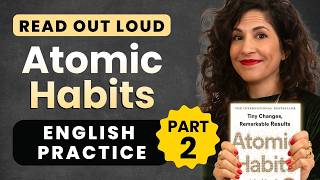
Hadar Shemesh reads Chapter 2 of Atomic Habits aloud, breaking down vocabulary like "incongruent" and "hassle," modeling pronunciation and intonation. She connects Clear's three levels of change to English learning, arguing that shifting your identity to "I am a confident English speaker" is what makes habits stick.
Chapters
Do you want to work on your habits and practice English? Today you get to do that. In this episode, we are going to read out loud from the book Atomic Habits by James Clear. I'm going to walk you through an excerpt from the second chapter of the book. We're going to explain some difficult words, talk about the concepts, and see how we can relate that to our English language journey. This is the second part of the read out loud series of Atomic Habits with me. If you wanna check out the first one, if you like it, I'm going to link to it in the description below and also other read out loud episodes. This is such a fun and great way to practice English and read while learning new words and practicing your pronunciation, intonation, rhythm, and stress. We are going to read chapter number 2, and I cannot wait because it's a great opportunity to talk about habits. To talk about English, to talk about pronunciation, rhythm, stress, and great words to know in English. If you're new to my channel, then hi, my name is Hadar. I'm a non-native speaker of English, and I am here to help you speak English with clarity, confidence, and freedom, and find innovative and exciting ways to practice your English effectively. Check out my website at hadarshemesh.com for a lot of free resources, and also follow me on social media. And if you want to go deeper into pronunciation work with me, join my free masterclass at hadarshemesh.com/masterclass. 60 minutes where you get everything you need to know about pronunciation, intonation, rhythm, and stress, and how to practice it effectively without spending a lot of energy into learning and practicing and speaking. Link is in the description below. All right, let's get started with Atomic Habits. I'm going to read it slowly and I want you to shadow me, so just read along with me. I'm probably going to read it more than once, and when Whenever I come across a word that I think should be explained, I will explain it. If I see an interesting pronunciation element, I will teach it. Same thing about the way I use my voice and intonation to tell the story. Let's get started. Atomic Habits: Tiny Changes, Remarkable Results by James Clear. An excerpt from Chapter 2. Why is it so easy to repeat bad habits and so hard to form good ones? Form: to create, shape, or establish something. To form good ones. Few things can have more powerful impact on your life than improving your daily habits. And yet, It is likely that this time next year you'll be doing the same thing rather than something better. Let's do it again. Why is it so easy to repeat bad habits and so hard to form good ones? So here in this first sentence, we want to Compare easy and hard, and I'm going to use my voice to do that. Why is it so easy, pitch and length, to repeat bad habits? I'm also comparing bad habits versus good one, and so hard to form good ones. So we have easy, hard, bad habits, good ones. Let's do it again. Why is it so easy to repeat bad habits? And so hard to form good ones. Few things can have a more powerful impact on your life than improving your daily habits. And yet it is likely that this time next year you'll be doing the same thing rather than something better. Mm, I felt it in my heart, thinking about all the habits that I want to build and I haven't just yet. Maybe after recording this video, I will. It often feels difficult to keep good habits going for more than a few days, even with sincere effort and the occasional burst of motivation. So occasional is something that happens only once in a while. It's infrequent and not regular. Okay? Occasional, every now and then. So basically what it means that, you know, like sometimes we get really, really motivated and we do something for a few days and then that motivation dies down. You must this from English. I always talk about it to my students who join my programs. I tell them at the beginning, you're going to be very excited about it, but if you don't build a habit, you are going to lose that motivation. So this is exactly that. And by the way, burst is a sudden, short, intense amount of energy. Occasional burst. Okay, you can actually visualize it. It's something that happens every now and then, and then it Like it's something that is very sudden, very short, an intense amount of energy, speed, or effort. Occasional burst of motivation. Habits like exercise, meditation, journaling, and cooking are reasonable for a day or two and then become a hassle. A hassle is something that is annoying, difficult, or causes trouble. So can you relate to that? Habits like exercise, Pitch going up. Meditation, journaling, still going up, and cooking are reasonable for a day or two and then become a hassle. Good. So now let's read it again. Shadow me. It often feels difficult to keep good habits going for more than a few days, even with sincere effort and the occasional burst of motivation. Habits like exercise, meditation, journaling, and cooking are reasonable for a day or two and then become a hassle. However, once your habits are established, they seem to stick around forever, especially the unwanted ones. So established is to build, set up, or make something permanent and stable. To establish something. However, once your habits are established, they seem to stick around forever, especially the unwanted ones. To stick around is to stay in a place or remain present. Despite our best intentions, unhealthy habits like eating junk food, watching too much television, procrastinating, And smoking can feel impossible to break. Changing our habits is challenging for two reasons. One, we try to change the wrong thing. And two, we try to change our habits in the wrong way. In this chapter, I'll address the first point. Let's do it again. Imitate me. Despite our best intention, Unhealthy habits like eating junk food, watching too much television, procrastinating, and smoking can feel impossible to break. Changing our habits is challenging for two reasons: one, we try to change the wrong thing, and two, we try to change our habits in the wrong way. Do it again with me, and when we list the first reason, we stress the word thing, and when we list the second reason, we stress the word way. For two reasons. One, we try to change the wrong thing, and two, we try to change our habits in the wrong way. In this chapter, I'll address the first point. Our first mistake is that we try to change the wrong thing. Wrong thing. To understand what I mean, consider that there are 3 levels at which change can occur. Let's practice the phrase, that there are 3 levels, a lot of THs, that there, TTH, that there are, R is reduced, 3, THR, levels. At which change can occur. Occur, happen, occur. You can imagine them like the layers of an onion. Onion, cup sound, onion, onion, onion. Let's do it again. Our first mistake is that we try to change the wrong thing. To understand what I mean, consider that there are 3 levels, levels at which change can occur. You can imagine them like the layers of an onion. The first layer is changing your outcomes. Outcomes. The T is held here. Outcomes. This level is concerned with changing your results. Losing weight, publishing a book, winning a championship. Most of the goals you set are associated with this level of change. Most of the goals you set are associated with this level of change. Let's do that part again. The first layer is changing your outcomes. This level is concerned with changing your results, losing weight, publishing a book, winning a championship. Most of the goals you set are associated with this level of change. Moving on, the second layer is changing your process. This level is concerned with changing your habits and systems. Say it together: changing your habits and systems. Concerned with, by the way, is to be about or interested in or focused on. Concerned with. The— this level is about changing your habits. Concerned with, think of it as if we're saying this level is about changing your habits. Implementing a new routine at the gym, decluttering your desk for better workflow, developing a meditation practice. Declutter is to remove mess and unneeded things from a place. So decluttering your desk for better workflow. So you're getting rid of all the things on the table so that you are not distracted. Most of the habits you build are associated with this level. So let's do it again. Just shadow me. This level is concerned with changing your habits and systems, implementing a new routine at the gym, decluttering your desk for better workflow, developing a meditation practice. Most of the habits you build are associated with this level. The third and deepest layer is changing your identity. Identity. You can pronounce the two Ts, identity, identity. The third and deepest layer is changing your identity. This level is concerned with changing your beliefs. Beliefs. To believe with a V, and this is belief, a belief. This level is concerned with changing your beliefs. Your worldview, world, world, worldview, your self-image, your judgments about yourself and others. Most of the beliefs, assumptions, and biases you hold are associated with this level. Assumptions, bias, biases. Let's do it again. The third and deepest layer is changing your identity. This level is concerned with changing your beliefs, your worldview, your self-image, your judgments about yourself and others. Most of the beliefs, assumptions, and biases you hold are associated with this level. Outcomes are about what you get. Processes are about what you do. Identity is about what you believe. Let's do this part again. It's really good. Outcomes is about what you get. So you have to have a clear vision for what it is that you want. Processes is the how-to. How do you get there? It's about what you do. Identity is about what you believe. Am I capable of being a fluent and confident speaker? Or not. Let's do this part again and talk about it in the context of English, 'cause it's so good. Outcomes are about what you get, the outcome, the result, the goal that you have. I want to be able to speak confidently about myself for 10 minutes without stopping even once. Processes are about what you do. It's how you get there. It's the roadmap. Okay, so that means that I need to practice every day for 5 minutes speaking about myself. That's the process. Okay, if I do that every day, I will be able to talk about myself with confidence for 5 minutes without stopping. Identity is what you believe. I am capable of speaking confidently and freely about myself instead of my English is not good enough. So identity is about what you believe. When it comes to building habits that last, when it comes to, when it comes to, when it comes to is when it is about. Regarding a specific thing, when it comes to building habits, when it's about building habits that last, when it comes to building a system of 1% improvements, the problem is not that one level is better or worse than another. All levels of change are useful in their own way. Let's do it together. All levels of change are useful in their own way. Their own, their own, their own. The problem is the direction of change. Many people begin the process of changing their habits by focusing on what they want to achieve. Let's do it again. Many people begin the process, process of changing their habits by focusing on what they want to achieve. I want to be fluent. I want to be confident. I want to get a better job in English. This leads us to outcome-based habits. The alternative is to build identity-based habits. The alternative is to build identity-based habits. With this approach, we start by focusing on who we wish to become, who we wish, who we wish Do it again with me. With this approach, we start by focusing on who we wish to become. So let's repeat it. This leads us to outcome-based habits. The alternative is to build identity-based habits. With this approach, we start by focusing on who we wish to become. Moving on. Imagine two people resisting a cigarette. When offered a smoke, the first person says, no thanks, I'm trying to quit. Tryna, tryna, trying to, tryna, tryna quit. It sounds like a reasonable response, but this person still believes they are a smoker who is trying to be something else. Tryna be, tryna be, tryna be. They are hoping their behavior will change while carrying around the same beliefs. Let's do it again. They are hoping their behavior will change while carrying around the same beliefs. The second person declines by saying, no thanks, I'm not a smoker. The second person declines by saying, no thanks, I'm not a smoker. Declines is to say no, to decline. Decline is also what happens to your card when there aren't enough funds on it. The card was declined. But in this context, to say no. Oh, no thank you. No thanks, I'm not a smoker. It's a small difference, but this statement signals a shift in identity. Let's do that part again. They're hoping their behavior will change while carrying around the same beliefs. The second person declines by saying, no thanks, I'm not a smoker. It's a small difference, but this statement signals a shift in identity. Smoking was a part of their former life, not their current one. They no longer identify as someone who smokes. Identify. You can also say identify, identify. When said quickly, the T often drops, or even when not said quickly, depending on the speaker. Both are correct. They no longer identify as someone who smokes. Behavior That is incongruent with the self will not last. Incongruent is not matching, out of place, or not fitting together. Incongruent. It's not consistent with behavior that is incongruent. Incongruent with the self will not last. So if I'm behaving in a way that is not aligned with how I believe about myself, it will not last. So if I think about myself as a bad speaker of English and I'm trying to speak more and I'm trying to be confident and I don't believe that I'm capable of speaking, it's not gonna last. I'm going to keep quiet at some point and avoid at some point, and it's not gonna be consistent. You may want more money, but if your identity is someone who consumes rather than creates, then you'll continue to be pulled towards spending. Rather than earning. You may want better health, but if you continue to prioritize comfort, prioritize, prioritize comfort, comfort over accomplishment, you'll be drawn to relaxing rather than training. You'll be drawn to relaxing rather than training. You'll be drawn to, you'll be drawn to. Be drawn to is to be attracted or interested in something. I'm drawn to practicing English every day. You'll be drawn to relaxing rather than training. It's hard to change your habits if you never change the underlying beliefs that led to your past behavior. Again, it's hard to change your habits if you never change the underlying beliefs that led to your past behavior. Underlying is deep, hidden, or the real reason for something. Underlying. So let's read it again. It's hard to change your habits if you never change the underlying belief that led to your past behavior. You have a new goal and a new plan, but you haven't changed who you are. Let's do it again. You have a new goal and a new plan, but you haven't changed who you are. True behavior change is identity change. Okay? So I want you to think about that concept from the perspective of language learning, right? What is the identity change that we need to go through to be able to see behavior change. What are the beliefs that we have about who we are when it comes to speaking English, practicing English, and how can that change, right? If I'm a person who doesn't have time to practice English, then clearly it's going to be hard to find time to practice English. But if I'm a person who practices English every single day, even if it's for 10 minutes, that's just who I am. You will find a way that behavior is going to be aligned with your identity. You might start a habit because of motivation. Oh, I want to learn English, but the only reason you'll stick with one is that it becomes part of your identity. Let's do it again. You might start a habit because of motivation, but the only reason you'll stick with one is that it becomes part of your identity. So think about it. Yeah, you can start a habit, but you don't not stick with it because you don't have time or you are not disciplined or that you are not consistent. Like all of that, yes, but it's probably because it hasn't become a part of who you are and how you think about yourself. Anyone can convince themselves to visit the gym or eat healthy once or twice or practice English every day. But if you don't shift the belief behind the behavior, then it is hard to stick with long-term changes. Let's do it again. Anyone can convince themselves to visit the gym or eat healthy once or twice, but if you don't shift the belief behind the behavior, then it is hard to stick with long-term changes. Long-term, long-term, long-term changes. Improvements are only temporary until they become part of who you are. Improvements are only temporary until they become part of who you are. So there are a lot of words that you can connect to here. Let's do it again together. Improvements are only temporary until they become part of who you are. The goal is not to read a book. The goal is to become a reader. Let's do it again. The goal is not to read a book. Ta-ta-da-ta-da. The goal is not to read a book. The goal is to become a reader. The goal is not to run a marathon. The goal is to become a runner. Marathon. Marathon. The goal is not to learn an instrument or a language. The goal is to become a musician or a speaker of that language. The goal is not to learn a language. The goal is to become a speaker of that language. Yes, I know I'm cheating a little bit. It's okay. After all, when your behavior and your identity are fully aligned, Let's do it again. After all, connected. After all, after all, when your behavior and your identity are fully aligned, you are no longer pursuing behavior change. You are simply acting like the type of person you already believe yourself to be. Let's do it again. Focus on connected speech. You are simply acting like the type of person you already believe yourself to be. And altogether, after all, when your behaviour and your identity are fully aligned, you are no longer pursuing behaviour change. You are simply acting like the type of person you already believe yourself to be. Well done, my friends. So now, who is the person that you believe yourself to be when it comes to speaking in English? Are you a confident, brave, successful speaker of English as a second language? If you don't believe that to be true, then I'm telling you that you are. And this is the beginning point of you building the habit of practicing English and speaking English regularly, either with my videos or with any other resources that you love working with. Remember that practicing English consistently is the secret to becoming fluent. It's not just about getting the right resources, it's about sitting down and doing the work and building those habits. And to be able to build those habits, you have to believe that you are capable of speaking English confidently, freely, and fluently. I believe in you. Great job. If you enjoyed this, definitely check out part 1 and stay tuned for part 3. Have a beautiful, beautiful rest of the day, and I'll see you next time in the next video. Bye.
More from Hadar











Read Out Loud with me! Dare to Lead by Brené Brown | Pronunciation & Vocabulary practice