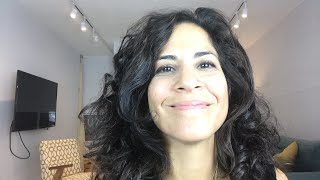
Live-stream by Hadar Shemesh inviting viewers to participate in a "Say your name" challenge to help build mini-training for non-native speakers on pronouncing names in English. She requests short videos or audio of viewers saying their names (deadline: Friday, November 10), provides contact options (Facebook page "The Accents Way", email hadar@accentsway.com and website hadaraccentsway.com), and previews a mini-training on stress patterns and pronunciation to be published the following Thursday. The video also includes a tour of her renovated studio in Tel Aviv and short pronunciation demonstrations (e.g., "totally" vs "lottery", the flap T, reduced function words "at/to").
Questions this video answers
Friday, November 10th.
Tel Aviv, Israel.
Via The Accents Way Facebook page (upload/send message), email hadar@accentsway.com or the website hadaraccentsway.com; private message can request a WhatsApp number.
Chapters
Hey, what's up? We're live. It's been a while since I did any live videos here on YouTube. So I'm very, very excited. And as you can see right here, it's my new space, my new workspace, accent space. And I'm very excited about it. But anyway, I'm here just to remind you that I am running the same say my name challenge. And if you haven't seen my video, go ahead and check it out. Hello everyone. I'm starting to get comments and that's always very exciting. How. Susanata. Aditya. Okay, okay. So since this is about names, I'm very happy to see your real names here. So write your names in the comments because I know you're your YouTube channel's name is not necessarily your name. So. Hi. Hi. Hi. Hi everyone. So I know that one of the biggest struggles for non native speakers is to say your actual name. Because your name in your native tongue is not exactly, it's not always very clear to English speakers. Am I right or not? Is it difficult for you to say your name in English? Let me know. So if it is, I have developed a really cool training to help you understand what you need to do in order to say your name. But for that I really need your help because I need to use examples and I want to use as many examples as possible. And for that I need you to say your name to the camera and send it to me. Of course you can record it as well. But since I'm making a video using your videos, your sources, right, the whatever you're going to give me, then a video would be best. If you're too shy then you can just send me a recording. That's fine too. If you write your name, it's okay. I might know how to pronounce it but I really need to hear your native sounds in order to know how to change it from the way you say it into the way it would be easy for English speakers to say it. Now I already thought it out. So it's going to be really cool because it's not only going to discuss name, it's going to discuss the stress patterns of English. How you stress when you use the primary stress, how you stress the primary stress. Okay, so all of these things I'm going to discuss in the mini training that is going to go up next week, next Thursday to tomorrow. We have a different video tomorrow. We're going to talk about how to practice on your own and how to receive, how to give yourself feedback when you're Practicing on your own. And you don't have me right next to you to tell you if you're doing the things accurately or not. So. Yes. So next week I'm going to publish the mini training. But I really want you to send me the videos. And the deadline is this Friday, in two days. And this is why I'm making this video, to urge you. I've already received a bunch of videos, amazing videos of people from all around the world. But I need. I want more. So that's me. I. I don't settle for just a few dozens. So send me your names and hopefully I'll use them in the video. And what else? I'm starting to read the comments and I get distracted. Where are you from? I'm from Israel. I'm from Israel and I'm in Tel Aviv. And let me show you around my studio. So this is where I teach. I teach groups here. So in 30 minutes I have a new group coming and that's very exciting. So I'll take you around. I hope you can hear me well and I'm just not. So these are the lights that I'm using to shoot here. And let me show you. This is the kitchen. Kitchen, not really a kitchen. It's where you get coffee. And here you can sit and speak to me. And this is where I usually sit and work and edit my videos and do a whole bunch of other stuff. And here, this is the one on one room with. Okay, I hope you can see things. And this is the vowel chart that I use what I teach. So that wasn't planned. I didn't plan to show you my studio here, but I'm all alone and it's 7pm and no one's here in the building. So I figured, you know, I can do that. Okay. So now that I showed you my workspace and I actually, this place was really. It was a dump and I renovated the whole place. Not alone with my family and friends. And I actually was shooting. Yes, I'm from Israel. Really? Is that a bad thing or a good thing? Let me know. You're the best. I love the way you pronounce. Thank you. How can I send you a video? Good question. I didn't even think to tell you what to do. Send it to either go to my Facebook page the accents way and you can either upload a video and send it as a message or below the post. And I'm also going to go live there later on today. Or you can send it to Hadar H A D a r@acentsway.com hadaraccentsway.com if it's difficult, then send me a private message and I'll send you my WhatsApp number so you can send it directly to my WhatsApp. Yes, I really want to get your videos. This is. This is how serious I am about this thing. So I'll also write it in the comments below so you have my exact email. Although it's pretty simple. Right. Hadaraccentsway.com okay, questions. So since I'm done and really, I'm really looking forward to making this video, I think it's going to be one of my most beneficial videos for everyone. Yes, you can. No, you're not ugly to send me a video. Someone said, can I send you an audio? Yes, you can. It's okay, send me an audio, but please don't be so hard on yourself. And what was I saying? That really expect the video again. Not tomorrow. Tomorrow's Thursday. The Thursday after. I forgot the date. Although I wrote it down. So I'll put all the information in the link below. Okay, so what other questions do you have for me? Your videos are great. Oh, my God. So Yaniv says that it's the only YouTube channel I actually watch, and that makes me super proud. So thanks, Yaniv. Watching from Chile. Chile or Chile, how would you pronounce it? So that's incredible, that idea that, like, I'm sitting here in Asia and someone else is watching me in Latin America. I can't get over it. Okay, any questions on how to pronounce different words? Any words that you struggle with? Where do you live? I just said it. It's. I live in Israel, in Tel Aviv. I'm not. Yeah, I don't live in the US anymore. So, yeah, I get like 5,000 questions. Where are you from? I love you guys. Lottery. Thank you. Your lady. Your lady. I don't know if it's your real name, but if it is, then I want you to send me a video so we can discuss how to say it in English. So what was it? Lottery. Lottery. And someone asked me. Totally. And I totally think that it's a good word to practice. So let's practice these two words and then I'm going to have to end this session, otherwise my students are going to start coming in and they won't be aware that I'm live. How to pronounce at and to. Okay, maybe I'll add that too. So, guys, I can't read now all your comments, but I promise I will go over all the comments. And read every single one. Because if I read it now, I get distracted and then I just look silly just staring at my phone or the side of the screen without really speaking to you. Okay, so we said totally lottery. At and to. Okay, totally. Let's start with that. It's a T sound. It's a T sound, but it's aspirated, so it feels like there is a little H after and right after it's the O, as in go see how low my jaw is when I say it. Toe. Not to. To. Oh, my battery's running out. Not to. To. Totally to schwa. And then a flap t and a schwa and then an l sound and a high E. Totally, totally. I'm going to have to move on really quickly because I have to start teaching here in a sec. So the next one is lottery, which talks about lottery. Flap T. Again, L. And then it's an open ah sound. La. And then another flap T and a schwa. La da la. Like tota. Right? It's the same middle vowel, Lotta. Re. Round your lips for the R. Pull the tongue up. R, Re. Totally lottery. Totally lottery. It's all about the flap t and the schwa. I think that what makes the difference. And the last one is at versus to. These two are function words. So you pronounce them. There are two ways to pronounce them. The proper way, like how would you pronounce the word at? So I'll open my mouth and pronounce it and then. And pronounce the t right after. I don't pop the T. I don't release the t at. So I kind of like bring the tongue up and block the air. It's an abrupt stop of air, but I can release it slightly at. But if it's reduced, which is 99% of the times when we speak, then it's going to sound like I'm at a bar. I'm trying to come up with more examples. I'm at the park, right? I'm reducing it. I'm not opening it for an ah. Ah. Same thing with to. To is the proper way to say it. But usually you won't hear people saying to with a t sound and then a long oo. It's usually pronounced with a schwa. T, T, T. To go, to think, to love, to appreciate. And then the only time you use to is when there is a vowel after to appreciate, to understand, to enjoy. However, a lot of native speakers just drop the to into a schwa, even when they need to say to. Okay, so the T is a lot more common to understand, to enjoy. Although you're supposed to say to understand and to enjoy when you do stress the word to. Who are you talking to? Right. If it's at the end of the sentence or the phrase, this is when it's stressed. And then I pronounce the whole oo sound. Who are you talking to? I'm not going to say who are you talking to? So. But I will say I'm talking to my friend. I'm talking T, T, T, not to. To, to. Now, I think it's an important lesson to and at. So thank you for asking. I don't know your name right now, but I will look for it. So thank you for asking. And I'm going to make a video about the word to. I don't think I have one. So that's it. I gotta go. I love you all. Thank you all for being there and being so freaking awesome. You make it all worthwhile. And do send me your videos on with your names. You only have until Friday, November 10th. Okay? So don't forget to do that so I can use it in my training. If you're embarrassed, then you can just send me a recording. Just writing your name is not enough. Okay, I need to hear it. I need to hear it. Okay, bye. Have a good night. Good morning, good afternoon, wherever you are. And I will speak to you soon. And I promise to do more of those lives. I kind of enjoy it. Bye. Yes.