The Live English Show #2 | About Confidence and Fluency [Q&A]
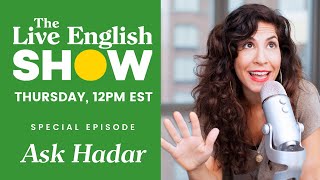
Hadar Shemesh answers audience questions about building confidence and fluency in English, covering active vs passive practice, shadowing, pronunciation work, and how your body affects your speaking. She also addresses dealing with unsupportive people and juggling multiple languages.
Chapters
Foreign. Hey, everyone. What's up? Welcome, welcome, welcome. I hope you're well. Welcome to the live English show. We're here again. So we are here on YouTube and on Facebook and on Facebook and on Periscope. I guess no one's there still. I'm going live on Periscope. Just saying. Okay, let me know in the comments that you're here and let me know if you can hear the background music. I hope you can, because I sure can. Yeah. Oh, now I see the comments. I was looking in the wrong place. See, you learn. You live and learn. You got this. Hey, Fahad, how are you doing? Hello. So can you hear the music or is it just me? Let me know. And also let me know what is one thing that you're proud of that you did this week. Okay, good. You can hear it. So one thing that you're proud of that you did this week. And I'll lower the music so you can hear me and share it with the community and share it with me. Okay. Hi, Sandra. Good to see you. Yeah. I decided that this is going to be my. The show's music. It's the brand new Heavies and it's called have a good time, which is what we're about. Right? We're gonna have a good time. And today I'm waiting to hear what is one thing that you're proud of that you did today? Today we have a fun. Oops. A fun session because I'm going to answer a bunch of questions. Some of them are recorded, so people recorded their questions and sent to me. So I'm gonna play them and answer. So it's going to feel like a real live talk show, even though it's just me speaking to myself. And then I'm going to take some questions from the audience. So if you have questions, make sure that you ask me and that you write it in the comments. Okay. I spent a bit of time with my family. Alessandro, good to see you. Yeah, that's a good thing. Okay, one thing that you're proud of. Let's see. And check the comments to see what other people are saying. I gave some homeless man some money. That's awesome. Giving, Giving. That's what we're about. Harass. Nice to see you. I'm proud that I got cleared and. Wait. That I got cleared and training and I have my job. Wait, no, I'm. I'm proud that I got cleared and up training. I had in my job. Good. It's. Sometimes it takes me some time to read. So. So congrats on that. Very cool. Let's see th sound like a dental D in fast speech. Okay, I'm already getting some questions here. That's good. As long as you're not wasting any time. Okay, who knows what my T shirt says? Let me know in the comments. If you get what my teacher says, you need to be able to read either Arabic or Hebrew. This T shirt was created by my good friend Liron and she creates fonts that are a combination or words that are a combination of Hebrew and Arabic. Okay, so for all of you out there, let me know in English what my T shirt says in English. Cool. Okay, so first of all, David says thank you for pushing us to. To be a little bit better with all the good things that you teach us. Thank you, David. Thank you so much. Are you from the Middle East? Yes, I am. Hug. Salama. That's good. Yes, exactly. It says hug both in Hebrew and in English. And I think it fits this season where not a lot of people can hug. Or at least we get self conscious about hugging. Even though I'm in my culture, you know, physicality is huge. We are all in each other's face and we're all about hugging and touching each other. I know it's not the same for all cultures, but it's definitely the case for us. And social distancing and Covid and all of that was a real. It created a huge disturbance in the way we live because all of a sudden we started being afraid of other human beings. Whereas we would, you know, in the past we would get energized by other people. So I think we're all trying to navigate that, you know, like trying to understand what it is to be able to be around the people you love without all the physical touch. I mean, for us now it's getting a little better. Now it's getting worse. I don't know. Tell me how you are doing in terms of COVID Are things getting better? There's always a slight delay, so I'm going to wait for it. Okay, I'm actually going to start. Sandra says that's in Hebrew. That's true. I'm going to start with the questions from you guys because I saw one question, so I'm going to start with that and then I'm going to go into. Into. I'm responding to Daniela. I'm like, yeah, it's the same as my necklace. I'm going to start with one question from you guys, from Chiara, and then I'm going to move on to the Questions that I have prepared for you. Okay, so Kiara is asking, is it really useful to watch videos or movies or series? TV series in English? I'll do it since six months and my English seems better. Okay, so Kiara says, I've been doing this for six months, so it feels like it has helped me with my English. Now Kiara, if you're here answering, if you can answer, let me ask you this. In addition to just watching TV shows and movies, have you done anything else? Let me know in the comments. Now, to answer your question, let's agree that anything related to English is good for you, okay? Like of course it would improve your English to watch a TV show in English rather than in your native language or, you know, if it were dubbed. So of course it's better to watch it in English. The question is, are you getting the improvement that you wish to see? That's a different question. Because I'll tell you this, when it comes to learning a second language, and I say that a lot, we tend to get caught up in passive consumption of the language because it's the easiest, right? Like watching television or reading books, it doesn't require a lot of effort on your end. I mean, some of you will say, hey, Hadar, watching a TV show in English is, requires a lot of effort, that's fine. But honestly, you don't put yourself at risk when you're just consuming English passively because there is no fear of making mistakes because no one knows what's going on in your head. So you can pretend like, yeah, I understood everything or you know, deal with your own fears and insecurities in your head, but you're not exposed. And a huge part of speaking a language is being exposed and having that uncomfortable space where you are all of a sudden pushing yourself out of your comfort zone, doing things that you're uncomfortable with because you know you're going to so called fail. Now I don't believe in failure. Not in life, not in business, and not in indefinitely, definitely not in English. But in our narrative, we keep thinking to ourselves, okay, if I make a mistake, that means that I'm going to fail. If I speak and no one understands me, that means that I'm going to fail, right? People are going to think that I'm this or that. So, so we have all of these fears and we tell ourselves all of these stories. And this is why it's very easy to stay in this passive consumption zone. Now, to say that it doesn't help at all, that would be a lie. And also different people consume English or learn English in different ways. I know of many people who told me that simply by listening to podcasts, I don't need this anymore. Simply by listening to podcasts, they were able to improve their English tremendously. And on the other hand, I know people who have been consuming English for years on end and they still feel stuck. So at the end of the day, it does improve your knowledge of English, which is important, your passive vocabulary, which is important. But when time comes to speak, you gotta have speaking time and you gotta have practice and you gotta know your, you know, you gotta know your basic grammar simply by speaking. I'm not, I don't talk about, like, learning grammar and memorizing rules. I'm not a fan of that. But like just understanding through listening and speaking and seeing whenever, like something, whenever you get stuck or whenever you don't know how to say something, not because you don't know the words, but because you don't know how to structure the sentence, that's when you know, okay, there is something here that I don't know about English and I need to learn. And this only happens. This only happens when you put yourself out there and you speak. So that's a long answer and probably not exactly what you expected, Kiara. But what I'm saying is that I think that you need to remember that learning, like watching TV shows is great, but if you wanted to make it amazing, turn passive into active. And how do you do that? By first repeating stuff that you hear, collecting phrases and words. Right. I'm all about copy pasting. I'm all about, like, stealing people's thoughts and ideas. Well, not really thoughts, but like, ideas are the way they say things. And then you make it your own. You take that structure and you can like, use it using your own content, but you can use the same phrases or the same structure or the way it was said by other people. But what you need to do is to take it and to. And to say it a few times. So you got to repeat it many times and build the pronunciation confidence by repetition. Okay, so this is how you can leverage your, you know, if you're anyway watching a TV show, you can really leverage it into an excellent practice by repeating stuff, collecting words, putting it on your list, and then practicing it using my vocabulary drilling technique that I have in one of my videos. And also you can pause and repeat if you're alone or echo it or shadow it. Right. Probably your family members or your friends are not going to like it if they watch it with you, but it's a really good practice technique. So these are the things that you can do while you're anyway watching. And again, like Chiara, if you said this has helped me a lot, then first of all, keep on doing it. It's amazing. And if it's working for you, then do it. And don't even listen to me. But when you hit a plateau and it probably will happen at some point where you feel like, well, I'm not improving anymore, that's when you need to start putting yourself out there more and getting conversation partners and speaking more. Okay, so good. I hope it helps. So Daniela was asking, is this the same as your necklace, the T shirt? Yeah. It was created by the same creator and I'm very proud. Okay, I'm reading. I'm looking at some of your questions. Rosa is asking, can you talk about your pronunciation program and when will it start? Yeah, I can share it with you really quickly. And I will tell you that I open doors again at the end of July, so stay tuned. Yelena is saying I use shadowing often while teaching movies. And my boyfriend hates it, of course. I mean, my partner slash husband, he. He like, whenever he hears me even reading Dr. Seuss or something from To My Girls, he's like, because I have this, you know, intonation and I overdo it sometimes because it's fun and playful and I'm crazy about Dr. Seuss. He's like, stop it. I can't hear it anymore. Yeah, so maybe don't do it with your friends and family or do it in spite despite them. Okay. Yeah. She says friends are really demotivating. It depends. Like, first of all, that's a good point. Okay, so what happens if the people around you don't support you? I just created a question out of your comment. I hope it's okay. So, yeah, especially if you do it around your friends and they start making fun of you or they say, you know, why are you doing this? You sound funny. If that ever happened to you, let me know in the comments below if you had friends telling you, why are you doing this? You don't really need this, and all of that crap. If they do it, then let me know in the comments. Now, two things. I have a lot to say about this, but I'll try to summarize it into two things. One, it doesn't matter who it is. If it's your friend or your mom or your English teacher or your priest or your, I don't know, T. English teacher. I said that already. Or your kids or your. Whatever. Let Me think of more. Your dentist, maybe. If there is anyone out there that is telling you that you shouldn't be doing something that you want to do that sparks you, that. That gives you joy, that encourages you, that motivates you, that you know that you need, and someone is out there telling you, why do you need this? And they kind of like shut you down and make you feel a little uncomfortable, then this is one reason, one more reason why you should do it, okay? One more reason why you should even do it even more, because people will always have opinions, especially the people who are close to us. And it's hard not to let those opinions get to us, especially if it's close people, like, you know, spouses or parents. But you have to remember that they usually speak out of their own fears and their own experiences, and they don't know what you are going through, and they. They don't know who you are in your life. And they have no right telling you what you need to do with your life. So it's going to happen, okay? I'm not saying that it's not going to happen. And a lot of times people think that they're being funny, right? Like making fun of you. But when that joke meets you at a place that you're already insecure about because you have your inner critic telling you all this crap anyway, right? And all of a sudden they're telling you this as well, and it just validates those negative thoughts that you have. And all you want to do is quit. Remember that this is exactly the reason why you should keep on going, okay? And to prove. To prove it to them first reason, that's. That's the last reason, really. But. But no, just. Just to show them what perseverance is and what, you know, like that you are saying serious about what it is that you're doing. But at the same time, this is your life. No one can tell you what to do. And if it triggers you or it presses the buttons where it makes you feel even more insecure, you got to remind yourself that these are just negative thoughts. And negative thoughts can turn into positive thoughts as well. It's just a matter of awareness, and it's just a matter of decision. And you can turn those negative thoughts into positive thoughts. So that's my first thought. Like, you don't let it get to you because it means nothing, absolutely nothing. When someone has judgment about you, especially if it's a close person, it doesn't mean anything about who you are and what you're doing and about your Choices. The second thing is try to avoid being in contact with people who bring you down. That's all I have to say. Even if it's friends, like, sometimes you have good friends for many years, but every time you're with them, it feels like they're sucking all your energy away. Be mindful of that. I mean, we do start the day with a very limited amount of energy. And if we. If it is taken away from us for no good reason, and we don't invest it in ourselves or the things that we like or the people that we love, I mean, we need to think about it. And if it's only about certain areas in your life, let's say you're trying to eat healthy, healthier, and there is someone around you keep that, keeps telling you, why do you need all that? Right, Right. Like, just don't talk to that person about that. Or if every time you practice your English, your kids are making fun of you and they think it's funny, I mean, then don't do it around them because you know it's going to drain you and make you feel uncomfortable and make you feel insecure. So don't put yourself in situations where you might feel like a failure. Right. Be very careful about your circumstances and your surroundings. It's really, really important. Now I'm going to look at some of the comments and. Okay. Yeah, Seleni says yes, you're totally right. Okay, so let me know. Yeah. Okay, good. I think I can't see all of the comments, unfortunately, but I might next time, like, open it up on another tab. Mary Lou is saying, be thankful to others when they make fun at you because you can challenge them while improving English. Right. Sandra is saying, it's true. I regretted that I listened to this comment once and I lost a good opportunity for me to grow more in my confidence. Yeah. And then, like, there is a slight moment where you feel insecure and you're like. And then you want to do something, and then you say to yourself, okay, maybe not. You know, I won't do it because she made fun of me. And then you lose an opportunity. You lose an opportunity to practice, to improve, to change your circumstances. And, you know, like, who's paying the price here? Not your friends. Not the people who make fun of you. Now, now I'm talking about friends, right? And family members. But we also do that with strangers. Right? We think too highly of what they think of us. Isn't it the reason why sometimes you're afraid to speak? It's not because you're because alone at home, maybe you're not as afraid to speak as outside with people, with colleagues, with friends, even now, why is it so scary to speak around other people than it is to speak at home? It has nothing to do with English. It has everything. Everything to do with the fear of what they're going to think about me when I mess up. Not when I succeed, when I mess up. Because you're already anticipating that you're going to mess up. And because speaking a second language is basically, you know, the opportunity to mess up. Because when you speak to, like, another language that you weren't born into, it's really, really challenging, and it's really difficult to do it flawlessly. Not difficult. Impossible. Impossible. So why are you expecting yourself to do the impossible and speak flawlessly? And if you don't, you feel insecure and afraid and like a failure. Just a few things to think about. Okay, so now I want to ask. Okay, Lucas is asking a question. Lucas, what do you think about focusing on a regional accent when learning English? Like a New York accent? Like California accent? Hello. From Brazil. Brazil. Okay, let me tell you what I think about that. First of all, do whatever inspires you. So if you feel motivated when you hear people speaking with a New York accent or Southern accent and you get it and it feels so natural to you, then do it. To be honest, who cares? Who cares what accent you choose to follow? Who cares what inspiration you choose? I mean, in terms of the other world, the people outside, if it gets you to understand things better and it gets you to do the work and you love it and you're passionate about it, do it. Absolutely do it. I wouldn't worry so much about nailing a certain accent because when it comes to pronunciation and learning pronunciation and acquiring a new accent, because it's not reducing an accent, it's acquiring a new accent. When it comes to acquiring a new accent, the starting point is first becoming clear, right? So there are levels for most people around this world. All they need to do is just get themselves to speak clearly and accurately and with confidence and to deliver their message. Right. Knowing what words to stress and what words they don't have to stress. So all of that is probably important for you to become an empowered speaker. Everything above that is luxury. And I'm all about luxury. Don't get me wrong, right? Like, I have worked on my pronunciation. So because I was in love with. With the melody and the sounds, and also as an actress, I had to acquire an American accent because it was a matter of getting Certain roles or not. Right. But if that's not the case for you, then if you want to dive deep into that luxury and you have time, go do it. Work on whatever accent you want, whether it's standard American, received pronunciation, New York, Scottish, whatever it is. Right. So as I said, I'm dividing it into two. The inspiration that you get through working on a certain accent and the the actual work that is basically, you don't have to get a precise specific accent unless you. You're really, really passionate about it. Okay. The subtitles work. That's amazing. I'm gonna play Kenny's question. Let's listen. Hold it, hold it. Okay, so a few people, I actually invited people and I still invite you to record your questions and upload them to my website. Whether it's on my podcast website or theaccentsway.com go to Ask Hadar and you can submit your question there. By the way, I have a really nifty search bar over there where you can search for any term and then it's going to pull out all the videos where I discussed this term. So really we invested in this really cool search bar that if you ever have a question for me and I'm not that available sometimes, then you can go to my website and go search for it and you can actually find the answer there. So you can also record an audio and send it to me. And then every once in a while I answer questions here and on my podcast. And if you haven't subscribed to my podcast, go right now and subscribe to the influency podcast on whatever podcast platform you listen to. Okay, let's see Kenny. Okay, let's do it that way. And I'm going to play let's pray that this works. I think it does. Not yet. Not. Okay. I might need to refresh it. And in the meantime. Okay, wait. Yeah. Hi, Hadar in high influencing community or should I say influencers. I'm Kenny. I'm 22 years old and I'm from Venezuela. Here is my question. Hadar. I feel so excited about improving my English, my pronunciation intonation. But on the other hand, I really want to start learning another language. For example French or Portuguese or Arabic. But the thing is that I feel so afraid of losing my English level or not have time or maybe motivation to keep fuck his what I have to work on because it's not the same to learn a language that took place prevent that language. So what I feel is that if I start learning another language, I will not be as Focused as I am right now to improve my pronunciation or my accent and stuff. So what should I do? Should I start learning another language or wait a little more until my English is a little more consolidated? Thank you very much for your answer and I hope you really listen to this. Bye. Okay, let me know that you were able. Okay, I guess you can hear it because there is a comment. This man speaks English fluently. Okay, great question. So Kenny's asking, for those of you who just joined. Kenny's asking, or he's saying, Kenny from Venezuela, hi, Kenny. He's very passionate about English and he wants to keep on improving and perfecting. Perfecting, we don't want to use that word. Right. And he wants to keep on improving and growing in English. However, the kid's passionate about languages, right? So he wants to learn another language. What would you say to him? Before I answer, let me know what you guys want to say. So what do you think would be the right thing for Kenny to do? So it takes a little time. In the meantime, let. Let me know in the comments and I'll start answering because, you know, I. Takes me a long time to answer a question. First of all, I command you for your hard work. And obviously it shows. You sound amazing, like, confident. I, I understand you clearly and I think and, and, and I know I, I've known Kenny from Instagram. We've been texting each that he is incredibly passionate about this work and about, about English. Now here's what I think. First of all, when we. I'm. I'm a multi passionate person and sometimes I know that I need to focus on one thing only, especially when it comes to business. Right. But I love doing many different things. So to me, not to do other things and only do that one thing is really heartbreaking. At the same time, there are times that I know that this could be just like an opportunity for me to avoid what is really important for me to do, to see improvement and growth and to move the needle in what I'm working on. For you, it's English. For me, it could be something else. So I'm saying, are you looking to learn a different language? Because you know that now is the hard work and you know that, like, because the, the first 80, 90% is like, you're on this constant growth and you feel the improvement. And then when you get to the final, like 20%, this is where the hard work starts. And sometimes we just decide like, okay, I don't want to do that and I'm going to do other things. I don't think there is anything wrong with that, by the way. I'm just saying. But we need to know what it is. At the same time, when you want to do other things, you need to understand that English is a lifelong journey. It's not something that you're going to be doing only in the next three months or six months. It's there to stay. You're going to need. You're 22, you're going to need English all your life. Are you going to wait until you're. And we always feel like we need to improve a bit more. That's the thing about English, because we. We grow. We grow. We feel that we hit a glass ceiling and then a new world opens up and we're like, oh, there is all this to explore, you know, and every time you keep growing and every time you realize how much more you have to learn. So what you're experiencing right now, not, ooh, you know, I can't. I have a lot more to learn. And if I only do it for three more months or six more months, I'll be at a good place. When in six months, even if you put in a lot of work in those six months, you'll be like, yeah, but there is more. And I want this and that. So what I'm trying to say is English is always there and it shouldn't. The work of on English shouldn't prevent you from pursuing your other passions. And yes, of course, focusing on two different things or learning two new languages, let's say, is something that I would probably not recommend. I think the brain goes into, like a mush, like a purge. That's what you get. Porridge, not purridge, porridge inside your head. I didn't even know what I wanted to say. Right. And I think that is not a good idea. But you already know English well and you command it. So I think if you're passionate about it, and I hear in your voice that you are, it's time to have English right there next to you as you're learning another language. It doesn't mean that you leave it. You're not deserting English. It's everywhere. It's around you. And I'm sure you're not going to be stopping, you know, like thinking in English or practicing English or doing your thing. So devote. Even if you still devote the 5, 10 minutes a day for English, and then the rest of your practice time goes into another language, I think it's fantastic. You don't even have to devote those five and 10 minutes. And the reason why I gave the that pitch at the beginning is that you need to ask yourself. You, Kenny, but also everyone else asking themselves if you want to do other things but you feel that your English is, you know, like you still have work to do on your English. Ask yourself, is it because you're a perfectionist and you think that, you know, you will get to a certain level if you only invest a bit more time or you have hit some kind of a struggle and you just want to avoid it? Because if that is the case, then I would say, wait, you know, you got it. You got to keep pushing, my friend. You got to keep pushing. You got to keep on doing the work. But if that's not the case, which is not from what I understand and know you, Kenny, that's not the case. Then go ahead and do your thing and do it while English is right there next to you. Okay? Marcella is saying, hey, I'm learning multiple languages and improving my accent. Love that. Love that. Thank you, Marcella. I always get motivated. Oh, Thank you. Thank you so much, Manda. Okay, Zubaydah is asking. Nothing is off topic in the live English show. Nothing. You can ask me anything. The question is, am I going to answer it? But you can ask me anything appropriate. Just saying. Okay. How many languages do you speak, by the way? Your accent gives me hope. Well, thank you. And I speak two languages, unfortunately. I speak Hebrew and English and I've studied a little bit of Spanish, Portuguese and Arabic. Not enough to call them my own. And I definitely have it on my list to learn two more languages. For those of you who know what they are, then let me know in the comments. Let's see if you really know. But I definitely have this on my to do list. But here is the thing. It is difficult for me, like, I'm not that. Like, this is what I want to tell you, that I. I don't have a special talent for languages and I actually don't even have a special talent for dialects. There are all these people that can pick up an accent, they listen to it and they know how to do it. And by the way, our guest next week is going to do just that. You might know her, Samara Bay, and she's going to be teaching you pronunciation through gest. And we might talk to her about dialects as well. But she, for example, can listen to a certain dialect and she can start teaching it right away. I need to study it thoroughly and practice it alone before I can even, you know, go out and say something with with that dialect. So it has been challenging for me, and this is why I've been slow on learning languages. But I've been. I was very so about English. I was very dedicated, and I think that the work that I've done was really precise to what I needed. Right. It was really precise. Whether it was the acting or the pronunciation classes that I've taken and how I worked in English and all of that. I think this has helped me really kind of like find the formula for me for acquiring that confidence and the pronunciation. Mohammed is saying, I'm learning English and Korean, by the way. I'm intermediate. Do you think I can balance between them? Well, I think it's for you to say, if you feel the improvement in both languages, then I guess. Then I guess the answer is yes, right? Then the answer is yes. That's it. If you find the time, if you are able to devote the same amount of time for both, that's amazing. Okay, let's listen to another question. See, who do I have here? Oh, okay. Yeah, I have a good question here from Maki. Let's listen to Maki's question. Hold on. Hold it, Maki. Okay, let's listen to her. Ready? Now here's the drill. I'm going to answer it, but I also want you to think of an answer and share it with her as well. In the. We just need to wait for it again, need to refresh it. Here we go. Hello, Hadar. My name is Maki. I'm from Japan. I've been really curious about the connection between the head and body when speaking English. I love your podcast of episodes, but especially the one where you talked with Mr. Smith. It made me think a lot. You two talked about getting into your body, not in your head. I'm slightly getting the grasp of it, but my understanding is still a bit vague. So my question is, over the course of your English journey, what is the most effective, effective practice to focus on your body? And what is it like to get into your body when speaking in a second language? I think my questions are a little weird, but thank you for your amazing tips and content. I'm looking forward to learning more from you. Have a good day. Okay, Maki, what a great, great question. First of all, thank you for being a podcast listener and I love it that you remember and liked the podcast that I had with Greg Smith about how to speak like a pro. And okay, so let's break it down. Maki is asking, what does it mean to feel something in your body rather than in your head? Because when we mentioned it, we talked about being a good speaker and connecting with your voice. And we said that when you're in your head and you're constantly thinking about what you need to do next and what you need to say and what are people. What people are thinking, then what happens is that you are detached from your body. And your body is where your voice resonates and lives. This is where your energy is. This is what people see when you speak on stage and feel. So I know this, and I've learned that as an actress because when we were in acting school, like, it was constantly this notion of if you want to really, truly be in the moment, you can think about what you need to do. Okay, now I'm going to go and pick up the glass, and now I'm going to say something really loud because then you are not really connected with your emotions. And when you're connected with your emotions when speaking, then your voice is a lot more versatile and interesting, right? And you have pitch, like you're able to go up and down. And the emotions are expressed in your voice. And a lot of people, they don't want to express these emotions or they don't know how to do that. And this is why the voice feels sometimes kind of like stuck and stifled and limited and too low or too high. And so the question is, how do you get a second language into your body? Well, first of all, you have to understand that whenever you speak a second language, you might feel nervous and tense and say yes in the comments if that's the case for you, like, if you feel like different energy and even sometimes anxiety when speaking English in our case, or a second language. So let me. Let me get some space here so that the idea about being connected to your body is, first of all, to understand and to recognize your body and to understand that every part of your body is your own and you're not just like this talking head when your body is stiff and you're always like, you know, you don't even know what your shoulders do or you know how to move certain areas in your body because you haven't moved them in so long, like your, you know, like your neck, for example. So first of all is to acknowledge your body. And what I'm telling you here has nothing to do just with English. It has everything to do with speaking in your native language as well and being connected to your voice and to your breath. So first of all, to make sure that you don't hold any tension when speaking. And tension as I Said is a result of this anxiety or fear that we sometimes feel when speaking. So I want you to all kind of, like, loosen up a little bit. I can't see you, but I can. But I can. I can actually see you. I have laser vision. I can see you behind the camera and the screen. So I know that. I want you to kind of, like, move around, see how you feel, and see what happens if you speak. If you're alone and you can speak to yourself. See what happens to your voice when you move around and kind of like, maybe roll your shoulders back and, like, you want your voice to have this elasticity. You want your body to have this elasticity, right. So you don't hold any kind of tension. And if you do, you just want to acknowledge it. Let's say you hold a lot of tension in your shoulders. And if right now, like, think of your shoulders right now and just relax them and say relaxed. If you felt that you were a little bit tense, say in the comments, relaxed. If you felt that you were a little bit tense, but now you are more relaxed. Okay, let me know. Okay. So you want to drop your shoulders whenever there is tension. I always feel like the voice and the emotions are stuck there. Okay. Or getting. Everything's getting stuck. And as I said, the voice resonates mostly in the chest. That's like your biggest resonance box in the body. And you can start by doing this and kind of like go on a lower note and see how you bring your voice to your chest and start kind of like vibrating your voice all around your body and every place you feel a little bit of pressure and a little bit of tension. Try to. Try to kind of like hum into it or make a sound into it or. Or just tap on it. So you release that tension and you release the voice lock there. So this is one of the things that I want you to think about. So total freedom, relaxation, but also being able to understand where to resonate your voice inside your body. So. So it's not stuck all the way up here in your voice. Okay. And especially not in your head voice. Sometimes that is the case, and you want to use your entire body. And this is one aspect of it. So making sure there is no tension and making sure you're using your full body for your voice. But another thing about being in your body, that's like another way to say, be present in what you're saying. And it's so incredibly important because it has everything to do with that judgment that we feel. Because when we feel judgment, it's when we are speaking to someone and we zoom out and we look at the conversation from outside and we start judging ourselves or we start, you know, admiring the other person so much that it makes us feel so afraid of speaking. So instead of being, being in that situation where you constantly zoom out and observe yourself be present, that is also the sense of be in your body. Be in your body. That means be right now, right here, speaking to whoever you need to speak to, thinking about the other person and thinking about you taking up space in, in this taking up space here, right here, right now in front of the other person, whether it's on a zoom call or whether it's face to face. And that what it, and what it is that you have to give to the other person, what it is that you have to, that you need from the other person. That's also what it means to be in your body because it means that you are not in your head thinking about all of these things that could go wrong or that you know what they are thinking about you or what you need to do later on. Because that's also something that happens. We are thinking about all the errands that we need to run or an argument that we had earlier on. Instead of just like being present with a person in front of us, we're thinking about the post that we posted on Instagram and how many likes did we get? So that is also another reason or another explanation of what it is to be in your body. Okay, I hope it helps. And mainly I think, Maki, what you want to do is start. Also remember that your body is an instrument because when, like, when it comes to speaking a language, you need your body. You need your vocal cords and your voice and your mouth and your tongue and your lips. You need all of that. And you need your chest. And well, you don't have to have your legs for speaking, but you do need your entire body and your nasal cavities and all of that. So you want to treat it with respect. You want to hydrate yourself. You want to make sure that you are doing pronunciation exercises to set you up for success. And on Tuesday, I'm releasing the ideal morning routine for practicing pronunciation. So I'm going to share with you a practice exercise so you can do daily, which is really cool. So if you do that every day, this is something that is definitely going to help you and get you in your body and train you. Just like a dancer, you know, like she needs to, like she or he need to go to the bar and, and Do a lot of plie releve and all of that. I've never danced ballet but or you know, an athlete that needs to go and work out. We need to train ourselves, we need to train our bodies so when time comes we are at our best. We can't just like think English and expect to perform perfectly. Okay. So it's important to train yourself so when. And that also has to do with your body. You have to train yourself to be at your best when time comes. Now. More questions. Lou is here. I have your question here, Lou. I'm going to probably play as far as I know, when the voice is placed in the body instead of the head or to be more accurate, balance between both of them shows a natural way of speaking and sounding good. So. Yes. So of course every language has its own natural sounding voice. But ultimately, if you find for every human voice there is this something that is called the optimum pitch level, which is where your voice is most comfortable at. And within that optimum pitch level, you can range, you can go a little higher, you can go a little lower. But ultimately like you want to have you, you want your starting point to be from there. And this is the most comfortable place for your voice. What happens is, is that we tend to manipulate our voice and push it high or push it low or being a little, you know, like speaking strongly or having a lot of strain. That's what I wanted to say. And there is no good or bad voice. Let's, let's agree on that. There is nothing wrong with your voice. But if you feel that you are exhausted by the end of the day, if you feel that after speaking English. Actually I have a question that I might actually use. Ask it. But if you feel that you are working too hard, then it probably has to do with putting too much strain when speaking. Okay, I'm looking for some more questions. Mohammed says yes, my teachers. My T shirt says hug in Arabic and in Hebrew. I've seen some questions earlier on. Let's see. Sorry, I need to find a way to collect those. If you have. Okay. Martinez is asking. Hi, Hadar. I understand slow spoken English 70, 80%. But when I want to talk, I get frustrated because I forget the words. Please give me your advice. Okay. I have a lot of videos on this topic. I'm just, I'm so. I'm going to be brief and probably direct you to some of them. But as I said at the beginning, maybe you weren't here. One of the reasons why we understand English well, but we can't communicate is because we have been consuming English passively. And as a result, we are. We've become really good understanding English. And you want to treat the English that you hear and the English that you speak like two different languages that need to be addressed differently. Now, here's the tricky part. When you improve your passive English, the English consumption, it only improves that. It doesn't improve your speaking, but when you improve your speaking, it helps you both improve with speaking and understanding English, which means you don't have to be a genius to understand that. The best practice is, first of all, speaking practice, active practice, speaking out loud. And Martinez, to me, it feels, and if you want, you can comment and tell me. To me, it feels you just haven't been speaking enough, whether it's with yourself or with people. Because if you forget words, it's because they're not available. And they're not available because you haven't had that moment or you haven't had that moment where you had to retrieve that word enough times. Because here's how it works. You're. You're like, okay, I'm trying to think of a good imagery. So think of a haystack and needles. You know that saying, right? A needle in a haystack. And it's hard to find those needles. But if you know where they are, or let's say if you have a magnet and you start using that magnet, it's easier to collect those needles. But getting that magnet is something that you need to acquire. You need to work for it. So right now, without the speaking practice, the magnets is your speaking practice. Right now, without the speaking practice, you have these needles and you need to collect them. And it's really hard because they are. They're there. You know the words. If you were to hear them, you would understand them. They're just hidden by a bunch of, you know, junk, which is all your other thoughts. And now that your thoughts are junk, you see what I'm saying? All the information that you consume, right? And you learn other things, and you hear other people speak, and you read and you write, and there is social media. So there is a lot going on in your head. So of course that word is not going to be available. It's going to be stuck all the way back here. However, if you learn the skill of retrieving that word, and the only way to do that is through speaking practice. You guys, there are no magic solutions. But if you practice your speaking and you encourage yourself to get stuck, that's the magic solution. Because when you get Stuck. That is a golden moment for you to recognize an opportunity to pull out that needle and to say, oh, I know where it is. Wait, I just need to. I just need to find it. I just need to find that magnet or to push away all that. All the hay, right? And then you find it. But you gotta allow yourself some time. And the next time, you need to look for the. For the word, because luckily the needle is going to be in the same place next time. It won't take you that long. It's not going to be immediate. But maybe you have a small magnet the second time because you've gained some practice and you'll be able. And you'll know where it is. So it's going to take you a little faster to get to that needle, that word. If you lost my. My metaphor here, then that's where I'm going for, right? And then the third and fourth time, you already have a powerful magnet right there in your hand that your needle is just like, jumping right at it before you even pull it out. That's the beauty of speaking practice. That's the beauty of allowing yourself to get stuck. Stuck without judging yourself. That's the beauty of silence and search, okay? Searching for the words. Because it doesn't mean that you're failing. It means that you're learning and progressing. It doesn't mean that you are inadequate or incompetent in English because you got stuck. It means that you are trying to make the process of retrieving that specific word a little faster. And everyone else, you can shut up and wait for me to retrieve that word. And when I retrieve it, I will continue speaking. But until then, you wait for me, okay? Because if you want me not to get stuck next time, you have to wait for me. Now, here's the thing. No one will say anything. It's you that. Well, maybe not you, particularly, Martinez, but for those who are afraid to get stuck, stuck in front of people thinking that it's unprofessional or thinking that that's not good English, but this is your learning process. And the more you do it and the more you get excited about getting stuck. And hey, I'm not saying that you're gonna find that needle, slash word. I'm not saying that you're gonna find it. Sometimes you'll have to Google the needle. And after the conversation, let's say you got stuck and you thought about it and geez, like, you can't come up with it, then you have to do the work, and then you have to Go and search for it on Google and or your local dictionary and then you'll come up with a word. Okay. And then you'll know what it is and then you'll be able to use it next time. Doesn't mean it's going to be available next time, but it's going to be there at least. And if you want to improve your spelling, speaking vocabulary, I have two great videos about that. One is about how to stop learning new words and my entire theory about the words that you should really focus on when learning new words. And the other one is a drill where I use five words. I show you how my system to drill new words and to practice new words. And I do it with five different words. So you can just go to go to my playlists and you'll find it there. It's on my channel. You'll see it. I just released it the drills. I released it about five weeks ago, I think. Okay. And if you do that and it's like slowly and gradually and it's repetition and building pronunciation confidence. Okay. That is the secret to build pronunciation confidence. And also always use it in context. Always give yourself examples and everything, everything, everything out loud. And if you haven't joined the influency community where you get. Where we get to practice everything's for free. It's on Facebook. Then you can go to my website theaccentsway.com and you'll see there. Join the influency community and click there and it'll take you there and tell you everything that you need to know. Because we have. And I think we got a question from. I got a question from isu. She was asking me about how to join the speaking club. And I'm going to tell you isu, I'm going to answer now because I'm talking about speaking practice. You're lacking the speaking practice in the influency community. We have weekly video discussions where we post a topic and we encourage you to upload videos. Super supportive community. And also there are like about five or six, four or five different zoom meetings within the community of that the community members moderate and we do it with breakout rooms and there is always a fascinating topic and people meet up again. It's completely free. You can sign up and get a notification and to know the schedule for the entire week. But if you join the group, make sure you answer all of the questions because if you don't answer the questions and accept the rules then we simply decline. We decline the requests because we're all about Quality and not quantity. So we are not. If we see that you are not serious or you're not like answering what we're asking then we want to make sure that you will be engaged and participate in the group. And this is very telling. So if you try. I know, I know that not all people, some people just don't answer the questions because out of habit or they forget. I do that mostly I'm just saying so you don't get disappointed. Yeah. Go to my website, the accentsway.com and you will see there join our community, the influency community and then it'll take you there. Deepak is saying please don't use Zoom already. Zoom is banned. Well, we are definitely looking into other platforms as well right now. It's what people know but we'll definitely take that into consideration. Is it normal? Let's see. Reading some comments. Hadara, can you tell us about your personal life? I think a lot of you know about my personal life. No. If we have time at the end, I'll tell you a bit more. Okay. Martinez, I'm glad you, you like the answer. Kia is asking if there are some apps to use to speak with people and improve my active English. So as I said, join the influency community and if you guys know of apps because I don't. I think there is. I don't, I don't and I don't want to recommend anything that I don't know and love. So I'm drinking my tea. So funny. Like this joke never dies. Do you have a book recommendation on abstract noun classification? No, sorry, grammar is not my thing. Gotowebinar is good. Yeah. Well, question what would your piece of advice to people who want to get an American or any other accent but they frustrated because they never lose their original accent? I mean you have to ask yourself why are you frustrated with having an accent to begin with? I know it's a little unfair of me to ask that. Who cares? You have an accent, right? And to say all of that because I don't have an all American standard accent but I'm very close and I have worked hard for it to get it and I've, you know, I've been teaching it for 10 years so obviously it has helped. I keep saying 10 years for like three years now. It's been more than 10 years. So of course it helped my command of English and accent. But the real question is like why? Why does it bother you so much that you have an accent? Because sometimes just like that, that obsession or that frustration, not obsession, but frustration. Because obsession can be something good. But frustration is exactly what holds us back. Because we try so hard, we try so hard to get that accent, we try so hard to sound right and to have that quality, like nice voice quality and those R's and those TH's. And when we try so hard, it's exactly what is going against, you know, the flow and the effortlessness of our speech. Sometimes if we let go of the expectations and the need to, to reach some sort of perfection, sometimes that's when it comes to you. Because if you have put in the work, if you have put in the work and the right work, so I'm going to address that as well. But if you have and you still don't see results sometimes the. My best advice, and I have said that to paying students as well, right? I used to have one on one students and when they've hit a plateau or when they work too hard, I was like, buddy, you need a break, Call me in two months. Because sometimes that is exactly the thing that is preventing them from progressing and just taking a step back, breathing in, allowing things to sink in is exactly what you need to get it into your system. So instead of like pushing, you have to let go. It's like giving birth, but not exactly. Now I have given birth. I'm sure that not a lot of people have here, so I don't want to assume anything. But like, for those of you who know what giving birth is like, it's like when you try to resist it, this is where it becomes really, really impossible to do it, to do it effortlessly. Well, there is no effortlessly in giving birth. But, but like when you resist it or you resist the pain or you resist the contractions, that's when everything locks down, okay? And when you let go, that's how everything moves forward. And I really do think that this is the same case for, with English fluency, but definitely, definitely. Also with pronunciation. The second reason why you still may feel stuck is maybe you've been practicing wrong. I have a video about, no, a podcast episode about how to practice pronunciation. And I talk about it there because it's really important to make sure that when you practice, you're not repeating the same mistakes that you know how to give yourself feedback, that you are only focusing on the things that will get you results and not on mindless, unnecessary, unimportant things that take up most of your time but don't get you to see results in progress. So understanding your 20%, the things that would really, really help you break through and reach a breakthrough, and at the same time, making sure that when you're practicing them, you're not repeating the same patterns and the same mistakes. I think that's the secret, and that's when you start seeing and feeling the change. Okay, so it's one of those two things, probably both of them together. Like, if you apply a little bit of this and a little bit of that, I think you will be on the right path to success. And at the same time, remember, remember, like, the mindset is really important here. It's important that you understand that there is nothing wrong about who you are and how you sound. Okay. And. Okay, you guys, Guys, this has been such an incredible pleasure. However, however, however. It's been over an hour, and let's do this. You know what that means. I'm going to stay here for a few more minutes to read your comments and to respond, but I'm going to say some final words here because it's the end of the show, and I want to tell you that I love you very much. Thank you so much for being here. And check out my podcast episode about how to learn how to practice pronunciation and along with that, how to practice intonation. So these two episodes give you, like, the go to when it comes to, like, taking the next step in your pronunciation. I hope you're all dancing with me. And there is no echo. No, I think there is no echo. Okay, you guys, thank you so, so much for being here today, and we will be here again. Have a good time. Time. I mean, I can't stop moving when I hear the song. Have a good time. Okay, Now it's kind like you want to see, like, the. Okay, I'm looking at the comments, and it feels like the end of the show. Thank you so much, so much, you guys. I'll see you next week on Thursday, 12:00pm EST. And on Tuesday, there is a video about practice, your ideal daily practice. So you're going to love that. Take care.
More from Hadar











Read Out Loud with me! Dare to Lead by Brené Brown | Pronunciation & Vocabulary practice