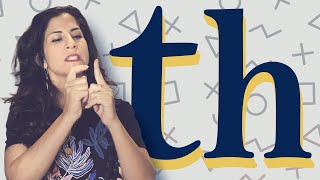
Hadar Shemesh shows how to make the English TH sound by placing your tongue slightly between your teeth. Learn the difference between voiceless and voiced TH, why you might substitute T or S instead, and which function words you can cheat on while practicing.
Chapters
Hey there. It's hadar. And this is the accents way. And today we're going to talk about how to pronounce the th sound. Okay, so the th sound is a sneaky sound. First of all, it's an uncomfortable sound for most non native speakers because you have to stick the tongue to make the th, which is indeed uncomfortable. We'll first talk about how to pronounce it, and then we'll talk about all the exceptions and how much work you really need to put into this. Okay, so first of all, to make the th sound, you want to stick the tongue out, but just a bit like this, okay? Not too much F. Okay. Not too little, because then it may sound like a different sound, like a T, for example. Thanks. So to make the th sound, the tongue needs to be out and and allow the air to pass between the tongue and teeth, creating this friction sound. Listen, theta, do it with me. Now we have two different ths. One, the voiceless th. And if you put your hands here and release air, right, you don't feel anything here, you feel the air coming out. And now try this with me. Did you feel vibrations? Good, because that's the voiced th Here. It was air with the vocal cords vibrating. Now, we haven't changed anything here. For both the tongue was out and the air was passing between the tongue and teeth. Now, two things you want to pay attention to. One, you want to make sure that the tongue is out, because otherwise it's going to sound like a different sound, like a tink, like a T, or maybe sink, like an S if the tongue is too far back. So you want to make sure it's out, not too far out. Right? Also, you want to make sure that the tongue is relaxed. If it's too tight or if the body of the tongue is going to block the air inside the mouth, it's still going to sound like a T. Think. Even though my tongue is out. That doesn't serve me right. So you want to relax your tongue and feel the air passing. It should feel like an F sound. But make sure that if you tend to substitute the th with an F sound, make sure that it's not the bottom lip that touches the teeth, but your tongue. And by the way, how do you know that your tongue is not too far out? You can put your finger here on your teeth, think, thought, and say a few words with a th. And you want to feel the tongue just slightly touching your finger, not pushing against it. Because if you feel your tongue pushing against your finger, then your tongue is Too far out. Okay, good. So let's. So let's practice a few words. Theory, authentic path, voice, th. They make sure it doesn't sound like they. All right. Or they they another. My brother and mother. My brother and mother each other. Okay, good. Now, when it comes to function words with th, like the this, that, those. First of all, these are sneaky words because you don't think about them. And then automatically your mouth would want to say something like the this, that, those. Now here it's okay to cheat. Generally, we are in favor of cheating. Okay? So whenever you don't have to pronounce the full sound. Don't. Okay. I'm telling you, it's okay. So for example, for words like the this, that. Those you can stick, like you don't have to stick the tongue out. You can place it on the back of your teeth, the top teeth, the. The. The this, this. So it sounds like a D, but it's not this D, but this, this, this. So you can't see my tongue coming out. But again, it's not a D sound, it's a D on the teeth. And then it's totally fine. So it's a lot easier to pronounce, especially when you need to transition between sounds like the car, the sun. Right. It's harder to do the sun. So if you put it behind the teeth, the sun, it's easier. And still it doesn't have that strong sound of duh that some speakers have. Not that it's a big deal because you're still going to be clear. Okay. Also, you need to remember that when you practice sounds, you need to focus on your highest priorities. So if your th sounds like a T or D, everyone will probably understand you. If you want to improve and if you want it to be a non issue, then definitely work on improving that. Okay, let's try a few more words. Authentic them. Tell them is that. Now I want you to remember that when it comes to the th, it might be easier in words, but then in sentences or phrases it gets a little more challenging because you need to work quickly between the two sounds. So for example, to say something like the may be easy, but then to say the sun might be more challenging or the theater 2th's together. So you always want to anticipate the following sound. So let's say you have a sound like an L that has a th right after like will they. So what you want to do is to anticipate the sound and stick the tongue out before the th will they. Same thing with N before th on the right. So you bring the tongue out for the n and then you're relaxing it into the ta so you don't have to push the tongue out, anticipating the th. That will help you with the transition on the in the will they all that at the tth. So here I brought the tongue up for the T instead of keeping it behind the teeth At. At doesn't change the sound anyway. It's a held t at relaxing it to a th. The add the get them and backwards as well. Bath time. So I want to think about this transition, and if it's difficult, then I want to work on this transition over and over again. Okay, let's try another one. Is that zth? Raise your hand if you want to turn off this video right now. Is that right? So here there's no cheating. You just have to work quickly. Now, you might be doing something like zat or that. That's totally fine. Just make sure that you're not merging the two sounds. Two different sounds. Focus on them. Iz the Z is inside that th out. So you want to transition and really visualize your tongue going from the inside to the outside. Is that after all, your tongue is a muscle. You control it, right? It's not like this. I always compare it to a sneaky little brat that is just like, running around, and you're like, wait just a minute. Wait, Look. Come here, come here. So that's your tongue, and you need to teach it to listen to you, especially when it comes to the th transitions. So what you can do is create those lists of transitions, right? Every time you come across a tricky transition or just a lot of words with th's and repeat them over and over again. Repetition is the only thing that will help you make it your own and make it spontaneous. Okay, so it's not enough to listen to this video and to just, like, try it out a few times. You've got to do it on a daily basis, even if it's just five minutes a day. And then it will become a part of part of you. And then you'll develop the muscle memory. You'll rewire all the connections in your brain, and you won't go back to the comfortable place, which is all the other sounds. Okay, so let's start a list in the comments below. Put all the possible transitions or tricky transitions of th and other sounds, and we'll practice together. I hope this was helpful. This was helpful. Have a beautiful week. Don't forget to subscribe to my YouTube channel. And come on over to my website because I have a lot of great stuff for you over there and free stuff, so why not come check it out? Theaccentsway.com have a beautiful day and I'll see you next week in the next video. Bye.
More from Hadar











Read Out Loud with me! Dare to Lead by Brené Brown | Pronunciation & Vocabulary practice