Tone of voice: what you REALLY mean 😡😑😊😂
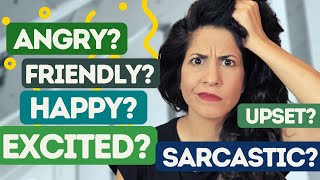
A short instructional YouTube video by Hadar Shemesh explaining how "tone of voice" conveys emotions beyond words. She demonstrates the same short sentences (e.g., "that's great," "Can I get a cup of coffee?", "You're so cute") in multiple tones (excited, sarcastic, indifferent, angry, romantic, joking, etc.), points out acoustic differences (pitch range, pitch direction, vocal quality, energy), and invites viewers—especially non-native speakers—to practice with a linked blog post.
Chapters
Oh, that's fine. That's fine, that's fine, that's fine. Let's talk about tone of voice. Tone is essentially how you say things, but when we think about it, it's more about the emotions and the feelings conveyed through your voice, regardless of the words that you're using. So just like in the example that I used, that's fine, you felt four different things. One, that's fine. I was genuine, I was calm, I was kind. The other one was, that's fine. Right. I was unsatisfied, a little sarcastic maybe. That's fine. Uncertain, confused, unsure. And that's fine. What was that? I was definitely not happy. Right. So the tone is basically the emotion that I'm expressing through my voice. A lot of times we don't let out a lot of emotions to be expressed through our voice. And it's really important in communication because, you know, for example, when you give a compliment to someone, you can say, you have a nice hat. You have a nice hat. So people actually put more meaning to how I say it rather than the words that I use. Right. So that might not be perceived as a compliment. Maybe, maybe they would take it as an insult if I say it like that. Oh, you have a nice hat. Versus you have a nice hat. So all I did was I changed my voice a little bit and I used my pitch a little differently from going really flat, you'll have a nice hat, leaving it up hanging. And my voice was a little harsh versus you have a nice hat. My voice was a little softer and. And I use pitch more. You have a nice hat. By the way, if you are new here, then welcome to my channel. My name is Hadar and I'm a speech and pronunciation coach and I'm a non native speaker of English and I am here to help you sound confident, clear and proud when speaking English. If you want to connect, you can find me at Hadar Accentsway on Instagram. And of course, I'm inviting you to click subscribe and click the bell to get all the notifications. So you know when my videos come out. Now let's go back to tone of voice. The reason why I wanted to make this video is because the other day I came across this long list of tone of voice words and it was actually aimed at writing because also you can have tone while writing, but we're not going to talk about that. But then I thought it would be so great to see how we can use all these emotions on the same sentence and see how it completely changes the sentence and talk about what actually happens to the voice when. When we use this certain tone in comparison to another. Let's begin by taking the simple phrase that's great and explore four tones of voice. The first one is going to be excited or happy. The second one is going to be sarcastic. The third one is going to be not interested or just indifferent. And the last one is going to be angry. Now, as I do it, try to detect what is different about my voice and my pitch. So, yeah, we can fake emotions by changing our voice. I mean, people will notice. So I don't recommend you to do that, but still understand that you can sound more friendly or you can sound more excited, even if you're not that excited, simply by using your voice and your tone and your pitch. Okay, so that's great. Excited. That's great. That's great. That's great. That's great. Sarcastic. I have that look when I'm sarcastic. That's great. That's great. That's great. Indifferent. That's great. That's great. That's great. That's great. Angry. That's great. That's great. Oh, that's just great. That's great. Doesn't sound like things are so great. Eh? That's great. Oh, that's great. Okay, so I said the same thing, but it meant four different things. Now, what is the difference? What was different about my voice? Let's try to explore it. The first one was. That's great. Right? So my voice was slightly higher. The pitch difference was bigger. That's great. That's great. Right. Now, if we compare it to what we did later for the indifferent. That's great. Not a lot of pitch changes there. So when someone is excited or happy, usually there is, like, a big pitch range between the stressed words and the unstressed words. That's great. Or at least you hear the difference within the word. That's great. Right? So my voice is up here. It's all forward. That's great. Right. Now, when I was sarcastic, I went down. Oh, that's great. Right. My voice was, like, a little harsher. That's great. That's great. Right. A little lower. Maybe a little bit of a vocal fry here. Oh, that's great. Oh, that's great. Okay, so I wasn't all the way up here. And then when I was not interested or just, like, indifferent, it. It was kind of flat. And my voice was not as full as it was for when I was excited. That's great. Oh, that's great. Oh, that's great. Oh, that's great. I leave it up hanging. I don't close it. That's great. Yeah, whatever, right? That feeling of like, I don't care, I don't care. And when I was angry, you felt like I was dropping at the end. And of course, my voice was more energized. Oh, that's great. Maybe more of the lower tones. Right? Like more of my chest voice. Oh, that's great. That's great. Great. Now let's take the sentence, can I get a cup of coffee? Can I get a cup of coffee? Right. So if you want to say it in a friendly way, remember, friendly and excited and happy usually means more pitch. So if you ask for a cup of coffee and this is how you say it, can I get a cup of coffee? Can I get a cup of coffee? It may not sound as friendly as, can I get a cup of coffee? Can I get a cup of coffee? Right. Because I use more pitch, my voice is a little softer, which indicates friendliness. You know, I'm being kind. I'm excited. Hey, can I get a cup of coffee, please? Versus can I get a cup of coffee? Can I get a cup of coffee? This tone is usually associated with being very strict or authoritative, which is also fine. Let's say you walk into a cafe and the barista is, like, treating everyone else but you, not even taking a look at you giving everyone else coffee. So probably you wouldn't want to be like, oh, can I get a cup of coffee, please? But more like, can I get a cup of coffee? Right. Because you're a little angry, you're a little frustrated. So the tone of voice is different, the pitch is lower, and your voice is a little different. It's more harsh. Can I get a cup of coffee? Like, stronger versus that softness that we have. Can I get a cup of coffee, please? Now, staying in the restaurant realm, if. If let's say I ordered something and I did not get what I want, and I can say, that's not what I ordered, that has a very different tone than that's not what I ordered. Right. So listen to the pitch. That's not what I ordered. My voice is a little softer. I'm being friendly, maybe. I really like the server, and I know that he or she did their best. I'm sorry, that's not what I ordered. Versus that's not what I ordered. I'm not saying that one is better than the other, but you need to understand that there is a difference, and each way of speaking fits or suits a certain scenario. So you want to understand what is the context to be able to use the right tone. And you want to understand that if you don't pay attention to how you say things, sometimes you might come across as too excited or friendly when that's not the situation. Or on the contrary, you may come across as unfriendly or demanding when that's not your intention, it's just the tone of voice that you're using. And as speakers of a second language, sometimes we apply the tone that we have or we're familiar with in our native language, or we express things differently, or maybe it's less expressive and in your native language, and as a result, it may come across as, you know, more indifferent. And you have to understand that pitch and the quality of your voice determine the experience that people have when they hear you speak. So it's a tool for you to express what you want in addition to using the right words. Because, as you see, like, sometimes we can say a positive thing like, that's great. And it may not sound positive at all. Let's take another one. You're so cute. You're so cute. So again, if I'm excited and genuine, you're so cute. You're so cute. Let's say I want to sound a little patronizing or condescending. Oh, you're so cute. You're so cute. You're so cute. Right, like, I'm changing my tone a little bit. I'm changing my voice. Oh, you're so cute. Oh, you're so cute. Oh, you're so cute. See how it's different? And even the intonation is sort of the same, but you feel something different. And it's not acting. It's not acting. It's just a way to express a certain emotion or feeling. Now, let's try another one, and then you will try it yourself. Okay, let's try the sentence. Are you waiting for me? Are you waiting for me? Let's write in a genuine, friendly way. Are you waiting for me? Are you waiting for me? Are you waiting for me? Now let's try to do it in a romantic way. Are you waiting for me? Are you waiting for me? Are you waiting for me? Now let's do it as a joke or a funny way. Are you waiting for me? Are you waiting for me? Are you waiting for me? You hear that laugh in my voice? Try it. Are you waiting for me? And of course, upset. Are you waiting for me? Are you waiting for me? I mean, I've been waiting for you for four hours. Are you waiting for Me surprised. Are you waiting for me? Are you waiting for me? Are you waiting for me? Okay, so now it's your turn. Let's take the phrase I don't know, I don't know, I don't know. And I'm going to write the tone and you are going to try it out and see how it's different. Let's start. Angry. Indifferent. Surprised. Confused. Shocked. Friendly and excited. Sarcastic. Okay, if you want to practice this more, then I've prepared for you a list of different tones, as well as a few sentences that can be said in different tones. So if you want to practice that, then click on the link and it'll take you to my blog post where you'll see that list so you can practice it and have fun. And also start paying attention to how people say things around you. And especially if you feel connected with someone or you feel that they're very friendly and nice and kind, what is it about their voice that makes them come across as so friendly and inviting? And on the other hand, if you have someone that repels you that you feel uncomfortable around, check in with yourself and see what it is about their voice that makes you have and feel those feelings. And because the voice is the first thing that people hear, and it really does convey all these beautiful emotions that we can experience. So it's good to know that as a listener, but it's also good to have it as a communicator because you want to be able to use your voice so it gets you what you want and what you need, and it helps you connect with other people. So thank you so much for being here. If you like this video, then click like. Click like and subscribe. I mean, I guess that's more exciting than click like and subscribe, right? It's like I'm being authoritative here. Click like and subscribe. No, because then you'd be like, who does she think she is? Right? So this is why I'm saying it like that. Click like and subscribe. Subscribe to my channel and then leave a comment below and tell me what is your favorite tone of voice to practice. Have a beautiful, beautiful day, and I'll see you next week in the next video. Bye.
More from Hadar











Read Out Loud with me! Dare to Lead by Brené Brown | Pronunciation & Vocabulary practice