When People Don’t Understand You…
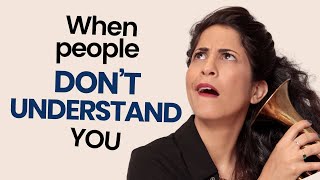
A short instructional YouTube video by Hadar Shemesh offering practical strategies for non-native English speakers who are not being understood. She explains how to recognize signs of misunderstanding, immediate repair tactics (smile, breathe, repeat slowly, emphasize a keyword, rephrase), body-language and mindset tips to stay confident, and recommends targeted pronunciation/prosody practice and note-taking as homework. Additional pronunciation resources are available on her website and channel.
Chapters
Hey everyone, it's Hadar. Thank you so much for joining me. Today we are going to talk about what to do when you are not understood. Now, this is a painful point for a lot of speakers of English as a second language, new speakers of English, because when you speak a second language, sometimes you have some communication barriers, like, you know, you don't have all the words, or maybe the pronunciation of the sounds in English are challenging for you and you haven't mastered those yet. And maybe some intonation patterns from your native language take over and you might sing it with a certain melody or rhythm or stress patterns that are different from what people expect to hear. So being misunderstood comes with a territory, which means it's something that happens when you start speaking a second language or even when you've been speaking for 20 years and more. Because sometimes we don't know what to work on or to focus on or to change and improve to be a little more understood. So in this episode, I'm going to give you some tips that will help you become more understood or at least more aware as to why you're not understood, and more importantly, some mindset tips. And that will help you deal with a situation where you're not understood. And instead of pulling back and keeping quiet and getting offended or feeling bad about yourself, how you can kind of like shift and reframe that experience and actually move towards communication and not away from it. If you're new to my channel, then please allow me to introduce myself. My name is Hadar H A D A R. I'm a non native speaker of English and I am here to help you speak English with clarity and confidence and a lot of joy. Because you know, that's what communication is about. And if you want to learn more about what I do and how I can help you, check out my website, hadar shemesh.com or my Instagram page, Hadar Accentsway. Okay, so let's come back to the reason we're here, which is to talk about what to do with when you are not being understood. Now, how to identify that situation. I'm sure you have all experienced it once in your lifetime in English or in your native language. And it happens when you say something to someone and that other person is either quiet, especially if you ask them a question and they haven't responded, or they make a face, or they actually respond with, I'm sorry, come again? What was that? Could you repeat that? Now, the moment that happens, you might feel like, you know, your heart sinks and you're like Crap, what am I supposed to do now? Or, oh, no, they think that I can't speak. So the first thing is to. Don't let that autopilot in your brain start running, right? Like all the negative thoughts or, you know, self judgment and all of that. We're going to put that on the side for a sec. The first thing you can do is to use nonverbal communication. Okay? Because communication is not just the words that we use and how we say them, but it's also body language, facial expressions, and our voice. So immediately you can actually tap into that and dissolve any tension or resistance or frustration. And sometimes, you know, the other person who cannot understand what you're saying is also feeling bad. Take that into consideration. And they don't want to make you feel bad, right? So when you smile, it calms them down as well. So the first thing you could do is just smile and breathe in. Okay. And breathe out, too. And then you want to say it again a little slower. Sometimes it takes people a little longer to process what it is that you're saying, because maybe you're using sounds a little differently than how they're using it. Maybe your melody is different than what they're familiar with. So it's not that they can't understand you, they just need a little more time. And maybe your voice was not strong enough. So repeat the words again slowly and support your voice. So take a deep breath and make sure that your voice is heard. Maybe they just couldn't hear you and say what you wanted to say again. Okay? If you still feel that you weren't understood, or if you know, if you see that the response is not automatic and then. Oh, of course. Then one more thing you can do. You can say it again a little differently because maybe there was a word there that was not clear to them, but if you use a different word, then that might be a little easier. Maybe they got the point of what you wanted to say, but if you were to say it a little differently, they would totally get it. And if that's not an option, or anyway, when you're saying it again, try to focus on the one or two key words in what it is that you're saying. So, for example, if you want to say, it's not my favorite place to go, and you said it and someone did not understand you, so when you say it again, you might want to say it a little slower. It's not my favorite place to go. And try to articulate the sounds and make sure that you hit all the consonants Especially at the end of words. But also think of the one word that is most significant, maybe favorite. In this case, it's not my favorite place to go. Okay, so you repeat what you said. You think of the keyword. Usually it's a content word like a noun, verb, adjective, or an adverb. And you say it with confidence, a little slower, with your full voice. Okay? So if you feel that you are generally unclear, then I actually have a video about how to use your voice more powerfully and a few additional videos that are going to help you learn how to emphasize words. So everything is going to be in the description below. Now the next thing I want to talk about is body language. Now I said that when you are not being understood, smile. And I think that even when you are on the phone and someone doesn't understand you, then the moment you smile, people hear it in your voice. So I still recommend doing it, even if it's not face to face communication. So let's say you said something and someone didn't understand you, right? So the moment your body starts getting all nervous, or maybe you lower your head, your eyes, like you've made a mistake, like a terrible mistake, maybe you're ashamed or something like that. And by the way, that's also important when you make a mistake or when you get stuck. Not just when you're not being understood, right? But when your body projects shame, it makes the other person think like you did do something wrong, which you didn't. Because you know, saying something and not saying it clearly is not a sin. So yes, of course we want to improve our clarity, but sometimes it doesn't work, right? Or sometimes we don't think about what it is that we're saying and we're not being clear. So the next best thing after practicing would be to just, you know, acknowledge it, embrace it, not feel bad about it, not feel lame about it. Because there's no reason to feel lame and just assume, say it again with confidence and pride of someone who speaks at least two languages, right? And for a moment they weren't understood. But this is going to be resolved right away, right? And I think mindset is key here and it really makes all the difference. So I want you to try that approach. When that happens, when you're not being understood, you smile, you just stretch up, shoulders down. If you are holding a lot of tension in your hands or your lips, just try to release those, take a deep breath and say it again and just trust that the other person is going to understand you. But then you Want to do your homework, which means to take notes and to write the sentence or the phrase or the word that wasn't understood. Because obviously there is something there that created this miscommunication. And while, yes, we want other people to sharpen their ears, we also want to get what we want when we speak and to not have that obstacle when speaking. And one of the ways to do that is to practice the elements that prevent us from being clear. Maybe it was a word with a lot of Rs. Maybe, you know, it was a word with a lot of consonants. And this is something that you're not used to in your native language. And maybe you dropped some consonants instead of pronouncing all the consonants. So you want to recognize the element that caused you to be unclear and to practice it. So next time when you use that word or structure or whatnot, you will know better. And a lot of times when you're not understood, then if you practice and do the work. And this is why I love teaching pronunciation. And I think that working on pronunciation and prosody, which is the intonation, rhythm, and stress, all of that is so incredibly important because it helps you understand people better and to become more understood. Right? I think it's significant. It's essential. So when you do that work, you become more aware and attentive to your clarity needs. And if someone doesn't understand you when you're trained, then you can immediately guess what was that thing that made you not clear. And you can change that, right? Because sometimes when we practice it, it's okay, we know how to make the sounds, but. But then it just doesn't show up when we speak. And that's okay. That's a natural part of the process. But when you're aware of it and you say to yourself, okay, that was a moment where I wasn't using my R or I wasn't using my dark L. And you say it again, focusing on those sounds because you've done it at home. When you practice, then it will enable you this ability to say it again in a way that people understand. So I recommend practicing pronunciation, and I have a bunch of pronunciation videos and drills for you on my channel and on my website so you can practice with. And some of them actually include some drills and audio recordings so you can find them on my website. And then after that, any challenging interaction is going to be easily resolved. Okay, now I want to hear from you. What are the things that you do? What, when people don't understand you, what are the thoughts that go through your mind what do you feel And I want you to share that in the comments first because I think I would love to hear how you are experiencing this but also I want you to see what others are experiencing too so you know that you're not alone in this and you are probably going to see that many people experience the same things as you, right? Which is very comforting but also you can learn from the experience of others and share from your own personal experience because that's what this community is all about. So please share your thoughts and insights and tips in the comments below. If you want to connect with me, I'm Hadar Accentsway on Instagram and of course you can check out my website that has a lot of great resources for you and that is hadar shemesh.com thank you so much for watching and remember making mistakes is the only way to learn. I'll see you next week in the next video. Bye.
More from Hadar











Read Out Loud with me! Dare to Lead by Brené Brown | Pronunciation & Vocabulary practice