When to use ON, IN and AT correctly in English | prepositions of place | part 2
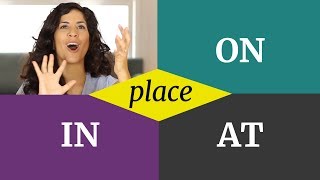
Hadar Shemesh breaks down three prepositions using visual metaphors: 'at' is a dot (a specific point or event), 'on' is a line or surface (streets, floors), and 'in' is a box (enclosed areas). The key difference: 'at' often means the activity or concept of a place, while 'in' means physically inside it.
Chapters
Hey, guys, it's Hadar. And this is the accent's way. Today is part two of the video lesson, how to use on, in, and at when it comes to time and place. Last video we talked about on, in, and at when it comes to time and today we are going to talk about it when it comes to place. Last video, I also said it that when you look at these three words, you want to think about it in those terms. Where at is the most specific, on is a little less specific, and in is the least specific. Now, when it comes to place, I want to add one more thing. Let's make it more visual. Think of at as a dot, on as a line, and in as a box. So at is most specific. At is used when you want to describe a specific person. Place. I am sitting at the table. There is somebody at the door. Let me go get it. Places around town. I'm at the supermarket, I'm at the movie theater. I'm at school, I'm at the office. So if you look at the map and you can mark an X on specific places, this is when you'd use at, at the store, at the supermarket, at school. So places, ideas of places. Okay. Also, it is used to describe events. For example, I'm at a conference, I'm at a concert, I'm at a meeting. So at is used to describe specific places. On is a line, a surface. So we can say on the street, on the road. You use it to describe levels. I'm on the second floor. You use it to describe coastlines on the east coast, on the west coast. Why it's not a specific place. It's somewhere along this line. So I can say I live on 14th Street. Okay. I don't commit to where. It can be anywhere along 14th Street. But if I want to be more specific, I zoom in and then I use at. I live at 35 West 14th Street. I live on 14th Street. Or I live at 35 West 14th street. I can tell you, hey, there's a great restaurant on the road. You have to try it. If I want to be more specific, I'll zoom in. Say there is a great restaurant at the end of the road. Okay. On the road can be anywhere along the road. Zooming in at the end of the road. When we talk about crossroads or intersections, we can use both on and at. So I'll meet you on the corner of Broadway and 82nd street, because these are two lines that are meeting. And I can also say, I'll meet you at the corner of Broadway and 82nd street, because it's a specific point. And then we have in. In is the least specific, as I described it. But I also said that you want to think of it as a box, but it's also something that is surrounded with something, some kind of borders, either walls or borders on the map. So in is used for neighborhoods. I live in Queens, I live in Manhattan. In is also used for cities in Tokyo, in Cairo, in Moscow. In is used for countries in the US In Argentina, in Asia, continents. Okay? In the universe. So in is always think of it as a specific place within a larger place with borders, with boundaries. Although the universe doesn't have any boundaries, but you get what I mean. So we talked about boundaries on the map, but we also have physical boundaries. For example, I'm in the room. She's in the house. I'm in a car right now. And I can also say in the park and in the office. But wait a minute. I said at the office just before. How can I say in the office? What's the difference between at a coffee shop or in the coffee shop? And this is where it gets interesting. So this is how I see it. And I invite you to let me know in the comments below how you see it, because it's a little vague and even American speakers can't tell exactly when they use in and at. It's very intuitive. I'll give you my take on it. In is the physical place. When you use in, you want to indicate that you're within the physical place because there is a reason for it. And at is more the concept of the place or it's about what you do in the place. Okay? So for example, I can say I'm at a coffee shop, just indicating that I'm at the coffee shop. I can be just outside of the coffee shop when I say at, because it's the idea of the place is what I do there. And if I say I'm in the coffee shop, it means that there's a reason why I used it. It means that I'm physically inside the coffee shop. Okay. I'm not going to say if someone calls me is like, hey, where are you? I'd say I'm at a coffee shop. But if my friend that is coming to meet me asks me, where are you? I'd say, I'm in the coffee shop. Come on inside. I'm inside. I'm in. Or I'm at the office. Oh, I'm at the office today. I can't see you. It can be me buying Coffee downstairs, still at the office. It can be me in the kitchen speaking to a colleague, but I'm still at the office. But if someone is coming for a meeting, calling me from downstairs, I'd say, come on up. I'm in the office because I'm inside the office. Let's say, for example, someone's calling me and it's like, oh, my God, it's snowing like crazy outside. Are you okay? Oh, yeah, don't worry. I'm in the office. I used in the office to indicate that I'm within the physical place, that I'm surrounded with the walls around me. Okay? That's what's important here. This is why I used in. Otherwise, I'd probably just use at so I can say at when I want to talk about the idea of the place, what I do in the place, it doesn't have to be physically inside the place. I can be just outside of it. Okay, I'm at the park, I can be across the street. But if I use in, then it means that I have to be physically inside, surrounded by the borders and the boundaries of the place. So to conclude at is a specific place, it's the idea of the place. It's an X on the map. It's a point, a dot on is a surface. It's like a line. Okay? It can be anywhere on this line, but you don't commit to where. An in is something that you have to physically walk into or get into. If we're talking about a place with borders on the map, okay? So on is a surface, in is three dimensional. So you have to walk into a place, and at is a specific place, whether it's on something or in something. Okay? So usually when you have in, you also have at in it. When you have on, you can also have at. Okay, that's it. I hope it makes a bit more sense. It definitely helped me when I was trying to figure out when to use any of these three words, because for me, all three words in my native tongue translate to the same word. So for me, it made a lot of sense to give visual representations to these three words. Okay, so let me know in the comments below if you have any questions. What do you still struggle with when it comes to on, in, and at? And come on over to my website to check it out because there are a lot of great stuff waiting for you over there. Thank you so much for watching. Don't forget to subscribe to my YouTube channel if you want more of this kind of stuff and have a wonderful week. And I will see you next week in the next video. Bye.
More from Hadar











Read Out Loud with me! Dare to Lead by Brené Brown | Pronunciation & Vocabulary practice