Will reading books help you get fluent?
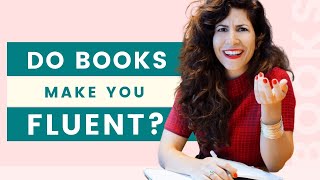
Hadar Shemesh explains why reading books alone won't make you fluent in English. You need to turn passive knowledge into speaking habits through techniques like reading aloud, shadowing audiobooks, retelling what you read, and practicing vocabulary actively.
Chapters
Hmm. What do you mean, what am I doing? I'm practicing my fluency, silly. Can reading books help you improve your fluency? The question of all questions. On one hand, books a world of imagination and knowledge and insight and pleasure. On the other hand, your English that has its own demands and requirements. Can book really help you achieve your goals in English? A lot of my students, when I ask them what they do to improve their English, they tell me we listen to podcasts, we read books, we read books and we read a lot of books. And that really helps us with understanding English better and with our vocabulary. And all of that is great and delightful. But the question is, can books really help you improve your fluency? So we are going to talk about that today. If you're new to my channel, then hello and welcome. I'm happy that you're here. My name is Hadar. I'm a non native speaker of English and I'm here to help you speak English with confidence, clarity and freedom. And I also teach you a lot of great strategies to improve your English and your fluency, which this video is just going to be about that. If you want to find out more about how I can help you, there's a lot of free content on my website. Then go to hadar shemesh.com or you can follow me on your favorite content platform. Okay, books. So on one hand, when you're reading books in English, it gives you this feeling like you are immersing yourself in English. You're learning new words, you are learning new grammar forms and structures, and you feel like you're really expanding your reach and you're expanding your ability to understand English, all of that is fantastic. But my question to you is this. Are you able to take the word that you have just read and use them spontaneously and quickly and confidently in a conversation? When you see a beautifully structured sentence that is a perfect example of conditional number three, are you able to see it and use it immediately? And that is my problem with improving your fluency through reading books. Because there is a big gap between your ability to understand English while reading it and even while writing it and your ability to actually use it. Reading books is also very convenient. It doesn't involve anyone. It's just you and the book. Or maybe you listen to audiobooks. It's great. You're in your own world, you learn new things, you dive into interesting narratives and you feel better about yourself because you're also doing something for your personal growth reading books. But aye, there's the rub, because it doesn't involve anyone else. It does not give you the real experience of using English. So apart from being exposed to English passively and not being able to use it actively, you're also very, very comfortable. And you're not challenging yourself and you're not allowing yourself to be vulnerable using the language. And that is the hardest part about speaking a language. It's really not just knowing the words and knowing the grammar structure. It's having the confidence and the courage to speak and to use new forms and new words when you speak. Now, as you can see, I'm not leaning into using books and reading books as a strategy to improve your English and definitely not your fluency. But I do have a lot of tips on how you can leverage your book reading into a real practice, into a real learning experience. And I'm going to share that at the end, so make sure you stay till the end. Now, if you haven't heard me talk about it before, the thing about reading books is that it creates the illusion of learning. It makes you feel like you're improving, but you're actually not seeing results. Why? Because you're only expanding your passive knowledge. So, for example, you're reading the book and then you come across a new word, and maybe you go to check it in the dictionary and you're like, oh, it's a new word, it's a good word. I need it. And you even maybe mark it to yourself, and maybe you even look for the definition and see how it's being used. All of that is fantastic. But if it remains on the paper, if it remains here in your brain, you are less likely to use it. And why? Because words are habits. Think about it. What is a habit? A habit is something that you do automatically, without thinking about it. So I consider words and sounds of English and even grammar forms as a speaking habit. You do it in your native language. You don't have to look for words. It's all automatic. And in English, when you learn a new word and you haven't used it just yet, you haven't built that habit, that speaking habit. So repetition is an important part. It's an essential part of being able to use a word freely. And when you keep seeing it on the paper and you keep thinking about it in your head, you haven't created the speaking habit, and therefore you are less likely to use this word. So great, you've learned a new word, and maybe you'll understand it when you watch television. Television. But the real struggle of using English is speaking, even if you don't have to speak on a regular basis, and you're okay with just reading and writing and listening. If you know English at a certain level, wouldn't it be great to be able to speak it at the same level? Wouldn't it be great not to have that big gap between the English that you know and the English that you speak? And the more you read books and listen to podcasts or listen to audiobooks or practice things on the paper, you are farther and farther away from being able to speak fluently. Now, I'm not saying books are not good. I think it's a remarkable way of expanding your knowledge and expanding your vocabulary. And this is where I want to talk about how to read books in a way that actually improves your spoken English. So here are a few tips that I want to share with you today. First, read out loud. You want to feel the words coming out of your mouth even though they're not your words. It's going to help you with pronunciation, because then you'll understand if you know how to pronounce this new word or not. And if not, you might want to practice it a little bit. It will help you get comfortable with your voice in English, and it will give you this illusion as if you're speaking. And that builds up confidence and also creates the speaking habits. So make sure that five or ten minutes out of the time that you're reading a day, you are also reading out loud. And when you do pay attention to pronunciation. Intonation, rhythm, make sure to pause and make sure that you're clear about how to pronounce certain things or certain structures. And if you get stuck, just say it again and again and again and research it if you need to until you feel confident. So remember, if you want to confidently use something that you're learning, first of all, you have to be confident in how you're saying it. And second, you want to build the muscle memory, I call it pronunciation confidence, that you'll be able to do it again and again and again. Then it sticks. You remember it better. Another way to leverage your reading into an English practice is to use audiobooks. Now, you can either just listen to the audiobook because that also helps you improve your listening skills because you need to be more attentive. So if books, then maybe audiobooks is better. But audiobooks are not for everyone. So if you prefer to read, then maybe you can play the audiobook as you're reading. So you can also pay attention to the melody, the pronunciation. And every now and then you can pause and repeat IMITATE or even shadow what it is that you're hearing. It's going to be fun, exciting. You can do it as you're walking around in the room and it will build your confidence and your pronunciation confidence. Another way to turn your English reading into an English practice is after you know, one page or five minutes of reading, close the book and explain what you've just read. It's going to help you with your comprehension and with taking an idea and turning it into words. Something that a lot of people struggle with. How do I talk about what I want to say? How do I organize my thoughts? This is a great way to do it and also will help you enhance your experience reading the book. Because you're going to go deeper and you're going to be like, oh, actually, I think I don't really know what I just read. So reading a part or reading even a full chapter and then explaining it in your own words. And if you want to get fancy, you can even record it and listen to it and record it again, improving the small parts that you felt were not right. One more thing you can do if, let's say you want to improve your vocabulary, is to collect words that you struggle with. So let's say you're reading and then you come across a word that you know you know but you never use or you're not sure how to pronounce it. This is why you avoid using it. So at that moment, you just write down the word on a piece of paper or your notes app or in your notebook. And then after reading the book, this is the list of words that you're going to work with. Now, I have a video that teaches you how to build your vocabulary using my pronunciation confidence method, and I'm going to link to it here. But the idea is to not memorize words, but to take words and to use them actively. Use repetition and use intentional practice to integrate those words into your vocabulary. Just marking them or just thinking about them while reading or even just making a list is simply not enough. Lastly, what you can do, and that is the best thing, you can start a book club. So let's say you're reading a book and you want more people to read with you so you are held accountable and you can create a healthy discussion around that book. So you can do that, and then you leverage your reading experience into a community and speaking experience. And there is nothing better than sharing your knowledge with others, helping others improve their English by joining your book club or simply by using English on a regular basis. Because books are amazing and podcasts are amazing and audiobooks are amazing and YouTube videos just like this one are amazing. But it's not enough. You have to speak. You really have to speak and put all that beautiful world of knowledge that you're learning into practice. There is nothing like practice. If you want to get better at reading books, read more books. If you want to get better at speaking, you know what I'm going to say. You got to speak. So it's not black and white. There is a lot of middle. And like I said, if you're reading books and you want to improve your fluency, use the tips that I shared with you today to turn it into a real practice that is actually going to help. All right. Now I have a question for you. What other tips do you have for people learning English who want to learn through books? What is something useful that you've discovered about reading books or listening to audiobooks that you might want to share with the community? Please don't be shy. Share your comment below this video and let's start a conversation. Have a beautiful, beautiful rest of the day and also tell me what books you're reading right now. Put it in the comments and I'll see you next week in the next video. Bye.
More from Hadar











Read Out Loud with me! Dare to Lead by Brené Brown | Pronunciation & Vocabulary practice