Alex Halliday, Founder of AirOps, on Content Engineering and the AI Marketing Stack | S14E2
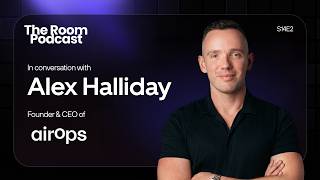
Alex Halliday, founder of AirOps, explains how his platform turns data and brand context into high-quality content at scale through systems, not just better prompts. He built viral fan sites as a teenager, became the UK's youngest publicly-traded CEO, and now positions AirOps against traditional SEO tools with features like workflow builders and model-ready inputs.
Chapters
The rate at which an organization can learn is pretty indicative of the rate at which it can be successful and win its respective markets. And so whether that's on the growth side of the business that I've done a lot of work or the product side, being very clear about what the operating rhythm of the team looks like, that could really lead to increased learning velocity.
Welcome back to The Room Podcast Season 14. Hi, Mads. Hi, Claude. So excited to be here. So excited to be talking about everything that's going on in 2026 in tech.
There's so much to discuss. Each season, as you all know, we sit down with some of the most thoughtful, insightful people building on the cutting edge of the startup ecosystem and talk about what it takes for them to build and scale enduring companies.
This season, we're diving into the ideas, inflection points, and experiences that have shaped some of today's most impactful companies, and the people behind them.
From Nextdoor to the Ring founder, we are diving into suites of innovation from early product decisions to navigating rapid moments of growth to acquisitions, IPO exits, and truly the conversations that offer a window into how great companies are built.
And if you enjoy the conversations, which I think you will, make sure to subscribe so you never miss an episode.
And of course, if you wanna stay connected, we would love to have you at our community events like our annual Inside Summit, and you can subscribe to our newsletter to learn more at theroompodcast.com.
Thank you so much for being a part of the community and welcome to Season 14 of The Room Podcast. We used Rippling at my startup, Pryve, and one thing that really stood out was how much it simplified workflows that are usually incredibly manual. With other tools, onboarding a new hire, setting up payroll, provisioning apps, and shipping a laptop can take weeks and completely disrupt your flow when you need it most. With Rippling, those workflows happen automatically in one place. That's a big deal, especially early on when every hour matters. Over 15,000 startups, including Cursor, Clay, and Sierra, trust Rippling to scale fast without adding additional ops and HR headcount so founders can keep building. So if you or your startup want to move as quickly as you can and focus on what really matters, like your product and your customers, you need Rippling. Right now, venture-backed startups can get 6 months of Rippling startup stack for free. Head to rippling.com/theroom and sign up today. That's R-I-P-P-L-I-N-G.com/T-H-E-R-O-O-M to sign up for 6 months free today. Focus on what you're building. Leave the rest to Rippling. rippling.com/theroom.
Perkins Coie supports the most innovative entrepreneurs and investors in fast-moving and high-growth sectors, addressing their myriad of legal needs. But the firm doesn't just provide end-to-end legal and business counseling to its startup clients. It also facilitates introductions to key advisors and sources of capital. Perkins Coie's interactive website, Startup Percolator, offers access to programs, resources, and rich dynamic content designed to assist entrepreneurs on their startup journey. To learn more, go to startuppercolator.com and Perkins Coie coie.com.
Welcome back to The Room Podcast. I'm Claudia Laurie, and this week we're joined by Alex Halliday, founder and CEO of AirOps, a platform helping companies build AI-powered content workflows and automate complex marketing operations. AirOps sits at the center of a rapidly emerging category, the AI marketing stack. And instead of simply generating text with a single prompt, the platform helps teams orchestrate structured workflows that combine AI models, data integrations, and human review to produce high-quality content at scale. The core insight behind AirOps is deceptively simple. Great AI-generated content doesn't come from a better prompt. It comes from better systems. In this conversation, Alex shares the unlikely journey that led him to that realization, from building viral fan websites as a teenager to becoming the youngest CEO of a publicly traded company in the UK. His career has followed the arc of the internet itself, from early web experimentation to the modern AI era. We talk about the concept of content engineering and why the real challenge with AI isn't generating text, but operationalizing it inside of organizations. Alex also shares why focus matters more than ever in the AI era, how AirOps decided to obsess over marketing teams as their core customer. And why narrowing down your opportunity can actually be the key to building a great company. And beyond product and strategy, we also discuss the emotional reality of founding, why startups rarely move in a straight line, and how learning to manage your reaction to uncertainty is one of the most important skills a founder can develop. And with that, let's open the door. This is The Room podcast with Alex Halliday of AirOps.
First of all, Alex, thank you so much for joining us in The Room today.
What a pleasure. Great to be here.
Delighted to have you. And we like to start at the beginning with all of our guests. So we're curious, where did you grow up and how has that shaped your view of the world?
I grew up in North London. For those who know it well, a place called Muswell Hill. Both my parents were academics. I grew up around a really eclectic group of writers and professors and teachers. And like many kids, I wanted to do the exact opposite of my parents. And so from a very young age was building things, making things, got into computers like as soon as I could when they still had a green screen and the dial-up modem was painfully slow. But I saw that as being my path. I was so drawn to it and it's been my world ever since.
So in that vein of early identity, did you always think you were gonna become a founder?
I saw it really as a path to a sense of freedom professionally, like creation and creating things and having the skills to be able to build and make and ship things. And so I think I didn't really know at that young age what a founder was. And this was before, I won't give away my age entirely, but this was before sort of founder culture and startup culture I think had really hit. But I did have this deep sense of wanting to master building products and the web as it was starting to emerge. And I had my first real taste of it around 15 when I had this collection of websites go incredibly viral. And it gave me this taste for what success felt like. And in many ways, you could argue I've been chasing that high ever since, because it was just such a moment of having a real identity, something I could be proud of, and something that I think allowed me to show my skills a bit to the world.
Let's hone in on those viral links for a second. Is this when you founded Social Go?
So this was long before Social Go. So I would basically find really big fans of music artists online who were creating forums and collecting views, and I would offer them a mixture of hosting. I would give them technical support and I would help them with advertising. I would share the advertising royalties with them and ended up building this network of 30 or 40 websites, including, I think we had the third most popular Britney Spears fan site. We had like the biggest Buffy the Vampire Slayer website, and we often would outrank all of the official websites and would start selling ads on them. And this was before ad targeting. So we were selling mortgages and life insurance to 12-year-olds trying to see what was happening in next week's episode of Buffy. So the arbitrage was real. And then ad networks matured. I got some really funny phone calls from network CEOs being like, we're paying you $20,000 a month, and we know this is like completely ridiculous. The music is gonna stop pretty soon, but that age it was pretty fun, to be honest.
Absolutely. There was so much to just build on the internet because there was no order, essentially.
Total chaos.
And a little bit was happening today with AI, but we'll get there in a second. How did this evolve then into you becoming the youngest publicly traded company CEO in the UK?
That's a funny story. So I, the advertising golden age that I was occupying came to a very abrupt end in November 2000. So it's a long time ago. I then continued my education. I was still building websites for people. I went to the LSE briefly where my dad was actually head of department, trying to do the academic thing. And then the same day I started a startup. So I moved into my university halls of residence in the South Bank in London and my startup office on the same day in Shoreditch on Rivington Street. And we started building a social networking platform. And this was before Facebook groups had taken off. And the only real competitor we had was Mark Andreessen's startup at the time, which was called Ning. And so we started creating this social networking platform for groups that wanted their own space. And it was similar to kind of what Circle is now, for those familiar. And we bumbled along for a bit, for about a year, and then we found this investor that was really interested in the company. And around that time, things really took off for us. And part of the way we financed the business was we took over a shell company on the junior market in the UK. So I had this weird thing of being the youngest CEO of a publicly traded company, but it's not as it may first appear. But I did have to go to AGMs as like a 23-year-old with very spiky blonde hair that people were very upset about in the investor forums and answer all these questions about where social networking was going. It was really intense. And the problem for me as a founder at that point, I didn't have any of the basic playbooks of running a startup. I was stubbing my toe all over the place. I didn't know the things that we now have at our fingertips for company building, fundraising, team building. This just didn't really exist for me at that time. So it was harder than it should have been, but at the same time, it was a formative experience.
Social Go wasn't your only stab at founding something. You founded another startup, then went and had pretty senior product roles at companies like MasterClass, Bungalow, and then forayed into becoming a venture partner. Peel back the layer a little bit around this arc and ultimately how that informed your decision to found a company again in 2022.
For me, the Social Go experience was 5 years, very intense. And after that point, I got really clear that I wanted to be around the smartest people I possibly could. As a next step, which I actually wish I'd done first, but no do-overs. And so I decided to start a new company in the legal tech space and at the same time form some relationships with venture investors in San Francisco who were visiting in London. There was a lot of Silicon Valley comes to the UK and these kinds of programs. We actually flew the team out for the legal startup to San Francisco and ended up getting a term sheet from Founders Fund contingent on me moving to San Francisco. And the Founders Fund were like, you can't start a serious company in the UK, like you have to come to San go for a bit and get immersed in this culture. And so I came initially on a tourist visa, doing my 90-day visa runs, and my co-founder and I got a coworking space at SOMA, as you do, hung out at the Creamery, which was all the rage back then. Uh, ended up not being a good fit for me, actually. And this is one of the lessons you learn as a founder, which is the idea of kind of founder-market fit, and which opportunities fit you like a glove and you just thrive in, and others which I think are much more challenging. And this was one where I spent 6 to 9 months on it. And I think it wasn't great for me personally, but I really loved being in this environment of San Francisco. And this, I think those years of 2013 to 2017 San Francisco were just incredible. And I don't know if we'll ever see anything quite like it again. Obviously AI is now reinvigorating the city, but back then I feel like you'd run into every single name in venture and startups just at the local Blue Bottle. And there were lots of small dinners where you would get exposure to these incredibly smart people. And so I felt very much at my core that this is where I wanted to be. And it was where I would get the best sense of what good really looked like and the kinds of playbooks and things that I could then take forward in my career. So I remember speaking to Sam Altman and Lucky Groom, and they were talking about this company called Teespring, which was taking off. I think at that point it was like $500 or $700 million of apparel through the Facebook feed, hypergrowth. And I went and met them in their office, which was this falling apart building with parrots flying around and a lot of patients from— there were wards inside this building as well. So you had patients wandering around, parrots flying around, and then everybody was working on the floor with their laptops. And I remember walking in and just being like, this is so fun. I need to be here. So I took a job there.
Did you work with Walker?
Walker. Jack Altman sat next to me. So he was like the personality pillar of the company. And Art Levy, who now runs Brex, like BD, and then the Numeral guy, Sam. It's basically like this really interesting little group there.
That's so funny. We backed Fourth Wall, Walker's next company, at my last firm.
Yeah, it was a crazy time. I think at that point they were the third fastest growing e-commerce platform of all time behind eBay and Amazon. They were also a cautionary tale, a bit like Zynga, of single channel risk, which we can definitely dive into, and then it started this run of 3 very different companies that I got to be part of through their Series A to D, E runs.
What do you think were the 1 or 2 key lessons learned from your time operating, seeing kind of hypergrowth in many different industries, and how that ultimately informed you now as a founder of AirOps?
It was like 9 years or something all in. There's probably some books to be written on the lessons. I think one thing is designing for learning velocity in these teams, because especially when things are changing quickly, which back then we thought we knew what that meant, and now we're being shown that it's all going even faster. But I think the rate at which an organization can learn is pretty indicative of the rate at which it can be successful and win its respective markets. And so whether that's on the growth side of the business, I've done a lot of work, or the product side, being very clear about what the operating rhythm of the team looks like, that can really lead to increased learning velocity. So, whether that's experimentation volume or prototyping or contact with customer, really just looking at a month of progress and understanding how much did we deepen our understanding of this opportunity is a good measure of success. I think that takes a lot of thoughtful design instrumentation and culture setting. So, that would be one that I would definitely take forward in anything I do.
Well, you definitely employed that with AirOps. Digging in a bit, you founded AirOps in early 2022 with Matt Hamill and Gonzalez, nearly a year before ChatGPT was launched. An interesting time. The company actually started in the data space, not in AI content. What was the original insight? What was the aha moment? And then what did you learn that made you pivot into AI-powered content workflows?
We at Bungalow had an incredibly large set of frontline teams that spent all of their time on a Sunday night sending CSVs around to each other just to try and get reporting in order, deck creation, I remember sitting there with Matt, and we were like, this is insane. There's got to be a better way than this. The first thread we started to pull, knowing full well, by the way, that we might pivot, but we're like, okay, let's explore this for a bit and see where it goes, was could we create an authoritative library of data assets that frontline teams can use? Can they use them in the tools that they want to kind of report on, operate their frontline teams from? And that would like Google Sheets, Slides, Coda, Notion. Can we bring these data assets, give them to teams, let them just operate faster off of great data. That was where we started. And inside of that product was this workflow tool that we built, which was like, hey, connect nodes together and you can have different steps, functions. And our first foray into LLMs pre-ChatGPT was having LLM steps in there. So you could use DaVinci-003 and all these like very rudimentary models, but they were magical. And as we started to develop and pull the thread on that, I had this moment where I didn't sleep for 3 days. I remember I was using the models for a mixture of SQL generation and other tasks. And I was just like, this is just melting my brain. Specifically, it was— I saw the laws of physics that govern software melting down in front of me. I just started thinking, this is the biggest technology shift of my lifetime in front of my eyes. And so I was in New Orleans at the time, and I told Matt, I was like, we have to lean into this. The first 6 months of that looked like experimenting all over the place. We had Harvard Education building workflows on the platform for teaching their students. We had all sorts of crazy use cases, but there was this one white-hot center of usage, which were these technical CMOs that would build on AirOps nights and weekends. They would do crazy things. We would think that writing an article is like a 5-step workflow. They would make something that's 100 steps because they're so opinionated, so high taste. And ultimately, as ChatGPT launched and we saw the application layer just balloon, of all these businesses cropping up, I remember feeling like if we're horizontal, we are going to disappear into oblivion. We have to pick a customer that we are excited to obsess about, build with, partner with, talk to every single day. And these marketers were amazingly creative and they were so willing to contribute to our business and our vision that I was just very excited to pick them. It felt too narrow at the time, but when the pie is expanding, these things that feel really narrow at any one time become $100 million, $500 million ARR businesses as the pie expands. And it was a story that repeated itself multiple times because every time we down-selected and focused, the business accelerated.
Wow.
By the way, I used you guys at Harvard. I was at HBS last year and I took a class on AI. And it's so funny because at the beginning of the hour I said I was playing around with it more for the podcast this morning and I was— the workflow looked so similar. I was like, I swear, I don't know if I've been in this tool before. And then I totally have.
Yeah, we still have a few folks like that hanging around. But I think that the combination of the logo flywheel, the proof points are getting really deep in a high economic value use case as fast as you can when there's all this noise around is just such a shortcut to growth.
Well, what you're really talking about here, which is the big aha behind AirOps, is what is content engineering in the age of AI? And this is really the idea that great content requires sometimes 50 to 100 step workflows, not just better prompts. Tell us a little bit more about what gave you conviction that the future wasn't just better models at a time where everyone's building on models and trying to improve models, but really better implementation. Layers on top of them.
The big gap between a model can do a thing and a model can do a thing to the level that you are happy as a brand to put your stamp of approval and publish it is about 100 times wider than most people realize. And this was an insight that we got very early on working with high-taste brands to use our platform. Uh, and we were humbled honestly at the beginning of the complexities and intricacies of real organizations, real brands with a lot of constraints, a lot of nuance, a lot of complexity. And so we were very early in this mini-FDE model of like really pairing with brands to understand their realities and how we get these models from like, that's really cool to that's really valuable. Content engineering has emerged as a response to this increasing need for accurate, up-to-date content in organizations that are mature and have high taste bars. And one of the slightly I think underappreciated effects of AI search and ChatGPT is that these models and experiences give consumers information synthesis superpowers. Like my attention span for buying a headset for long-haul flights used to be 30 seconds, and now it's 2 or 3 hours of equivalent attention from the models as they go and synthesize what's out there on the web. And that means that the quality, precision, authority, and freshness of that content has never been more important. But the existing way of working of like We're going to refresh 5 blogs this month, guys. It just isn't sufficient to really help modern brands keep up with this insatiable appetite for content and specificity. And so content engineering is emerging as this like really important MVP in the modern marketing org to be able to address that, get to scale with AI content, with humans in the loop along the way, but with the precision that actually adds something to the conversation, is informing the consumer and ultimately persuading the agents. And so originally this was very oriented around traditional search, and then about 13 months ago, AI search just was a rocket booster to this narrative, and it's become just this incredible trend that we're a part of and hopefully leading.
You've mentioned there's a lot of Pytaste brands doing some pretty complex things. Maybe since the last 13 months, what is the craziest use case you've seen one of your customers employ?
I've got a good one. So I actually can't mention the specific company, unfortunately, but we had a company that wanted to do like usage guides for their API. And so they wanted to tell all of these stories about how to use their API for all of these things. And that's like common for us, right? It's like, how do you get to the long tail of use cases, blend things like social proof and other customer proof points with use case guides, screenshots, like that kind of thing is like a very common AROPS use case. But what made this interesting is they actually wanted to have valid code in the actual articles that people could copy paste. And so we had to build an agent that would be able to test the code that it was proposing for various use cases before it went into the article. And that's like an example of something that's like, if you ask the average person, can ChatGPT write a blog post? You're like, of course, like, why'd you need a content engineering platform? Hello? Like, it's 2026. But then the real value is truly just out of reach for one reason or another. And that's where marketers come to us with these, like, we love it when it's a little impossible. We're like, oh gosh, right? We need to code. We actually need to validate the code runs and we need to run linters and other things on it. And let's build that into a content engineering workflow. But that's what makes the job interesting. So that'd be one example.
It's nice to see when you take a step back and actually focus a product on a niche, you actually almost create like more abundance and use cases. And clearly that's resonating with the capital markets. You've gone on to raise north of $60 million to date, which was most recently led a Series B by Greylock at a $225 million valuation. So first of all, congratulations on those milestones.
Uh, thank you.
We are curious though, who was the first person to say yes? To investing in you and AirOps?
I would love to give props to all of our investors along the way, cuz the link between all of them is they got to conviction quite early in the process before the venture sort of blob caught up. I love that, like independent thinking in your board members and people that can sit in a room without listening to the noise are really valuable as board members. And that's something I look for. The very first check came from Zach DeWitt at Wing. And if you're a founder thinking about raising money, I would talk to Zach all day long and recommend him. He and I worked together at Bungalow. He was a board observer and Wing was an investor. And so we had this wonderful overlap in a different subject matter, different business, but he'd get to see me operate and present at board meetings. I would get to see him wrestle with interesting business questions and his intellect shone through. But actually, like Zak, I say this every single time I say this at the Wing partner meetings, Zak is the person you call when you're having one of those days because he is this ball of energy and enthusiasm, nuanced and precise. He's not delusional, but there is this like, sometimes a founder, you just need someone to tell you, reflect back the progress you've made, help you zoom out, reframe the challenge, and set you on your way. And I love him for that. I think he's been amazing as we've gone through, you know, several rounds with this business, and we couldn't have done it without him. But honestly, the check from Wing at the beginning was very quick. He ran a very quick, high conviction process. I actually DM'd him on Twitter because I didn't have his his number for some reason. And I think we had the seed check on the Monday afternoon.
Wow. That is fast conviction. Uh, high taste, one might say. And really helpful just to paint that picture of also that partnership that you had early on and how that has pulled through as your subsequent rounds of financing. We were talking about a little bit, these processes can be opaque and at the same time, the AI bubble or just AI excitement around the venture ecosystem has created a really interesting dynamic in fundraising today. Curious how you would think about an advice for fundraising right now?
This is actually related to the previous story. I don't believe in this thing of only talk to investors when you're raising at any stage. Actually, I've been given this advice by a lot of people I trust generally, but on this point I disagree. Pretty much all of the investors, I think every single investor that we have added to the cap table, we've percolated the relationship a bit before. You know, we've sowed the seeds of the strategy in the space, and we've given them things to think about. We've made asks of them as well and sort of battle-tested their thinking. So I do think relationships, especially in early stages, it's about the conviction they have in you as an operator, obviously. And I think it's so hard in a fast fundraising process as an investor to really have enough time to get a sense of you as a person and the space. So I think first piece of advice is like, just try and build relationships and make those relationships valuable for the investor before you've even started the fundraising process, which it looks like sharing interesting things, getting their takes on things, asking what they think about interesting topics. And then I think right now, the sort Software is being built in many cases at the speed of inference, and there's a lot of questions about where the value is going to lie at the application layer. But what remains the sort of enduring thing that you need to prove is that you have a deep understanding of the buyer, the real reality of that person. What are they facing in 2026 that you're going to be a solution for? How do you make it into their top 1 or 2 problems that they want to solve? Do you have relationships already that are representative of your buyer? Do you have people that are like interested in the problem you're solving, even if you don't have a product yet? I get a lot of pitches and things sent to me, and some of them are like, we're imagining data analytics with LLMs, and it's like this cool demo. And I'm like, yeah, but who is really gonna be like super motivated to go to bat for you with the CFO to go buy this? And like, early-stage founders are like, whoa, that's so far down the line. But if you actually start with a real high-value economic problem, obsess about it, and become the person to go to for that, the software now and other elements of the process, I think, become a lot easier. And actually, this was a lesson I had to really learn, and my co-founder that was kind of my favorite founder. It took him like 3 or 4 months to drill this into me because I was like, we're going to build this platform and you can build anything on it. And he's like, okay, but what specifically are people going to want to do? Who is going to write a $100,000 check for this platform and why? And I was like, no, you don't, you don't see the vision. But it was like, you have to kind of hit real commercial reality early right now to convince investors that you understand the problem deeply enough. You're building excitement in real buyers. And then obviously execution and building the company comes shortly after.
Rippling is something I actually relied on when I was building my startup, Priv, and I think it speaks to a broader truth about startups. Most people don't start companies because they love running payroll or managing HR and compliance, but somewhere between hiring your first employee and raising your next round, you end up deep in HR, IT, and operations, and it can really pull you away from building. What should be simple things—onboarding, payroll, setting up tools—start to take over your life. That's what Rippling was built to solve. Rippling is a unified platform that lets startups run HR, payroll, IT, and finance in one system from day one. Rippling's startup stack replaces disconnected tools that don't sync with a fully connected platform. So if you wanna stay focused on your product and your customers, you need Rippling. Right now, venture-backed startups can get 6 months of Rippling startup stack for free. Head to rippling.com/the-room and sign up today. That's R-I-P-P-L-I-N-G.com/the-room. T-H-E-R-O-O-M to sign up for 6 months free today. Focus on what you're building, leave the rest to Rippling. Rippling.com/TheRoom. There's this interesting tension right now where especially a lot of non-AI founders, when they go out to fundraise, they're being pushed to be like, what's the big vision? What's the $100 billion company? And then similarly, some founders that have that big vision often don't actually have those use cases that have a clear path getting to that first $10 million ARR, $100 million of ARR. That's a very helpful sort of orientation for us. In that pursuit, we know that the founder journey is not always a straight line. We were talking earlier that it is often a slog and sometimes you just have those days, as you were referring to earlier. Can you share a moment where something just was not working or did not go as planned?
In the last 20 years of doing this, I think most of the time things are not working. Quite as you want. Probably 70% of the time a day you show up and there's an element of a customer is churning or something, or a competitor launches something. One of the most important things as a founder is to reduce how reactive you are emotionally to things that happen. It's very easy to be on the core, I think we say now, building a company, and to not value all the opportunity that's existing in this disruption and only focus on the things that are going wrong. But you have to take it as the picture. Like, we are all dealing with one of the biggest shifts in knowledge work and software of our lifetimes, and preparing your mindset for a lot of curveballs, a lot of disruption, a lot of things, a lot of magic that we can take advantage of along the way, I think is really important. I think for me, like, early last year, we were being a little bit unclear with our customer what our posture was towards AI search is this mega trend. Our view is like, you can come and use the platform for whatever you want in content, marketing teams will figure it out. And I think that was in a world where there was a lot of competitors who were speaking directly to that urgent problem. Like we weren't resonating, deals were not closing as fast as we'd wanted. And there was a few weeks of real heartache around that. Then what we tend to do is write memos internally of like different directions we could take and try and sell it as a clear, coherent, articulated direction. We ran that process for this, and I think it flipped us all into high conviction mode that talking to AI Search and helping that to get adoption of Airopps, pioneer content engineering, and more would unlock the business. And when we did that, we had our biggest quarter ever by a factor of 4, and things took off. But I do always think the really hard periods tend to be followed by a breakthrough. Now I'm like, oh, this really sucks, but I feel like it's energy building for us to then make some very clear, decisive actions. I genuinely don't worry about them Well, as much, he says.
Yeah, he says quietly to himself in the corner. Exactly. It's clear that something is working. You scaled incredibly well over the last 4 years and have incredible brands and customers building on the platform. Companies like Ramp, Webflow, Chime, even Kayak. The marketing and SEO tool space has a few incumbents. We're curious how you've thought about going head-to-head against existing SEO platforms and in complement to many of the kind of more classic AI writing tools we've seen.
We are really trying to talk to the marketers that have the big ideas and need a canvas to bring them to life. A lot of them have like a traditional analytics tool where they've really struggled is we have the data layer here for traditional search signals. We have all of our documents internally, but then how do we bring these big campaigns to life and strategies? How do we move from doing work across 7 or 8 tools to create those at-work products we can push to actually being able to start to hand off more of this work to LLMs with precision, with human in the loop, with all these sort of boxes, important boxes checked. So I think we see ourselves as creating a new category and one that I think is going to build up a lot of steam this year as this handoff to LLMs becomes more and more accelerated. Now marketers are some of the most creative people in the world. They have big ideas, they have taste, they have a lot inside of them, they have a lot of energy, and they need to push that into a tool that can capture that and bring it to life in AI. Like they can't vibe their way to a lot of their ideas coming to life. In our experience, having a platform and a team that could work with them to do that is where we really play. One thing about categories is that VCs love to talk in terms of category creation, and I find it a little bit amusing in a world where things are changing so quickly. And I understand they want an ordered view of the universe and something to talk about at their partner meeting. But I also think that like the category that we are in and we are creating is still unfurling itself and definitely have our perspective on it, but it's anything but baked despite what I think some people might I think.
Yeah, absolutely. No, you're leaning into this like entire shift in a workflow experience for the end user and playing around in the platform myself. I think I got initially a little bit overwhelmed even by just having to select a grid and having to select a workflow. I just didn't even know which was the right mode, but then I noticed you guys had a generative search bar where I could just type the flow that I wanted. So I used that instead and I found that a lot more intuitive because now I've just started thinking in freeform text, and I do expect the computer, the AI, to actually be able to help me. And a part of that is because I work at Vercel and I use v0 every day, so I'm just very familiar with a v0 style workflow. To that end, I'm curious what you're seeing in terms of trends at the end user level, like what parts of the platform and the product experience is really taking off, how are you guys building into the either like technical level of your end user or lack thereof?
In order to get LLMs to be as precise as our customer needed, we had to create this platform that almost felt like a developer tool, unfortunately. Maybe someone else has solved that problem, but for the last generation of models, it was like decompose the problem to really small testable pieces, allow marketers to build their workflow, have really good observability. Unfortunately, quite a high technical bar to build some of the more complex things. So we've had to really provide a lot of support and build things like Copilot that help with it. But I think I think the precision and the decomposition and the procedural nature of the current Webflow product was incredibly successful. We spend a lot of time educating people on how to use it and teaching them some of these concepts, but for the existing product we have out there, I think the precision really hit. And then on the grid standpoint, collaboration, multi-party sign-off and approval becomes bottleneck in a world where outputs are easier. And so us being able to like do diffs and versions and all the things that developers actually do, but bring them to marketing inside of the grid, has also been incredibly important. And then we do a of work behind the scenes to do context engineering and import so we can bring as much of the business context into the platform for these use cases and often prepare it for the use case. So social proof, call transcripts, the list goes on. So I think it's, it's the context layer, it's multi-party approval, and then it's precision workflows. I do imagine that all three of those concepts will look wildly different in a few months. To be honest with you, we are in a different era right now. And it's one that we're excited to lean into, but there's a ton of very exciting things happening right now.
How is your team staying nimble and adapting where we're actually shifting consumer queries away from the existing platforms, of course, like Google, into ChatGPT and other search experiences? Like, obviously OpenAI isn't sharing exactly their roadmap with you, so maybe they are, John, you're shaking your head a little bit, so we'd love a sneak preview there, but you're enabling the end users. How are you helping them stay ahead of where search is going?
We definitely have never sold like a push-a-button-and-we-do-all-the-work-for-you type solution. I think what we want to do is make sure we provide really good guidance on how to build systems that can deliver long-term growth that's sustainable. I think one of the great shifts from the world of SEO in the old days to, well, not the old days, I guess like 2 or 3 years ago to this new world is I think the models are getting better and better at information synthesis and finding really novel, fresh content to then provide to users. And so We really see the kind of durable place to invest for brands being quality information gain content that's fresh, which is a lot, but it's basically like you've got to get more stuff from inside the experts in your company and your systems out to the models so that consumers can understand your product and buy from you. We do a lot of work there. We're about to launch a product called Page360, which shows you the entire picture of your pages, which pages are stale, which pages are nearly working, which pages ChatGPT is reading but not citing, all these slices of your content that really should be going and improving. And then we're also doing a lot to provide best practice workflows for refresh and other things. And so we're trying to create as many of these primitives that marketing teams can build with, and we're trying to give them a data foundation that they can use to do really great work. And we invest a lot in research as well on the side. So we run research experiments constantly with customers to see what's really working. So all customers of Airoops get real evidence that we've collected that certain tactics work, FAQs, freshness signals, author bios. What's the actual lift that folks see from an AI search visibility standpoint when they're employed? We're all students of this moment, and we just try and provide as much information and education and knowledge sharing as possible to keep people ahead. Absolutely.
And this is clear why you've previously said the value is going to accrue more so at the implementation layer than just at the model layer. Because ultimately you're driving the business impact here through the applied approach. I'm curious then for the AirOps stack, how have you thought about what you want to own to be your points of differentiation and where are other components that you are willing to not have to be like the core owner of innovation on?
We can start at the bottom, which is proprietary inputs. Platforms need to have really high-quality model-ready inputs for these use cases. So we have a whole team working on that. There's a really cool roadmap of And that's a mixture of signal from the market, information we go collect or buy from the market of what's happening, how's consumer behavior changing, but also preparing context from inside the business ready for the model. So that context layer and that foundation for all of the workflows and agents is something we 100% want to continue owning. And then I think this is where the story changes a little bit. The best marketers are building their own apps. They're using NCP, they're working in Claude for Work, and I think we're going to embrace that. I'm really excited to see how people can build on our data and we can enable more precision-governed access to data and almost like go-live evals for brands that want to enable content creation across multiple platforms, but need context and guardrails to do so. That's our kind of Airopps everywhere piece. And then I think the other is what does the ideal user experience for multi-team content creation look like? And I think that's one where we'll have some news soon, but I'm pretty excited. It's a very interesting interesting, very creative time in software. And I think the brands that kind of shy away from that are gonna be irrelevant. Okay.
I'm kind of vibe podcasting with my next question, cuz it wasn't a prepared one, but when agents are inside of AirOps in the future doing this on behalf of marketers, how are you deciding which other third-party platforms to then recommend inside of AirOps? If you need to be doing this type of optimization for your website, and you could do so with another party through a partnership. How are you guys thinking about informing your recommendations to like an agentic experience?
Yeah, I think there's lots of pieces to that, particularly as it pertains to like developer or pseudo-developer tools, which I would include us in. We actually are starting a new partnerships motion to answer this question a little bit. We are working on like an MCP preferred vendors list. I think a lot of people want to bring their own MCPs to this as well. But I think the bit that needs to sit on top of a great MCP catalog is the right playbooks and reasoning chains to make the most out of them. So I think that's a core asset of any agent runtime, which is to understand the best way to leverage MCPs for specific use cases. And that will be a foundation for recommendation for us. So I'm slightly vibroadmapping now, but I think that's definitely going important. MCP is something which I think is a little bit misunderstood right now. It's seen as this like connector where you can pull information, but if you look at the roadmap, it's actually got some really ambitious features that they want to add for longer and longer running processes. And so I actually think there's a world where MCPs become like the primary accessor for platforms for much more complex, longer running projects than what we see today, where it's like go fetch a Notion doc or a Linear ticket. So this is all unfurling, right? I don't have all the answers, but I definitely think the, the kind of connector ecosystem around your platform, the discovery of that, and how you make sure those connectors are used in ways that drive real economic value is like one of the most interesting questions in software right now. I absolutely agree.
We'll have to do a special on Model Context Protocol and diving in a little bit deeper. In that vein of actually serving the end customer, as this optimized AI-driven efficiency continues to occur, how do you simultaneously preserve brand voice, authority, and trust for the end buyer?
I think it's a great question. The really good marketing teams that we speak to are spending a lot of time on foundational context for the models right now. It's like one of the most important assets to have to drive precise acceleration. Otherwise you're just like blurping out stuff, right? No one wants that. So I think the first thing is like, let's be really clear on what good looks like. And you'd be surprised at how many brands do not agree on this internally. Uh, but definitely getting to what does good look look like? How do we sound? What's our speaking voice? What's our different product lines? What's the positioning of our products? It's a bit like when you bring in something like a DBT into a growing company, and you suddenly have to agree on what all the metric definitions are, because you're starting to codify them. Marketing teams are now starting to bring agents in to do more and more work. And they have to agree on all of these things that roll up to their brand and the perception of their brand. So I think that's one. And then the second is really making sure that you're very aware of information gain and the information gain strategy around content. How are you adding to the enormity of information out there? And that can look like internal data systems, internal experts, cost, like client interviews, transcripts and other things. But like, we spend 70% of our time on this topic with brands because you don't want to just recycle content. That's not a durable long-term strategy. And I think the third pillar is, as content goes live, really making sure you have good checks and balances and you have really clear rules and guardrails around what's going live. Every single one of our customers is spending time on review and editing and feedback. But what you're doing is you're pushing humans to the top of their license and you're stripping out everything below. So, you know, we're not taking this human input time to zero, but we're trying to focus on where they can add value and actually, in many cases, create better outcomes than they would have if it was all We spent a lot of time today talking about the founding story of AirOps, your founding story as a founder, as well as some of the nuts and bolts of what AirOps is doing in this new world that we're living in.
So, as we look to the last few minutes of our time together, I'd love to ask what's next for AirOps?
So many things. We had a great year last year. I think we went from 2 to 13.5 million in ARR, and obviously That's, for me, that's awesome just to watch the team achieve that and be part of it. And then big plans for this year, certainly European expansion is one. My mom will be happy. I'll be in London more. I think thinking about new markets, new verticals for us, there's a lot happening with agentic commerce right now, and we've not done a ton on that specifically. There are some adjacent opportunities. They're a bit more in the weeds, I think, are very good for us to think about because just for context, 70% of our ops world is more B2B. So that would be a great shift. And then from a platform and technology standpoint, I think we're We're in like the golden age of software and creativity around software. And I think we want to lean into that in a big way, even if it means disrupting ourselves a bit. When I think about companies right now and investing, the ability for teams to meet the moment as things shift quickly is a key thing to look for. And so we're trying to build a culture here where it's really embracing things that are happening in the market that are real unlocks for our customer, even if sometimes that means certain things that we were helping them with yesterday, we're no longer the best place to help them with. You've got to embrace it. And so that will look like the platform really changing changing in the next sort of 6 months and us being able to really make sure that AEROPS is playing an important role in marketers getting the most out of these models and transforming how they work and how they construct their teams.
We'll be staying tuned for all of those exciting changes, but maybe more on a personal level, how are you thinking about growth as a founder and CEO, especially now on your fourth company?
Yeah, I think everybody is on a pretty aggressive ramp. The slope has to be high now. I get a lot of feedback from my co-founder on wasting time on things that aren't high leverage. It's really hard sometimes not to dive into something, but I'm trying to get better on that front. Building the right support network around me. So we've had a new chief of staff join called Lauren, who is just insanely good and is getting me into shape on lots of fronts, and that's appreciated. We also just did a big leadership survey called Leadership Circle, which was feedback on how we're showing up, how we're perceived as leaders. It's not a performance review, it's much more for the leader individually. And mine was like so interesting to read. I went through it on Friday and just one example of trying to get more information on the reality of me as a CEO right now. How are people feeling? Where am I doing a good job? Where am I not? This is the challenge of a lifetime to like keep up with this and continue to do better quarter over quarter, communicate more clearly, make sure that people that join have information they need to do their job well. It's my life right now, and it's a, it's a big scary hill some days, and other days it's just like magical and amazing. Side. Totally.
Thank you for sharing that. Okay. So, we have a couple minutes left. We're gonna ask our hero question for the podcast. Who is a woman in your life that has had a profound impact on you and your career?
On the first day that I moved into my startup office in Shoreditch when I was 21, I moved in with my co-founder. Her name was Catherine, and she was a high-taste print designer, actually. She was like a just amazing designer, but she really had incredible taste and high standards and was just wise on so many fronts personally. And we got to sit next to each other every single day we were building the company. And she was like maybe 8 years older than me, but she taught me so much about myself, but also taste and design and how to relate to other people. And I had a lot of— I just look back and I knew nothing on so many of those fronts. And I think she, she definitely gave me a great toolbox to use in life. And we're still very close. Yeah, it would be Catherine, my first co-founder.
We'll have to tag her once this episode is released. And Alex, thank you so much for joining us on The Room today. This was incredible and super interesting.
Such a joy. I love this. This is a real pleasure.
Thank you so much for joining us at The Room Podcast. If you want more from The Room every week, subscribe to our newsletter at theroompodcast.com/newsletter. We'll be back next week with a new episode, an inspirational guest, Tuesday, 10:00 AM Eastern, 7:00 AM Pacific. See you in the room.
We used Rippling at my startup, Pryve, and one thing that really stood out was how much it simplified workflows that are usually incredibly manual. With other tools, onboarding a new hire, setting up payroll, provisioning apps, and shipping a laptop can take weeks and completely disrupt your flow when you need it most. With Rippling, those workflows happen automatically in one in one place. That's a big deal, especially early on when every hour matters. Over 15,000 startups, including Cursor, Clay, and Sierra, trust Rippling to scale fast without adding additional ops and HR headcount so founders can keep building. So if you or your startup want to move as quickly as you can and focus on what really matters, like your product and your customers, you need Rippling. Right now, venture-backed startups can get 6 months of Rippling startup stack for free. Head to rippling.com/theroom and sign up today. That's R-I-P-P-L-I-N-G.com/T-H-E-R-O-O-M to sign up for 6 months free today. Focus on what you're building, leave the rest to Rippling. rippling.com/theroom.
Perkins Coie supports the most innovative entrepreneurs and investors in fast-moving and high-growth sectors, addressing their myriad of legal legal needs. But the firm doesn't just provide end-to-end legal and business counseling to its startup clients. It also facilitates introductions to key advisors and sources of capital. Perkins Coie's interactive website, Startup Percolator, offers access to programs, resources, and rich dynamic content designed to assist entrepreneurs on their startup journey. To learn more, go to startuppercolator.com and perkinscoie.com.
More from Alex
220: Alex Halliday: How to build content engineering systems that get cited and scale without slop


Should We Do This Yet? Clear Advice On 5 High-Impact Technical SEO Decisions - Alex Halliday