Ep 339:Why 'Lazy Bottles' Don’t Exist: A Functional Approach to Pediatric Feeding with Hallie Bulkin
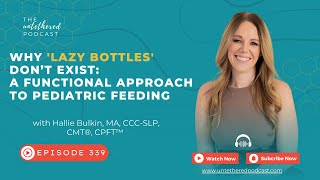
Podcast episode (Untethered, Ep 339) in which Hallie Bulkin, a certified myofunctional therapist and pediatric feeding specialist, challenges labels like “lazy bottles” and “lazy feeders.” She emphasizes assessing function over visual grading (e.g., lip tie classes), looking at whole‑body factors (tone, posture, respiratory coordination, positioning), starting with therapy before surgical referrals, and collaborating with interdisciplinary providers. The episode also promotes the Pediatric Feeding Hub membership.
Chapters
But we gotta stop using the word lazy as it refers to babies. Whether it's a bottle, whether it's a baby. You know, bottles aren't lazy, babies aren't lazy. And that term, it's dismissive and it ignores the real underlying issues at hand. Hi and welcome to episode 339 of the Untethered podcast. And I am your host, Hallie Balkan. And today it's just you and I and we are going to dive into a hot and sometimes controversial topic in the world of pediatric feeding. We might. We are talking about lip ties, latch struggles, and those so called lazy bot. You've probably heard those phrases tossed around in parent groups, maybe even in conversations with colleagues or friends. But like, what does it all really mean? And what should we as feeding therapists be thinking about when we hear these concerns or we hear these things, these conversations thrown around, Right? This episode is especially timely because our Pediatric feeding membership is open this week. And so if you're a pediatric SLP, OTP2 who works with feeding or wants to stick around, because I'll tell you how you can get clinical support, mentorship, and answers to questions like this and every single week. Okay? So let's dive in.
Welcome to the Untethered podcast. I am your host, Holly Balkan. I'm a certified myofunctional therapist, feeding specialist, podcaster, business owner and mentor. This podcast is all about getting your questions answered and collaborating with colleagues to bring you the most up to date information in the orofacial myofunctional therapy, airway tether, dural tissue, and pediatric feeding therapy space. If you're new here, I challenge you to keep an open mind and join my mission to spread this message far and wide. And if you've been around since June 2019, thanks for being a loyal listener. As we jump into today's episode, remember to listen with correct oral rest. Posture, tongue up, lips closed, teeth apart.
Breathe through your nose.
Let's get started.
All right, so I see this pattern all the time, right? There's a baby, they're struggling at the breast or bottle, and the first thing that people want to do is blame a lip tie or the nipple on the bottle. Or worse. Sometimes they blame the baby. And I hear things like from, you know, parents and even providers, and they'll say like, oh, they're just lazy. No, no, babies are not lazy. Babies inherently need to feed to survive and so they don't choose to be lazy. Let's just like put that to the side. Okay, here's the thing, right there's always a reason if a baby's not feeding well. Always. And it's not about labeling. The labels drive me a little crazy. Right. So let's not label. Let's look deeper. As therapists, like, we are uniquely qualified and positioned to assess not just these symptoms, but the symptoms system. And so when a latch is shallow or a baby's only feeding on, like, one side. Right. Sometimes babies feed better on one side of the breast versus the other. Or even in a certain position, they feed better on the bottle or maybe they're fatiguing quickly. Right. We need to ask why? Like, what is going on structurally? What is going on functionally? Is there anything going on neurologically? Because feeding is not a luxury. It is a survival skill. And if it's not going well, that affects the baby. It affects the parent or caregiver and the entire feeding relationship and dynamic. Okay? So I want to talk about how we can do better for our tiniest little clients or patients, you know, if you will. And so let's start with lip ties. Let's dive in. Oh, lip ties. Okay. So, you know, yes, upper lip frenula can absolutely restrict lip movement. But here's the truth. Not all visible frenula are problematic. In fact, many are completely normal and asymptomatic. So what we need to look for, and if you. If you been on the podcast or you've taken any of my courses, you've been here for a while, you're gonna just hear me say the same thing over and over again. But we have to look as therapists for function. Can the baby flange their upper lip? Can they maintain a seal during sucking? Are they leaking milk? Is there clicking? Are they gassy? Is a latch shallow? Right. And here's something else that I want to make super, super clear. Classification systems, like the Class 3 lip tie, or an anterior lip tie or whatever people are calling it, because I see all kinds of different terms thrown around. They mean nothing without a fun impact. If there's no functional impact, whatever you want to label that tie is not helpful. So we have to stop relying on visual grades and start leading with function. Can visual grades be helpful, especially for, like, insurance reimbursement, if that, you know, they need to see numbers or classifications. Sure. When it comes to actually, like, creating a treatment plan and implementing that plan and treating the human, you know, that feeding dyad, the infant and mother, for example. Right. We gotta start looking at the functional impact and again, stop relying on numbers, grades, whatever. Okay. Because that's not leading with function. We can look at that, but also lead with function. And so I want to give a quick little case example, right? Three month old was referred to me for severe lip tie. Parents were told that it needed to be released by release provider as soon as possible. But when I assessed the baby, we discovered the baby had low tone, poor lip activation. They were compensating by sucking in, like, harder with their cheeks. And we started oral motor therapy, sensory oral motor therapy. And after, I think it was like three sessions, the latch was improving. They had better milk transfer. There honestly was no need for a release at that point. And so therapy first. Okay, when I say therapy first, like, yes, a lip time may be present. Yes, a lip time may be part of the story, but it's not the whole story. It's one piece of the puzzle or one piece of the story. And we need to be looking at all things and prepping that baby and trying to intervene behaviorally. When I say behavior, mean with like, therapy first so that we can determine if that child actually needs to go through with a procedure. Okay, and so, like, what about latch issues? Let's. Let's talk about latch issues. Right, so it's not just the tongue or the lip. I want you to drop the idea that the latch is just about the mouth because, yes, of course it involves the lips, of course it involves the tongue and the jaw, but it also involves the head and neck control. It also involves reflexes and body positioning and tone and even respiratory coordination. Right. I've worked with babies who couldn't latch because they had undiagnosed horticollis or they presented with air induced reflux or overstimulation or, you know, or. Right. Different scenarios. But I've also seen latch improve dramatically with a simple, like, change in how we're positioning them. Maybe we're using a sideline position and we're teaching that to the caregiver and we're integrating paste bottle feeding if they're on a bott. And so what should you be thinking about as a therapist? You should be thinking about, like, is the baby able to stabilize their head and neck? Right. Are they able to sustain sucking without tiring out after a few seconds? Is there jaw excursion, is there sex? While a breathe pattern coordinated? Like, there's a whole host of things that we really need to be looking at. And these are the kinds of things that we talk through, like, every day inside the pediatric feeding hub, inside the membership. Because these assessments, they can't be done in isolation. You need clinical reasoning and somebody to bounce ideas off of. And that, my friends, is what we're here for. So, you know, I want you to kind of think back to like, you know. All right, how do we rule out whether or not there's a lip tie present? How do we rule out whether or not this latch struggle is, you know, the tongue or the lip or a combination of those plus other things maybe, right? And then come in the lazy bottles, or as I like to call them, lazy labels. Okay? So it's so funny because I. Funny, not funny, but I had a PA current refer to like bottles as like the lazy way of feeding at some point. And then this whole like lazy bottle about, I don't know, honestly, who came up with that term, but it just kind of seemed appropriate. And I had heard it before and it got attached to that, that story in my mind. But we gotta stop using the word lazy as it refers to babies. Whether it's a bottle, whether it's a baby, you know, bottles aren't lazy, babies aren't lazy. And that term, it's dismissive and it ignores the real underlying issues at hand. Okay? Most of the time when a baby's struggling with bottle feeding there' somewhere, like the flow maybe is too fast or too slow. The nipple may be too long or too short or too firm. Right? The baby's oral motor system isn't, you know, coordinated. It's. The patterns are not. The sexual breathe pattern is off. Maybe they don't have the strength to maintain, you know, the feed. I had a patient who had been labeled as lazy because they couldn't finish a four ounce bottle. But on assessment, they had, you know, trouble with tongue retraction. They had poor suck strength, they, they had nasal congestion. It had made it hard for them to breathe while they were feeding. Right? And so that's not lazy. That's a capacity issue, a coordination, right? It's not about laziness, it's about capacity, about coordination. And as therapists, it becomes our job, right, to identify that and then guide caregivers with compassion, not blame. And so I want to say it louder for all, all those you in the back, okay? For the people in the back. We don't blame the spoon. Someone chokes on soup. No. So let's stop blaming bottles and start assessing the babies. Right? And as therapists, I think we have an obligation to lead the way with this and to stop using things like, oh, they're just a lazy feeder. Oh, they're just, you know, like attaching labels to a baby, negative labels to a baby. A baby as it relates to biological needs. Breathing, feeding, you know, it's just. It's not a good look. And if we're doing it, of course the parents, caregivers, and other professionals will do it. So let's lead by example and drop those terms out of our. Our everyday vocabulary. And I don't think most of you do this, but I have heard people refer to bottles as being lazy. And it's not nature's way, and this, that, and the other. And look, you know, babies need to feed. So however that parent chooses to feed the baby, that's. That's their prerogative, right? That's up to them. It's not lazy. It's their choice. Right? So. And babies are not lazy. Well, it's just. Just go back to that. So what can you do as a clinician if you're feeling, like, kind of fired up about this? Good. That means you care. And if you're also feeling a little overwhelmed, that, my friends, is okay, too, because this work that we do in the pediatric feeding space, it's complex. And so I want to give you, like, three practical takeaways today for your next feeding evaluation. Okay? Number one, don't jump to, like, a release referral right away. I want you to observe function first, and I want you to start with therapy for, like, two to three sessions and see what therapy can do. Now, if you are so dang sure that that child is so restricted that therapy is only going to help, prep them very little. Like minimally, you know. Okay, fine. But those scenarios are more rare than they are common. So if you're constantly jumping to a release referral after every evaluation, please don't. Please observe function and intervene. Start with therapy and see where it goes. Okay? Number two, I want you to look at the whole baby. Look at their posture, their tone, their reflexes, the feed environment. We're not. We need to look at the mouth, we need to look under the tongue. Yes, please do that. But also look at the whole baby. And number three, collaborate. If you guys, again, have been following me for a while, you will hear me talk about collaboration until, like, my ears bleed. Like, collaborate with IBCLCs. If you don't have lactation credentials, ENTs, body workers, you know, OTs, SLPs, right? Make sure you are clear on what you are seeing and why. Okay? And most of all, just don't try to figure it all out alone, because you don't have to. You don't have to go it alone with this. So that, my friends, is why we did create the Pediatric Feeding Hub, which is our Pediatric Feeding membership. It's a clinical mentorship space that's designed for SLPs, OTs and PTs who are working with or who want to work with pediatric feeding. Inside, you get live weekly office hours with our expert feeding mentors. It's a team of SLPs and OTS and you know, and we also have different topics that we cover and discuss. You know, babies, picky eaters, all the things. It's a private community where no question is too basic or too introductory or too simple or stupid or silly or any of the things. All questions are welcome and you get the support that you need to feel confident and grounded and excited about your work. Right? So if you've ever sat in an eval and and or in therapy and you play, you're like what do I do next? Right, my friends, this is for you. The doors are open right now and we only open them a few times a year, so go to pediatricfeedinghub.com that's it for today's episode. If you love this topic, go ahead and let us know. Let us know what you want to hear more of on here, but go ahead and share this with a colleague. Leave a review if you want. Tag me on Instagram at Holly Bulk and let me know that you are listening so I can shout you out and share it. And don't forget, the Peed Feeding Hub is only open for a limited time, so get in before doors close in a few days. My friends, I'll see you back here next week and we will be chatting with a a guest next week on another really hot topic. You're not going to want to miss that one. So until then, keep untethering and keep changing lives. I will talk all soon.
Quick Disclaimer all information, content and material of this podcast are the opinions of the speakers and is for the informational.
Purpose only and not intended to serve.
As a substitute for the consultation, diagnosis and or medical treatment of a qualified healthcare provider. Thanks for listening to this podcast. If you found value in this episode and want to hear more of these myotots, airway and feeding related episodes, be sure to leave a review on Apple Podcasts and share this episode on your social media platforms. You can access free resources and all I offer@halibalkin.com or pop over to Hollybalken on Instagram to get all the latest updates.
More from Hallie



What I Was Missing in Feeding Therapy: ARFID, Airway, and Myo with Samy Hernandez





