EP 348: Tongue Ties, Sleep Apnea & More: The Patient-Centered Approach to Airway Dentistry
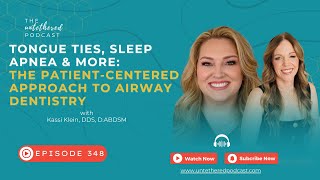
Podcast episode (Untethered, Ep. 348) — host Hallie Bulkin interviews Dr. Cassie Klein, a Texas-based dentist and founder of Spring Oaks Dental who practices airway-centered dentistry. Conversation covers Dr. Klein’s personal path into airway care (adult case → mother with severe sleep apnea → pediatric focus), common pediatric and adult airway presentations (craniofacial underdevelopment, mouth breathing, snoring, bedwetting, behavior issues, ear infections), assessment and team-based treatment (CBCT use from ~age 6, coordination with myofunctional therapists, bodyworkers, ENT/chiropractors), tongue-tie evaluation and frenectomy considerations, expansion and appliance options (fixed/removable expanders, Vivos guides, myobrace, clear aligners), and the importance of patient-centered communication and parental buy-in.
Chapters
My kid sweats at night so bad and they'll, you know, they won't think it's related. They won't really mention it at first, but as we're talking through sleep and everything, I think maybe that's why this is personal. Because my son was like, he would wake up dripping. And so that is, that is just a sign of sleep disordered breathing. That's a sign that there is something going on with the nervous system. That's a sign, you know, that's not regulated. We're, we're sweating. We shouldn't sweat when we're relaxed and sleeping. Right?
Hi and welcome to episode 348 of the Untethered podcast. Today we have Cassie Klein joining us.
Dr. Klein is a Texas based dentist.
And the founder of Spring Oaks Dental where she focuses exclusively on airway centered care. She's passionate about helping kids and families thrive through functional treatment planning and a collaboration across disciplines. Dr. Klein is a diplomat of the American Board of Dental Sleep Medicine, a vivos clinical advocate and ambassador for the BRAVE Institute. Her own family's journey with airway and sleep challenges fuels permission to connect the dots for patients and providers alike. Welcome to the Untethered podcast.
I am your host, Holly Balkan. I'm a certified myofunctional therapist, feeding specialist, podcaster, business owner and mentor. This podcast is all about getting your questions answered and collaborating with colleagues to bring you the most up to date information in the orofacial myofunctional therapy, airway, tethered oral tissue and pediatric feeding therapy space. If you're new here, I challenge you to keep an open mind and join my mission to spread this message further far and wide. If you've been around since June 2019, thanks for being a loyal listener. As we jump into today's episode, remember to listen with correct oral rest. Posture, tongue up, lips closed, teeth apart.
Breathe through your nose. Let's get started. Assy. Welcome to the podcast.
Oh, thank you. I'm so excited to be here.
I'm excited to have you. I always love chatting with fellow airway minded providers, especially when I know that you all have been on your own journey too, because there's so many, many parallels and everyone here knows my story for the most part. But I would love for you to share with us how you got into like the airway dentistry space. Like, did you start there? Were you always there? Did something kind of throw you down this rabbit hole?
So it's, it's always an interesting journey. I feel like for any, for like every airway provider I've ever talked to. It seems like it's always a mix of, like, I heard something and then something happened, and then I fell into the hole. Right. So. And that's not. That's very similar to my story. So I had kind of started hearing about airway, probably like 2017, 2018, I think, is when it was starting to kind of pick up. And around that time, my mom actually had a heart attack. Well, I had been reading some books and learned about sleep apnea. And I had just taken this really, like, huge, like, year and a half long implant course. And because I took that course, I got a CBCT, a 3D X ray machine for my office. And as we are scanning people, I can see their airway. And I didn't know that there was any kind of correlation, but once I was able to see it and then what I was hearing about airway, and then my mom, I started looking into it and asking more questions, and I was like, oh, my gosh, my mom has sleep apnea and nobody's ever mentioned it. So I had her do a sleep test and came back. She had severe sleep apnea. And then, I mean, you can't unsee it. So all of the patients. And so I guess my journey is probably a little bit, like, opposite. A lot of people start with kids. I started with adults. I started with my mom. Right. And through that, I learned all about airway and sleep. And then you keep digging, you keep asking why? And then I would say, like, 80% of my patients now are kids. Because the earlier you can get it, you can keep moms from having heart attacks, you know?
Yeah. No, that's incredible. It gives me chills because it's, you know, that's the message we keep trying to put out there is like, you're never too old for us to help you. However, the earlier we can get in there, like, the better we can set you up functionally, health, you know, health wise, get you really functioning at your prime. And so. So you now. So your practice covers pediatrics and adults, correct?
Yes, we see everybody. Everybody with an airway.
I love that. Okay, that's so cool. So talk to us a little bit then, like, let's go into the developmental stuff, right. On the early side. So we see a lot of these babies being born and toddlers and preschoolers and young kids where they have very underdeveloped mandibles, maxillas are sitting too far back. You know, we're getting pushed back. And, you know, some cases in certain ortho offices but just like looking at the craniofacial development and everything, like, what are the trends that you see with these kids coming into your office?
Yeah, so it's very, very small jaws. The, the, the big diagnosis is craniofacial underdevelopment. Just, just a fancy way of saying small jaws, but really that's like you said, a small maxilla and a small mandible and just these really like crowded, deep bites, said the baby. Teeth all touching each other, no tongue space, that tongue lives in the airway or those mouths hang open, they can't breathe through the nose, things like that. I mean that's, it's just rampant. And we see it in babies. We see it in 10, 11, 12 year olds. I mean, I see it in adults too. So. But it's, it's. Those early signs are definitely there and we look for those every day.
When these parents come to you, are they coming to you because they're like, someone told me my, my baby's jaw is too small. Or are they like, no, someone sent me to you because my kid has behavior issues or they don't sleep or you know, their growth is stunted or whatever. Like what are like the chief complaints that you're getting?
So it is, it is all of that. It is. I literally will have parents come to me for every reason you can think of. And that's something that I try to focus on is like finding the parents the why. Right? Like, because we know airways connected to so many things and I can tell you, yes, we can treat your airway, we can treat your jaw development. But at the end of the day, if it's not addressing the parents concern and it's not, you know, they're not going to want to do it and follow through with it. Right. But it's most of the time I see mouth breathing, most of the time I see sleep, I would say is a really big one. My kid comes into my room at 4am every day and me and my husband aren't sleeping at all and nobody in my house is sleeping. And so they're like, something's up. So I'd say that, you know, those are the big ones. Definitely behavior issues and even sometimes into cosmetics and the bite and things like that.
I love that you highlighted like finding the why, like when you focus on that. I just like wanted to like shout that out. I feel like I've talked about it before, but I'm not too good. It's like highlighted enough that everybody is coming to you with their own personal Experience whether it's them, their family member and like figuring out the chief complaint, why they're there. Not just having it as like a little question on the form, but actually like digging into that. Everyone's like, how do you get people bought in in your practice? How do you get them like staying through the whole, a whole pediatric feeding or myofunctional therapy program? How do you get them completing their expansion journey? Like, how do you, you know, how do you do? Well, one, we collaborate with providers who get this. But. And I know we can talk about that, but, but to like we find out why they're there and we work towards like whatever their struggle is and helping them like go from like where they are struggling to really thriving and whatever that looks like for them is going to be different than the next person at times. Like there's a lot of overlap in signs and symptoms, but the chief complaint may be a little different. So I just love, I love when I hear people highlight that like, yes, like that patient centered care that is so lacking out there these days.
Yes, I know it's easy to just have a protocol and apply it to everybody, but you have to have, especially in kids, you have to have that parent buy in. Not that you're trying to sell them something, but they've got to see the value in it. It's got to speak to what their concern is. I can be concerned with the child's bite, I can be concerned with the child's crowding, but if they're concerned with the behavior or the bedwetting or something like that, that's what we need to focus on. All the other things will fall into place. We know that when we start treating. But, but we have to connect with the parents especially.
Yeah. I mean I kind of joke that everything in life is marketing and sales. It's like all how you position it. Right? And it's all, it's like, yeah, we're not here for like yucky snake old salesman stuff. Like buy my stuff and be my client and no, it's like, how do I connect with this person so they know they truly want to like deeply help them. Like I want to help them overcome this. I want to be the provider that works with them. Like, I do feel like we can do this. And I think that's another thing too is like we've had so many adults even because I, we treat adults for myofunctional therapy, but only pediatrics for MYO and other stuff. And so we've had adults be like, wait, you can help me. Like, you're the first person I've ever talked to that's like, this is a thing. I'm not crazy. I don't have PTSD or some other, like, Munchausen syndrome or some other, like, diagnosis or like, everyone looks at me like I have five heads. They send me to another professional. It's like the rat race, you know, of trying to figure out who can actually help me because my symptoms are real. And like, you sit there and you're like, no, I very much hear what you're saying. And I'm seeing like, check, check, check, check. Like, yeah, this, this is something that we can help you with. So, yeah, I think it's, it's really cool when patients, like, realize, like, oh, wow. And then the other cool thing, I don't know if you see this too, is like, you start to talk to them and you talk about, like, why they're there, and you start to connect the dots between certain symptoms and they're like, wait, that's related. Like, this has to do with that. Like, I came to you because my kid's wetting the bed, and now you're telling me that they're tongue thrust and their, their lack of sleep, like, has, like, what does that have to do with anything? You're like, oh, it is so all interconnected. Right.
I love those light bulb moments because you know that you connected like, you've hit it. Yes.
Yeah, those are the best. So let's talk about collaboration. So how does that work? Like, collaborative care in action. In your office, in your area, do you have people you refer to? Who are you working with? What does that look like?
I have a whole network of people that are near and dear to my heart, and I couldn't do any of the treatment as successfully as I do without them. Right. So my body workers, my chiropractors, my cranial sacral therapists, I have access to some of the best myofunctional therapists. And I mean, it's a back and forth collaboration all the time. I mean, no patient leaves our airway consults without knowing about these other providers and knowing that it is a team approach to truly get the airway functioning. I can take care of structure. That's what I can do. I can move teeth, I can influence jaw growth, I can cut a tongue tie. But what I can't do is coach you on the therapy. What I can't do is manipulate. Manipulate your body and regulate your nervous system. And so that's what. Yes, we have to have that Team of people. I'm very lucky in my area that we do have great people here.
Yeah. And just everybody knows where are you located and what's your.
I'm in Spring, Texas, which is a suburb north of Houston.
Love that. Amazing. Yeah, you guys have lots of incredible people throughout Texas, but especially around that region. So that's. That's awesome. So in your practice then, like. So now obviously you said you manage like the heart tissue, right? Whereas, like I always say, I don't. I don't do hard tissue. What I do with soft tissue might influence hard tissue, but I can't promise you that it will. That's out of scope. So you do hard tissue, you know, bodyworkers, myofunctional therapists, et cetera, reduce soft tissue. What is your, like, treatment approach look like, though? Like, is it. Because I feel like the word that comes up a lot in this space, especially these days, aside from, like, airway centric, is functional, like, functional approach to treatment. So what does that look like in your office?
So my famous words are form follows function. And for everybody that comes through, adults and children, we look and we see where the biggest deficit is. Right. So is this a child? That the function is just off the charts? We cannot get. You know, they're tongue thrusting. They can't control their food. They are. They're drooling. Is it. Is it this a functional first or sometimes it's structured? Do we have these, like, extremely narrow jaws that even if the tongue was functioning perfectly, could it even do what it needs to do inside these jaws? Right. So we have to look at form and function and determine what needs to come first. And it is a little bit different for each patient. But the. I can move teeth wherever I want to. I can do whatever I can do with hard tissue and jaws. But if the function is not there to support the structural changes we've made, it's not going to be stable long term.
I love that. I love that. And so in looking at, like, the treatment plan, you know, versus guiding growth and all that and form and function. Right. So one of the structure, structural issues that come up, comes up all the time is is that tongue tie, Right. Or those heathered oral tissues. And we know that it definitely impacts all the things how, like, do you have a specific way that you assess for it in your office? Do you rely on, like, those collaborative team members that you refer to to kind of assess and send back to you? Like, what does your process look like?
So have, I would say, heavy reliance on my rock stars. That help me. But it is, you know, I. The. The conversation that I have with people is I can look at it and I can. I know what it's supposed to do. Right. So we look at visual. Like, I can see sometimes some tongue ties, you can see, and they're definite and they're there, and there's no arguing. Sometimes you can't quote, unquote, see it, but that they can't move their tongue. And so in those cases, I'll tell them, you know, I would like to see your tongue be able to do this. So I have a few exercises, a few things I have them do to just assess range of motion. But then ultimately it comes down to, I need you to go see my myofunctional therapist. I need them to assess your true range of motion, your true function compared to what we would like to see it. And then that will determine if a release is needed.
And then are you, like, at what age do you start doing CBCT is on kids or patients and done.
Yeah. So our Standard is about 6 years old, younger that we have done them on, younger than that. It depends a little bit on symptoms and what we see. But about the. About six years old is when we start looking in 3D.
Yeah. And I'm always so curious about this topic because I know tongue ties are like such a big. A big to do. Like, my daughter, both my kids were born with tongue ties. I had a tongue tie. It's all, you know, it all starts to make sense. My oldest one, we found her tongue tied when she was 24 months old already. And I ended up taking her to an oral surgeon who did release the tongue. And she then went into expansion a few years later, whereas my youngest was released at, like, day five of life. And I was released somewhere in that mix. And so I was like, if I'm doing this to my kids, I should do it to myself. But I think what was so fascinating was, you know, like, I talked about these things and I teach these things. And then I had the experience of feeling, like, the release of tension and how that. How things in my, you know, my orofacial structure shifted after that, like, that tissue was released. It was just. It was very interesting. And it wasn't something that, even though people had talked about it, that I think anyone could really, like, truly explain or describe to me. But I always try to tell. I always try to tell patients and even other providers, like, here are like, the big things you should look for. You know, aside from an obvious restriction, are there symptoms like Are there key symptoms or signs that you recommend patients look for that you're looking for with these patients who may have these heterodoral tissues in your practice?
So one thing that I love to talk about with my patients is kind of one of those light bulb moments. Like we talked about ear infections. And so if I have a kid that is on their medical history, they've had a history of ear tubes or a history of lots of ear infections, then we will talk about tongue ties. That's like a big starting place for me because of the swallowing pattern that, that causes that stagnant fluid in the, in the ear tubes. Right. And if I know that that tongue, there's likely a tongue tie or there's likely something going on, it's not allowing a proper, like vacuum suction swallow, that's not draining those eustachian tubes. And so that, that's a big jumping off point. That's one of the big symptoms that I see that come from that. But any type of, anytime I see a kid with small jaws, we're going to assess for tongue tie, right? Because the tongue is the architect of the jaws. And if the tongue is not capable of its full range of motion, then we're going to see small jaws, we're going to see crowding, we're going to see bad bites. And so that's something that we're always going to look for.
Amazing. I love that. And so, yeah, I just think about like, well, me as a kid, I had chronic ear infections which then turned into like strep throat through my teen years. It was so fun. My kids had neither of those. One of my kids, the older one, who had a tie release at 24 months, so who knows if it would have developed, but she just had like massively enlarged tonsils. And then when we scanned her, her adenoids were also enlarged. Her sinuses were filled a little bit. Things were like a little murky, you know, throughout the CBCT at age 4, she went into slow expansion for a year and it just totally changed the game for her, like, and within three months those tissues had like shrunk on her, her tonsils. We didn't assess the adenoids at that point, but I, I just make the assumption that if the tonsils dramatically decreased inflammation wise, I'm guessing that that probably happened at the level, you know, of the adenoids as well. Um, whereas my, my younger one, she had like a history of croup and as a baby, like someone would sneeze within like a foot of her and she would be sick by midnight. Like it was just like every little germ turned into croup. It was so fun. And as a three year old, she had it nine times and was constantly on steroids. I was like, something has got to give because this is just depleting her immune system. She can never seem to catch back up before she gets sick again. And so we went into early expansion with her as well. But anywho, that was very helpful. She also went into expansion at 4. And everyone listening knows they came out of their hopefully final appliances this past week at the point of recording this. But you know, it's, it's been a journey and very grateful to have the knowledge that I have, but also know that it's not common knowledge and it's not knowledge that a lot of parents or even professionals have access to or, or the ability to kind of connect the dots. And so I always love having these conversations where we can start to do that for people listening. Is there anything else like when you're evaluating a patient that jumps out at you? Like, I know we've kind of talked about like the ad noise, the tonsils, the, the ear infections, like any other major signs, like even if it's just something you see on a patient, like commonly visibly see on them.
Yeah. So just one thing that comes to mind. This isn't something I see, but it is something that I hear. A lot of parents will say my kids sweats at night so bad and they'll, you know, they won't think it's related and they won't really mention it at first, but as we're talking through sleep and everything, they'll. In my son. I think maybe that's why this is personal because my son was like, he would wake up dripping like his.
Yeah.
Yeah. And so that is, that's just a sign of sleep disorder breathing. That's a sign that there is some. Something going on with the nervous system. That's a sign, you know, that's not regulated. We're, we're sweating. We shouldn't sweat when we're relaxed and sleeping. Right. So that's a really big one that I see and like to talk to parents about that. That's a sign, even though it may seem normal or common, that it's, we need to look at the breathing.
Yeah, no, that's so fascinating because I don't know that anyone's ever really highlighted that. And I took my daughter to craniosacral, I took her to osteopathic, took her to pt. All the Things as like a baby. And the cranial sacral therapist was also like, you know, practicing Chinese medicine. And she was like, she took like a wooden spoon on her back and like, made a certain shape and she was like, we have to like move the heat out of the body. And it did work. Yeah. But it didn't hold forever. So like, here I am trying to like, wooden spoon the heat out of my kids back and everything. But she was a kid where it's like she just ran hot. Like he put her in a. I had to get like one of those cooling packs to put behind her in a car seat. Because anytime she was contained where it was a car seat, it was her bed or crib, whatever. Like, she was exactly that. You pick her up and like drenched. Like, what? Just I'm like, okay, we have to change your entire outfit. Like, your entire face feels soaked, your hair is sweaty. That is so fascinating. I never had connected those dots. So thank you. So I'm like. And she, you know, she's still a kid who runs a little hotter than other people, but she doesn't like sweat like that anymore. And she's now been through her airway journey. Like, she's at the end of expansion. So I'm like, huh, it's pretty. So yeah, yeah, yeah. Fascinating. All right, all right, so okay, so that's awesome. So what else? What else? Are there any like, myths or misunderstandings that you feel like you run into? Like, I know as like a feeding therapist and a myotherapist, like, especially with the babies, the parents are always like, oh, you know, they're on their own growth trajectory and it's like, well, maybe they're not. Because that was both of my kids and they were both kind of like, the younger one tracked better than the older one, but the older one was on the first percentile her entire first year for weight, like, jumped from like the 5th to the 20th for height. And they're just really tiny petite kids. And I don't know if that was like growth stunted because. Or they were just going to be on that trajectory regardless. Either way, her weight was slow to gain because she was struggling to feed. So that much I do know. But yeah. Any, like, comments? I know you said, like, just because it's common doesn't mean it's like, normal. Anything else that you feel like pops up like myths or anything.
Yeah. So I mean, the one that I hear all the time is they'll grow out of it. Right. Whether it's big tonsils or whether it's mouth breathing. I mean, in school that's what I was taught. If a kid was in mixed dentition, meaning they have baby teeth and permanent teeth, it's normal for them to grind their teeth. It is not normal for them to grind their teeth. And I'm sad that I actually said that to people, but I know better now. But it's not. Yes, that's not normal. And that's not something that we will grow out of.
I love that you highlighted that because, yeah, grinding is not normal. And it's interesting too, because when I tell people, I'm like, yeah, children are supposed to have space between their teeth. They're like, well, they do have a space. And they'll talk about like the diastema. And I'm like, we need to flip that lip and look and see if there's a tongue tie there. Possibly because there's no other space between the rest of the teeth. It's only right there in the center. But yeah, I mean, we always, we always hear things like, you know, oh, if they can push out their tongue past their lip, like they don't have a tongue tie. And. Or my favorite right now in the SLT world is there's some like feeding therapists, SLPs who are like, oh, well, tongue ties only impact like breastfeeding babies or bottle feed, breast and bottle feeding babies like when they're younger. And I'm like, no, don't think that's the thing. I mean, yes, it does impact them, but it doesn't only impact them. So yeah, it's, it's that mouth breathing thing though. That one comes up a lot too. Because people are like, well, when a baby's born, you know, aren't they trying to like clear their airway? And I'm like, okay, well, after they suction them and everything like they should, and their airways clear, those lips should close. Like we should be nasal breathing at birth. And people are always so surprised to hear that. Like, that's just like total mind blown.
Yeah. I always say, like, if your cat was walking around with your their mouth open, you'd take them to the vet. That's not how they're meant to breathe. That's not how we're meant to breathe either.
Yeah, totally. Or you know, like, I have this one three year old who, poor thing, she snored like a middle aged man. Like, and the preschool teachers, I always use her story because it was so extreme. They were just like, can you come in here and listen for a second? I was like dropping off a Kid. And so I popped in and I was like, oh, all right. I was like, what? So I went to the director and I was like, hey, we have some concerns. I've not been brought in to actually screen. Why don't you go take a listen and if you want me to do a little free to chat with the parents, like, you know how to find me. And so I got on the phone with them. Parent happened to actually be a provider who had worked with adults, like, not like in this space, but like in the therapy world and had no idea. They were like, well, the child sleeps 12 hours straight at night. Well, that's because they're so tired that by the time that head hits the pillow, they have got nothing left. They're not getting quality sleep. That child was actually like, rushed into like a emergency tonsil, like tonsilatenectomy because they were worried that the child was going to die in their sleep.
Yeah, so obstructed.
So obstructed. And this was a kid who also was like, turned around at circle time, did not respond to their name. Seemed very spacey. Just kind of like out to lunch. After the procedure, after the child started sleeping, all of a sudden, sitting at circle, responding to their name, completely engaged. Academics were on par. I mean, like, the child was three, but, like, you get what I'm saying, Like, all of a sudden all the developmental milestones were being met cognitively, whereas they were not prior to this. And then we were able to work on, like, the myo speech feeding side of things. It was just, it was such an alarming, like, situation for me that I was like, oh, my gosh, like, how many other children out there? And adults, right? You hear about this with adults with sleep apnea, but a child with obstructive sleep apnea at three, like, no one. People are like, that doesn't happen. Oh, yes, unfortunately. Yeah. See a lot of it in your practice with osi.
Yeah, for sure. My son is actually. He was my first case. He's been my best learning case. But he. That was him. I mean, he was. He snored like crazy. He was a thumb sucker. He had huge tonsils, huge adenoids. I mean, just like every symptom under the sun. And I didn't. Like I said he was my learning case. He's now 10. And I learned about this eight years ago. Right. So we've had a lot of time.
On the same journey. I even said, I was like, we're usually on these parallels. Exactly. 10 year olds got in around 20. They were 24 months or so. Yep. That's funny.
Yeah. We ended up having to have his tonsils and adenoids removed, and he was a whole different kid. And what I didn't expect. Expect, which I still think is super interesting, is that I think he could hear me better. I mean, I know he could probably hear me better. Those at his adenoids were so big. So not only were they blocking his airway, but they're blocking the. The auditory signaling. Right? The. The resonance coming from people's voices and things like that that he just didn't have access to. His speech was clearer. He didn't sound like he was underwater anymore. I always told him. I was like, it sounds like you have peanut butter in your throat. But that was just all that tissue that was back there. But, yeah, I mean, so I never love to jump to surgery, but absolutely, sometimes that's what we need.
Yeah. No, and it's interesting you say that too, because I just. I start to think about, especially after going through morphing myself and feeling everything in the mid facial region and even, like, just really honestly, like, I was, like, laying down a Pilates performer, and the back of my head hurt a couple weeks ago, and I was like, why is the back of my skull hurt?
Like, what is this?
I'm like, everything's shifting. All these cranial bones are, like, moving around and, like, being influenced by, you know, the muscle, the tissue, and fashion, all the things. And I was just. And I'm like, yesterday. So my kids just went this new, like, Swedish candy store open. So they, like, went and filled their bags on. On Sunday. Sunday, yeah. And so on Sunday, I was like, I'm not gonna eat this stuff. I'm not gonna eat this. But I had the arms taken off my appliance last week, so I physically have nothing on the teeth. So I was like, I'm just gonna have, like, a couple pieces. I went to chew it, and I.
Was like, ow, Ow.
I'm like, my. But like. And I don't realize that because eating normal food that's not, like, super chewy is fine. And like, even, like, eating steak or chicken, I'm okay. But chewing on the gummy, I was like, holy cow. I didn't realize how sore I still was. Like, I can't chew this stuff right now because everything. I feel it everywhere. And so it just. It was so fascinating to go through this because, like, I've done DNA vivos. Like, I had expansion and braces as a kid. I didn't invisalign. Somewhere along the journey to like, I've done, like, all the things and I. I don't remember. I'm sure I was, like, sore when I had braces as a kid, but I'm like, I don't remember ever feeling anything throughout my entire premium.
It's intense.
It's a lot.
The experience of waking up new muscles, that's something that. So when I do a frenectomy on a kid or adult, that's one conversation I always have with them too, is like, you're about to experience some new muscles that you've never had access to, or at least parts of muscles you've never had access to before. And a lot of my patients will actually say that they feel like they have a sore throat after. And I. I had too many calls when I started doing this. They were like, my kid is sick. Or I think that they're coming down with something, you know, after the procedure. And it would just be a sore throat. And I started. I was like, that's those nerves. That's. That's those muscles starting to engage. Because it's. It's very common that it just overlaps that timing.
Yeah, it's. That's fascinating. I'm like, now I need to go and talk to, like, my team and be like, has anyone ever complained about this? Because I. Either they haven't complained to us, or I just am not paying attention. I think that's so interesting and it makes sense. It's like when you start to use muscles that you. That were laying dormant before because they just were not accessible, or you were compensating and using things a certain way, and now you have the full range of motion and the ability to actually use things differently. It's like everything's awake. This is so different. Um, but yeah, it's. It's just wild to me to like, feel like, all the things that I'm feeling because, yeah, I mean, things are now accessible that weren't before. You feel it everywhere. And it just makes me think back to children with. When things are, like, locked up, right. And locked up, locked up, that inflammation, it shifts things. Like, if you. We get these kids who constantly have, like, the PE tubes, you know, in their ears because of the ear infections you taste in tubes, they're not draining, they're getting constipated infections, whatever. Or sometimes they're just, like, registering, like, their hearing is not registering in the normal ranges because of some of the, like, the increased inflammation. Shifting things where they're not supposed to be. The station tubes are not dropping like Everything you were, like, talking about. And it's fascinating because a lot of kids will talk the way that they hear. And so we do also see that often where, like, the speech changes after, and you're like, oh, okay. And sometimes we had no idea. Right? We're like, we didn't realize you weren't hearing properly. Oh, my God. Because the kid didn't have ear infections. They just weren't hearing properly. It was like. They were like living in a tunnel. So, yeah, it's very fascinating to see the changes that come, the positive changes that come from all of these interventions. There's things.
I mean, every day I feel like I see something new or learn something new or somebody presents a different way or had a symptom resolution I wasn't expecting. And it's so cool. I mean, our bodies are so cool. But I. That's one of the cool things about airway dentistry and in the airway space is that it's just. It's just really interesting to see what's connected and what. What improves when you start your body on a better trajectory.
I love that. I love that. So what are your, like, next steps in this lovely airway world? Are you. I know we taught, you know, you have a vision for the future, so I'll let you speak to that. But I always love it when people are like, I've got a bigger vision than what I'm doing now. Because what you're doing now is amazing.
Well, so I have. In my practice, I have two associates right now, and teaching them airway and kind of seeing them start to learn and connect the dots and then talk to their patients. I had the realization, I'm like, I can help more people if I can teach other doctors to do what I do. Right. That my reach will be wider. And I am so passionate and love what I do, that if I can communicate that to other people, then, like, we can change the world. We can save the world. Right? So I like. I like to joke that I will talk to airway, talk about airway to anybody that will listen, because it's. It's just so interesting, and it connects with everybody. Everybody has an airway. Everybody breathes.
Yeah. Yep. And you get those. Like, you get those patients, you get those providers, you get those people who start to hear about it. Like a parent brings a kid, and they're like, wait, wait, wait. I think I have this. Do I have this? I'm like, I have trouble sleeping. I have this. I have that. And you're like. And it's all connecting. Exactly.
And then you look at it from, like, restorative dentistry. So we do fillings and crowns, but, like, why is this patient having so many cavities? Why are they having so many. Why are they breaking their teeth? Are they grinding? Are they, you know, wearing them down thin? Or they have acid reflux because of restricted tissue? Or, you know, there's so many things that if I can. I can do all the mechanical dentistry, we can fix all the teeth, but if we can figure out why they're destroying their teeth or why that disease exists in the first place, we can not only prevent them from having it procedure after procedure, but keep them in a healthy state and preserve our work, selfishly preserve our work for a long time. Right?
Yeah. No, that's a really good point. I remember having a conversation with a dental colleague, like, five years ago, maybe, at this point, I don't know. But he had said that he sold his practice. He kind of got out of the restorative dentistry because he was doing a lot of, I think, like, veneers and just, you know, making teeth look pretty. And he, his. He's like, my friends kept coming back and they were broke and they were chips, they were cracked. Like, you know, things were happening. And it was sort of like, why does this keep happening? And then he realized. He was like, I. He was like, I felt like I was actually making, like, do following the traditional methods. Like, I was making their airway worse by doing what I was doing instead of advancing things forward, helping them. And this person actually went back to school as a dentist. He went back to school for orthodontia to, like, learn more, because he was just like, I want to be part of the solution. I don't want to be a part of the problem. And so I love when I hear people talk about restorative dentistry because, like, one of my best friends that I grew up with has a holistic, airway focused dental practice in Maryland. And they do all the same stuff that you're talking about, but they do it through an airway centric lens. And it's like, yes, obviously we still need these things, but how can we do it in a way that, like, supports the airway? How do we do it in a way that supports the body in a way that's really healthy for us? And then also, like you said, and kind of then go, what's the root cause? Like, why are we even having to address this? Why is this popping up in your, you know, in your case? So it's. It's Very fascinating.
Yeah, I, I agree. That's what I mean, that's what our practice is built around too, is we have. One of my associates does. He's in charge of the restorative dentistry. And then I have one other that does. She splits airway with me. And so that's very airway centric. But everything we do is, is coming from an airway centric perspective to preserve that and optimize it.
Yeah. Are you doing like, any expansion with, with pediatrics as well?
Yes.
What do you do? Like, what kind of expansion?
We do fixed expanders. I always do an upper and a lower fixed expander. We do removable expanders. We do the vivos guides, the guided growth things. We use some myo brace appliances. What am I forgetting? We do aligners, clear aligners at early age. At every age. Yeah.
I love hearing that too, because there's so many, like, tools out there these days that can be used. And so I always, you know, I was like, I was really hopeful you were going to say just like, one thing. No, because I always tell people I'm like, go to someone who has more than one option. So that way, you know, they're really helping, like, you tailor it to, like, your needs, your desires. And listen, like, I've had the husband love him dearly, but like, he needed more than an ALF appliance clients. But my friend was willing to put it in his mouth because we felt like that was like the gateway to the next thing. So it was more or less just to get him in the door. And then we moved and then he had to take it out of his mouth and then he's gone no further. But I was like, great. Oh, my goodness. No, but that's, that's really awesome. And that you're doing that and that you're like, collaborating with all these providers and that you have access to, to those other providers to support your patients, whether they're going through expansion or, you know, restorative. They've got restorative dentistry needs because we clearly know that there's more going on there. That's in tongue ties releases, teal tissue releases all the things. So that, that is amazing. So tell everybody. I know you shared before, like, where your practices do a website or Instagram that you can share where they can find you.
Yeah. So we're in Spring, north of Houston in that suburb. But my practice is called Spring Oaks Dental. And then I have the, the website is springo central.com Instagram spring ocean. And then I have a personal airway Instagram page at Breathe, Sleep and Airway. Love it.
Amazing. Well, thank you so much Cassie. Is there anything else you want to share before we wrap up?
No, I think we covered a lot of great stuff that was fun. We did.
We dove into a lot. Well, thank you so much for joining me. This was so fun.
Thank you. I appreciate it.
Quick Disclaimer all information, content and material of this podcast are the opinions of the speakers and is for the informational purpose only and not intended to serve as a substitute for the consultation, diagnosis and or medical treatment of a qualified healthcare provider. Thanks for listening to this podcast. If you found value in this episode and want to hear more of these Myotots, Airway and Feeding related episodes, be sure to leave a review on Apple Podcasts and share this episode on your social media platforms. You can access free resources and all I offer@halliebalkin.com or pop over to Hollybulcan on Instagram to get all the latest updates.
More from Hallie



What I Was Missing in Feeding Therapy: ARFID, Airway, and Myo with Samy Hernandez





