Ep315: Creating a New Standard in Feeding Therapy | Samy DeBellis, M.S.,CCC-SLP, TSSLD, ASDCS, CPFT™
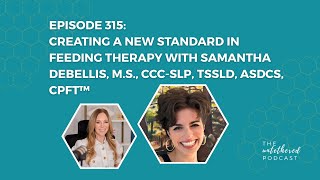
YouTube interview (Untethered Podcast Ep.315) in which host Hallie Bulkin interviews SLP Samy DeBellis about her path into pediatric feeding therapy, professional training (Feed the Peads, CPFT), mentorship, and clinical practice. The conversation highlights practical, low‑pressure strategies (comfort scale, food chaining, food helpers), rapport and play to engage children, challenges with parent carryover and family dynamics, the value of virtual hands‑on certification, and Samy’s recent move to Philadelphia. Closing includes contact/Instagram handles.
Chapters
Hi and welcome to episode 315 of the Untethered Podcast. Today we have Sami Develas joining us. Sami received her Bachelor of Science degree in Speech Language Pathology and Audiology with a double minor in Disability Studies and Fine Arts from Hofstra University on Long Island, New York. She earned a Master of Science Degree in Speech Language Pathology from Sacred Heart University in Bridgeport, Connecticut. She's a licensed SLP in the State of New York, holds a Certificate of Clinical Competence from asha, and holds a New York State Teacher of Students with Speech and Language Disabilities Professional Certificate. She has trained in Lingraphica and is a Certified Autism Spectrum Disorder Clinical Specialist Specialist. Through her academic, clinical and professional work, Sami has had the opportunity to work in a variety of settings including the home, daycare, preschool, elementary school, in an agency office, and currently works in a private practice. She has experience treating a variety of disorders and difficulties including articulation, phonology, receptive expressive language skills, social skills, pragmatics, and pediatric feeding disorders. She is trained in Feed the Peas and she just became a Certified Pediatric Feeding Therapist as well. Sammy developed a passion for maximizing independence, safety and communication as well as making mealtimes enjoyable for the whole family. When she's not working, you can find her on a cross country course at the Dance Studio and enjoying quality time with friends and family. Welcome to the Untethered Podcast. I am your host, Halle Balkan. I'm a certified myofunctional therapist, feeding specialist, podcaster, business owner and mentor. This podcast is all about getting your questions answered and collaborating with colleagues to bring you the most up to date information in the orofacial Myofunctional Therapy, Airway tether, Dural tissue and Pediatric Feeding Therapy space. If you're new here, I challenge you to keep an open mind and join my mission to spread this message far and wide. If you've been around since June 2019, thanks for being a loyal listener. As we jump into today's episode, remember to listen with correct coral rest posture, tongue up, lips closed, teeth apart, breathe through your nose. Let's get started. Quick Disclaimer all information, content and material of this podcast are the opinions of the speakers and is for the informational purpose only and not intended to serve as a substitute for the consultation, diagnosis and or medical treatment of a qualified healthcare provider. Sami, welcome to the podcast.
Thank you so much for having me. I'm so excited.
I'm excited too. So, all right, we're going to jump in and talk about all the things today, but before we do that, will you Start with telling us, like, about your journey. Like, what has your journey been into becoming a feeding therapist?
Yes, it has been a wonderful journey. I started out in 2020, in the peak of when I graduated from grad school. And I started immediately at an early intervention agency. And within that agency I was seeing a lot of kids, birth to three years old, who weren't speaking or had some communication delays. But then a few months in, I got a referral for a two year old who stopped eating. He saw his brother choke on an apple piece and then he just decided that he wasn't going to have anything crunchy. So my boss asked me, do you want this case? And I told her, I don't know anything about feeding. I wouldn't even know where to start. And I think that's a big issue with a lot of programs for graduate school these days, is that we don't really have a lot of exposure and knowledge coming out, going into the field about feeding therapy. So I told her, yes, but I will want need a lot of guidance because I don't really know what I'm doing. And she specializes in feeding. So she held my hands and was a great mentor. As I was working with this one child and the mother saw progress within a few months and was so happy. And it honestly felt like I was doing magic. Like I felt like this was a gift, that I was coming into people's homes and saying this is what I would do if I were you and modeling it. And then seeing kids start to become less tense and relax at the table and just enjoy food. So that is how I started. And then as I became more comfortable, my supervisor gave me more and more feeding referrals. So that started to become my thing. But the, the practice that I had was really with her, under her guidance. So I wanted to get some CEUs and reach out to other professionals and see what I could learn. And then I was on Facebook one day and I found Halle Vulcan Speed the Peeds. I thought, what is this? And I thought that it's an investment, but this is what I want to do. If this is really my path, then I'm going to get the best education possible. So I took feed the PEDs in 2021. So that was about a year later after starting with feeding referrals. And then after I took it, I remember going to the Facebook page, like right after you were done, and I said, when is this notification coming out? Because I just knew I learned so much. But I want like the top tier, like what's the Next step after being trained. So I heard about getting certified. And, Hallie, you were like, we're working on something in the works. And then a few years later, when I saw that you were only accepting a certain number of people and that, here's the application. Whenever you're ready. You can start now. I immediately jumped on it. I'm a certified pediatric feeding therapist now, and I'm just so happy. It's been a great journey. Yay.
I'm so excited for you. And it's so funny, too, because I do feel like there were a number of people who were like, okay, are you going to create a certification? You created a Maya one. Because all the people asked for a my. And honestly, like, in the Maya world, I was like, there's other certifications. I don't really need to create one. And people were like, no, we like how you teach creating a certification. And I was like, oh, my goodness. Okay. So I feel like having that under my belt for, like, a couple years before or kind of like, slash during creating this one. And, like, that was kind of our guinea pig, if you will, where we really. We actually, like, updated our cases multiple times in that one. And we. We do things a little bit differently over there than we do in the cpft. The CPF T, I will definitely say, is a much heavier, more involved, you know, process. But I also feel like pediatric feeding is a much more invol space than. Than myo. MYO is kind of, like, singular, whereas pediatric feeding is, like, multifactorial, if that makes sense.
Yes.
So I was just like, oh, man, this feels like a lot. A lot of work, but, okay, everybody really wants it, so let's. Let's see. Let's. And I remember having conversations with different individuals in the pediatric feeding space and just kind of trying to do some market research. Like, what do you think a certification should entail? Like, what do you, like, what kind of curriculum would you have them, you know, engage in for more intermediate to advanced? And it's funny, because the curriculum that we even, like, put together initially is not even the curriculum that we completely went forward with because we went back to you all, and we're like, what do you all want to learn more of? We can always add in what we think you need to know, too. But, like, we want to start with what you all are seeking. And I remember sending out, like, a survey and being like, what courses? You know, here's a suggestion. Here's what we have in mind. Now, what else do you guys want? And then I think we sent out a second one with all of them and we were like, now put them in order of importance to you. And that way we were like, okay, this is it. This is the order that we're going to seek professionals in our space who are like experts in their craft to basically come in and create these courses. This is the order of importance. And so, yeah, that's how the curriculum was kind of like born out of all of that and all of you asking us for a certification. But I was like, obviously a certification is not just intermediate to advanced coursework. That's just one component. It was like, we really. I was like, how do we take this hands on experience and take it virtually, right? Having you all work with cases, but giving you this mentorship even though we're not physically at your side. And it was so fascinating to me because I. People were telling me they spent like ten grand to go to some like in person, year long certification. You know, maybe not. It's not actually, it's not a certification. I think it's like a certificate program at some, at a university in New York and not calling anybody out. But they were like, I didn't, they were like, I really didn't get anything out of it. Like, I don't feel like it was that beneficial. And I was like, that, that's not what I want to hear. When people come out of this, they're making a huge investment in time financially, like in your career. I want y' all to come out feeling like, wow, I feel like I'm on top of the world right now. Like, I feel like I can really go out and like work with these cases. I could even mentor others if I want to because some of our graduates now, you know, of the CPMT are telling us that.
And I'm like, that's so cool. It is.
But I was like, this is obviously much bigger. And then it was so fascinating too, because what really kind of even shifted my perspective was one of my neighbors. He works for a company where they train nurses on virtual reality headsets. And they're wearing these VR headsets as if they're standing next to the patient, but they're in their kitchen or they're in their family room, right?
Yeah.
And I was like, okay, all right. I'm like, if this is where like emergency medicine is headed, I think that we can create this virtual cpft. We don't have to have like an in person component, but we can mirror certain things and make it like as hands on as possible, virtually. Okay, all right. We Got this.
Yeah. And honestly, it felt like it was in person when I was on the calls. That was the highlight of my week, being able to talk to my peers and talk about the different cases we have and how we would address certain things. It was. It was such a great time. And it's cool how with this certification, I saw both long term and short term results. The short term for me was using things like the comfort scale, shout out to Sasha. That was so helpful for kids to just take a deep breath and come to the table and communicating their thoughts and feelings about food in a way that was meaningful to them. And parents immediately were like, wow, now that I use this at home, there's a lot less breakdowns and frustration and more readiness to be at the table. So that right there, that short term, quick change was amazing. The long term for me, I feel like, was just word of mouth. Like, when parents were happy with what I was doing, they were spreading the word to people. And now there's this speech pathologist that works in a hospital down the road from us where she just refers to us all the time and says, oh, Sammy is a certified pediatric feeding specialist. Like, you should really talk to the speech language place. Call Melissa and ask for Sammy. And just hearing that is so. It's like an out of body experience to be like, wow, there are people who are asking for me by name. There was even somebody. I'm from Long Island. That's where I am right now. And there was somebody in Queensland who heard about us and was willing to travel here to speak to me and get my opinion. Like, it just. It is amazing. So out of body, but in the best way possible.
That's so cool. And all because you took Feed the Pete's. Because you're like, I want to invest in. And this is what I want to do. I want to invest in myself, I want to invest in my career. Like, I know I want to be. You know, I want to dive into pediatric feeding. And then finally CPFD came along for the first time. You dove into that.
Yeah.
And so what was. I mean, I know the answer, but I'm gonna ask you anyway so you can share with everybody else. Yes. What was your ultimate goal? Like, when. When we spoke, you know, almost. I don't know, not a year ago, but like last summer, right before this all started. Right.
Like, I think it was early August.
Or July.July, yeah.July 2024, when we spoke. What? Like, do you remember what your goal was? Like, what you wanted out of the cpft?
Oh, goodness. Okay. Don't. Okay. I. I think I do. I had a few goals. The one that comes to mind is I just wanted to feel confident. I wanted pretty much any case to be able to come to my office, and I would have a general idea of where I could go with this specific case. I do remember that. Am I anywhere close to what you're thinking of?
Yeah, No, I know that when we spoke, you were. I'm like, trying to. I had it written down, and I got away from it.
I'm like, where did he go? No, that's a big one.
Yeah, that. It's here. I'm like, there's just so many little pieces of the pile. I actually. Because we. We track. You know, we keep track of everything. So I have, like, your application, too. So I'm like, let me just pull that.
Whoa.
I have your application.
Oh, my gosh. A year ago, almost.
I know, I know, and I know. Okay, so you shared that one of your challenges. This is not the question, but I'm gonna tell you anyways. Was that just, like, difficulty with motivating your clients that you felt like a lot of your clients were like, I'm not eating today, or, no, thanks, I'm full.
Yep.
And it's been, like, hours since they ate. Yes.
Yeah.
Do you still have those kiddos saying that? And if you do, do you have a new strategy?
Yeah, of course. And I feel like that will almost never go away. Like, you're always going to encounter that one kid who's like, I'm not gonna eat today, or, I'd rather not. I get that a lot. And my quick turnaround where I just saw immediate progress was, that's okay. We're learning about food today. Just, like, not even putting that expectation to eat something. So I just changed it. Even before this certification, Halle. I would say things like, that's okay. You don't have to eat it, but you can go a bit better than that. Just go the next step and say, it's okay. We'll learn about food today. We are learning. Let's use our senses and learn about new food. Your choice. Do you want to learn about cheese or cucumbers? Your choice. And just always giving choices, making it highly motivated for them. I bring out my little paw patrols, and it's progress for me when I see a kid using the paw patrol to eat a new food. So whatever motivates them. But even just that simple phrase of we're learning about food today, it is just huge. Taking away that expectation of eating something and just Saying we're learning about it. And honestly, like, the odds of them now interacting with the food are a lot higher when you say that.
Yeah, well. And it's like you actually said at the very beginning of this episode, you feel like kids are more relaxed, right? Their nervous systems are kind of like, oh, okay, she's not gonna force me to do anything that feels scary or uncomfortable or maybe. Maybe there's a challenge coming, but, like, I can handle this, right? Like, this is. You know, and so I love that you remove that expectation, because basically what you're doing is allowing their nervous system to kind of recenter itself, and then they're way more available to do all kinds of challenging things. And what do you know? It's like, those are the sessions, right? Where these kids are like, I'm not touching that today. And then all of a sudden, like, 20 minutes later, they're, like, picking up food and bringing it to your mouth. And you're just sitting there quietly, like, celebrating in your head. You're like, I can't scream out loud, Holly.
The amount of times where I'll be working with a child and the mother is sitting behind the child, and let's just say he eats something that he's never eaten before. When I see that rise of. I want to scream. I just put hand up, like, don't. Do not say anything. No reaction, no reaction. Because positive pressure is still pressure nonetheless. So telling parents things like, good job. I'm so proud of you. Yay you for eating. I just. I tell them, I know you're excited. I know you just want to do a happy dance right now, but we're not going to do that right now. We're going to keep it low pressure. Positive pressure is pressuring. Yes. It's just keep it in. So funny. I love it. I love it. And then.
Okay. Another one of the challenges you had shared was that sometimes, like, parents were not always carrying over, which is a big struggle that I think when I spoke to many of you, that came up a lot. We're like, I'm having a hard time. Some people were like, I'm having a hard time counseling family families. Other people were like, I have a hard time having parents even carry over the success that we had in our session to the home setting, like, on a daily basis or some of the suggestions I'm giving. Do you feel like there's been any changes there?
There's been change, but I feel like it's still up to the parents, you know? Like, I feel the best thing that I've done is I write out the suggestions that I'm giving to my client and saying, okay, here are the things I'd like you to do. Here's the day at the top, and let's do a checklist. And the next time I see you, I'd love to go over the checklist with you and we can talk about what's working for you. Is this something that is helpful for you? Is it too challenging? Is it not realistic? I feel like having something tangible opens up conversation. It starts the dialogue between me and the parents. And what I mean by it's up to the parents as well is that I could give them this chart. I could try to open the dialogue. And parents, a lot of them are very receptive to it. Some other parents just, you know, say, oh, I didn't have time today. And then in that response, I would say, okay, well, what can work for you? I want to do something that works for both of us. And that usually helps. Just having that open dialogue and kind of putting some responsibility onto the client. I feel like that's been very helpful. And, hey, some clients just don't respond to it and may feel like it's not a great time for therapy right now, and that's okay. Like, feeding therapy, as I'm sure you know, is very involved for listeners out there, feeding therapy is very involved, and it requires a lot of carryover. And of course, it may not be realistic to sit down with the child most times a day, and that's okay. It really is what works best for the family.
Yeah, 100%. I love that. And going back really quick to, like, your goal. So you kind of shared a story about, like, why you signed up for Feed the Pete's, but then you said, like, your big professional, which we talked about, which your big professional goal is to help children and families who are experiencing stress around meal times and help them kind of just find joy in expanding, you know, food repertoires and just being able to take your knowledge to the next level and everything so that you can best, which I think you've said as well. So I'm pretty sure you nailed it. But I was like, let me just confirm. Yeah, it is.
Yeah. Yeah. And in continuation of that, I feel like another shout out to Shasha. I, like, feel. Feel that what is helpful with helping kids feel relaxed in addition to a comfort scale is also just being silly. I feel like I am very silly. And I experiment and I say, what do you think it would be like to have bread with a chip? It's smooth and it's crunchy, and I just. I'm very playful, and I feel like kids know when you're happy and invested. So when you're invested, when you're modeling that you're curious and you want to be brave and smell something and then talk about it, kids just feel motivated. Building rapport is so important because then kids look up to you. So when you're doing something really cool, they may want to do something really cool. So that's definitely been really helpful. If kids are having trouble bringing something to their mouth, can you fit it between your nose and your lips and curling your lip up to see if you can hold it? It's just fun. Like, making it fun is a really big thing.
I love that. I always used to say it's like feeding therapy or really just being a speech pathologist in general is like, standing on your head all day. Like, you have to be on. Like, you are on. And if you want to get those kids interested in you, like, you better be way more interesting than everything else in the room.
That's a great way to put it. Yes. That's what I do all day. And it's so fun. And it's.
It's fun. It's fine. Like, it's so fun. And people are like, isn't that exhausting? I'm like, well, some days are tiring, but other days, like, I would just come home, like, you know, after a full day of treating, and, like, I'm just completely, like, energized and lit up because I'm like, this is what I love doing. And it gives me so much energy. And, like, yes, I'm on all day, but also when I'm on with the kids, very different than being on with adults.
Like, yes. Oh, yeah. Definitely fun. Yeah. When they're into it, it just makes it so much better. Yeah, it's great.
I love that. And, you know, one of the things, too, that I learned, I feel like, very early on in my career, because, like you said earlier, we really don't learn anything about feeding in grad school. I think think there's, like, we can probably count on one, maybe two hands the number of graduate programs now that have pediatric feeding courses or even focuses to some degree in the United States of America. I've heard of a couple that maybe have, like, a feeding track or that are, like, actually have a pediatric feeding course, but they're rare. Not that there's a bazillion, you know, schools out there that. That do, you know, SLP graduate programs, but from those that do exist, it's. Yeah. Pediatric feeding is not. Not very commonly found. What I wanted to say though is. And what did I want to say? I'm totally losing my train of thought. Oh, early on.
Yep, there you go.
Here we go. Early on, I just remember and actually like this one kiddo I was working with, you know, just totally not interested in engaging with me at all. Was. He was autistic, very high functioning, like, but he just was like in his own kind of space. And I was a new therapist. I. They had transitioned an old one out, I was the new one. So he didn't really know me that well. And I kind of just like looked at what he was doing and I knew he was super into trains. And so I just got down on the floor and laid on my side and started to roll a train around on the floor, like paying absolutely no attention to him. And it just kind of piqued his interest, right. He was kind of like, oh, she's not forcing me to do anything. Like, she's playing with a toy. I like, maybe I will check this out. And like within minutes, like he came down to the floor and he started to do what I was doing. He started to spin the wheels on the train. And I was like, oh, I like your train. And you know, it's just like, kind of just. I always tell people it's such a dance. And I know Shasha says this, I know Nadine says this, and I'm sure Beth probably says it to some extent too, but it's like it's such a dance between art and science. Like, we have to have the science. Like, that's one of my favorite things I've always said too, because I'm just like, you gotta have the art side of it. You gotta know the dance. You gotta know how to do the dance with them and how to engage them and how to interact and kind of get them interested. And nobody really usually teaches. Like, I know Sasha teaches that, but most people don't teach that.
Yeah, yeah. It's so funny you're saying that, that because when you were telling this story, what I was thinking was, learn about his world. Like, what's he thinking about? What's he doing? So I would have done the same thing. He's playing with trains. Let's get on the floor and play with trains. I tell parents that sometimes feeding therapy may not start out with food. It may start out with building rapport. And if that means we're on the floor with trains for a few Sessions, you know, whatever it takes to get the kid comfortable and relaxed with you and engaged with you. Yeah. Rapport is. Is like, number one, 100.
I love that. And it. It's very interesting, too, because you'll see a lot of intakes that will ask, like, what is your child interested in? What are your child's favorite things? And it's. I see people asking, but I don't always see therapists using that information in a way that actually gets the child engaged. You know, it's sort of like, oh, we. We printed off a coloring sheet with Thomas the Train, or we printed off, you know, bluey or whatever. You know, whatever they're into these days. You know, we have some toys that they love and. But then I see people kind of, like, floundering. They're like, well, I had all their favorite things here. Why were they, like, they just weren't interested in any of it? Well, it's like, well, you came in anxious. They sense that energy on you.
Yeah.
You. You kind of had certain expectations about how you wanted the eval or you wanted this session to go. And as things unraveled and didn't go your way as a therapist, like, you became more anxious and more concerned about what the parent thought. I go in, right. Kind of like what you're saying. You're like, I go in zero expectations. My one goal is to get this kid to know that they can trust me, to know that they can. That I am never going to make them do something that doesn't feel good. I might challenge them, and it may not feel the best at first. Sometimes, like, there may be some things that don't feel super great, but I'm never going to force feed them. I'm never going to force them to do. Do something that feels dangerous and super scary. We're going to take calculated, you know, risks together that help us calculate our best guidelines that help us move towards our end goal. And they're gonna. I need them to trust me to do that. Right. And so it's like you said, we spend that time building rapport, building trust, making sure they know that, like, I am a safe place because I want them to want to come back. Like, if they don't want to come back, we got a problem.
Yeah. Yeah, I. I hear that the. The client I use for my final presentation, I was explaining in the presentation that he was seeing another feeding therapist before me, and the thought of going to feeding therapy for him, he would just start bottoming in the car. Like, just even the thought of going and when mom told me that, it broke my heart because I don't want kids to ever feel that way when they come see me. I mean, it's, it's kind of like a balance where I'm your friend, I'm also kind of a teacher, but I'm also your friend. Like we play. Yeah. It's that balance of having, you know, that authority. But it's also you're my friends and we're here to play and be explorers together. What are we exploring today? Yeah, just. Just that kind of thing. It's, it's really important to me that kids feel happy and excited to come.
Yeah.
Yeah.
Well, and I think you bring up a really good point because unfortunately we do receive probably a good number of kids who've had not so great feeding therapy experiences. It does happen more often than not, and it may not always be voiced as such from parents, but if, and I'm not saying that everybody out there does this, right? Like, there's hopefully a very small number of people, this is not a common, but there is like a feeding program that is, I won't say who they are exactly where they're located, but they're not far from where my practice is in the D.C. metro area. And they engage in forced feeding. And it's more of a hospital intensive type of program. And we have, because we go into the home, we've had kids who refuse to enter the kitchen who see that like, like you're saying like this kid was vomiting at the thought of go, you know, in the car on the way to feeding therapy. These kids see a chair or a high chair and they absolutely just melt down.
Right?
They absolutely refuse. And you're like, this kid doesn't even like being in this room of their house because of what food like. So I think a lot of. I'm sharing this because you shared your story and it made me think like we all kind of need to like take a step back and think about what past experiences has this child had before coming to us? Because it's not even just about building rapport with us, Right. It's also about understanding there may be some baggage here, there may be some history that it's not just our normal situation where we have to like get them to like us and want to play with us, but we also kind of have to undo sometimes where they're coming from and what pre existing beliefs exist even in these young children around their experiences surrounding food and surrounding people who are there to help them eat food. Right. And so the onus then falls on us. And sometimes parents don't even see this connection or realize this is happening. So we don't always have this information. And so that's why I always like to tell people, like, patient first, human first, right? Like, yeah, who is this kid? What are they showing up for today? Like, what are they available for in this moment? We're not going to know that until the beginning of every single session. Because every session is different, right? I mean, you obviously know this. I feel like we have very similar approach and strategies in that way. But I think as long as we remember that and we remember to like, look at the human first, I think it makes things so much easier because people are like, hallie, how do you connect so easily with these kids and with their families? And like, because I remember that while I have a certain goal that I would like to accomplish, that's not the end all, be all. Like, obviously that's the reason why the parent is here and they have a similar goal. But the kid, if they're not available for that today, like, it's not happening. And if I'm not providing a safe environment and space where they feel like they can be vulnerable and they can try new things and be adventurous, like you were saying, like, it's not happening. So I think that onus falls on us every single session with every single child to kind of just check in and be like, like, how are you today? Like, what's going, you know, not that a kid's gonna tell us, right? Depending on age, cognitive ability, who knows, but like, we kind of have to do that, that check in ourselves and kind of figure that out first before we just dive in.
And that's okay. It's. And I tell parents it is okay to take a step back and see how the child is doing. Because, hey, if they are a ball of nerves and in the corner, they had a bad day, sometimes sessions happen like that and we're not going to eat today, we're not going to explore, and that's okay. And that's part of rapport building and letting kids know that you see them and you hear them and it's okay to not necessarily jump right into goals. And I love how you put it that sometimes we need to undo what's been done. Because I feel that way about the child. I did the presentation on where he came in after vomiting at the thought of going back to that speech therapist. Yeah, he. I just, I had to put in the work to not only build rapport with him, but undo what happens. To change the way he looks at food and new experiences. And I'm just going back full circle to the cpfc. That taking that certification just, just amplified my skills as a clinician. The rapport I build, what I ask during assessments. I feel like sometimes I look back at the assessments I did before I took this course and I think, well, that just, I didn't ask the right questions. That's what happened. Maybe I could have asked something different. It was so helpful. I just saw such immediate results in how parents feel. The anxiety for parents too goes down and it's just, it's such a great thing. So I really want to make sure that the love for the CPFT is out there because it's, it has changed the way that I speak with clients. Like even going back to what I was saying about how, oh, we're learning about food today, like even just something as small as that just makes such a profound impact. So thank you. It's been great.
Well, I love that and I love all your shares and I think it's really helpful for people to hear that, you know, especially if they're considering jumping into the cpft because it's definitely a time and, and financial investment. And so, you know, I think you, you've shared a lot of very helpful info with us. And one of the last things that you said about the, the families too, like you mentioned, and I'm like such a good point. The children not just, you know, feeding off of like our energy and how we're presenting, but they often feed off of how the parent is presenting. So it also becomes our job, especially the parents in their room, to like, get them to, you know, kind of regulate their nervous system so the child can regulate theirs.
Yes, yes, we do. It's a big job. And, and I even tell parents sometimes, like, if you're not feeling great today, that's okay. Can you please wait in the waiting room? Like it's, and it's okay. Like sometimes parents are with me and it works. Or they're in, they're sitting next to me or they're engaged, what we're doing. But for other parents, it's a very high strung environment, you know, so, so when, when the cases are really challenging and it becomes a medical concern, weight gain concern, when it gets to that point and parents are feeling really like they're struggling and that they're desperate, sometimes it's challenging to even be in the room at that point. And I tell parents, I could call you after the session or we could have a standing appointment at 2 o' clock on Friday where we talk about sessions. Sometimes I get some consent from parents to take videos of what I'm doing, so that way they can see snippets of what's going on and I email it to them. So, yeah, just opening up the conversation for what works for the parents. Parents, because that's really what it's all about. We only see them for like twice a week, half hour or 45 minutes each, but they're the ones who are with their kids. So it's. It is really important to have parents involved, but at their level of comfort.
Yeah, I'm glad that you highlighted that because I think that people are probably are going like, ooh, light bulb moment. Maybe I can ask the parent not to sit in the room. And that's okay. And it's like, as long as the kid is okay without them, like, this could be really beneficial for everybody.
I.
And I will tell you, we've had situations where the parent is like, I can't be in the room. Right. And they'll. They know. And we've had situations too where it's like the child performs very differently depending on the parent that's bringing them that day. Like, we've had someone, some kids perform really well in front of dad, but not in front of mom and vice versa. And it's just so fascinating to see some of these things happen because. Because the kid also knows sometimes what they can get away with with one parent versus not another too. So very interesting to kind of observe the family interaction and dynamics and see like, okay, what's going to be most beneficial for this? K. I love, I love that you kind of highlighted that. All right, so before we wrap up, are there any, like, favorite strategies or things from CPFT that you, you are walking away with? Like, you know, I know you already kind of shared a couple things, but anything that comes to mind.
Oh, my gosh, Cheryl, the comfort scale, I just, I cannot get enough of it. I know that I mentioned it, but something I think is important about this, this scale is that you can make it with the client and you can use icons that are motivating for them. Some kids love emojis. Some kids love paw patrols or dinosaurs. And asking, what's your number for smelling a green food? That has been so helpful. Having a food log that I use and I say at the, at the beginning of each session, okay, we are introducing goldfish and crackers for today and then talking about what the child rated. Smelling the goldfish, licking the goldfish. And seeing that. So it's documented. It's just documented of what we did during that session. That's been super helpful. Food chaining. I remember at the beginning of the cpft, you asked us what our goals were, what we wanted out of this. And I remember I. I said what. What I truly felt. But I also picked what I knew would get me Shasha, because I wanted to learn so much from her. And I just wrote, I want to learn how to manipulate foods in the kitchen to help kids get more motivated to expand their food repertoire. And I'm so happy I was with Shasha because I have learned so much from her. And I'm sure that for as long as I'm with kids, I'm going to learn so much from her. So learning how to use certain tools like food scissors and a grater or even food barriers by. By putting food into a clear container and then can you kiss the container? So the kid is bringing new food closer to their mouth, but there's a barrier. So having that barrier, having food helpers. This is all from Shasha and the CPFT Food helpers. When a child is learning about a new food, but they're kind of anxious to interact with it. Well, how can we make this a better experience? What if we brought a preferred food, like goldfish, and we mash it up and then spread it on something new? Now, how do you feel about it? Can we try it this way? And things like that? All of these strategies from the CPFC have just amplified my experience as a feeding specialist. So those are my main takeaways. I. I could talk to you for another hour about what I'm taking away.
But I know you have kids to go treat, so we can't keep you all day.
Yeah.
Oh, my gosh.
Well, this is.
Yeah. This has been so amazing. Is there anything else that you want to share with us before we wrap up? I know we kind of. If we touched on a lot, but anything else?
Quick shout out. I am moving to the Philadelphia area, so if you're listening to this and you want to see where I am, I'll be in Philadelphia. I'm not sure if you're going to share that, Holly. Like my hands or anything, but yes. Yeah. If you want to reach out to me. I made an Instagram account at Sammy DeBellas and I work at the Speech Language place right now on Long Island.
So we'll tag both of those handles on Instagram so they can see where you're currently working, because it sounds like you also have an amazing mentor there. And then we will tag your personal account so they can find you and follow you and see where you're going to be next. So yay. Thank you Sammy so much for joining me today. This has been so much fun.
This has been so fun. Thank you.
Thanks for listening to this podcast. If you found value in this episode and want to hear hear more of these Myotots, Airway and Feeding related episodes. Be sure to leave a review on Apple Podcasts and share this episode on your social media platforms. You can access free resources and all I offer@halliebulcan.com or pop over to Hollybulcken on Instagram to get all the latest updates.
More from Hallie



What I Was Missing in Feeding Therapy: ARFID, Airway, and Myo with Samy Hernandez





