Episode 121: A Dentists Journey To Specializing In TMD And Airway with Dr. Ryan P. Robinson
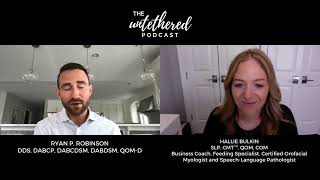
This is a transcript of Untethered podcast episode 121 (host Hallie Bulkin) featuring Dr. Ryan P. Robinson, a Delaware-based clinician triple-board certified in craniofacial pain and dental sleep medicine. The conversation traces Dr. Robinson’s shift from general dentistry to founding the Pain and Sleep Therapy Center focused on craniofacial pain (TMD), sleep-breathing disorders, and dentofacial orthopedics, emphasizing early pediatric intervention (infant frenectomies, ALF and other growth appliances), myofunctional therapy, multidisciplinary referral networks, practical screening/referral workflows, and public education (his book The Root Cause and an upcoming Pediatric Airway Symposium).
Chapters
Hi and welcome to episode 121 of the Untethered podcast. Today we have Dr. Ryan Robinson joining us. Dr. Robinson graduated from dental school and he couldn't wait to get back to the community in which he grew up. He was looking forward to helping people achieve their perfect smile. Little did he know that a few years later, his background in dentistry would give him the opportunity to look beyond the teeth to something that could have changed his patient's overall health the airway. Dr. Robinson is Delaware's first and only doctor, triple board certified in craniofacial pain and dental sleep medicine. After many years of treating the airway in his General Dental Practice, Dr. Robinson decided to open up a specialty practice to address the needs of the community. This practice, called the Pain and Sleep Therapy center, focuses on finding the origin of the problem as opposed to treating with medications and band aid fixes that have become so routine in Today's medical system. Dr. Robinson dedicates his time to treating craniofacial pain, including TMD and headaches, sleep breathing disorders, including snoring and sleep apnea, as well as dentofacial orthodontics, which focuses on proper development of the face and Airway. Dr. Robinson treats patients of all ages and states. It's extremely rewarding to help an adult enhance their quality of life by finding and treating the source of their issues. What's even more powerful is treating children and having the opportunity to cure their problems. He goes on to say, children are the most fun because with early intervention and therapy, we can help the child grow and develop properly, saving them a lifetime of issues that otherwise would not have been identified. We focus on identifying these issues at.
A young age so we don't ever.
Have to treat them as an adult. Dr. Robinson is a published author and is passionate about spreading the message of airway health through his book the Root Cause. Discover the why behind you'd TMJ and sleep issues. In his spare time, he enjoys spending time with his wife, Renee and their two children, Bryce and Reese. He also enjoys golfing, attending sporting events and traveling. Quick Disclaimer all information, content and material of this podcast are the opinions of the speakers and is for the informational purpose only and not intended to serve as a substitute for the consultation, diagnosis and or medical treatment of of a qualified healthcare provider. Welcome to the Untethered Podcast. I am your host Hallie Balkan. I'm a certified orofacial myologist, feeding specialist and mentor. This podcast is all about getting your questions answered and collaborating with colleagues to bring you the most up to date information in the orofacial myofunctional therapy, tethered oral tissue and airway space.
I challenge you to keep an open mind and join my mission to get.
This information out to the masses.
Let's get started. Ryan, thank you so much for joining me today. I'm excited to talk about all things TMD and airway and all the amazing things that you're doing out there.
Yeah, thanks for having me. Let me just first start by thanking you because I feel like in this field that we're in the airway space, even tmd, the tots world, and myofunctional therapy, there really isn't that many great resources for information for people to come and kind of learn about this stuff and become more aware. So I applaud you for what you're doing. It's incredible. I wish I had the time and energy that you have to kind of get this message out to the world. But I've been following you since you started and I think you have the world's greatest podcast. I listen to it all the time. And I just want to thank you for your contribution to the field because without this, I don't think half of us dentists are even looking at the things that we should be looking at. So thank you for everything you've done for us.
Well, thank you. It's been really fun and really amazing. I'm not sure how I found the time for it either, but I think it came to the point where I said, I just went to look for the podcast and it wasn't there. And I was like, oh man, this is totally my mo. I'm like, all right, well, we're just going to create it then. Let's do this thing. And it's really been amazing because I've gotten to meet so many professionals and individuals in this space that I never would have cross paths with, I think otherwise. And so it's really been a great connecting, you know, great networking and connections have, you know, and it's just, it's so fun and I love connecting families, especially with professionals and other professionals, with professionals. So it's really given me that opportunity to do that and really help families get the care that they need to. So even if it's not my team, you know, and me who are working with them directly. But anyway, so let's talk about you. So let's jump into your journey and you know, your journey into the TMD space and the airway world. You know, how do did that happen for you?
Well, I've learned through doing a couple of these podcasts that we don't really have time for at all. So I'll try and kind of hit the key points here. But, you know, like most, I'd say, you know, hungry, ambitious, you know, young dental professionals in the world. I graduated from dental school in 2011. I was indoctrinated with this information that I thought was, you know, Bible that I thought was the. Was the word of the Lord. And I came out just extremely hungry, ready to learn, ready to, you know, give people smiles, ready to, you know, change people's life through. Through helping out with their teeth and their oral health. And I came into the world, the dental world, really quickly. I bought a large dental practice in my. In my area where I grew up in, which is Delaware, which is actually a state. If you didn't know that it's the first state. People just know it as, like, the 20. 20 minutes that they pass on 95 to get to D.C. and Philadelphia, but it actually is a state, and you can stop and say hello, we have some good beaches down here as well. But anyway, so I came back to the town that I grew up in and bought a pretty big practice. There was a couple dentists there. I came in, I purchased it. It was a guy who was kind of considered one of the godfathers of our communities when it comes to dentistry. I learned a lot from him, from a. From the business aspect of things. But I kind of came in with my own ideas. I kind of came in with my own business acumen, my own business plan. I created what we now refer to as the wow Experience, where I just wanted to, like, literally every single patient that walked into the door, I wanted them to have a wow type of experience. So they went and told their friends and family, and we grew pretty fast, and we grew pretty significantly. And, you know, life was great. You know, my wife and I had been married for, I think, four or five, you know, six years at this point. A couple of years into dentistry, we got married in dental school. Actually. We're middle school sweethearts. If, uh, just wild. Um, so we. We got married early in dental school, and, you know, we were living a great life. I was making a ton of money. I was, you know, helping change people's lives. I was. I was this CE junkie. I was just traveling around, you know, the country on the weekends, like, learning everything I could. I wanted to be the best root canal specialist. I wanted to be the best implant, you know, dentist. I was doing orthodontics. I was doing, like, I was doing surgery, you know, third molars and stuff like that. There wasn't anything that I didn't touch, just because I was extremely excited to, you know, be able to do all these things. So. So that was all going all well and dandy. And, you know, I chose dentistry because of that, you know, cushy lifestyle and the ability to not deal with morbidity, mortality, the ability to have weekends and nights free and, you know, create this life that I wanted. That's the whole reason I became a dentist. No offense to dentistry, but I didn't really know if I would love it until I. Until I got into it. And then so the world kind of changed. And probably, as you know, when you have kids like that, like, I felt like I was just going a million miles an hour down the freeway, like, grabbing everything in sight that I possibly could and, you know, trying to do as much as I could. And then I had my first, you know, child, and in 2015, and, like, it was like the perfect storm of intervention in my life that I needed. And it was just like, whoa. Like, you know, now life had a little bit more of a meaning to it. I took my first airway course in 2015. This was four years after I graduated dental school. I didn't even know what an airway was. I just. I think the title was a big conference, and the title was like, add an additional million dollars to your practice. And I'm like, yeah, that sounds great. Cool. I'd like to add an additional million dollars to my practice. So I did this breakout session, and I'm like, holy mackerel. Like, everything that this guy was saying, I was like, wow, I've been looking at this stuff forever, and I've just been ignoring it. And I've just been thinking that it was a variation of normal. Like, it's what we were taught in dental school is like, hey, this stuff is just a variation of normal. This stuff is, you know, just something that's there and we don't know why. And so that kind of made me raise more awareness to, like, well, why? You know, and that's. We're going to talk about my book. I know, but that's the whole thing. Like, why, why, why, why, why, why? And so I've really never been the guy to kind of stay within the rule book and sort of, you know, just do what I was told. I was always the person who kind of challenged the norms and asked why? And said, well, why not? And, you know, how can I possibly do better than what's currently going on. I believe truly that if we bring an open mind to every situation that we come into, we're going to learn. And when we learn, we're going to do better. And, you know, quotes all over my office, all over the walls. And one of my favorites one is that Maya Angelou quote that says, you know, do the best you can until you know better. And then when you know better, you do better, right? So that's what kind of we do. So 2015 changed my life. My son was born. I took my first airway course. I came back with a full head of steam. My staff thought I was absolutely crazy. I had, like, five hygienists at that time. We were cranking. I had three doctors working for me. I mean, we were a big, huge operating practice making. Making a lot of money, treating a lot of patients. And I was like, pause, timeout. We need to start screening for the airway. And people are like, what the hell is that? And I'm like, here's what. Here's what this is, and here's what we need to do from from now on. So we just started screening and referring out for sleep studies and things like that. And. And organically, this just continued to grow. And as more people come back that were treated with CPAP successfully, I'm like, wow, we're really, well, like wives that were coming in and saying, you saved my husband's life, or the reverse, right? I got back in bed with my husband. I was the one who was snoring, right? And so it was just this wild sort of paradigm shift in my life that just made me get even hungrier and made me even be more devoted. And so fast forward a couple of years to 2018. And literally from 2015 to 2018, I went on this. This intense, you know, while we had our first, you know, son. And then in 2017, we had our daughter, Reese. And so throughout that time, I was just burning and churning on ce. I put everything else aside. I didn't want to do another root canal. I didn't want to place another implant. I just wanted to learn about the airway. And in doing so, I learned about, you know, craniofacial pain and that type of thing. And so 2018 comes, and I'm literally sitting for three board exams. American Board of Craniofacial Pain. American Board of Dental Sleep Medicine. American Board of Craniofacial Dental Sleep Medicine. And so, like, you know, these are the highest kind of distinct, distinguishing, you know, boards that kind of govern, you know, people like me who do what I do. And so 2018, I got triple boarded all in one year. It was wild, insane. So at that point, I had been treating the airway for a while. And, you know, it started, you know, with just treating sleep appliances with CPAP failures and things like that. And then it got it more into like, oh, we can be like the first step for these patients. We can be someone who does a comprehensive evaluation. And not everybody needs a cpap. Not everybody needs their tonsils and adenoids out. Not everybody needs an oral appliance. Like, how do we figure out a system, a, you know, an operation that we can, you know, be the first line of defense, that we can have our general dental practices screened for this stuff, be able to refer it to me and my team, my airway team, to do a comprehensive workup and then figure out what that patient needs. So, you know, this has come a long way. So in 2018, I'm like, you know what? We've grown out of this umbrella, this general dental practice. I need to create my own center. I need to create a center that's dedicated to, you know, tmd, airway, myofunctional therapy, that, that type of thing. So in 2019, after we built a brand new office, 5,800 square feet office, you know, with 11 ops and no dentistry whatsoever taking place inside those doors, just limited to TMD and sleep, here we are like, you know, two years later, we made it through Covid and I have the most amazing team in the world. I have two myofunctional therapists that work with me full time. I have Dr. Joanna Green, who I know you've interviewed previously. And she's kind of, you know, come. I joke with her all the time. I'm like, I've infiltrated your mind and now you can't not see. Because you know what Frank Spear says? He says you can only, you know, treat what you can see, and you can only see what you what, you know. So once I kind of drug her into the airway world with me, like now she's like the queen of tots. She's like the frenectomy specialist. She does early intervention growth appliances. She does comprehensive orthodontics. Now both of my kids are in active myofunctional therapy with Lauren, our myofunctional therapist. They're both in ALF appliances with Dr. Green. So we always, we joke with the kids. They have alf, we got an ALF in their mouth. So that's what we say at Our practice. But, yeah, it's become. It's become a whole. A whole lifestyle for me. And I don't do dentistry anymore. I don't do any of the things that I learned in dental school, which is just wild because I felt like, you know, anything that I do now is, like, not what I learned in dental school. Like, everything was like a. Was a paradigm shift for me, and everything was a challenge to what I had previously learned. So that's sort of a long story, sort of short, shortened a little bit. So that's where we're at. We've created the Pain and Sleep Therapy center in Newark, Delaware. We consider it a very comprehensive center for any. Anybody who's struggling with, you know, head pain, anybody who's struggling with, you know, sleep issues, anybody who's struggling with breathing issues. Like, we really have created quite a team. And, you know, we'll get into this. Not just our team, but we've created quite a network in our. In our. In our area. And without the network, you know, affiliated providers that I refer to on a daily basis, like, I would. I wouldn't even be a quarter as successful as I am today. So, you know, I owe a lot of what I do to my team. I owe even more to my mentors that have helped me kind of grow into this and really become passionate about this and really look to change people's lives. And, you know, it got. It went from you know, treating the adults to, you know, now we have a heavy focus on the kids, which is just even more amazing. And, you know, my wife has her own journey. My kids have their journey. And, you know, I'm just here to kind of facilitate this and make sure that people get the help that they need.
That's amazing. I love it. And I know we chatted a little bit beforehand, and we have very parallel lives just in terms of our kids age and their journeys, their health and all that fun stuff. And so, you know, like, Lily had gone through her ALF appliance, Myo tots, release, and Mia, we're looking at her because she's got a little bit of summertime asthma that seems to come and go. But, you know, I'm looking at this and going, there's other things that are telling me that we may need to do some early expansion with her as well. And I just. I love early intervention. And it's funny because you mentioned that where you started is absolutely not where you are now. You're not doing the same thing that you're doing when you. When you graduated and When I graduated in 2009 from grad school, I was working with preschoolers doing speech and language. And then I went into early intervention and I was doing more feeding and I did some feeding in the schools but it was not allowed. And you know, when I went into early intervention, I got to start to do a little bit of that. But at that point I was burnt out and I was like, I'm out of here. I'm going to work in private practice. Took about eight months off, went to work for a private practice for a year before opening my own. And it was just, it's been a complete 180. I mean we went from, I was specializing in working with kids with autism and I was going, you know, these kids have these patterns about the foods that they will eat and that they won't eat. And I was very fascinated about it. I really wanted to dive deeper into like the gut brain connection and the root cause behind some of these things that we were seeing. And that really further led me down my path to just becoming a pediatric feeding specialist. And so with that I felt like I was already doing some of the myofunctional things. I just didn't have a name for it. It wasn't taught in grad school. I was looking at these things and going, how can we help these children? And that missing piece was truly understanding that we need to add a little bit into the mix of pediatric feeding. When we're talking about a child usually under the age of four, it's usually more of a pediatric feeding approach. I call it with a twist of myo. And once you're at the cognitive level, a four year old will do a more traditional MYO program. And those are obviously not hard numbers, but an SLP and trained in this space knows what they can do with what patient. It was very fascinating. I went, took my mile course, my, my eyes were on and I was like, oh no, I have to go back now and assess like those eight kids. I'm not even going to charge the families. I'm just going to go, just going to offer an assessment and I'm telling you, it completely changed my treatment protocol. Everything I was doing with those children changed. I had kids, I had a child who went for a emergency tonsillectomy, snoring. You know, her ahis, her snore was worse than middle aged overweight men. I mean it was, it's incredible, Incredible what is being missed in these early populations. And some especially, I always preach this to early interventionists who go into preschools if you can go pop in once in a while and listen to these kids while they're sleeping during nap time, if they're a kid who's there all day, you are going to very quickly identify children who you may not be treating immediately, but you sure as heck better be referring them out for a sleep study or to somebody who can look at their airway. Because I would walk in and go, does that child always sound like that or are they sick right now? And they say, oh, no, she always sounds like that. And I was like, oh. I went to the director and I said, look, I know I might be overstepping here, but I'm really concerned about this child's health. And that led to. This happened in many instances, but there's so many different ways that we can get to helping these children and these families if we know how. And so I'm really excited every time I speak to somebody who gets it. Because, you know, the early intervention is so critical. It's critical to their brain development. It's critical to their functioning in school and classrooms. It goes beyond just, like, how well they sleep at night and if they wet the bed or not, which are all very important things, but it really impacts their daily function. And, you know, anyway, so I'll. I'll stop talking and turn it back over to you.
But.
But yeah, so you, I know you, you've built this amazing network. You have this multi, multidisciplinary treatment approach, and you're getting amazing patient outcomes. How are you. How early, I guess would be the best question. How early are you all working with these patients in your practice?
Yeah, that's a great question.
And let me just first start by saying I think that's a fantastic idea, what you just mentioned. I'm going to steal that from you about, like, having, like, going into the daycares and having, like, the preschool teachers screening or something. Screening, like during nap time. Right. I mean, that's genius. And I've never thought of that. I, like, I feel like I need to now go around to my community and spread that information. Thank you for that. I already pulled out that pearl and that's going to. There's going to be an initiative next week for that, I can promise you that.
So, yeah, I mean, you know, in.
Our practice, we like to consider ourselves, you know, from womb to tomb is what we say.
We honestly, we've grown this really awesome network of providers. And so we're working with, you know.
IBCLCs who have these programs where they start getting intervention into life.
In the womb.
Like, so they're working with mothers who are just learning that they're pregnant.
They're just learning that they're going to.
Have a child, and they're wondering what's next. And so we have these IBCLCs in our community who kind of walk through what to expect and what good nutrition looks like and what good sleep looks like. I mean, all the latest research that we're seeing is telling us that, you know, sleep disorder, breathing and lack of craniofacial development and tongue ties and all the, all these things that happen. This happens. This happens before birth. I mean, this happens, you know, and if the mother has a problem, then more than likely the baby's going to have a problem.
So, you know, we're starting early, early, early, early, early. And so we've created an infant frenectomy program where we sort of are the.
Wide receivers of the IBCLCs. They kind of do an evaluation once the baby's born, do a feeding evaluation and look for any structural physical limitations, meaning ties and things like that. And then once they find them, they.
Send it over to Dr. Green and.
I to assess and figure out if this is something that needs a revision or release or some sort of surgical.
Intervention or if it's something that we.
Just need to work with body work or something that we just need to work more closely with. Function. Right, because it's not all about appearance. It's. It's about parents and function and, you.
Know, the whole, the whole assessment here.
And the whole team assessment. So we get involved with babies like, you know, from two days, two days, you know, after birth.
I mean, we have lactate, just regular.
LC's from the hospitals who refer to us directly. Right. From the hospital. And then we find them, find them a feeding and lactation home and we go from there. We use it.
We use a really team approach.
So, yeah, we treat the babies and then like we're.
Are.
The gap that we had for the longest time was like we treated the babies and then I've been treating the adults, you know, for a really long time. And we didn't have that intermediary, you know, piece of our practice. And so I wanted to do it, but I'm really busy with the adult part. You know, I work all five days a week. I work Monday through Friday, and I'm extremely busy putting out all the fires that walk into my practice.
I'm the only one in my, in.
My whole entire area that does anything with craniofacial pain, anything with TMD so I get a ton of general dental referrals. And you know, sort of the secret behind a lot of that is a lot of these patients that are walking in with craniofacial pain and tmd, they actually have an underlying sleep breathing disorder. And we find that, and it's something that was going, that has gone unnoticed. So then when you start, you know, getting patients head pain control, you start getting them breathing, sleeping better, you know, the next question always is, well, what about my kids?
How do we prevent them from turning into me? And I say, you know, that's the question I asked myself when I started doing this, when I had kids as well. It's like, well, how, you know, my wife, we can talk about this. But my wife went through an expansion. She went through, she went through a two jaw surgery, you know, out in California. She's going through my functional therapy. She's going through the whole gamut of things. You know, I wear an up, I wear an orthotic at nighttime to sleep, I wear nasal cones to sleep. I take my mouth shut every single night. It's like, well, how do we, how do we prevent our kids from turning into that? Well, we're missing this piece of our practice where the kids are, you know, anywhere from 1 to, you know, say 6, 7 years old when we start doing early orthodontics. And so that piece of the practice has really evolved quite significantly, significantly over the last couple of years. That's where the myofunctional piece comes into play. That's where the comprehensive exam comes into play. And we figure out, you know, does this, does this, this child need to see an ent? Do they need to see body worker? Do they need to have nutrition counseling? Do they need to get a growth appliance? Do they need myofunctional therapy? Do they, do they need a release, you know, with, you know, some of.
Their oral structures that are, that are limited.
So yeah, I mean it's grown, it's grown significantly from womb to tomb is what we, is what kind of we, we, we say at this point and there's no patient that we can't point. So when you say early intervention, like my two and a half year old got an ALF appliance, right? My daughter Reese, when she was the youngest patient in our practice to get an ALF appliance and it was wild because I don't know if you have any of these anecdotes from your practice, but the first night we put. And here's the thing that's really Crazy. And I know you can relate to this. We always thought my son was the bad sleeper. We always thought my daughter was the good sleeper, right? My son gets up at 6 in the morning, every single morning. And he's the one who kind of fights to go to bed. And we're like, man, he's not getting enough sleep. And once we started learning more about this and we started walking in, watching him sleep, he kind of sleeps like a mummy, right? He sleeps on his back. His sheets are in the same place they were when we put them to bed. He's getting that nine, ten hours of sleep and that's what he needs. And he's fully functioning the next day. Whereas my daughter will go down at 8 o' clock and she's literally sleeping till 8 o' clock the next day. We're like waking her up. But you know, you go in there, the hair's disheveled, the pillows are all over the place. I mean, we went in there one time, I remember she was sleeping on the floor. Like she wasn't even sleeping in her bed. She's sleeping on the floor. Like her head's down by where her feet is, her blankets are through. I'm like, that is, that's interrupted sleep. This is dysfunctional sleep. Like, no Wonder she needs 12 hours of sleep. I mean, that's not a secret. So when we started kind of going in and watching our kids sleep, and this is what we tell our parents to do when we do, you know, our consultation is take three videos, you know, go in at 10:00 o', clock, take a video, go in at 12:00', clock, take a video, Go in at 3:00', clock, take a, take a two minute video. And then we want to see what those look like. We want to look, we're looking for lip closure, we're looking for restful sleep, we're looking for inaudible breathing. We don't want to hear the kid breathing. You know, we're looking for peaceful sleep. We're looking for, you know, deep delta wave sleep and REM sleep that's going to, you know, be responsible for all that cognitive development and all those neural pathways that are being formed at such a young age. I mean, that's the time where you want to get involved in these kids. So we put an appliance, we put the ALF appliance into my daughter's mouth. I'm not joking, I'm not joking with you. And we, my, my son got his and my daughter got theirs on the same exact day. Dr. Green put them in the same exact day. My son slept longer, my daughter slept less. It was like crazy. It was like both paradigms sort of changed and they completely, you know, it was just wild because we went in there and like, my daughter's sleeping in the same position and she wasn't waking up with like, you know, grogginess. And so since then, I mean, my daughter's been in an appliance, the ALF appliance now for, you know, she's going to be four, this at the end of the summer. So she's been in the appliance for about a year, which is amazing. My son's been in his appliance for a year as well, and he'll be six. So it's like, you know, that early intervention type stuff, we don't, we don't really put an age on it. It's like, when does the kid need help? And even if we're just doing a little bit of nutrition counseling, even if we're just doing a little bit of myofunctional therapy off the bat, like some breathing retraining and things like that, like, it helps, you know, it helps a ton. Like, my, one of my best friends was in last week for his son, who's 5, his consultation, and we literally got him off. We told him, hey, let's do a two week trial without dairy and let's also, you know, get him to use, you know, flonase sensimist. And he's like, dude, you wouldn't believe it. Like Evan is now, he didn't get up once last night and he went in there and he's like breathing through his nose. And like, so just like little changes like that can make such a big difference. And I mean that, like, to your point, you know, with your daughter, like, when we do a comprehensive evaluation and we're taking 3D imaging and things like that, we're able to measure the cranial bones, we're able to measure the palate, and we're able to see, okay, maybe they're sleeping well. But do they still need intervention? Do they still need growth appliance? Do they still need myofunctional therapy to get the tongue up to the roof of the mouth and get that development to happen. And so there's never too early of an age, I guess would be my answer to that. And that's a long way to say whenever.
Whenever the child shows signs, like they.
Don'T even have to have symptoms. Whenever the child shows a sign and we feel like we can intervene, that's when we do it. And for a lot of these patients, we know these treatment plans are going to take 10 years. We're going to be with them through the kids whole entire development. And it's our goal to prevent them from ever having to come see me when they get older. You know, we don't want them to turn into me. We don't want them to turn into my wife. The sick people that I deal with every day, I'm dealing with sick, you know, and Dr. Joanne is now is preventing sickness. So we have. We've created quite a team, and it's just so empowering to talk about, and.
I'm so proud of what we've been able to do.
Yeah. And for anybody who's maybe new to the podcast, I'm the same way. You know, I had traditional orthodontia. I had that rapid palatal expander. I had braces. And then after that, they put me into a permanent upper and lower lingual bar, and they said, oh, this will fall out by the time you're 20. I think I was 13 when they put them in. Okay. At 30, I finally was like, can somebody please take these things out of my mouth? It is really hard to keep that area clean. And I. You know, I was going for extra cleanings because of the plaque buildup beneath the bar behind my lower teeth. And so anyways, fast forward. They took it off. My teeth started shifting on the bottom, and I was like, what's going on? Come on. Like, these things have been in for 17 years. This is not cool. So finally, at the age of whatever I was in my early 30s, I went and was like, all right, something's up. And this was also after I had taken my MYO course, I knew I was tongue tied. And so after I had my second daughter, I had my tongue tie revised. And from there, I was like, all right, I know I need an appliance. So I went through two years of DNA, and I'm about to finish up one year of Invisalign. And the Invisalign is really just cosmetic because I'm vain. So I was like, please, please fix those teeth that were beautifully straight before. I know my palate wasn't beautiful, but I know my teeth were at least straight. So. But it's amazing. It's amazing to have space for my tongue now. It's amazing to, you know, I definitely. I need a septoplasty. I'm not done. I still have other things to do along. Along my journey to really maximize my airway. But Looking at my images and especially looking at Lily's, my five year old, almost six year old, she. It's incredible to see how much her palate grew in the course of a year. And I really think, you know, we say this with early intervention just in general. The sooner you get in, the faster things start to improve. Right. So it's much easier to get in and work with a pliable toddler or, you know, elementary age child versus waiting till the traditional, like, hey, we got to wait till all the permanent teeth come in or an adult like myself. I mean, not as easy. And definitely it's more complex. There's more interventions needed, it takes longer. It's. Yeah. I mean, for me, Even with my DNA viva suppliance, about 50 waivers, 50% of the way through, about a year in, I was getting body work, but I noticed that when I would, I had to increase the frequency of the. I was going to work with a PT who does manual counter strain and is pri trained and you know, and he is just phenomenal. And I noticed that I had to go to him in order to crank my appliance because my bones, they were nothing wanted to move anymore. It was like, okay, you've hit a wall where, you know, traditional person might have said, oh, we're done. And I said, you know, my team was like, no, no, no, you're not done. We just have to make sure that we prime the environment so that you can continue to grow that palate in the way that needs to be grown. And so I'm very thankful for my team. And it's really very cool to have that type of network and just that team who fully, holistically comes together, looks at the individual patient cases. Okay, here's where we're at, here's where we're trying to go, and here are the different options to get there. And those options often decrease as you get older. So it's nice to have options with younger kids.
Yeah, yeah. I think what you're describing there is your pathway to health. Right. So. So, I mean, I think I've learned.
This and like, you know, I use the ALF appliance in our practice.
I use the vivos DNA appliance in our practice. We use the homeoblock in our practice. We use, you know, normal sleep appliances in our practice. You know, I use orthotics in our practice. We use a lot of different, you.
Know, selections, variants of, you know, things that we put in people's mouths to.
Help, you know, get to the, to the end goal. I mean, and there's a million ways to do it.
But I think what you and I.
Have learned through doing this for so long is the body needs to be ready for it and the body needs to facilitate what's about to happen.
So we're kind of fools if we.
Think we just put something in there and it's just going to change everything. Just with a twist or just having it in there. And that's just not how the body works. The body is just so much more, you know, intricate than that. And everything's connected. And that's what we've learned. It's like we've learned this from so many different people. And I've, and I've, you know, I.
Think it's a great point to bring up.
Like, I've learned from the best, right? I've been personally trained by Dr. Zaki. I've been personally trained by Barry Raphael. I've been personally, personally trained by, you know, Suruzaghi, by Daniel Klauer, by Kevin Boyd. I mean, all these, By James Bronson, all these people that I've. I've been. That I. Personal connections with that I text on a daily basis.
You know, there's not one day that.
Goes by that I don't text one of those guys or I don't text.
You know, some of my people that.
I've learned from and just say, hey, in this situation, what do you think? You know, we just. We collaborate, we collaborate, we collaborate.
And I've. I've learned that I'm never going to.
Fall in one person's camp.
I'm never going to put an ALF appliance in every single person's mouth. I'm never going to do a Vivos DNA appliance. I'm never going to refer out to Dr. Mariana Evans for rapid palatal expansion with TADS involved for every single, like, every.
Like.
That's my job. My job is to do a comprehensive evaluation, pull out all the factors, find the root cause, identify what the origin of the problems are, and then listen to the patient. Like, what are the patient's chief complaints? You know, if the patient just wants to get back into bed because they're snoring, you know, I'm probably not going to push them into TAD. Rapid palatal expansion with Dr. Evans, which is going to take 24 months. You know, I'm probably not going to push a DNA appliance on them. I like to meet up my patients with where they're at. And that's why when I see a patient, I want to create pathways to health. And I want to say, here is one way you can do it, here is another way, here is this way. But I want to let you know that if you choose this way, it involves a lot of sacrifice, it involves a big commitment, it involves an open mind. It involves you challenging a lot of the things that perhaps maybe your physicians are telling you, you know, and not to discredit any of the physicians. A lot of them have come a long way. I gave a lecture last week to the American College of Lifestyle Medicine and have you know that they may consider adding a six pillar. I don't know if you know about the aclm, the American College of Lifestyle Medicine, but it's these. These physicians that basically believe in lifestyle change, and they believe that lifestyle change is the best way to treat. They're not with the magic pills and you know, just treating with pharmacology. They. They sort of take more of an active approach and get involved with nutrition, exercise, sleep, stress management, all that. Well, they have five pillars of. They have five pillars of health is.
What they call it.
And so they had me come and speak to the board, and they're now considering making breathing the sixth pillar of which would be.
That should be pillar number one.
Yeah. Which would be incredible. And like, so there's a guy named Howard Jacobson. He interviewed me last August on his podcast called Plant Yourself. And he is like, I would have said that nutrition was number one pillar of success. And he's a big ACLM guy. He's like, I truly believe after. And he drove from North Carolina to.
Have an evaluation by me.
And, you know what my treatment plan was is expansion and myofunctional therapy. And he's like, oh, my gosh. So he's in this process of changing his whole breathing and structure and function and all that stuff. But he then did a podcast on me and he's like, I truly believe that breathing is the number one thing in the world and is the most overlooked, undiagnosed, underrepresented, whole, entire function in the entire world. And so we had hours of conversation and debate, and he wanted to learn all about it. And I think from there, that kind of spurred the board members of ACLM to come interview me. And now I'm working hard to try and get people like me and you to do more presentations, because if we can collaborate with those guys, everyone can find an ACLM trained physician in their community. Like, imagine how many more patients we're going to help. Yeah, it's going to be incredible. So we need to continue to bridge these gaps. We need to continue to, you know, go do things that are uncomfortable for us. And like, we can't just be in our little siloed approaches. And so that's why you and I are talking this morning, right? So we can give more people the platform to say, hey, what I'm thinking is normal. And what I'm thinking may be looked. I may be looked at as the black sheep in my community. But. But guess what? You know, like, what's the saying? You know, first they ignore you, then they fight you, then they listen, then you win. Right? So, you know, we got to go through those stages, and it's not going to be easy, but we're knocking down the barriers. We're building, you know, networks, we're connecting bridges, and this field of medicine is just going to get bigger and better and more people are going to get helped. And it's because of people like you. So.
And yourself, and yourself and your book. Let's talk about your book. I mean, so I think that's a phenomenal resource, right? So you've got your book the Root Cause, Discover the why behind you'd TMD and sleep issue. So I love that you've put this in writing. And I know there have been more books, I think, that have come out over the past couple years that really help to build up this space, but I haven't really. I don't know if I've seen one about TMD and sleep issues, per se. So tell us about it.
Yeah. So Covid happened, right?
Right.
Covid was. Was 2015, I believe, was the. Is the most impactful year of my life.
Right.
That's when things completely changed. Besides that, Covid was the best thing that ever happened to me. I mean, I was again, I was kind of in this zone where I was just going a million miles an hour, like, treating as many patients as I could. And Covid hit and I ended up in my office with my kids screaming in the. In the next room, you know, to play with them. And it was March, and I'm like, what in the heck am I going to do with my time here? We closed the office for a month and I'm like, you know what this is? I had to take inventory of my whole entire life. I took inventory of my family, of my profession, of all the people that I thought were impactful in my life. And it was a good time to just sit down and reflect. Like, you never get, you know, you know it. You have the same age, kids as Me, like, when do you and I get a chance to reflect? So we don't have much reflection time. So it gave me a time to just kind of get away and reflect on like, where do we need to go? Like, okay, I've had a lot of success, but I've had success. How do I get more people to have success? How do we create a social movement?
Right?
I mean, I have, we need to create a social movement. Physicians don't change, providers don't change, educational institutions don't change without social movements. And we've seen this across all other spaces. If we don't create awareness in the public, in the public's eye, then we're never going to get the, we're never going to get the changes that you and I want to see. So, you know, for me it's like, okay, I created a new company called Integrated Airways, right? So that's, that's my consulting company. I do like, business mentorship for dentists who want to be, you know, more like me. I do CE and stuff. So I created this 10 part CE series during COVID where I basically had, you know, I spoke, I'm on pediatric airways. You can find all this stuff on my YouTube page and on integrativeairways.com and I created a 10 part series where I just wanted to educate, educate, educate, educate, you know, for providers, for the public, for all that stuff. And so I realized, you know, I'm pretty good at telling stories and I'm pretty good at like, you know, taking the patients that I've been able to treat and giving them a platform so that other people can relate to them. And that's what it's all about. Like, everybody wants to find a patient that they can relate to because, because without that, I don't think we, you know, you get the buy in. You want to find someone who's like you, right? You can look at all these people and say, well, that's, you know, he's overweight or he doesn't do this or you know, all these excuses in the whole entire world, right? But you want to find someone who's relatable to you. So I said, why don't I create a book that kind of goes over my wife's case, goes over my kid's case, goes over my journey and then pull out, you know, 10 cases that I've been able to do over the last five years and just put their story, you know, in a book and like let people relate to it. I tried to pick different patients that I felt like, all dealt with different things. You know, a trigeminal neuralgia case, you know, a case, a ton of patients come to me. The majority of my practice that I see is TMD related. And, you know, the people are coming in with head pain and they just want to get rid of their headaches or jaw pain, and they just want to be able to open wide enough to eat a burger, right? Just like simple things like that. That then when we dive into it and we go into the root cause and we ask why, and then when we know the answer to why, then we ask why. And then we know the answer that why? We just keep asking why, why, why, why, why? Until we get to the root of the problem. And like one of my other mentors, Jamison Spencer, who's like the TMD and airway sleep apnea guy, and I've learned a lot from him. He kind of taught me, you know, the mystery is in the history. And if you don't take a good history, then you can't figure out what's going on with that patient and you can't figure out how to help them. And so when I was in the general dental practice, I had a really tough time going from prepping a crown, doing five hygiene checks, taking off my loops, and then being able to talk to someone about their sleep. I had a really, really hard time wearing that hat. And that's when I was like, you know what? I can't. I got to dedicate myself to TMD and sleep only. So, you know, the book is about telling people stories. That's really all it's about. I mean, I would love to say that it's as powerful as, like the James Nestor book. No, I mean, that guy is born to write, right? I mean, that book, like, literally changed my life. And I already knew about all this stuff. Like, he, like, what an unbelievable mission that guy went on and what an unbelievable story. And I think I have patients that walk in my office every day. Like, they're literally clutching that book like it's the Bible. And they're like, I came to see you because of this book. And I'm like, that's fantastic. So we need more of these, you know, documentaries. And I'll hook you up with it with a couple of these guys. But a couple of my buddies in California are working on a NETFLIX documentary, and that's kind of behind the scenes type of thing. But I'm being interviewed. Clower's being interviewed, almost is being interviewed. Zaghi's being interviewed. The Lipskisses are being interviewed. Kevin Boyd. I mean, all these people, like in MySpace, are all being interviewed. And we're gonna have this, hopefully this documentary that's premiered on Netflix. And the goal is to create a social movement where moms start going into their pediatricians and asking questions and demanding answers, and people start looking for the why behind their problems. And looking for. Instead of just surviving, that's another little key thing that let's not just survive, let's thrive, right? Let's take people who are sick and create health. So these are all things that I'm just trying to do my part to just share with the world. Hey, here's 10 cases. Can you relate to any of them? And I find that I've tried to pick young patients, old patients in the middle, pain patients, airway patients, all that stuff, and just try and have more people relate to someone in the book. And when you relate to someone in the book, you then go give my book to somebody else and say, hey, you need to read this. Chapter six is about you. I literally read chapter six and I thought about you. And so, you know, read this book and then go see this guy, and he's going to. He might not be able to fix you, but he's for darn sure going to find someone who can fix you. And that's what happens with me. You know, we welcome, you know, 60 to 75 new patients to my office per month. And, like, you know, I'd say 40 of them get treated in my office. The other 20, 30 of them, like, well, I'm sending somewhere else. I'm sending to Joanna. I'm sending to Lauren for myofunctional therapy. I'm sending to Mariana Evans. I'm sending to ENT. Like, I'm sending to. I'm sending out for CPAPs every day. You know, CPAPs can work, and they are helpful for people. So, yeah, the book is about telling stories, and it is special to me because I got a chance to open up about my journey. And, you know, importantly for me, my wife and my kids, who mean the world to me. And Covid gave me a chance to take inventory on my family. And that's when I got my family into treatment. And, you know, the proof is in the pudding, right? Like, if you don't live this stuff, I got a septoplasty, right? I fix my nose. And so when you talk about the root cause, like, here's a quick little side story. I go in to get my teeth clean in one of our general practices. My hygienist who's been cleaning my teeth for the last six, seven years. She's like, hey, have I told you that you're grinding your teeth? I'm like, what the heck are you talking about?
I don't grind my teeth.
I'm the sleep guy. I'm the TMD guy. What are you talking about? No, no, I don't have any pain. She's like, well, your joint pops. I'm like, yeah, I know. It's been like that forever. It's probably the result of my orthodontist back in the day, right? Pushing every. Distalizing everything and pushing, you know, my condyle back so far that I now have a disc displacement, whatever. That's just orthodontics, you know, general orthodontics in general. But, you know, so I'm like, no, no, no possible way. She's like, no, I'm going to show you pictures. She took pictures. And I'm like, man, like, my teeth are kind of wearing down a little bit. I'm losing a little bit enamel here. So I go home that night, I asked my wife, this was like four. This is probably like three, four years ago. I'm like, do I grind my teeth? And she's like, yeah, when you sleep? And I'm like, why didn't you tell me this? I'm like, why didn't you tell me that I grind my teeth when I'm sleeping? She was like, oh, I don't know. I didn't. Never bothered me. I didn't, you know, it's. It's. It, you know, didn't know if it was a problem. So I'm like, oh, I got to figure this out. So I do a full workup on myself, scan the whole nine yards. I found out I have this terribly deviated nasal septum. I mean, terrible. With like a grade four bone spur touching the lateral wall. My sinuses were like 30, 40, 50% filled, you know, with. With junk. And I'm like, oh, my gosh, I can't breathe through my nose. So if I can't breathe through my nose at nighttime, of course my body's going to go into fight or flight mode. Of course my brain's going to recruit my muscles of my airway and my face to grind and clench my teeth. And once I fix my septum. And so I made myself an orthotic at that point. Once I fixed my septum, literally, my grinding problems went away when I started taping my mouth, wearing my nasal cones to open up my nasal valves, got the inside of my nose fixed. And, like, literally, my grinding went away, and now I feel like I don't wake up at nighttime and I go to bed. I need seven. Seven half hours of sleep. I wake up feeling great. I wake up, you know, the energizer bunny, as everybody calls me, you know, with my staff and, you know, it's just like. But that's all I needed. You know, I needed. I needed my nose fixed. And the nose is just so important. The nose is the.
Is.
The nose is the pharmacist for our minds. The nose is the. The gatekeeper for our bodies. The nose is the weather. Weather vane for our emotions. I mean, the nose is what it's all about. Nitric oxide inside our paranasal sinuses. Like. Like, I could go on and on about the physiology, about breathing, which I won't. But, like, that was my problem. And everybody's got different problems. Like my myofunctional therapist, Lauren Reinhold, who's amazing. She helps people every day, you know, kind of like you do. All she needed was a pair of nose cones. Like, that's all that was keeping her from. From getting into deep, deep delta wave sleep. Deep restorative sleep. Like, she was waking up every hour because of this collapse with her nose. I did a workup on her. I said, lauren, you're, like, healthy. You're, like, healthy as a horse. The only problem is your nasal valves are pinched shut. You have no room to get air into your nose. And she's like, really? So I gave her nose cone. She's like, oh, my gosh. She's like, ryan, I slept through the night last night. I'm like, get out of here. So since then, I've had three more hygienists in our general practice that have come in that have just needed nasal cones. Like, no expensive treatment, no surgeries, no expansion. Like, literally, their chief complaints was, like, waking up at nighttime with nasal cones. Now they're like, they're breathing better, you know, and they're staying into deep sleep. So it can be simple. You know, you got to meet people where they're at, and you got to. You got to. You got to take inventory of what their chief complaints are. And you have to work tireless, tirelessly to fix the chief complaints. Because once you fix somebody, they're going to go tell their friends, they're going to go tell their family, and they're going to just, you know, shout you to the mountaintops, to, you know, anybody who will listen. And we've just created such believers in what we do. And so my book is about putting those patients on a platform.
I love that. And on my website, it actually says something like, we talk about the transformation that we give our families, and it says something like, from surviving to thriving. We help our patients and their families realize what is possible. And it's one of those things. I also do coaching with private practice owners in our space. And I have a mastermind of individuals who want to do. They wanted to grow their practices this year. And so they're. They're in the business mastermind that I run. And we talked a lot about, you know, it's not so much about the marketing is not about, hey, here's what I do. It's about what transformation are you going to give to these individuals that are coming to see you? And I think that thriving is. It's subjective. That's defined by your patient. What does thriving mean to them? And so I love how you've highlighted several times one thing that I preach. We may feel like we know the best plan, we know what we would love for you to do, but we also know it is a financial commitment, it is a time commitment, it is an energy commitment. It is like, this is going to be your life for a number of years ahead of you. And so if you are not fully bought into that and that is not your goal for yourself, we need to meet them where they are at. And I have had adults come to me and small jaw, very crooked teeth, or they were developing an open bite that was continuing to open up. And this individual is in their 30s. And they said to me, I don't want the appliance. I don't want surgery. I don't want years and years of therapy or appliance work. I just want to stop this from continuing to get worse. And I was like, okay. So we did myofunctional therapy, and I'm telling you, in six sessions, she was well on her way. Her tongue, now, it didn't fit that well in her palate, but it fit as well as it was going to with the anatomy she had in place in which she wanted to. To work with. And we did teach her to stop thrusting her tongue forward and swallow properly to the best of her ability, which means she's no longer going to have that tongue resting on the teeth or pushing against the teeth during. While she's swallowing. And, you know, for her, that was her goal. And that's where I had to meet her. And, you know, as. As much as I know it sometimes kills professionals in this space because we go, like, oh, I know what we could do here. Like, this would be such a cool case to see that. You see it all the way through. Seeing it through for them, they get to choose what that is. Right. They get to define that. And I want to be able, just like you, to meet that person where they're at, give them what they're requesting. And, hey, sometimes they turn around and go, you know what? Like, I know that I said I only wanted this, but I now realize what I was missing out on. I didn't realize that my sleep was so awful. I didn't realize that it didn't. That it wasn't normal to feel this exhausted and have this experience excessive daytime sleepiness. I didn't realize that, you know, I had all these other symptoms that were connected to what's going on in my mouth. And they. When they start to taste a little bit about. Of how much more, you know, how much better they can function during the day, they go, okay, I want more. Now. It's like, now I've become a little bit of a junkie, and I've had some patients who then go, okay, what's next? I'm committed now. Like, you've gotten. And that's because we just started little. We got their foot in the door. We gave them what they asked for. We didn't push our agenda on them. And then they, you know, and not everybody. Some people are just happy to have that, whatever that quick fix is, even if it's not addressing the root cause. Totally. But for all intents and purposes, I love that you really speak to individualized therapy, listening to your patients, figuring out, you know, what's going on, where this all started, and what we can do for them today based on their goals for themselves. So I think that that's really an important point because we can definitely still make a lot of improvement and changes for our patient, even if they're not going the full gamut. So let's talk about. I know you have an airway symposium coming up, a pediatric airway symposium coming up this fall. So share that with us. Everybody knows about the event.
Yeah. I'm super, super, super stoked to kind of get this message out.
I mean, this is, you know, it's full circle.
Right. I started treating the adults who were sick. Then they asked me how they could treat their kids. And now we've dedicated a lot of our practice to treating kids. So I felt extremely honored. This is the fourth annual Pediatric Airway Symposium, and I'm going to give you.
A couple side stories, because I always.
Do, and I'm going to take us down a rabbit hole.
But the fourth Annual Pediatric Airway Symposium is for.
It's for all professionals. It's for SLPs out there. It's for PTs, it's for OTs, it's for physicians, it's for pediatricians, it's for orthodontists, it's for dentists. You know, it's for everybody to come and, like, it's for ENTs, it's for pulmonologists. It's for everybody to come and learn.
About, like, how we can impact today's youth. When do we intervene?
Like, what things do we need to look for? If everybody just knew, a list of, like, five things to look for. Good gosh, we'd be able to treat thousands, maybe millions of more patients.
So, you know, Daniel Klauer, who's one.
Of my best friends in the whole entire world, he put this on in his hometown of South Bend, Indiana, five years ago. We missed last year. I was supposed to have it last year. Of course, Covid happened, right? So we had to push back a year.
So it went from, I believe, South.
End Indiana, to then it went to.
Missouri or Kansas City or somewhere in the Midwest.
Then it went out to San Jose, California, and now it's in Philadelphia. And I was asked to host this, and this isn't my event. I'm just asking, I'm being asked to host this. So it's really special to me. I think we've got an incredible, incredible speaker lineup. Dr. Zaghi is the keynote speaker this year. Dr. Steven Olmos. For people who don't know that he's been doing this stuff for like, 40 years. He's the king when it comes to clinical protocols and systems and things like that. He's who taught me how to, how to create a comprehensive system. In my office, I use all of his protocols for, you know, new patients. In my office, he's speaking, you know, like I said, Kevin Boyd, Daniel Klauer, Eric Phelps, Mariana Evans, Crystal Fincham, who's a myofunctional therapist. Myself, Darius Lagmani, who's a sleep physician out in Chicago. You know, there's going to be so many. There's going to be a panel at the end. It's going to be a great, great, like, can't miss event. We're doing in person and we're doing virtual.
We realize, you know, we decided to.
Do virtual just so we get more people to hear the message.
The goal is to have everybody come?
The goal is to have 500 people to come. The goal is to have everybody come and be able to network and be able to shake hands and be able.
To, like, you know, create, you know, this synergy and. But if they can't come, they can.
At least sign up for virtual. We have this REMO platform that we're using this year. First time ever, you know. But special little story, and this is kind of close to my heart. Two years ago is when my wife had her aha moment. We went to San Jose, California, and I roped my wife into going with me. Now she's been working for the business sort of a little bit, you know, with, like, branding and, like, marketing and that type of thing, but she never really had her. Why? And of course, you know, I'm sure you can relate to this with, like, your husband. You tell your husband something, he's like, yeah, yeah, yeah, yeah, yeah, yeah. And then, like, somebody comes who's maybe.
Doesn'T even know as much as you and tells your husband something, and your husband's like, did you hear what she said at dinner? You're like, that's what I say every single day to you. Like, what are you talking about? And so, like, she just needed to hear from somebody else because she's like, been. She thinks I'm crazy, like, with all the passion that I have with all this stuff. But now she does it. So she went out to this pediatric airway symposium. I roped her into it because I promised her we would go to Napa for wine. So it was in San Jose, California. We went to the pediatric airway symposium. They were going to head right up to Wine country and do this great event. It was myself, Dr. Green, Dr. Green's husband, who's a dentist, Dr. Kyle, and my wife Renee. And so she meets up with Dr. Klauer in the hallway. And Clower goes, yeah, are you coming in? And she's like, nah, I think I'm gonna sit in the hallway, do some work and have some coffee and things like that. At the end of the day, we're gonna go up to Napa. And Clower goes, oh, I reserved a seat for you in the front row. And just kind of joking with her. And she's like, really? Do you think I should come in? I'm like, yeah, I think you should. I think you'd learn. So she comes and listens to this full day, and, like, she. At lunchtime, she goes, oh, my God. She goes, remember that girl that they showed? She was like, that's me. And I was like, I know. And she's like, that's me. Like, that's my whole entire. That's my whole entire childhood. And I was like, I know. And she goes, oh, my God. Like, what do I do? And I'm like, I think the first step is you come in for a comprehensive exam, and we come figure it out. So we get back, she comes in for an exam, you know, my wife. Beautiful, big set of teeth, just big, beautiful, broad smile. Even a little bit kind of gummier smile, really kind of more long in the face and narrow. I mean, beautiful, beautiful girl. We did this comprehensive evaluation, and I didn't realize all the stuff that she struggled with when she was a kid. Like, I didn't really realize it all, but she had, like, chronic ear infections. We traced back her record. She had nine sets of ear tubes.
Nine.
And, you know, in the myofunctional therapy world, like, ear tubes, ear issues, equilibrium issues, swallowing issues. These are all these. This is all dysfunction. This is all. This is all muscular dysfunction. And so then I had her mom start tracking down all these old photos for me. Every single picture that we looked at. Thumbs in the mouth until she was seven. Every single picture that we looked at.
And you'll see this if you come hear me speak at Pediatric Airway Symposium.
Every single picture that we looked at. When she's sleeping, she's got a blankie in her fingers. She's got her thumb in her mouth, and obviously her tongue is resting low, so she grew like this. So she's got this really, really steep mandibular angle. Somehow all 32 teeth erupted into her mouth in this little, tiny palate. She's got no room for her tongue. She's had all these, like, hormonal issues, GI issues. She has, like, I personally filled 23 cavities from 2012 to 2015. She had 23 cavities in between her teeth that I had to fill. Now we realize that was because of mouth breathing. Like, you know, so my wife had this aha moment. We did this whole comprehensive workup, had her take a sleep study. Of course, she didn't come back with sleep apnea because she's breathing a lot. She's like a hyperventilator. She's breathing like, you know, I think it was, like, 17, 18 times a minute, which is just ridiculous. You know, as you know, you should be at, like, 10 to 12 breaths per minute, but she's, like, audibly breathing through her mouth all night long, and it's very frustrating. For me to look over and watch her, like have her lips open like this, breathing through her mouth. I can hear her breathing throughout the entire night. She wakes up, she's ready for a nap two hours later. It probably was a wedge that was created inside our personal relationship where I'm like, geez, like you're so lazy. Like, why are you so lazy all the time? Like, you always need a nap. You want to go to bed at 9 o', clock, you don't want to wake up until 8 o' clock in the morning. Like, you know, it was probably a big divide with us. And so all the light bulbs went off for her and like we got her help. So she came in, she did comprehensive evaluation. First place I sent her was myofunctional therapy to correct all of her dysfunction. Lauren started working with her, you know, and then she started wearing like an orthotic. And then we're like, you know what? She's like, I want more. I want more of this. I want to learn. I want to have the structures in place that I can use because I now know how structurally insufficient I was. So we sent her to Dr. Evans. Dr. Evans did TAT expansion. I mean, she got the big Michael Strahan gap, you know, during COVID you know, got this big beautiful palate. Got everything back together with orthodontics, but her lips were still wide open. She still had terrible, terrible lip incompetence just because of that really steep, you know, mandibular angle. So, you know, we kind of went back and forth with this. And then eventually she went and saw Dr. Gunson out in Santa Barbara and he did a two jaw surgery where, you know, he did, he basically corrected all of her skeletal, you know, problems. And now, now, I mean, you'll see the pictures when I present it. It's beautiful. Like she can touch her lips together. I look over at her every night and I just like love her even more. Which is terrible to say, but like, I love like looking at her and like seeing that her lips are touching. She sleeps like seven hours nowadays. And she gets up with me. She goes to bed at 10:30, 11:00 clock at nighttime. She gets up at 5:30 to work out every single morning. She doesn't take naps anymore. I mean a complete change. Like she can get on an airplane and not have to like have this intense pain that she dealt with with all of her ear issues, her hormonal issues have calmed down. Like that patient would have gone unnoticed. Like she doesn't have high blood pressure.
She doesn't have a sleep apnea.
You know, she's one of these upregulated sympathetic nervous system patients who has upper airway resistance who never, ever, ever, ever, ever would have been identified in our.
Normal medical model and in our normal dental setting.
Yeah, that was me, too. All of my labs came back, you know, beautiful. Oh, my gosh. They've even increased, you know, the vitamin D required, and you're in the top 10%. Do you get more? I'm like, I barely go in the sun. I don't know how that's happening. You know, I mean, there's. They would tell me all these things about my labs and everything that looked beautiful. Everything's, you know, perfect. And I'm going, okay, but I'm exhausted. I like, I fatigue very quickly. I get headaches. I, you know, they're not migraines. My sinuses are awful. I mean, there was one point in my 20s where I was getting sinus infections every spring and fall. And they would put me on two rounds of Z Pack followed by Augmentin. And finally at the fourth time that happened, I said, can you please look at my chart? Like, this is the fourth time that this has happened. And they ended up putting me on Augmentin right away that time, and it cleared up much quicker. I'm like, I have been on medications almost probably 70% of the months this past year. I'm like, this is not okay. Because when you put somebody on this many rounds of medication, like, one, my body's become resistant to Z pack, that I just don't respond to it anymore. I'm like, and two, we shouldn't need traditional medicine to fix this. Somebody should be looking into why this keeps happening. And I finally was like, you know what? I'm taking this into my own hands. And that was in my 20s, before I even knew better. That was before I ever entered into this space. But I knew something was off. And I spoke to somebody yesterday who has a podcast, Sleep Apnea stories, and she said, you know, she was the same way. She was like, I had excessive daytime sleeping sleepiness. Everybody was pushing me off, telling me I was fine. Oh, it's this. Oh, it's that, oh, now you're a new mom. That's normal. And she said the wake up calls when my. Her 6 month old was in the back of the car and she fell asleep at the wheel. And she said, thankfully, I woke up right before I hit a truck, and I didn't hit it. I was able to hit my brakes. She's like, but I demand. I went to Google and figured out I need a sleep study, and I demanded it. And how many patients have to fall through the cracks and have these awful experiences and not understand even what they're missing out on, on a daily basis from a functional standpoint? Because doctors don't know what to ask for or look at, and they just write it off to, oh, well, everything's coming back normal on your lab. So I don't know what to do tell you. And this I'm like, these are the patients. I've had grown men cry in my office in tears because they're like, I've seen 13 other specialists and not one person asked me these questions or told or, or believed me. They did not believe that, you know, my dysfunction or that what I'm feeling. They just told me I had PTSD or that I needed to go on, you know, medication for depression or I. Well, yeah, I can't imagine why. You're, you're depressed and you're having issues, you know, you're not sleeping, your body's constantly in fight or flight. And so there's just, there's so many patients, even with very overt symptoms, I think for us at least, that are absolutely falling through the cracks on a daily basis. And, you know, I love that you're working with early intervention and trying to prevent people ever getting to that position as an adult. But for those of you who are adults who are in that position, there are things that can be done. And, you know, I don't talk about it much, but my husband is in a growth appliance as well. And, you know, he's. I haven't gotten permission to. He doesn't like his, his stuff being as open in public as the kids and mine are. But, but he's in a growth appliance and he's got a tongue tie and he needs myo. And so it's, it's baby steps with him, with my own husband. You know, it took him going to our airway centric dentist and having that team say, like, holy cow, like, getting him to switch over from his dentist that he went to, to this dentist who I grew up with, mind you. You know, he's like, well, she's just going to tell me what you tell her to tell me. So I don't know, do I believe her? I'm like, yes, you believe her. She'll take scans, she'll show you imaging. You know, it's. But it's been incredible because he's had growth and for him, it was starting with an ALF appliance. Even though we know that that's not necessarily the best appliance that we think for him. You know, he's had implants, and we know that he'll hit a wall at some point and probably need a second appliance. But that was that baby step that we had to take because he was like, I'm not going into that DNA vivos. I watched you sleep in that thing for two years. There's no way you're putting that in my. So, you know, that was our baby step in with him. So we'll see where that goes.
I mean, but it's a. But it's a great point. It's just like, meet the patient, where they're. Where they're at. And, you know, when we put on these events and you do these podcasts and, you know, people come to these pediatric airway symposiums, it just takes one.
Person, like, you know, saying something that.
Resonates with the patient. And now they're on their journey, and not everybody wants to go on the journey, but at least they know that it's there for them. And, you know, we're not going anywhere, you and I. Like, we're just creating more people underneath of us who can do what we do. Because we know we're not artists. You know, we're kind of. We're scientists, really. We want to make sure that, you.
Know, the things that we know in.
Our brains, we're able to kind of teach other people how to do what we do and help more people. So I think one of the things that you described that I think is.
Really powerful is hope, right?
A lot of patients, like grown men coming into your office and crying, you.
Know why they're crying?
Because they have hope for the first time.
We joke about it all the time.
I'm oftentimes the sixth or seventh, eighth specialist that someone has seen.
No one's given them any answers. There's probably. There's probably not a week that goes by. I know there's not a month that goes by where we don't get at least one person, like, literally sobbing at their consultants. And it's because we've just shown them what has gone on. They've had that light bulb click in their head, and they're like, oh, my gosh, it makes sense. I haven't even touched them yet. I haven't treated them yet. But what they're crying about is called hope. And hope is something that you can never discredit, because when a patient has hope and a patient begins to know that their symptoms are not. There's a root cause behind it and there's a way that we can fix it. That it's overwhelming for a lot of patients. And some people, like your husband, we start small and they eventually ask us for more. And some people, we go full boat because they're ready. They're ready to take their journey the moment they walk in. And so it's cool. But that hope thing, like, don't ever discredit that. Like, when you give someone hope, you've just given them a new lease on life. And that's extremely powerful.
It is. And it's what I love about what we do. So well, I will I don't want to take up too much more of your time today. This has been amazing. But we will def definitely link the Pediatric Airway Symposium and I will say, you know, Mariana Evans has been on the podcast we've had or not we've had. I've heard Darius and Kevin both speak in person at Jane Bronson's event live a couple years back in in Virginia before. Before COVID happened. And so I know these are some phenomenal speakers that you guys have lined up. I know Saroosaghi. I've heard him speak virtually several times. So, you know, it looks like it's going to be a phenomenal event in Philadelphia October 23rd or 22nd to 23rd. So again, we'll link that in the show notes for anybody who's interested. And just thank you so much, Ryan, for joining me today.
Yeah, this was awesome. Thanks so much. I hope to chat with you again in a couple of years when we're doing even newer, cooler stuff, because you.
And I both know this is an evolving field that we're in. So we joke it's the current version.
Of what we're doing now. So thanks for all your contributions again, really appreciate it and look forward to speaking with you again.
You as well. Thanks for listening to this podcast.
If you want to hear more of these Myo Tots, Airway and Feeding related episodes, be sure to leave a review on Apple Podcasts or pledge a small amount on patreon.com the Untethered podcast.
If you found value, others you know in this space will too.
So be sure to share this episode on your social media platform platforms and join us over on Facebook on my Facebook page @hallebulcan biz, on Instagram at Ali Bulkin. And you can head over to theuntetheredpodcast.com to grab a copy of the Show Notes, where you can also subscribe to be kept up to date on the latest podcast episodes.
More from Hallie



What I Was Missing in Feeding Therapy: ARFID, Airway, and Myo with Samy Hernandez





