Episode 153: A Speech Therapist’s Personal Airway & Myo Journey with Alonna Bondar, M.S., CCC-SLP
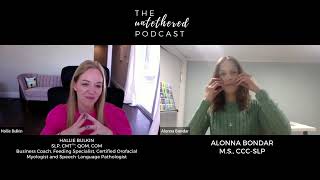
Interview (Untethered Podcast Ep.153) with pediatric SLP Alonna Bondar describing her 30+ year personal and professional journey through TMJ pain, chronic bruxism, multiple dental procedures (bite plates, TMJ surgery, root canals, extractions, crowns/bridges), and progressive interest in airway and myofunctional approaches. She reports a home sleep study showing about 11 hypopneas/hour (mild sleep‑disordered breathing), experimented with lip‑taping (Buteyko tape), and adopted nasal‑breathing training. She describes longstanding voice changes (vocal nodule/hoarseness), posterior tongue‑tie discovery and planned frenectomy (CO2 laser with Dr. James Ryan), upcoming nasal surgery (planned April 2022), and reflections on interdisciplinary challenges—especially inconsistent ENT scoping, adenoid assessment, and the limits of bite plates. The conversation also covers practical rehab, feeding considerations, therapy carryover issues, and clinician self‑care/continuing education.
Questions this video answers
Mild sleep apnea with 11 hypopnea episodes per hour.
January 2021.
April 2022.
Chapters
Hi and welcome to episode 153 of the Untethered Podcast. Today we have speech language pathologist Alana Bondar joining us. Alana has been a pediatric SLP for over 20 years. She spent many of those years specializing in early intervention, providing speech and language and feeding therapy. She currently owns a private practice working with children specializing in speech sound disorders and orofacial myofunctional therapy. Quick Disclaimer all information, content and material of this podcast are the opinions of the speakers and is for the informational purpose only and not intended to serve as a substitute for the consultation, diagnosis and or medical treatment of a qualified healthcare provider. Welcome to the Untethered Podcast. I am your host, Hallie Balkan. I'm a certified orofacial myologist, feeding specialist and mentor. This podcast is all about getting your questions answered and collaborating with colleagues to bring you the most up to date information in the orofacial myofunctional therapy, tethered oral tissue and airway space. I challenge you to keep an open mind and join my mission to get this information out to the masses. Let's get started. Well, Alana, I'm so excited to finally be chatting with you. Like, I feel like we're in person, but we're not. We're on zoom and have you here joining me on the podcast today. Welcome.
Thank you so much for having me. This is so exciting.
I'm so excited. So I know we're going to be focusing, you know, and for people who don't know, like Alana and I have been talking on social for, I don't know, it feels like years now. And we both are have a big presence on social, so we know each other, like even more so outside of our conversations. Which is why I'm so excited to have you here sharing your story. So, you know, I don't know where you want to start in your story, but if you want to go back to the beginning of time or tell us where you are now, like, I'm going to defer to you and let you, let you share with us, you know, a bit about your journey and, and so we can understand, you know, this long path that you've been on.
Okay, so that's a good question. Should I start a little bit now and then take you back? Yeah, we'll start now and then take it back. So the most present thing that's going on with me now is this hoarseness in my voice and me realizing that it's related to everything that I went through over 30 years ago and I'm going to take you back then. And I had to actually sit down and, you know, carve out all the details because so much has happened and because I didn't even realize then what I know now. I didn't even know it was something to write down and keep track of and be able to go back later and say, oh, this is why that happened. This is the cause of it. In telling my story, it's not really meant to throw anybody under the bus. Of course, I'm not mentioning any names, but not to throw any professions under the bus. I feel we all know better now, and we do better now than we knew 30 years ago. I think when my journey started, I don't think anyone even considered, oh, she's having TMJ pain. What's the root cause of it? Oh, it's airway. It didn't even come. It was never mentioned to me, ever. So it started, like I said, over 30 years ago. I was a teenager at the time, and I had a lot of what they call TMJ pain. And when you're a woman, why do they say you have TMJ pain? Because you're a woman and you're always nervous and you're anxious and I have a type A personality.
Yeah.
Oh, well, I don't know. Probably depression was thrown in there at some point. But I do have a type A personality. I don't have enough hours in any day. And so I kind of blamed it on myself. I'm really tightly wound. I have so much to do. I had it blamed on that fact that my ponytail was too tight in my hair. Not kidding. No, not kidding. I started reassessing how I did my hair. Too many clips and, you know, that kind of stuff. And I went through a lot just to get people to, you know. But I did the therapy. This is what I did. I went for therapy. I was having all this, you know, tmj, tons of pain. And my first step was to. Somebody suggested I go to a real specialist, downtown Brooklyn. I live in New York, so in downtown Brooklyn. And he said that it was related to teeth grinding. And like I said, I was going for therapy, but I was also taking ibuprofen and Tylenol around the clock. Just around the clock. And of course, I was being told, as I'm taking all this Tylenol and ibuprofen, I'm being told, oh, that's so bad for you. And I'm like, well, it might be bad for me, but I can't get through my day I can't get through my night. If I didn't take it before I went to bed, I would wake up at night in so much pain. And it was just round and round we go. I went to the specialist, he made me a biplat to wear at night. What happened? We were basically putting a band aid on the problem. Because here I was telling him that, and you can see my teeth were all worn down. So he's telling me I'm grinding my teeth. I had so much trouble sleeping. Here I am thinking, well, I'm not sleeping because I have so much anxiety. And I'm grinding my teeth because I have so much anxiety, which I do fine. But I think it was like, what's the chicken or the egg? At that point, I had to buy plate mate. And then when that didn't work, he said, oh, you need surgery. That was surgery number one. He went into my TMJ joint. TMJ joint. Say that a few times. And he said, he has to clean it all out. There was a lot of, I don't know, debris of sorts, whatnot. And of course we did that. That was not. Not good. I was drinking Ensure. It was. It was not good and it didn't help. And I kept. Yes. And I kept grinding and I ground through the biplate.
I hear this. I hear people do this all the time.
Yeah. I walked into his office, this, with a broken bite plate, and he said, oh, wow. Like that's. You know, he may believe I was the first person that ever did it. Maybe I was, maybe I wasn't, but okay. He made me a new one. And, you know, again, round and round we go. So here I am biting through a very hard plastic. Bipolar. This was. Right. They take a mold, they take impressions. This was not easy to break. And here it is. I broke it. So if that doesn't tell you something. Yeah. But okay, Right.
Ouch.
And on we go. So I found myself at an oral surgeon and we did some, you know, we did root canals. We did. Oh, finally pulled the tooth. Because the pain was. The pain actually wasn't so much in my jaw as much. It was. It felt like it was in my tooth on the left side. So when the biplates weren't helping, the jaw surgery didn't help, the TMJ surgery didn't help. They said, let's do a root canal. Did a root canal, didn't help. Surprise, surprise. Before you knew it, I was pulling the tooth. I had the tooth pulled. I don't think I'll ever forget what he said to me, the oral surgeon said, this is a healthy tooth. Yes. The look on Hallie's face, guys, you can't see it, but healthy tooth, but.
Let'S pull it anyways. Is that.
And I said, and I. I'm sitting there, you know, still, like, under whatever he gave me. And is. Are we for like. So now I have a tooth pulled out. It was a back molar and I. I'm even worse shape than I was before because now I had to have a bridge put in. So, yes, I'm having a bridge made. Great. I'm having a bridge made. Well, did you think the pain stopped? No. Then the pain. I said, well, maybe it's the next tooth. Oh, gosh. Well, I'll just fast forward a bit. I'll give you the ending. I had more root canals, not a braid. I didn't have it pulled. I have a crown there now. And then there was talk about pulling that tooth. And I said, absolutely not. I said, unless you can show me on an X ray that there's really infection there and it needs to be pulled, we're not pulling that tooth. So she would. This woman, the dentist, she X rayed it and she's showing me some kind of shadow. And I'm not buying it.
Yeah. Let's do it again from another angle.
No. I found myself at a. I did some searching. I found myself in another root canal specialist. And he said, I don't really think this needs to be pulled, but I'll send you to a par. He sent me to an oral surgeon, and this guy said to me, don't pull out any more teeth.
Oh, wow.
Don't pull. Unless there was. Obviously unless there's infection, but if it looks like this, don't pull it.
Thank goodness.
But he didn't have any answers for me, by the way, as to why everything was happening. This only goes back, I want to say, about seven years. Okay.
Long ago.
Yeah. He wasn't even looking at why I was grinding, why I was having all these problems, all the pain. And I was still being chastised left and right by every physician. You're taking ibuprofen every day. I said, well, what choice do I have?
And nobody asked you about your sleep, right? At this point?
No, not one person.
So interesting.
And I go to the dentist regularly, by the way. Every six months I'm there. And every six months, you know what happens when my mouth is open and they're cleaning my mouth? Oh, you grind your teeth. Do you wear a bi plate? That's the question I'm asked every single time. And I'm going, uh huh, you know, my mouth is open. Yeah, like I can't put your hands.
In my mouth and you're upsetting my tmj. Can we make this end quickly?
Right? Oh, let's not even, let's not forget about how painful it is to have a root canal when you have tmj. Oh, yeah, right. And here it is. That was the only question I got asked every six months. Do you know, do you do something to protect your teeth? Do you know that you grind your teeth? Yes to both. And the conversation ends. Yeah. And then one time he said to me, well, maybe you want to bring in your biplate and I'll take a look at it. What is he going to take a look at? The fact that it's almost ground down to the, you know, about to break in half again. What is it going to look at? Right. So at one point I did actually, at one point I did go to. Now I remember I went to a TMJ specialist who created me a new bite plate. He said that one would work better. It actually did for a time, probably just stop me grinding so intensely. But the root cause was still there.
Right now you're still clenching. I mean, there's still.
I imagine, I imagine. And no, the pain didn't go away. And I had done the botox. Botox, yes.
Okay.
And I pay all this, by the way. The amount of money I spent out of pocket was outrageous because I don't have really great dental insurance. So there we are spending money left and right, but anything, right, even great.
Dental insurance barely covers anything these days. So it's.
That's true too.
Yeah.
So there I am paying a few hundred dollars for the botox. I have to say I understood the reason why people do botox after that. It really, it really does help. They were like, you know, the lines over here look a little better. And I'm thinking, oh, this is nice. And the only thing it actually did was give me a really bad headache. I did not react while I get migraines and that just like shot me off a migraine. And I remember that day really well because I had an interview for a supervisory job and I went into the interview with a massive headache and oh gosh. So yeah, and it didn't help. Didn't help. So now I have a new biplate. Not sleeping pain every day. I know I'm grinding. Yes, I'm. Yes, yes. Hallie waking up, you know, like clenched. I know I'm clenching during the day. I found myself clenching. So then I'm told by one of the therapists I went to to do, not biofeedback, but like, relaxation exercises, because clearly I'm clenching and I'm not relaxed, which, you know, it's kind of, you know, it's, you know, a wheel. So, yes, I'm clenching at night because of the airway issue, but during the day, it holds out like you're just clenching all the time. Yeah. I don't think, you know, it really.
Becomes your new normal. Right. It's like you're correct. State of being. Yeah.
Yes, correct. So I did have to work on myself, you know, hey, why are you sitting during the day like this? You know, it wasn't an airway issue during the day. And I should say that I didn't see myself as a mouth breather. I never hung my mouth open, even before I went down the rabbit hole of, you know, myo. But I, you know, I look at pictures of myself. Certainly I don't have that gummy smile. I don't have that hanging mouth open, but it most likely was open just that little bit. Consider me not a full nasal breather, which I've learned now. And at nighttime.
Yeah. Depending on what time of day and. Yeah. What's going on.
And certainly I would wake up once I went down the mile hole. I realized I was waking up in the morning, mouth was open, so that I knew. I knew I was mouth breathing at night. And then when I heard Ken Hooks on your podcast, and he's a respiratory therapist, my husband is one as well. And so I was very interested in hearing what he had to say. Yeah, he's fantastic. If anybody didn't hear that episode, go back and listen to that. He's fantastic.
Love.
He's great. He's really great and a great person to deal with. I emailed him and he was just so. Such a pleasure. And he sends you a kit, and you wear it at night. It's just. It's a home sleep study. And he sends it to you, and you do it at night in your own bed. And then you send it back to him and he gives you a report. He analyzes it. And he told me that he. He said mild sleep apnea, but there were 11 hypopnea episodes an hour. So in women, what he discussed on the podcast was, in women, they don't really say sleep apnea episodes, they say hypopnea episodes, but essentially sleep disorder, breathing. Nothing I didn't know before right well, well, you know, now.
Confirmed.
Yeah, yeah, it confirmed it. And I want to say it was easy to do, not that expensive. And he was such a. He actually spoke to me on the phone, went through all the results, answered all my questions. We spoke briefly about the things that I'm speaking to you about today. And I said, okay, you know, now what? Now I know this. Now what do I do with it? I did go to visit Dr. Park, and he was at Montefiore at that point, and he didn't. He really. He read the study and we discussed, and there was nothing, you know, that he wanted me to do that was radical. I didn't, you know, say that I need any surgery in my, you know, my nose or I have. My palate is not super high. My tongue can fit in pretty well. I've since had it looked at. It's a myotherapy from some myotherapist. They measured. It fits pretty well. I've gone down the route of thinking about PAL expansion, but tabling that for now. He suggested taping at night and some other things he discussed with me. Some things that people may not realize, but when we're trying to protect our airway at night, not eating so close to bedtime is really helpful because food and digestion is involved in breathing. Breathing is involved in food and digestion. So besides, for my reflux, it was a good idea anyway. I. I stop eating a few hours before bed so that my body doesn't have to work to digest food at nighttime. So that's one of his suggestions. And then I taped. I did wear my. Not my Octave. I wore Buteyko tape over my mouth, and I started getting much better sleep. Yeah, much quicker sleep.
Was he able to confirm for you that he wasn't concerned about, like, nasal obstruction? Did he, like, scope you?
No. Yeah, I. He. I do have a mild deviated septum, but he didn't feel that it was obstructed enough. He said, go ahead and take. You know, that was okay. Like, he didn't see any reason for me not to. Yes, we should say that, you know, never take before confirming that there isn't any obstruction that will prevent you from nasal breathing. So I did have that confirmed. First he scoped me and we discuss taping. And I send all my little clients to ents. Hallie and I were discussing before we started recording the podcast that I do have to now suggest it to them. Please can you scope this client? Because these are my concerns and I want to work on nasal breathing, but I Can't do that. Until you confirm for me that there's no obstruction. I can't tell you how many times I get a report. And there's no mention of the child being scoped, no mention of adenoids, nothing. And the scoping can be done so easily in the office. I just. I don't know, I'm just missing something here. I don't understand. Why not? So instead of taking it to chance, I've been making relationships with EMTs and, you know, asking them to, please, can you do this? Sending them an email before the child goes, I have a child going next week. An email's going out. This is what I suspect. I want to work on her nasal breathing, please. You know, confirm or deny, whichever way it is, but let's know what's going on in there.
Yeah.
You know, we can see the tonsils, the palatal tonsils, but we can't see the adenoids.
Right, Right.
I can't. I don't know.
Yeah, I know. And that's like one of my big pain points because it's been so hard to find somebody in the D.C. metro area. And you would think that. And D.C. maryland and Virginia. When you have three states right next to each other, you can very easily, you know, drive from one area to the other. It's just been incredibly challenging. And the latest is that as one of our airway centric ents, just this week sent a report back with the mom to one of my team members and said, well, the child's not snoring, so, you know, I'm not concerned about enlarged adenoids or, you know, and the tonsils look fine. And I said, okay, well, did. Can you ask the parent did they do a scope or a scan? And she's like, nope, they did not. Like, that's already been confirmed. And I was like, so how did, how did the ENT visualize those adenoids issue the adenoid tissue if there was no scope or scan done? You know, like, we can't say for sure. Just. Just because. And this is what just grinds my gear is like, you do not have to be snoring. You could have an open mouth posture and be relatively quiet. You could have an open mouth posture and have audible breathing, not snoring. Yeah. I mean, there's so many different presentations. And if we are sending a child to the ent, not once, some. Not toys, sometimes three times, we've sent them back, you know, because we are gravely concerned that there is an obstruction that we need to rule out. Like, we've Hit a wall in therapy or, you know, we want to take the next step. We want to make sure that the airway is patent. Right. Whatever the case may be, like, please, please take a look at them. And it's, you know, it's not our job to even have to ask that, but it's sad that we do have to ask specifically for what we want ruled out. And I use the terminology now, you know, concerned about upper airway resistance. And I had an ENT present for the membership recently who said, you know, some ents don't even know what that means. And I'm like, they don't know what upper airway resistance means. I mean, as an slp, I'm not an ent, and I feel like I can make sense of what that might mean in my brain. So upper airway and like resistance, like turbulence. Right? Like trouble breathing. Can we just like figure out what's going on here?
Or how about when you have the ENT that says snoring is okay, then this is the real problem. He knew the client was snoring and didn't see that as an issue. So now we have a. But I said to him, did you ask the mom how this child? Does she fall asleep easily at night? Does she wake up in the middle of the night? How does she wake up in the morning? Is she having any difficulty attending at school? The answer to all of that was yes, yes, yes and yes. Yeah. While she sat here in my office with a rolled over lip and mouth breathing and the poor kid, you know, when I ask on my intake forms, I ask about school performance and the mother's writing in there, how the child is having attention issues. And he didn't even ask any questions, nor did he scope her. Yeah, yeah. And I said to him, listen with all, like, I, you know, I. The email was respectful. I really want to make a relationship with him. I don't want to have an argument, you know, it's not an argument, it's. Can I just educate you as to what we look for? By the way, he sent the client, I should say he sent the client to me. He sent the client to me for a pervasive articulation issue. So the child in therapy for years, years. And he doesn't see how any of it's related. And we can discuss that. She also has a posterior tongue tie that's also, according to him, not related. But we'll, we'll see, we'll see. I'm just getting started with this case, but I. So I sent him Back an email and educated him. Look, I see my role. I used to get really frustrated and kind of put my dukes up. And now I say, I take a step back. I let the email sit for a day, and then I say, well, he clearly doesn't understand, so I need to educate. And I'm willing to do that. I'm willing to give him the articles. I'm willing to give him, show him some pictures. I send him the pictures that I take in my therapy, in my assessment, explain to him what I'm looking at, the feeding issues that go on, you know, all of it. So I'm willing to educate. And so, I mean, part. The reason why I contacted you to do this podcast was because I thought, you know how many people, adults are out there grinding their teeth at night and the dentist is saying, can I make you a bite plate? And by the way, I should say to go back to that because we kind of squirreled away, but that's okay to go back to the bite plate. The reason why I won't have any more bite plates made, Certainly not that one. Oh, I didn't mention to you that my. Someone fell down the toilet. And it's okay. It needed to be down the toilet. It was on the edge of the sink, hit the toilet. And at that point, the universe was.
Trying to tell you something there.
Absolutely. And at that point, I already had seen Dr. Park, and I'm like, I don't need that thing anymore. Because it really was not allowing me to have correct tongue rest posture. It was bringing my tongue forward and causing a thrust. Because of the way it's created, there was not enough room for my tongue and I had to push it forward. And if I'm pushing my tongue forward and we can all go down that, you know, the connections with, you know, poor tongue posture and how am I supposed to breathe through my nose?
Yeah, well, also, if your tongue is coming forward and it's not resting in the palate, it's also changing the orientation of your jaws. So.
Hi. Absolutely. Absolutely. So all those connections. So it went down the toilet and I said, time to. Time to look into airway. Time to have another approach because clearly up until now, not working. So, yes, I mentioned, I did the taping and then I started to really pay attention to nasal breathing during the day and of course, joining all the myo groups and just really getting down that rabbit hole. And boy, it's. It's a rabbit hole. It's a rabbit hole that you. That you never climb out of, you know, and I see myself as just. It's just an ongoing process of, you know, learning more and knowing more. And the latest, as I mentioned, did I mention in the beginning about my voice issues? I forget. Yes, I said that.
You told me, but I don't remember if we recorded that yet. So I think I started in the.
Okay, so I will tell you more. And you did start.
Yeah, you did start with that. That's what's going on now.
That's what's going on now. So, interestingly enough, I. I'm an SLP for, you know, over 20 years, and I always had slightly hoarse voice. I was told at one point that I have a vocal cord nodule. I did some voice therapy, but essentially I have been living with like a small nodule for years and years, and everybody sort of knows that's my voice. But around January, it was January 2021. So a year ago, I had like almost dysphonia. I had no, like, no voice. And for an SLP specializing in apraxia and my. I mean, it was. It was rough. Still is. Yeah. And I really had no idea why. And so I did what I had to do. I started voice therapy. I went to an EMT who looked at me. She did scope me, and there was nothing. She saw a little spot here, something about the blood vessels. There were some broken blood vessels, but nothing terrible. But the wave was poor. And clearly I was having issues with my voice. She recommended voice therapy. I did do some voice therapy. I did see changes, improvement, but I was still having a lot of pain, took a break, felt like I needed to find someone else. And fast forward, I go to see an EMT at a well known university hospital in the city, and I'm keeping the name quiet for a reason. And he's telling me about all my doing. You know, I have a lot of tongue tension he's feeling under, you know, just behind my jawbone. And I said, I do, huh? I said, yeah, I think I have a. I'm pretty sure I have a posterior tongue tie. I've already been down this wall kind of showing it to all my friends. And I have a lot of floor of the mouth elevation, and I'm pretty sure I have posterior restriction. So he goes, you do? Oh, stick out your tongue. And I said, I didn't want to laugh because I was trying to be respectful, but I said, clearly you don't think that's the way to diagnose a posterior tongue tie, though. Clearly he did.
So what was his reaction? What did he say?
He looked at me and then just kind of. Okay, you know, and it wasn't the time or place to really go into anymore because, you know, did he agree.
With you or did he decide you didn't have one or did he comment?
He didn't. He didn't. He had no. He just didn't even know.
Okay.
He didn't even know. He just didn't even know. Okay. And that was that interesting. And I decided to just table that because I was still trying to figure out the connection myself because he had only mentioned to me a few minutes ago about all this tension in my tongue. And now the wheels are turned. I'm sitting there in his office going, wait a minute, I did the voice therapy. And then I'm thinking, you know what it is? I'm trying so hard to maintain correct oral rest, posture, day and night.
Yeah. And you're treating patients, mind you, so you're basically in therapy 24 7. Yeah.
And so, and so what's happening here? I don't have it. I. I cannot lift my tongue up in the palate the way it needs to be without the tension in my tongue.
You're compensating.
Yeah, I am 100 and all of a sudden the light bulb. Like, it was an epic moment. Yeah. Like, so I really couldn't. It was like, ah, right. And so. And it's just another layer to this issue. And I'm thinking, well, I want to explain to him more about this, but I'll. I'll email him, I'll send them the articles. You know, I'll be back. Yeah, yeah, I'm going for my follow up in a couple of weeks and I'll have another convo with him. But I did start therapy with a clinician in that office. And she is amazing. And I brought it up to her at the first visit because she's, you know, kind of touching and feeling, and she's like, wow, you have a lot of tension in your tongue. And I said, do tell.
Me more. What does that mean?
Do tell, do tell. And I said, you know, I think this is a real connection for me with my voice issue. I said, yes, I know I have work to do on, you know, a lot of issues related to voice and how I use my voice. I get that I became more specialized in apraxia and so spending a lot of time working on, you know, the prosthety and a lot of reps in those sessions. And perhaps I'm abusing my voice more than I realize. And so she's been amazingly helpful in all the techniques. And I think I sound pretty good today compared to just a couple of months ago. Learning a lot, and she's amazing. I said to Hallie before we started recording that the next step for me is the release. And I'm going to make the appointment today. I'm going to do it. I've been holding off only because I, you know, we use our tongue so much and I'm. I'm nervous, but at the same time, I can't keep doing this.
Yeah.
You know, there's so much rehab.
Like, I mean, to throw yourself into therapy the next day with clients, like, it's just going to help you, really. So all the myoes I approved. You know, it's funny.
It's fascinating. Yeah.
I put Lily through it at 24 months. Right. She had some great benefits. Benefits from it. And then Mia went at five days of life, and I was like, you know, I put both of my kids through this. I think it's like, finally time that I step up to the plate and do it too. As their mother, like, if they can tolerate this, like, so can I. And I. One of my therapists actually came with me. She wanted to observe the appointment. And, like, we recorded. They let me record the release. So I have it on my phone somewhere. I've never watched it because, like, I'm not like, I know there's a lot of therapists. You're like, oh, this is so cool. And I want to attend releases and, you know, do guided releases and everything. And I'm like, all you. You guys have fun with that. Like, that is so not me. Like, I think it's cool to see the, like, the full body impact and to see the range of motion increasing. Like, but I do not need to watch tissue be released like that. That just gives me the heebie jeebies. So same. I didn't become a doctor. Yeah, no, no. I'll leave that to everybody else. But it is cool. I'm like, I have it on my phone. I have, like, permission to share it. And I don't think I actually ever have, like, share. Shared the recording beyond, like, my immediate team just because I just forgot even had it, like, out of sight, out of mind. But it's. Yeah, no, we were talking about this before we recorded. My release was done with our laser and with a light scalpel, CO2 laser with Dr. James Ryan. And he also released both my children. And it was. It was easy. Like, I don't remember. Like, not that I don't remember. Like, I expected, right So I expected that, like, I would feel more during the procedure than I did. And obviously, like, I was, you know, numbed and lately, you know, under twilight or whatever, it was very easy. And after the procedure, like, I felt fine that night. It was hard to eat oatmeal. I don't know why I decided oatmeal would be a good idea, because I was kind of like, well, I don't really have to chew it much. Like, it'll be pretty easy to eat some oatmeal, except for when it's like hardened into a rock 45 minutes later because I couldn't eat it. It was so hard to eat.
It's also very gummy and pasty. I don't.
Yeah, don't ask. The feeding therapist to me clearly was not thinking straight. I have no idea why I thought that would be a good idea. I also think I, like, didn't plan properly and didn't have the right foods at home. And here I am with like two young children and I'm like, looking in my pantry. What can I eat? I don't really want a potato, so maybe I'll just have some oatmeal. Yeah, horrible idea. But I tell everybody else, I'm like, something really cold is great. Or you know, like a smoothie or something easy to drink or room temp. A little warm would be fine. Don't do anything too hot. Like that doesn't feel that, that's not going to good. But really didn't have many restrictions. Like he, he always says, like, don't drink like through a straw immediately and don't, don't eat anything with like. I know, I don't mean to. I'm over here.
I'm going to get rid of them. Okay.
No, it's, it's fine. Like, you know, like during the healing process. It's fine. He just says like in the first 24 to 48 hours, especially if you have sutures, he's always like, don't avoid straws. I think it's just the, the inner oral pressure, you know, with straw drinking and everything. But anyway, so it was, it was great. I thought I was going to be in pain. I thought I was going to wake up uncomfortable. Like, I thought I was going to be sore. And I felt none of that. And I was like. And I didn't take anything after. I did take, I think some ibuprofen, like a couple hours after the procedure, just because I anticipated like that I would be in pain and really uncomfortable and I didn't need It. I didn't have to take anything beyond that. And I was. I was like. I mean, I was like, wow. Wow. Like, I. That was really cool. So, yeah, I mean, it was a great experience for me. I definitely have. You know, I. I've shared on the podcast before that, like, my own active wound care was not what it could have been. Like. I should have had somebody else doing it on me because I healed in more of, like, a triangle or more. More of a triangle than a diamond. And that's just how my body heals. So I have, like, slight reattachment, but I don't think it's to the point of, like. Of definitely needing another release. We'll see what happens. I'll keep you all. I'll have to do a separate episode. I'll talk about my upcoming nasal surgery that I have scheduled for April 2022. But, yeah, we're going to see. It's all. All these different pieces to the puzzle. Right?
Right. So I think this is the next piece. Either way, I have restriction. I see it. I have some scalloping. I see the issues. I worked on myself to fix my tongue thrust and those issues. But would it certainly be easier if I didn't have to monitor my tongue movement all the time?
Yes.
We shouldn't have to do that. I have a big appreciation for my clients that come in with these MYO issues. And I had a conversation with a mother the other day because this child has zero carryover with his lisp. And I did tell her I should say in the initial assessment that he does have the posterior restriction. And I showed her and showed her the floor of the mouth elevation. But then, of course, she went to a professional who said, no, he doesn't have a tongue tie. Right. And these days, I don't even. That doesn't even bother me when people say that, because I said, okay. I look at her, I go, okay. Then I don't know what to say. I mean, I had a situation with a little baby. I don't see a lot of babies, but she happens to live right on my block. It's a neighbor of mine, and they could not find a feeding therapist. And I said, sure. I. I did physiotherapy for over 20 years. I'll go, you know, And I come in there and, you know, the MYO issues were, like, glaring. And the pediatrician was telling her that she should go to a neurologist. All her delays are, she should go see a neurologist. And I said, no. What she really needs is an entity. Why is she mouth breathing? Why can't she eat, you know, yada yada. And of course she did go to the auntie that I recommended. He did everything, the release, the adenoids, the tubes and I can't tell you, she's already a different child just a couple of months later and so, so much for your neurologist appointment. So I don't even take it, you know, I don't even look at it as oh my God, I don't even fight back anymore. I'm just like, I look at the parent, I say, uh huh. And I told the parent with this nine year old child here in my office and I said I can tell you what I'm struggling with and I'm an slp. So I think about my speech and my tongue movements all the time so I have somewhat better control. Anyway, I know that I'm working on myself and I work at it. Yeah.
And it's effortful. It's exhausting really, it's exhausting.
And for a nine year old boy who has, trust me, his speech is not even on top 10 on his mind on an everyday basis. Right. For the average child who has no restriction, carryover is difficult. And now you're asking him to figure out how to stabilize his tongue. Well, with this restriction and I have.
The anatomy to support that, so it's not even really a fair request.
Yeah, yeah. And so of course, you know, I, you know, we went, I did the whole functional assessment, I showed her all the feeding issues, all the tongue thrust issues. So it needs to be fixed to prevent. He had expansion already, but it will just all collapse back, you know, and I gave all this information to the mom. But you know, going through it myself, I really could speak to the difficulty that I have even as an SLP and you know, being much more mindful than most people. And now I'm kind of, now you got me fired up, I'm going to go do this release and yeah, no, but it's, I think it's really, it's really important to be able to now go back to my clients and say, you know, this is what I was experiencing now I had the release and this is, and I'm hoping to have some really good, you know, good changes after this when it makes you human too.
Because you can also speak to the fact that like you're hesitant about the release and even though you've seen the benefits in your patients, you know, when it comes to your own care. And I've shared this with families I've said, look, like I was in my 30s when I got it done, but I am an orthodontic relapse case, and I decided that I don't want this to happen to my children. And this is why I have a podcast, and this is why I teach this, and this is why we specialize this in my practice. And this is why my kids are going into early expansion. And it's an investment. I know it is an absolute investment in time and finances. But the way I look at it, too, is if I can prevent more issues from snowballing down the road, this upfront investment stings now, but it's going to pay off later. And look, I'm not saying that we won't need ever anything ever again. Nobody knows that. They may still, still might need some things down the road. Who knows? You know, like, Lily, for example, went into an ALF appliance, and it definitely opened her airway. It opened her, you know, grew her palate. Her palate has held. It's beautiful. She's in myo, like, follow up myo to get that lisp under control and that, you know, little slight tongue thrust she has. But otherwise, everything else looks great at this point. And she needs to grow her mandible forward a little bit. And I kind of realized, okay, I think we've hit a wall to a certain degree with certain skills because of the position of her mand in comparison to her maxilla. And, you know, it wasn't until I was sitting with an ortho friend of mine who was looking at me present Lily's case at a conference, who said, he kind of looked at me, and I was like, lay it on me. Just tell me. Like, tell me what I need to hear. I was like, don't be shy. Tell me what we need to do. And he said, I just. I think she needs a lower lip bumper. I think she needs to bring that mandible forward. And I was like, googling, like, lower lip bumper. What's a lower lip? Like, I've never heard of this thing before. But, you know, even for us in this space, like, we're constantly learning and. And I think the beauty of being the patient and for me, like, being the mother of the patient, of the patients, being the wife to the patient, being the daughter of a patient, being, you know, outside of just being the practitioner, has made me really, like you said, like, you have such an appreciation for what our patients go through and what the families of our patients go through of, you know, the children that we work with when it's not the adult themselves, then, you know, I think, one, it makes us human. Two, it makes us appreciate. When I've had patients come to me, some adults in their 30s, and say, I don't want expansion. I don't want a tongue tie release. I just don't want my problem to get any worse. Can you help me? And I'm like, well, I can try. Like, there's no guarantees, but let's give it a go and see what happens. And in, like, six sessions together over a couple months, we were able to basically get the tongue up into the palate to the extent that's possible, with the understanding that it's never going to be perfect.
The anatomy, right?
Yeah. Like, she was like, I don't want jaw surgery. I don't want an appliance. Like, I don't, you know. And she really didn't have, like, the tongue tie issue so much as, like, more of a narrow jaw, you know, high, narrow palate. But her goal, like, this patient's goal was just, I don't want my teeth to get any more crooked. I don't want my teeth. My tongue to push my teeth any further. And I said, okay, well, let's see what we can do. And so we work together towards that goal. And so I always, like, I like to share these stories because I feel like we all have our individual goals, and at the end of the day, while there may be the most optimal scenario for certain patients, parents of children and or adults themselves may have their own goals in mind. And so, you know, I think it's. It's interesting to share it, though, because when they hear stories like yours, which is. I was so excited to have you on the podcast. When they hear this, they go, oh, my gosh, that's me. Like, I've struggled with these things. Nobody. Why hasn't everybody ever told me that I could be having these issues going on? Well, for the same reason. Nobody ever told you and nobody ever told me. It was like, we've stumbled upon this space ourselves as SLPs who had access to education in the Mayo world and the tots world. And then we kind of went like, holy cow, hold up. It's like, everybody, hold on. Pump the brakes. Are you telling me that this is what's going on? And why has nobody ever told me this? Like, why don't you learn this in grad school? Beside myself.
I look forward to sitting. I have an appointment in a couple of weeks at the dentist. My routine cleaning. And I just. I look forward. I Want her to ask me? I. This time I'm going at it. I'm going to be like, before you even get in my mouth because then I can't speak to you while you're cleaning my mouth. Can I, can we have a discussion about what you're going to see in there and why? Because I'm so tired of them telling me that I have ground down teeth and am I wearing a bike plate? Like, I think it's time to like have a different conversation. So I'm going to do that. I'll let you know. I do want to say that in terms of my sleep because I should finish off that part of it. And how am I doing today? After taping and learning more about tongue rest, posture, for the most part, my sleeping is a lot better. A lot better. I do think the inability to fully get my tongue up does create sometimes this kind of my sleep is not deep enough at some point. And there are times I do wake up and have a hard time falling back asleep. I do have a snorer in my bedroom too. Not me. And so I can't always say what wakes me up. But it will be interesting to see if a little bit more trouble than I'm experiencing will dissipate or hopefully go away when I release my tongue and just that next step.
Yeah, I'm sitting here thinking like, as we're discussing this, the ENT's office that I went to was like, do you want like basically we're like, we can do a home sleep test if you're, you know, if you want to do it. But I'm like, I've had cbcts. Like I know that I've got sleep disorder breathing and it just kind of like we never actually, I'm realizing, finished that conversation and it was more so like she's like, you need it regardless. Like, I can see your scans, I can see that you can't breathe. Your nose, based on how your septum is deviated and you've got enlarged, you know, turbinates and you got enlarged nasal swell bodies. And I was like, oh, I really can't breathe at all through that half of my nose. Fabulous. But I'm sitting here going like, huh, maybe I should contact Ken and do like a home sleep test with him before having surgery. And then after I've healed like six months later go back and I mean it really takes a full year for all swelling to go down, they say. But I, you know, I feel like by like the six month mark we maybe even at the six month mark, in the 12 month mark. I don't know. I just kind of want to see like a case study of what does my sleep look like beforehand with someone who's gone through adult expansion with somebody who's had the tongue tie release already but still has the nasal obstruction. And then like, what does it look like afterwards?
So interesting because I was thinking about doing one before my release. Yeah. And then after the release.
Yeah.
But I think it's good enough to know that I had the sleep issues. Yeah. Making these changes. And then after the release, I think it's a little much to do with twice in the next couple of months. But yeah, you had one with Ken.
Already, so you technically have like your pre op one. Like, I don't think you have to do it like immediately before. Probably not going to change much. We haven't done much. I mean, you've done voice therapy, right? But you haven't really done much.
No. And I did do the taping, which I don't have to tape anymore. I wake up, my mouth is closed.
Okay.
No matter when I wait. Yeah. Even if I wake up, to me.
Because people recommend taping for light. And to me I'm like, I feel like an autumn. And I kind of have a very strong standpoint against taping. I'm like, if you're an adult and you want to choose to tape, that's your prerogative. We are not really proponents of taping children unless you are 100% sure that there is no nasal obstruction. And I do not trust most ents, at least not in our country. So for, for people like recommending, you know, the ENT says, oh, they're fine. Show me a scan. Show me a skin that shows there is no enlarged tissues. Like, I just, that's my personal preference. I'm not speaking out against other people who do recommend it. I just like, I don't feel comfortable. But.
Well, this was, this was for me. Right. I'm going to try to.
And like, I tried it to, like, I've done the Myotape around my mouth on myself. And you know, I woke up in the morning and I'm like, I don't really feel a difference. And I think I actually stressed my system out because I have like, I can only breathe through half my nose. So if I can even.
You wore Myotape, though. You wore the tape around your mouth or on your lips.
Right. So like I did the Myotape around the lips, so it kind of like. But I, you know what I do, though? I stretched it out really big so that when you put it on your lips, it actually brings, like, the lips together. And then I was like, this is gonna cause wrinkles. Like, I can't get too. My husband was like, what are you doing to your face? And I was like, I'm trying to get my lips to stay closed. I'm sleeping. So I did find a difference. Yeah. And I've seen adults say it's really helpful, but I think if it's going to be used therapeutically, it should be used therapeutically as something that has an end goal. Right. It shouldn't be something that we have to do for the rest of our lives, because there's still an underlying root cause that we haven't addressed if we're having to tape our mouth. So I love that you were like, yeah. You were like, okay, my nose is patent. I was able to lip tape, and it taught my lips to be closed at night, which I think is the exact purpose or reason behind doing it. So it drives me. Just drives me crazy because there's people out there who are recommending lip taping on pediatrics and basically saying, no, we're doing this for life. And I'm like, but why? Like that. That.
So I do want to say I listened to a podcast recently, I will not name names, where a professional discussed the fact that he tapes for life. I. I don't know. I personally felt. I also tried several different tapes. I started with the MYO tape. I found it wasn't really keeping my mouth closed all night because it's open on your lips. It goes. If anybody doesn't know, it's. It goes around your lips and it leaves a little opening. Sometimes it's good to start that way because you don't feel so claustrophobic. And in case you really have to breathe, you can. So some people like to start that way. Then I tried. I used the Buteyko tape, which is so sticky and so good. It is so sticky.
Did you do, like, top lip to bottom lip, or did you go straight across? Like, how do you.
Straight across. Straight. Straight across.
Can you open your mouth if you have to, though?
No, it's very sticky.
Okay.
Very sticky. Very sticky. I see. Personally, I loved it because I knew my mouth would stay closed, and I was very comfortable. I was able to nasal breathe. I should say that I now know a lot more about working on nasal breathing. You know, like the Buteyko method and doing some. I've been taking some other courses. I have one coming up. I'm working just Teaching children, adults to nasal breathe as a whole, before, like taping would not be my first go to. I probably, I did it for myself. Then after I was recommended by Dr. Park and that worked for me. But I do think that, you know, a lot of times people on mouth breathing, they just don't even know how to nasal breathe, right? They don't even know. They don't even know they've been mouth breathing for so long. And even, you know, you have children that have their adenoids taken out. And the old me used to think it's a magic cure, take the adenoids out, the kid will nasal breathe. Well, how come they're still walking around with their mouth open?
Behaviorally, that's all they know.
Yeah, that's all they know. Yeah. So, you know, that's where I'm like.
Therapeutically, like especially like in sessions, you know, and to teach things like we obviously work on closed mouth posturing and different ways of keeping them out closed. And so like I am all for it, like therapeutically when we know the knees, that nose is patent. But, and I think part of my discomfort, like I've told you guys, like in the dmv, I can't find any NT that I trust. So I think part of also my whole disposition towards recommending at least for like pediatrics is we could if, if that's really sealing the lips and these kids can't breathe through their nose, that's dangerous. Like we have now taken away their main source of airway of breathing. So, you know, that's, that's my whole, my whole spiel on that.
Yes, I had one mom, Yes, I had one mom say to me she doesn't want to wear it in the evening at home. He wears it by me, but he won't wear it. So she goes, can I just put it on him when he's sleeping? And I said, well, that's a maybe yes, maybe no. But the real issue is that he has to learn to nasal breathe during the day. So, you know, she wants to go in while he's sleeping and he won't give her a hard time and just put the tape on his mouth. And I said, yeah. So of course we took out the bride. Yeah, we took out the bribes, the prizes. I got really good prizes. You know, if he comes back and mom tells me that he did it, he'll get to pick from my prize box. And you know, he's seven. You can bribe a seven year old, it's easy.
I am not below bribery.
Oh, I, I am not Below it I have prizes and prizes.
I'm all for it. All for it.
Whatever it takes.
Yep, exactly. Yeah, no, it's, it's just, it's interesting and I think also, like, talking to some ents that are in this space now, like, it's really opened up my eyes to like, the way that they've been taught and how a lot of them have had to go after school to get additional education, just like we have. Unfortunately, they've also gone through med school, so, you know, they've done a lot of education where you would have hoped and. Or they'll say like, well, I did learn about this, but it was for like five minutes in a course. Like, it wasn't an actual, like, topic we focused on.
Well, it was the same, the same five minutes that we learned about tongue tie. Hallie.
Exactly. Okay, well, no, tongue tie was never mentioned. Tongue tie was never mentioned in my program.
It was mentioned to me. I remember learning that we were shown a picture of an infant with a heart shaped tongue. A heart shaped tongue, like a really anterior tongue tie. And we were told, if you see a baby that looks like this, it most likely is a tongue tie and they will not be able to breastfeed. That was the conversation. That was the conversation.
No, we were told, like, oral motor was a dirty word. Like, that was like, I went to a research university and oral motor was not okay. Like, we don't do oral motor because it's. Everything is enzymes. Like, everything is an enzyme at that point. And I'm thinking, you know, and the only education we got on dysphagia was adult and geriatric, like, post stroke, post, you know, like more so, you know, that was, that was our education and I was fascinated by it. I didn't want to work with adults, but I was fascinated. I actually, I don't think a lot of people know this about me and I don't know if I've ever shared this on the podcast, but I was such a nerd. So my instructor was somebody who, like, randy the floor at nih. Like, she was just this brilliant human being. And when we, she first taught our undergrad class, that's when I first had her for the anatomy and physiology of speech and swallowing and like, you know, kind of taught us on a grad school level as undergrads. And we were all like, ah. Like, it was like a grad level, grad school level textbook. Like, anyways, I remember like on my, one of my first tests, I got a C and I was like, hold up, like she always told us, if you're not sure, go based on what the textbook says. Because I will never mark you wrong if it's correct based on the textbook, even if I said something differently in the class. And like, whatever, right? So I go back through the textbook, I comb through, and I'm like 13 of the 15 I got wrong are correct according to the textbook. And so I remember like submitting it to her and she changed my grade. And she's like, no, you're right. And her response was, thanks for sleuthing. And I was like, what? And so I thought she didn't like me. I was like, okay, well, whatever. And then I have her again in grad school for anatomy and physiology for. And like the adult dysphasia course and everything. Now at this point, like, we had built a great relationship. Like, she really, like there was mutual respect. I don't think she meant it negatively, even though it came out that way to me undergrad, to the point where I became her ta. I created an entire anatomy and physiology lab, like a one credit lab for grad students, students in the slp, you know, in that cohort. I created the binder. I was bringing my skeleton into the lab, full body skeleton. I mean, I was like, totally geeked out on like all things. She took us to nih. I got to. I was the one who got to sit in like the radiology chair for like, where they do the MBSs, you know, and all that. It was. It was very, very cool. And I was like, I should have known then that I would be doing something like I'm doing today at that point, even though I had not had a second of conversation about infant toddler, pediatric, like swallowing anatomy despite nothing, nothing. And then of course, a dirty word, not from her, but from other instructors who basically shared all of the evidence, right? All the research against oral motor and four end zones. And that was my introduction to this space.
No, I had. I had to. In graduate school. I took a course, a nostalgia course at nyu. It was an elective and we had to go. I went to Brooklyn College for graduate school. So we had to go into the city, which, if anybody lives in Brooklyn, New York and knows the trek into New York City and back and the parking and the whole. So we had a small group of us and we took turns and we carpooled and it was really great. And we had a fabulous teacher. Of course, I do not remember her name. I'm really sorry, she's not there anymore. She was fabulous. But we learned all adult we had one class out of the. Whatever was 10, 14 weeks semester. I don't remember. We had one class on children. It wasn't something we had one. I remember having one. I went into pediatric dysphagia because I worked as a service coordinator in an early intervention program before I became a therapist. And I had made some friends and I swore up and down I was not going to do pediatrics. I was fascinated by when Christopher Reeve had his accident and he had gone through rehab. And I just became really fascinated. And at my NYU interview for grad school, when they went around, we had like a interview with several, like 10 students around the table in a conference room, and they went around asking everybody, well, why do you want to become an slp? And people gave like your standard, I want to help kids, you know, and they got to me. And I said, I'm just so fascinated by Christopher Reeve's rehab. And I just, this is what I want to do. And I was all down for it, right? Well, I did get into nyu. I didn't go. I went to Brooklyn College because it's near my home. But, you know, it really fascinated me. And I swore I have my own kids. I don't want to work with children because I can't work with kids all day and then come home to my own kids. Like, how is that going to work? You know? And then I had my mentor, like, right there, and I said, okay, I guess I'm doing this and I love it. So, yeah, I've never looked back, you know.
Yeah, I mean, I kind of fell into it accidentally too. Like, I went into the schools, which was my agreement with, you know, my university, that I would work in the local school systems. I was paid, you know, but for three years, I did full time preschool education program in the schools for two years, which was like, unheard of. But I kind of battled them because I really wanted infants and toddlers. And they're like, well, we've never sent a new grad into infants and toddlers. If you haven't done that as an outplacement in your graduate studies. And I'm like, I wanted that. Nobody gave it to me. And so I was really, really frustrated. And then my third year, I ended up going into infants and toddlers. While in infants and toddlers, they do a little bit more of the feeding stuff. But in the preschool education program with the three to five year olds, they really didn't. And I was like, these kids need it. I want to do it with them. I want to learn. And they told me no. And then an SLP left and they gave me her caseload. And she was in one of the, they called it beginnings at the time, which has now changed from all the political, you know, can't have certain things attached to certain whatever. Basically the classroom where they put the non ambulatory kiddos. And these kids, some of them had 24 hour nursing care, you know, around the clock, I'm watching nurses pour feeds down their throat with their chin up in the air, neck's in extension, you know, And I'm like, oh my God, like even I know something is not right here, right? I knew nothing at the time, but I knew that was dangerous. And they had feeding goals on their key on their iep. And I was like, wait a second. I was told I couldn't do feeding with these preschool education kiddos. Like, why, why do these kids get it but those kids don't? Like, why do you have to be wheelchair bound to receive services? Like, so that I started throwing a whole stink about that anyways, I threw myself into feeding courses because I was like, I have to do right by these children and I don't know what I'm doing. And they've just basically plopped me in here with no mentor, nobody can answer my questions because my, you know, my CFY supervisors don't do feeding. They don't know, nobody to ask. And I'm like, this is extremely horrifying and dangerous. And I was frank with these parents. I said, look, like, I'm gonna do best. Like I'm gonna do the best that I can, but I know very little and I'm learning. I'm a new clinician, so if you don't want me just, just putting that out there. And the families were wonderful, those that did communicate with me, but I was just like, this is what's going on. Like, something needs to change and something needs to change fast. Like, this is not okay, right?
And then we dug right in and here we are, right? We're never gonna work with peace 12.
Years later and tens of thousands of dollars later. I don't know, like, I feel like there we are.
I'm waiting for my accountant to. I sent him my quick, my QuickBooks, you know, my expense and my profit and loss statement. And I'm waiting for him to email me and say, how much money did you spend on continuing it? Is that really true? Are you just trying to, like, you're just trying to blow up your expenses and I'm going to be like, oh, no, that, that is in fact. True.
Yeah, yeah. No, I'm like, I don't. So everyone's like, oh, like I get an ACE Award. And I'm like, well, yeah, I've never paid for that in the past. And then I ended up paying for it because I. Well, I don't think I paid for it or something, but I paid for the.
I did it once and then I.
Said, well, I was audited, so I was paying for the registry. So now I like, officially got the ACE Award. I didn't pay for the actual, like, piece of paper, but like, I'm like, now I can say I have an ACE Award, right? I'm like, yeah, you know when you do 142 hours every two years, like, you have enough every three, right? When they read, it's just like, I didn't ever count because I knew I had way more than I ever needed. And I don't always submit all of them, but they were asha courses that just automatically got added to my transcript. So here we are like, oh, my gosh. So anyways, yeah, no, it's that rabbit hole that we all talk about that we all go down and then we all look at ourselves in the mirror and go, oh, man, you got to deal with me first.
So I am going to do that and I will report back. Yes, very excited. Yes, I have this piccy right here. I'm calling him. Yes, right here.
All right, all right. So we'll do follow ups. I'll have to do an episode on my upcoming nasal surgery and. And I'll report back on my test with Ken and all the aftermath as well. So I love sharing this because I know that our listeners really appreciate hearing real life case studies. And I think that when, whether it's a parent going through it or a child who's also been through it, or there's the parent of a child who's exploring this for the first time. I get such great feedback from our listeners that go like, yeah, I would.
Love to hear from people. Yeah, I would love to hear people DM you, or DM myself and just say, yeah, it spoke to me.
I'm going to go tell them where they can find you. Where can they find you?
I'm always on Insta at Bondar Speech, B O N D A R speech. And I'm pretty active there. Yeah, pretty active. Maybe more active than I should be some days. But I love it. I love it. I learned so much from everybody else and I love the collaboration that we have on Instagram and it's brought me to where I am today. I really, I just enjoy so much the feedback I get from people saying that tip helped me and I would love to know if my story resonates with you and what you're going through. And so, yeah, be nice to share that.
Absolutely. Yeah. So at bondrspeech and we'll make sure we put that in the Show Notes. Thank you so much, Elana, for joining me today. I always like chatting. We could chat all day long.
All day long. Thank you so much, Ali. Of course.
Thanks for listening to this podcast. If you want to hear more of these Myo Tots, Airway and Feeding related episodes, be sure to leave a review on Apple Podcasts or pledge a small amount on patreon.com the Untethered podcast. If you found value, others you know in this space will too. So be sure to share this episode on your social media platforms and join us over on Facebook on my Facebook page at Halloween Balkan Biz on Instagram at Hallebulcken. And you can head over to theuntetheredpodcast.com to grab a copy of the Show Notes where you can also subscribe to be kept up to date on the latest podcast episodes.
More from Hallie



What I Was Missing in Feeding Therapy: ARFID, Airway, and Myo with Samy Hernandez





