Episode 162: A 6.5 year old's Perspective On Her Airway and Feeding Journey
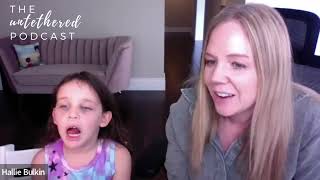
Episode 162 of the Untethered podcast (host Hallie Bulkin) interviews her daughter Lily (6.5 years) about Lily’s airway, feeding, and myofunctional therapy journey. Key points: Lily’s early feeding difficulties and picky-eating tendencies with gradual improvement; tongue-tie release at age 2 and ongoing orofacial myofunctional therapy (tongue-to-spot, lateralization, bolus prep, S sound work); use of an ALF appliance around ages 4–5 with pre/post CBCT showing improved airway anatomy (smaller tonsils/adenoids, opened nasal cavity); appliance worn ~1 year and removed when Lily was five; current monitoring of dental development (lower incisors erupting behind baby teeth, possible extractions) and consideration of further expansion with an airway-aware orthodontist. The tone is conversational, parental, and educational.
Questions this video answers
At age two.
ALF (Advanced Light Wire Functional) appliance, worn around ages 4–5 for about one year.
CBCT (cone beam CT) scans before placement and after removal.
Tonsils and adenoids decreased; sinuses and nasal cavity opened and appeared more patent.
August 21st.
Chapters
Welcome to the Untethered podcast. I am your host, Hallie Balkan. I'm a certified orofacial myologist, feeding specialist, and mentor. This podcast is all about getting your questions answered and collaborating with colleagues to bring you the most up to date information in the orofacial myofunctional therapy, tethered oral tissue and airway space. I challenge you to keep an open mind and join my mission to get this information out to the masses.
Let's get started.
Quick disclaimer. All information, content and material of this podcast are the opinions of the speakers and is for the informational purpose only and not intended to serve as a substitute for the consultation, diagnosis and or medical treatment of a qualified healthcare provider.
Hey, everybody. Hallie and Lily here. And this is episode 162 of the Untethered podcast.
Welcome.
So what are we talking about today? Well, Lily has been on her own airway myo expansion journey, and so we wanted to take the time. Today it is take your child to work day when we're recording this. And so Lily, one of her activities today is to record a podcast with her mama. That's me. So, Lily, welcome to the podcast. You've actually been on the podcast before, I believe.
I know.
Yeah. And it's been a while. How old are you now?
Six and a half. And I'm almost in second grade.
That's right, she's six and a half. And down here in South Florida, our schools end before Memorial. Before Memorial Day, I was like, which? Not Labor Day. I keep calling it Labor Day, Memorial Day. So, like, right before Memorial Day weekend, she'll be done with school, which is about a month away on the date that we're recording this and a couple weeks from when this. This podcast episode will air. So Lily's very excited that she's almost done with first grade and going to second grade. Lily, can you tell us what was your, like, most favorite thing about first grade?
Because. Because my class has the best teacher. That's in my school.
You have the best teacher in your school? Yeah. Ms. Hen. I know you love Ms. Hen. She is wonderful. We got very lucky with a phenomenal teacher this year.
And I'm in a gifted class.
You are in the gifted class. That's right. You also have a math teacher. You go to a different teacher for math, right?
Yeah. And My name is Ms. Physikis.
Ms. Fazikis. And we love Ms. Fazikis. And then because we moved from Maryland and things were a little bit different down here, we also worked with another amazing teacher outside of school. What was her name?
Ms. Mako. She's my tutor and she teaches me math on the time.
Yeah, I know you guys are working on time, which you love. Yep. So Lily is doing awesome, but we've, we've kept Ms. Macko around because we find that it's been really helpful because she didn't learn a lot of math stuff last year during homeschool because that was her papa's job and he kind of fell down on the job a little bit. So we're just going to. We'll just leave that there. But anyways, school year is almost over. Lily's doing awesome and we thought it would be fun to come on and update you in regards to where she is in her myo Airway tots feeding journey. So I'm going to ask Lily some questions and she's going to share whatever answers come to mind. We have not practiced this. It's not scripted. None of these podcast episodes ever are. But I really just want Lily to share with everybody her take on the whole process. Ok. Yeah. So Lily, when you were a baby, it was like really hard for you to like, nurse and to eat some things, even drink from a bottle. Although it wasn't as hard for you to eat when you started to eat like solid foods, like the baby foods and cooked foods and things that I made for you. But you started to not like as many foods when you were like 15 months old. And now you become a little bit more adventurous, like you like to try newer things again. Right. So the first thing I want to talk about is just what you think about food. Like, I don't want to give you any of my thoughts or if it's easy or hard or foods you like or don't like, but can you just tell us a little bit about, like, your thought with like, foods and where you're. Okay, go ahead and share with us.
So I don't think that chicken is good because I feel like it's like a dry food and I hate it.
Okay. Do you, can you tell us about the taste of it?
I think it feels dry and like it tastes like. I don't know how to describe it, but it doesn't taste good.
Okay.
I'm very picky.
Well, do you think you're very picky? A little picky or maybe you're not picky. Maybe you just have certain foods that you like and certain foods that you don't like. What do you think?
Well, I'm starting to like to try things and some I don't like, and some I am liking, but I'm still a little bit picky.
Okay. And so I think it would be interesting and maybe you and I will do this later since it's take your child to work day. Maybe we should make a list of all the foods you eat now and see how many you eat, because I don't think you're that picky anymore. I mean, I think there's certain things that you don't like. Like, you don't like chicken, you don't like beef, you don't love fish, you like fish sticks, but you don't love, like, baked fish, right?
Yeah, I don't like fish by itself. I like fish sticks.
Right. So. But I think you're going to be surprised to see how many foods you eat. And I don't think you're that picky anymore. I think you just have certain foods you like and certain foods you don't like. So that'll be kind of a cool exercise to do together later, right?
Yeah.
And then we can share with everybody foods you like.
But how do we know?
I have a list of foods and we can check them off and circle. So I have this list that I give to clients that bring their children to us, and we have them check off the foods their child eats, and we have them check circle foods that their child used to eat but doesn't eat anymore. And then we have them make a list of if there's certain foods that the family eats that they would like for their child to eat or try. We have them write those foods down. We do the same thing for drinks and even things like ketchup and mustard, and those are called condiments. So we'll go through that list later and see how many. Because children who are, like, picky, usually they don't stay picky for a very, very long time. Maybe it's only a couple of months. And if they start to cut their foods down, meaning, like, they only have 20 foods they eat or they only eat 10 foods, then we call them selective. Like, they're very selective eaters. And it can be really hard to go places and find something on the menu they'd like to eat. Now, you don't like a lot of kids food. Like, you don't love, like, hot dogs, you like chicken hot dogs, the organic ones that we get, right?
Yeah.
You don't like. You don't love hamburgers, but you've tried that recently, and sometimes you like a couple bites of a hamburger.
Yeah, but I don't like the whole thing. Because I don't like it that much. It's not like I like it or like I love it or I love it a lot. I just like it a little bit.
Okay.
I might just want like three, two, or one bite of it.
Okay, that makes sense.
So.
But you're trying new things.
Yeah, yeah.
And like you said, sometimes you like them, sometimes you don't like them. Did you know that adults also sometimes like food and sometimes don't like food?
Yeah, that's normal.
Everybody has their likes and their dislikes. So I don't think you're that picky anymore. I don't think so. I think we're have to count the foods. I think you eat way more than 20 foods. You also eat a lot of fruits and vegetables.
Yeah.
Yeah. And I know you love carbs and like cheese and stuff too, but I.
Don'T eat pears a lot because they're very juicy and messy and sticky. I don't like sticky stuff.
Ah, so tell us about that. You don't like sticky stuff. What are other sticky things that you don't like? Well.
I like the fruit roll that we have, but sometimes it's really, really sticky.
The like, long one and.
Yeah.
Okay. Did I get from Costco. Wait, the.
That come with a card?
Oh, those are the bear ones from whole.
Yeah. One time I promised to my friend, when you pack me on for lunch, I. I give her the card.
Oh, you give her the card. That's nice of you to share. Are there any other sticky things you can think of? Because you like honey and that's very sticky and messy.
Yeah, but I usually use on a spoon or just like put my finger into it and then look at them. It's not that sticky. And it's not sticky because it's like, liquidy.
Interesting. Okay, but it's a. So you. So stickier liquids are okay, but not like sticky solid foods. Like the fruit bar is like a solid food. I see. Okay.
But like, the medicine that I took was sticky too. Yeah, but it didn't get on me. It didn't get on me that much because it only dripped down the cup a little bit.
And that was also only for like 10 days or something. You had to take medicine. Yeah. Okay. Are there any other things that you can think about, like with food that you love or that you don't like or anything that's that you're thinking about?
Jelly is sticky and I like it a lot.
Yeah. And you usually. Here's what I'm thinking. Some of these sticky things that you, like, are, like, you don't touch them with your hands.
Yeah.
So the fruit roll up thing, like, you're using, like, your hands to pull it apart or to eat it?
Yeah, I use my hands and I pull it apart.
But like, jelly is in something. Jelly is in something.
Bite it so I can, like, unroll it and I eat it.
Okay. But like the honey or the medicine or things like, they're in something else and you're not having to touch it with your hands. So maybe your hands don't love the way that it touches. It feels. But it's okay once it's in your mouth.
Yeah. Okay.
That's good information. You know, there's occupational therapists that can help with things like this.
I just like to eat food because it tastes good.
Okay, well, that's good. So let's talk a little bit about your tongue. And you were. You had a tongue tie as a baby. Right. And a toddler. And when you were two years old, we had your tongue tie released. And ever since then, you. That's when you started to become a little bit more of an explorer with certain foods. And we worked on getting your tongue to move all around and everything. But now you are in orofacial myofunctional therapy with Jess Jessica Hutter, who's. Who works with Mama. Right. And can you tell us some of the things that you've worked on?
I've worked on both.
Okay. Can you show us what that looks like? Very good. What else have you worked on?
I worked on tongue to spot.
That's putting your tongue up on the spot. Good. Thank you for showing us. Putting your tongue up on the spot behind your upper front teeth, which also helps to. It helps to. What am I trying to say? Helps to get control over your tongue. Right. It works towards getting that nice shape of the tongue so that when we. Once we chew our food, like you're working on the bowl, that can help us to get the food onto the middle of the tongue so it's ready to swallow. And when we suction the tongue to the top of our mouth. Right to our palate. What else have you worked on with her? And I'm just going to grab this while you're talking.
I've also worked on.
Sorry. Continue talking.
I also worked on. Side to side.
Moving your tongue side to side, huh?
Without moving my jaw, I just do this.
Good. I love how you mentioned you do that without moving your jaw because we have to have good control over our mouth. Right. And so she's. If you're not watching this right now. She is moving her tongue with great control, the tip of her tongue to the corner of her mouth on one side and then to the other side. We call that lateralizing the tongue. That's awesome. You've worked on a lot more things. We're not going to list all the different things that you've worked on, but the idea is that we work to separate the tongue from the jaw. Right. Make sure the tongue can do its job without using the jaw all the time. And we've worked on getting water or saliva or your spit onto your tongue and swallowing that. Right. And keeping our tongue up on the palate while we're swallowing so it doesn't come, like, forward or go through your teeth or push against your teeth. Right. You're also working on. So we're working on that swallow. We call it bolus prep. Getting the food ready, the swallow of the food. And then also your sounds. We've been working on that. So sound. Right.
And you have to do it without. You have to do it without getting your tongue through your teeth like this. You don't want to see any red when you say, like, sound. When you hear the S. That's right.
So the S. We're trying to keep that tongue where it's supposed to be in the mouth so it's not coming forward. Right. And we don't have air escaping. Yeah. Awesome. So that's some of the things you're working on. Mayo. Right now. Lily, do you have an appliance in your mouth or no, like, appliance in your mouth right now?
I don't have an appliance in my mouth right now, but last year I did.
Let's see. So you're six now. Yeah. You had it taken out when you were five. So like a year and a half ago. Well, yeah, a year and a half ago it was taken out. And a little over. A little over a year ago. So it wasn't last year, but the year before. And you had it for one year. We got some great expansion. But as she's growing, we know that we're going to need a little bit more expansion. That was kind of phase one of our orthodontia. We went and saw some orthodontics, orthodontists. Thank you for correcting me down here in Florida. And the first one said, wait a year. Right. The second one said, let's wait a little bit, because she's got some. Do you remember what those teeth are called on the bottom? They're coming in Shark. You got shark teeth and what that means. If you're watching the video, you can see. If you're listening to the podcast, I'll explain. Her lower central incisors, which are her lower front two teeth, are coming in behind her front two teeth. So what happened was because there is still some crowding on the bottom, and we definitely need more expansion there.
They're coming in the back.
They're coming in behind. Exactly. And so they missed the root of the baby teeth, and so they resorb the baby teeth, meaning we. We have to see if they get wiggly and fall out on their own. So Lily's been working on wiggling them to try and get them to fall out. Or we may have to have them taken out, Right. If they don't come out.
Yeah, but I don't want them to be.
I know. Nobody wants to have to take them.
Out, so come out by their shells.
So you have about, like, four more months to see if we can get them out by themselves. And if not, we might take them out and start some other expansion as well. It's a long time.
I know, but it's only four more.
It's a long time. We have a long time. Don't worry. So Lily had an ALF appliance, or ALF Advanced Light Wire functional appliance. And we did get some really great growth. The appliance. We had done a CBCT before it went in, and we did a CBCT after her appliance was done. And a CBCT is a cone beam, basically a CT scan. And so that looked at her mouth, her airway, and all kinds of fun stuff. And what we did see was that her. We saw her tonsils, which we could see with the naked eye, but we saw her tonsils decrease. We saw her adenoids shrink down. We saw her sinuses open up, and we saw her entire nasal cavity went from being almost a blur on the CT scan to being a beautifully open, perfectly functioning airway. And so that appliance, at that time, our goal was, was to get some forward expansion and to get some lateral expansion so that we could open the airway. But we fully knew that we would likely need to go into further expansion and other orthodontia afterwards. Our goal was really airway health at that point, and we achieved that goal between age four and five. And you're now six and a half. You'll be seven in August, right?
August 21st.
August 21st. So exciting. So that's about, let's see, April to May, June, July, August. Four months yeah. So in four months, it will be seven or three months and three weeks.
Did you just say 10? What's in 10 months?
I did not say that.
Of course you did.
See, you're silly. You're silly. So at this point, we're just monitoring her airway and constantly just checking in because it's been really hard to find an ortho down here in South Florida who's willing to get started on her, like now instead of waiting six months to a year. But we have found one who is airway savvy, but uses traditional orthodontia, you know, like expanders and braces. So we're. We're debating what next steps are. Right now I've actually taken her sister Mia to Dr. Barahill, who is in North Miami. And Mia will be doing some expansion with her. And so we may consider taking Lily there. We'll see. We will see.
No, but it's such a long drive.
It's like 45 minutes. 40 minutes. 45 minutes. It's bad.
45 minutes. It's literally more than 15 minutes.
Welcome to life with a six year old.
Yeah, welcome to life with a six year old.
Anyways, is there anything else, Lily, that you would like to share with them before we wrap up our conversation today about your airway, your breathing, your myo, your appliances. What else? What else? I will say that Lily has this beautiful, beautiful oral rest posture now where she has her lips together, her teeth are slightly apart, her tongue is slightly suctioned to her palate, and she breathes nicely through her nose. So we do love that. Right? Lol. Tongue up, lips together, teeth apart, breathe through your nose.
We love it.
Okay, so that's it. Anything else to add?
No. No.
Okay, well, thanks for hanging with me and love today. She's throwing up peace signs as she says bye to you guys. Like I said, welcome to life with a six year old, everybody. Have a great day. This is Hallie and Lily signing off.
Thanks for listening to this podcast. If you want to hear more of these myo tots, airway and feeding related episodes, be sure to leave a review on Apple podcasts or pledge a small amount on patreon.com forward/the untethered podcast. If you found value, others you know.
In this space will too. So be sure to share this episode.
On your social media media platforms and join us over on Facebook, on my Facebook page @halliebulcan biz, on Instagram @halliebulcan. And you can head over to theuntetheredpodcast.com.
To grab a copy of the Show.
Notes, where you can also subscribe to be kept up to date on the latest podcast episodes.
More from Hallie



What I Was Missing in Feeding Therapy: ARFID, Airway, and Myo with Samy Hernandez





