Episode 166: Choosing Your Path: What Sets One Program & Provider Apart From The Next w/ Jen Kirkham
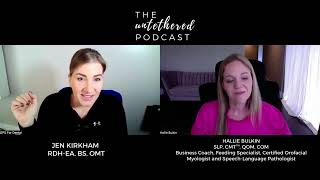
Jen Kirkham from the Gelb Institute discusses what separates training programs in myofunctional and airway care. She emphasizes mentorship, critical thinking, and how interdisciplinary teams of dentists, orthodontists, and therapists work together, plus how a night guard can be a clinical entry point for patient care.
Questions this video answers
Episode 166
June 24, 2022
Jen Kirkham — Chief Operating Officer (COO), Gelb Institute
gelbinstitute.com
Gelb Institute — gelbinstitute.com
Chapters
Hi and welcome to episode 166 of the Untethered Podcast. Today we have Jen Kirkham joining us. Jen is a leader in the Airway movement, focusing on simple systems and solutions. She's the co founder of the Tao Tao Method taught by the Gelb Institute and Chief Operating Officer. She trains dental teams across the country on tmj, Airway and Ortho using the new Night Guard. Her passion for all this and more is from personal experience. She leads with empathy, understanding and relatability, using technology to keep doors open for families to have resources for care and and the dental team prepared to be that resource. Quick Disclaimer all information, content and material of this podcast are the opinions of the speakers and is for the informational purpose only and not intended to serve as a substitute for the consultation, diagnosis and or medical treatment of a qualified healthcare provider. Welcome to the Untethered Podcast. I am your host, Hallie Balkan. I'm a certified orofacial myologist, feeding specialist and mentor. This podcast is all about getting your questions answered and collaborating with colleagues to bring you the most up to date information in the orofacial myofunctional therapy, tethered oral tissue and airway space. I challenge you to keep an open mind and join my mission to get this information out to the masses. Let's get started. Jen, welcome to the podcast.
Hi Ali. I'm so glad to be here. It's always such a pleasure spending time with you. I mean, it's so much fun.
I know. I'm so excited to have you back and to have a whole different conversation today than last time you were on and I can't wait till we can be in the same room together again because I know we have a good time together.
Yes, we do. We live in a dynamic space, don't we?
We certainly do. Yeah. And I want to talk a little bit about that today and I know you do too. So let's jump right on in and talk about. You know, I know that there are so many different educational programs, right. That are just like, I feel like popping up left and right in the industry and, and I think it would be really an interesting conversation to talk about like what sets apart one from the other, you know, is. Is it that one is moving, somebody's moving faster than somebody else is at level of education? Is it, you know, does it have to do with something as far as like how much you know or I don't know, you know, there's all different variables that can play into this conversation. So I would Love to just kind of get, you know, your perspective on like what you're seeing, like what's, what's separating like one program or provider from the next.
I, I love that like, you know, we live in such a dynamic space. We see programs all the time. And I got to give accolades and kudos to everyone who is leading every single one of those programs because it takes a lot of effort. It takes like new skin in the game. Right. And I think everybody is heading in the right direction. That's what happens within a movement. This is an airway movement. So one certain path doesn't always look the same for one person. And so it's good to have a variety, it's good to have a differentiation. But then sometimes we get to be like, well, it might confuse professionals and providers because we're used to having a recipe, we're used to having be like, okay, I know these facts, 1, 2, 3, then the next step is 4. The next step might not always be 4. Right. And so what I'm finding in the space is like, you know, everyone seems to have their protocols, but there's more than one way to approach it. And so where I like to see is, I love to map out like, okay, where are the universal principles? And then based on those universal principles, what is setting certain providers apart? Not in a who's winning, who's losing, but it's who are they being on the inside that's setting them apart and allowing them to impact their patients lives at a deeper level than maybe just rattling off facts and protocols. Yes. What are you seeing, Hallie, in the programs and providers and what are you noticing?
I mean, more specifically, like in the MYO space, I'm seeing a ton of courses and even different certifications popping up. And I think that begs the question of what needed to change. Why is this happening? I think it's actually happening because we needed change. I think that the old ways weren't working. I think that it goes beyond the level of education that you can gain from a course and it goes into what else is accessible, whether it's mentorship, connection, community, ongoing support, knowing that you can connect with your patients and that's just as, as important as what you know. And like you said, there are so many providers who are used to checklists and hierarchies and certain systems.
Right.
We check the box, we go to the next one. We check the box, we go to the next one.
That's just not how it works.
It's so dynamic and we need to be artists and in this space where we're embracing the art of science, we're basically looking at the patient sitting in front of us. And we need to be critical thinkers who go, okay, this is what I'm seeing today. This is what we need to do today. Not, okay, Mayo is a 12 week program, and this week you get this exercise, and next week you get these exercises and so on and so forth. Because I'll tell you, we get those patients and they don't really have to ever appear to have had a program before. So, you know, it's. I think that's why we're seeing so many more courses. Not to say the original courses taught that way, but I just don't think that the courses that existed previously were teaching critical thinking. And for me personally, that's something that I think is extremely important, that we embed, we intertwine that into our programs. But I also teach identity, because if you can't identify as the provider that you need to be for your patient, then who are you?
Right.
And I think that that actually interferes with your ability to deliver what they need at the end of the day. So I know this is like a much larger conversation, but, yeah, I mean, that's what I'm seeing. And I have to say, while it upsets a lot of people in certain organizations to see that there are so many more people who are teaching courses and even creating certifications, including myself, you know, I'm excited. I think there's a seat at the table for everybody. I think people learn different ways. I also think people will take different courses from different people to learn different perspectives. But I think that we all need to support each other at the end of the day because I think we're all on the same journey and our end goal is to help our patients. Right. So that was my long answer to the question.
Yeah. Well, I mean, it's good to, like, just observe what's happening and just to know that competition is something that actually drives everyone for the better. Like looking at who ran the four minute mile the very first time, and then once someone realizes somebody else could do it, it's the Baxter effect. It helps us all do better. If I'm running a race and I have somebody next to me that's really trying to get that same direction faster, better, stronger, I'm like, oh, I get to push myself further than I thought that I could. And I think that's where we look at, like, this is not an exclusivity conversation. This is an inclusivity conversation. And actually What I want to bring to the table today is kind of looking at, like, I don't want to bring religion into this, but this is a good example in the Jewish culture, and you probably know this better than I do, but this was brought up at a business mastermind in a women's group that I belong to. And it really helped me gain perspective as to what is happening in the airway. Myo appliance expansion ortho space is that every Friday there is a Shabbat dinner. Like, it's a celebration of restoring with family gathering together. You break bread together. Oh, gosh, I'm sorry about that.
That's okay.
So there's like every. There's. There's a ritual. Everyone gets together, celebrates with a meal and getting. Gathering. Right. And. And I think the term that I learned was yeshiva of the process. Everyone gathering to the table. Everyone brings something together, but you all benefit either from a meal or some type of contribution. And so the spirit of that tradition was like, okay, having a seat at the table is usually like something that people use as term. Like, I've proved myself and I'm going to contribute and I'm going to push my way through and have a seat at the table. But instead, if you take it from the spirit of, like, yeshiva or the Shabbat celebration, it's almost like the table is there and you set the table and then you gather for a holistic experience where someone contributes their knowledge and someone else contributes their knowledge, and it doesn't matter. It doesn't matter. Like this competition of who's better and who's not. It's like you all contribute your strengths. And so circling back to, like, programs and what's setting providers apart is that when. When I talk to a provider team, you know, I'm in the appliance space, right. Where there's a thing that fixes a thing.
Right.
And without, like a standard protocol, I mean, there is kind of like a recipe. But when I see a provider who is just bringing their overall knowledge and personal experience and treatment to the table, patients get it and see their doctor and provider more like an equal rather than an authoritative figure trying to push something on them. The first principle, universal principle, I recognize is we, in our program, we have providers treat themselves or one of their family members first with the statistics of how prevalent airway and sleep disorders are. I mean, who can't get a better rested sleep, Right?
Right. Absolutely.
So we start them out with a sample on themselves and work with them and saying, what are you experiencing? What Are you noticing? And that change from the inside, then it doesn't matter how much they know or how much they don't know. It is like, hey, you know what? I saw something of value that I could better improve my health and wellness. And because I am your provider and I am that support system for you, I think you could really benefit from this. And we see higher levels of case acceptance. And I mean, of course, numbers matter. They're more successful in, number one, personal impact. And then the monetary rewards come because they have that spirit of yeshiva. They're just bringing their value to the table and letting this equal contribution happen from their team, from their patients. And guess what? It spills out into interdisciplinary collaboration.
Anyway. Reminds me of that quote, like, nobody knows how much you know until they know how much you care. Right. It's like people want that human connection. And I think, you know, that's one of the reasons why I think private practice has been so easy for me, because I became that mom who struggled with feeding, and that became my specialty. And when you can sit across from the patient and connect with them on that level and say, hey, you know what? Like, I experienced this with my child, or I've been through this myself, it is a completely different conversation than somebody walking in and saying, okay, I've treated 5,000 patients and here's your treatment plan. I mean, it's more. It's kind of like a warm, fuzzy environment versus like a more sterile environment. And people are going to connect on the warm fuzzy most of the time. I mean, I'm not going to say that that's a general rule of thumb for everybody, but at least in my line of work, you know, I find that the parents, they just kind of go like, okay, you get it Right. Great, let's go. What do we do next? Right. It's just they can kind of like take a deep breath and ease into the process versus coming back at you with 15 questions. It really. I completely agree with that approach and I've seen it work firsthand and I love it. I love guys do that. I think that's really powerful.
It. I think it helps dull that, that. That pinpoint feeling of like, I. I didn't know, or like, I don't know enough, like I'm not blank enough. Yeah, it takes that all away. Yeah. Where as long as you know that first next step and then have somebody that's on the journey with you, then you can kind of like navigate together. So I really love that. So what are you noticing? What are you noticing with.
How you're able to collaborate.
I mean, let's get down to the nitty gritty and like, detail here, because I know your audience here is a mix of different providers. What are you noticing intangible with working with Myo, working with OTs, PTs, dentists, orthodontists. Like, what do you notice that is the number one connector and key perhaps to working together with all the different disciplines that are required to help a patient? Like, what are you noticing with your practice that sets it apart?
So, I mean, aside from taking the time to build those relationships and to understand what their perspective is, and we've study clubbed together, right? We've sat down and reviewed cases around a table together. And I think that that really reinforces for the provider, for myself, and for the other providers that we all have, like you said, a seat at the table. We all have different knowledge. We're all coming at the same exact case with a different perspective, different background, different helpful information. And sometimes that actually changes the treatment plan. Like we've had. I remember this one case. It was myself, an oral surgeon who does tongue tie releases, my holistic dentist who does appliances. We had a couple of myofunctional therapists. One was an RDH who's a colleague of mine in the area. So it's not really always on my team, but again, just another person in my same space who has a different background and perspective. An osteopath couple. We had a vision therapist. We had all these different. And also, I'll add that one of the osteopaths is also a physical therapist. So we had all these different trades, right, sitting around the table. I don't think we had an OT present, but it was very fascinating because we all looked at the case and the dentist said, I offered her a toy if she could just get her lips closed and work on, like, keeping her lips closed. And I looked at her and I said, how dare you? And, like, I can say this because I have the relationship with them. And she looked at me like, what?
What?
And this was the partner of, like, the two. There's a couple, you know, air. One's actually like ortho and airway, and the other one's dental airway, and they're in the same practice. And she was like, what did I do wrong? And I was like, first of all, let's remove, like, rewards. I know you guys have your toy box and everything. But I was like, this child doesn't have the anatomy to allow for that. You just asked her to do Something that's physically impossible. And this is an orthodontist, like, dentist. Like you would think that, right? So, but they're not looking at what the lips can do. They're just looking at the dental aspect. And so when we all sat down together and looked at this and an osteopath piped in and he said, you know, well, and look at her, look at her posture and look at, you know, this. And you know, he started commenting and then his wife, who's also an osteo, started commenting. He was commenting more on like the ptoste standpoint. She came in with another osteo, you know, opinion. It was just, it was fascinating to see everybody collaborate and add what they were seeing through our own lenses to the same case. And that completely changed how the orthodontist, she was like, I feel horrible. I'm going to call that patient tomorrow and apologize. I mean, and I was like, I didn't mean to make you feel bad, but like, I think that it's critical that we sit down. And I know in, in today's lifestyle and fast paced world, this is really challenging for us to all sit down and actually look at a case around a table together. This is why we had study club. But it's so critical that we find a system that allows us to all have our eyes on a patient and collaborate and contribute the knowledge and what we're seeing through our lens so we can really make a holistic treatment plan and say, okay, here's what we're going to do for this patient. Here's the next step. Here's this, here's this, here's that. Are we all in agreement? Because that to me is best patient care.
You know, I love that. And you said something with the orthodontist and like, how you said, how dare you? And then she was like, oh my.
Gosh, I feel horrible. You just identified.
One of the other principles that I see with providers is that it doesn't matter what happened, it's actually what you choose to do next. So that dental orthodontic provider, what did they do next? They're like, they realized their mistake in how they approached it and listened and listened to the contributions and then contacted the patient. Be like, hey, I figured out something new that would make a better impact in your care. Yeah, it's like, you got to swallow that pill, eat your foot, eat your words, whatever you want to call it, and then do something a little bit different. That is another principle. It doesn't matter how much you know, it's how much you listen? Yes, 100 to the patient and to other providers.
And that's why I love working with them, because they're phenomenal providers. And we can all come forward and say, you know what, I don't know, but let me talk to somebody and find out. Or, you know what, this is not working. Let me consult with a colleague. Let's pull somebody else in on this case, and let's figure out how we can help you move forward. And I think, to me, those are the best kind of providers, people who admit that they don't know everything and don't let ego get in the way and who are willing to consult with the team or even a new member of the team to best help their patients at the end of the day. Ultimately, again, we're all here to help our patients.
And I think it's about giving yourself enough credit. Let me tell you a story. So one of the doctors that I've spoken to was asking for help with a case, and it was a dentist that was talking to us because he needed more mentorship, and he was kind of considering our program. And I'm like, you know what? I always. I'm generous with my time. I'm generous with my knowledge. Here, let me, Let me show you, like, and let you experience what it is like to work with us. And so we took a couple of steps forward, you know, reviewed a case. He signed a quick little HIPAA form so we could discuss, like, very specific details. But then what. What he didn't do next is like, take. Take full ownership of, like, okay, you know what? I really see how much you can help me. And it's just seeing the value of some program. So if you see a need of a program, doesn't matter what program is out there, if you're drawn to it, you know, you know, test it out. And if you know that it's going to be beneficial to you and your patients, if it's going to help you move the needle forward. Guys, take the leap. Take the leap. And there is a value exchange. We are in a world where their programs cost money. Make sure it is reasonable. Make sure you can work it into your lifestyle, but enroll into that program so that you can come to the full feast, so you can come to that yeshiva experience and come to the full table. Otherwise, you are knocking on the door asking for scraps and samples, and you might not be able to step forward. So. So take that leap of faith responsibly. Follow the. Follow that intuition and then really own, like, what you are really capable of. I mean, Hallie, if have you worked with providers who have maybe stepped forward and kind of taken a nibble at your program, but not have that full experience? What do you see that they are experiencing now versus someone who does?
Yeah, I mean, it's an interesting question because, like, my inbox on social media, for example, is flooded all the time with, hey, can you just help me with this one case or this one question? And I'm like, I hate to not be able to help. But also, you have to understand, like, I run two businesses. I have a family. Like, you know, I can't offer everybody free help. So my, you know, I'll say email, Jess, and if you'd like to set up a consult, I'd be happy to help you. And you can kind of get a taste of, like, what I offer or just hop into the My own membership or something like that, and, you know, you will have access to me in there for some mentorship. And then if you decide you want to go another step further, then there's the course. Right. And so the. My own membership is very accessible monetarily. It's something that really anybody in the space can do. And so, you know, but I do see some people jump in, like, kind of dip their toes and take as much as they can get, and then they leave. And I see them kind of floundering and I'm like, well, you didn't take a course. Like, the membership is there to support you. Yes, come in. If you just want to dip your toe and see if this is for you or not. And if you decide it's not for you, that's fine. But I do see people who will come in and then they leave and they're kind of like, well, I don't have access to support anymore. It's like, well, your next step would be a course. Like, you need a comprehensive approach to understand what you're looking at. What do we go now? Like, where do we go next? Who needs to be on this team? Like, there's lots of great free information out there, but to try to piece it together yourself, it's just. It's not going to support you in the way that you need to support your patients. Unfortunately, like, it's just not. So, yeah, it's one of those things where we just. We encourage everybody. Take a course. It doesn't have to be with me, but find a course that jives with you and take it because you seem interested. You seem to want to take that next step. You kind of you're, you've dipped your toe in the water and you know, you're trying to do it, but you can't really do it. And, and it's also not fair to a certain extent to then pop into a whole bunch of different people's inboxes and ask them to mentor you or support you for free when you haven't even done the due diligence to even get yourself educated in the space first. So that's actually a big issue that I see in my field. And so I try to both educate and empower and not, you know, and do it in a very kind way because I do want to support everybody. But at the end of the day, if you really want to do right by yourself and by your patients, you need to have the foundational training and skills before you can really even benefit from further mentorship and before you're going to benefit your patients.
So yeah, and I think that carries over. If you, if you invest in yourself enough into a program that feeds your soul, that feeds your needs, then you're going to be in a better place on the inside to be able to look at a patient, to do a complete comprehensive assessment and to be able receive value for your services and your contributions. So it's like there's this contribution and value exchange that happens that you deserve compensation for doing therapy, life changing therapy, and value yourself enough to buy into a program that's going to give you the skills, the tools and the support that you need in order to accurately help patience, at least taking steps. I, I love that it's, and I.
Think it all comes back down to identity. And so that's why like with my whole elevation, movement, I have the three pieces, I have identity, skill set and mentorship. Because you can go get the skill set, you can find the mentorship. It's becoming easier to be mentored in this space. But if you do not identify, we'll just use an example as an orofacial myofunctional therapist, right. Or a feeding therapist or whatever it is that you're trying to do, you know, an airway dentist or you know, whatever, I don't know you guys are terming what you guys call yourselves these days. But you know, if you're not, if you don't own the identity on a subconscious level, like truly in your being and you're not working from that place, then you are not going to value the price tag attached to the course. You're not going to value that investment in yourself, you're not going to See it as something that you need to do. And so I get that. And that's one of the reasons why I integrated identity into this, because I see that so often. And so I do like little mini trainings on identity at the beginning of all of my programs, because I see a major transformation happen, both in owning what they're learning. The confidence level goes up, as obviously, competence leads to confidence. But it's more than just competence and having the information. It's this whole new level of identity that leads to a confident practitioner. And I'm not saying be arrogant, and I'm not saying go out and say, you know everything, nobody knows everything, but you have to identify as that practitioner before you can truly step in front of a patient and successfully treat that case. And there's a lot of people who already do who have no idea that they identify this way and they haven't had to work on this. But that's not true for everybody. So I do see that as that big, like, oh, I'm not good enough, or I don't know enough, or I don't have had enough experience. And I tell everybody it'll come with time. But today, the identity has to be in place today, not ten years from now. So that's a big thing. I preach on.
Yeah, it is really owning your impact, and I love that you have that. Three parts, three essential pieces, really. And, you know, today we have been talking all about universal principles and having a starting place, starting place for yourself, a starting place for your patients, and really dive into the value exchange that that is available out there. So doesn't matter what program, but find what your needs are and where you're at right now and just like, take. Take that step forward.
Absolutely. So where can they find you if they want to connect with you, Jen, where should they go?
So the easiest place to find me is@gelbinstitute.com there. I'm the chief operating officer of the Gelb Institute, where we promote the new night guard. And interestingly enough, it's something that I personally use. My family uses it, and it's actually a great starting place for someone just to keep their airway open during work, during play, and during sleep. It's been a game changer for not only dental teams, but I'm doing my husband's myofunctional therapy. I'm paying attention to what's happening as he's wearing the device during the nighttime, what's happening during the daytime, how is he feeling while he's working and lifting and like, what is his tongue doing? Because we have to retrain and he's going to be preparing for a release. So I'm telling you this from experience, is that the more expansive knowledge that you can have, the better you're going to be able to treat your family, to be able to treat your patients and like I said, own your impact and start wherever, wherever you are, move into a program. So that was a long answer for where do you find me? And it moved into what I stand for. But it is true. I live, I live and breathe this because it is a part of my life. It has been life changing for me and that is what I am dedicated to do, is help others realize their potential in the Airway space.
Well, I love it and I love you. So thank you for joining me today. We'll let you run, but we'll make sure that the galbinstitute.com is in the show notes and that everybody knows where to find you.
Great. Thank you so much Holly for having me and I can't wait to get her. So we'll get you in 3D and give you like a personal hug.
Thanks for listening to this podcast. If you want to hear more of these Myo Tots, Airway and Feeding related episodes, be sure to leave a review on Apple Podcasts or pledge a small amount on patreon.com forward/the untethered podcast if you found value others you know in this. So be sure to share this episode on your social media platforms and join us over on Facebook on my Facebook page at Halleblin Biz, on Instagram at Hallebulcan and you can head over to theuntetheredpodcast.com to grab a copy of the Show Notes where you can also subscribe to be kept up to date on the latest podcast episodes.
More from Hallie



What I Was Missing in Feeding Therapy: ARFID, Airway, and Myo with Samy Hernandez





