Episode 204: Progressing Through Play and TOTs with Dr. Brita Destefano
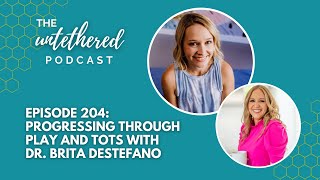
Untethered Podcast episode 204: host Hallie Bulkin interviews Dr. Britta DiStefano, a Denver-based pediatric physical therapist and founder of Progress through Play. The conversation covers Dr. Britta’s path into caring for infants with tethered oral tissues (TOTs) through personal experience, the role of pediatric physical therapy within multidisciplinary TOTs teams, and clinical approaches that prioritize comfort (e.g., postural/post-release techniques, avoiding noxious stretching—illustrated with a bamboo-finger-trap analogy). They discuss common co-occurring conditions (torticollis, plagiocephaly), feeding and tummy-time strategies, milestone progression framed as a pyramid of precursor skills, the importance of provider expertise/networking, and the substantial mental-health and family impacts when infants struggle to feed or tolerate handling. Practical contact info: PTPdenver.com and Instagram @progressthroughplay.
Chapters
Hi and welcome to episode 204 of the Untethered podcast. Today we have Dr. Britta DiStefano joining us. Dr. Britta is a Denver based pediatric physical therapist, mom of two and founder of Progress through Play. She believes that milestones shouldn't be a mystery and that babies deserve to feel and move comfortably in their bodies. She's passionate about proactive care when it comes to tummy time struggles, torticollis head shape and tongue tie. Quick Disclaimer all information, content and material of this podcast are the opinions of of the speakers and is for the informational purpose only and not intended to serve as a substitute for the consultation, diagnosis and or medical treatment of a qualified healthcare provider. Welcome to the Untethered Podcast. I am your host, Hallie Balkan. I'm a certified orofacial myologist, feeding specialist and mentor. This podcast is all about getting your questions answered and collaborating with colleagues to bring you the most up to date information in the orofacial myofunctional therapy, tethered oral tissue and airway space. I challenge you to keep an open mind and join my mission to get this information out to the masses. Let's get started. Britta, thank you so much for joining me on the podcast. I'm excited to chat today.
Yes, me too. I am ready to dive in and.
I know, I know we actually, for all the listeners out there, we've already recorded a podcast. I had major technical issues on my end, so we are redoing this episode. So a special thank you to Dr. Britta because you know, your time is valuable and I so appreciate you sharing your experience and story with our listeners.
Of course I could talk about this all day long and actually I do because that's what I do all day, every day. So I'm happy to.
I love that. So let's start then with how you got into this space. You know, as far as tethered oral tissues go, is that something that you just jumped into right outside of school or did you kind of fall into this space like so many of us?
Yeah, I think like many of us that have found ourselves in this space, it was from personal experience. But historically physical therapists were not necessarily originally part of a TOTS or tethered oral tissues team or that wasn't something that a lot of pts were going into and there is now a growing section of us which I love. We are all so supportive of each other and we network together, but it really was an eye opening experience for me when I went through having a child with tethered oral tissues. So I think many, many of us in this space have that exact same story, but that was almost nine years ago. And so I've been a pediatric physical therapist for, I guess, 13ish years and have always had a focus on the younger patient population and with a really big passion for infants. And so with my own private practice now, I treat really only from birth up until they start walking. So our youngest, youngest kiddos. And when I had my son, so many of the things that I was going through just rang a lot of bells in my head of things I had heard parents report to me. And it started connecting so many dots for my practice and how I could be better supporting families that I was working with. And it took a while for me to formulate how that was really going to look in terms of my current practice model, because at the time I was working in the early intervention system, which has a lot of kind of specific barriers that you have to work within. And after I had my second child, who also had some issues as well, I took some time off actually, and really was able to sit back and think about how I wanted to support these families from a really holistic perspective. And then that is how I kind of dove further into this rabbit hole of tethered oral tissues and started doing more trainings and finding out how I could be a better part of that team for these families. Now I have a practice that sees probably 50 to 70% of the kids that come in have some oral dysfunction as well as other stuff going on. I now do collaborative evaluations and treatments with an occupational therapist. And it's just been a really cool journey that unfortunately was through that personal struggle and personal experience.
Yeah, no, and I think so many of us relate to that. You know, it's both, like, fortunate and unfortunate. Right. It's like, it's unfortunate that we all went through this, but, you know, I think it really has given us this perspective that allows us to more holistically approach our own patients. So I love that, you know, I love that you have that, you know, ability to help your patients with all of these things now. And I did also work in the schools initially just with preschoolers. And then my last year, my third year, I went into I. And, yeah, I mean, the red tape when you're working for, like, any type of a county or state type of, you know, program. Oh, yeah. But you're allowed to do what your role is. It doesn't necessarily matter what your license says you can do. Right. They're going to obviously make sure you're doing like what's in scope with what they require of you. But they also tend to limit your scope. And yeah, it was like, well the green team does this and the red team does that. And I was like, but this child needs this. So if someone on the red team can't see them and I have the skills to provide this, like why can't I do them? Like I'm just going to go into the house and do this and they're not going to know. So here we are. It was good time.
Yeah. It's nice for parents to have options and for there to be the resources available through the early intervention system that so many families and children need. But I love being able to offer an alternative for families who are looking for something that, you know, I can see patients for the first visit within a week of them calling me. And we get just a lot more flexibility in the way I'm able to provide my services. Yeah.
And I think the other thing too is because as you mentioned, it can be a really phenomenal service for parents and children. We do have families too who call us and say we want a supplement or it's more coaching model and we want more direct intervention from what we offer. And so I think that they both have a place and they're both necessary. But yeah, as a therapist working under that, that setting, it was, I was like, this is not for me.
I'm going to go into private practice.
Where I can control what I do. So yeah, definitely not downplaying EI by any means. But it's, there's always bureaucracy and red tape when there is some form of government involved in your day to day job. But tell us, you know, tell us about, you know, a physical therapist role.
Right.
So as a part of the care team for tethered oral tissues, if like maybe a parent or even providers are not familiar with your role, can you tell us a bit more about what you do? I know you said you collaborate with an ot. What is like your specific involvement usually?
Yeah, great question. So physical therapists are movement experts and that includes movement of the entire body and how the body works together. And because feeding is a full body activity, there's a lot of things that can be going on elsewhere that can affect a baby's ability to feed and also stuff going on within the mouth that as a physical therapist we can address as well. So there's that whole neuromuscular re education piece of pre post release. This is a muscle that needs to relearn how to function and then also tension throughout the body. If we have torticollis going on, if we have some preferred movement patterns due to GI discomfort or reflux, or we have a flat head or muscle tone concerns, low muscle tone, high muscle tone. There's so many other factors that play a part in how these babies function and how they feel. So my philosophy is that babies deserve to feel good in their bodies so that they can move well and they can learn through that movement and feed well and all of the things that they are supposed to do as infants. And that's where I hope to be able to support families in that aspect of the team approach.
I love that. And I think it's so important that we understand everybody's role and what we all bring to the table because we do see one of the things you mentioned, you mentioned torticollis. The other thing we see often in plagiocephaly, we tend to see a lot of these babies who carry tension. I think it can be challenging for them to make progress in the work that I do and that some of my colleagues may do when we don't have someone like yourself helping with that full body holistic approach. Because we know that tension is often carried throughout the body. And it's going to impact nasal breathing, it's going to impact where the tongue rests in the mouth and feeding. And, you know, we could just, you know, list a whole bunch of things but sleep, like all the things, all the important things that we need to live. And I think it's critical that we are collaborating and that we're coming together to recognize what each of us bring to the table. And I, you know, was just giving a presentation and talking about how it is our job to educate parents, but also recognize it can be very overwhelming when we refer to a whole different host of professionals. I always say, as soon as we know that the airway is clear and that they can nasal breathe, we have to also be looking at the body. Whoever that individual is in our area that's specialized in working with these infants and toddlers, we need to be referring to them and we need to be educating parents on the importance of them working with you. Because, you know, the best way I like to explain it to some parents is like, you're. The baby's kind of locked up and this can happen to us as adults too. It happened to me. My, my pt. He basically was like, you know, your body is locked up. And we got to kind of, you know, he's pri trained and uses like modern counter strain technique, which he says is different than the counter strain technique that most people are familiar with. And you know, but just completely amazing approach to, you know, the body work that I needed. And I just, I think when parents understand it and they. It's almost like we tell them if we can help relax the body, then we're going to see more relaxation in the mouth. We're going to see the ability to maybe feed better, breathe better, they'll have more lingual control if the tongue is not tethered, you know, all the things. And so, yeah, I just, I commend you because I think the work you do is so incredibly important. But also I don't think it's highlighted enough. I think it's glossed over by a lot of providers out there, you know, in various fields. And maybe that's part of that's just understanding or lack of understanding. So do you find that you spend like a lot of time educating parents, like on what you're doing and why?
I do. It's so interesting. I mean, we are very lucky in the Denver area to have a lot of really collaborative professionals. And I know, you know, some of them. And so in that sense, I feel like I at least have a leg up there, that a lot of the providers are bought in on the importance of approaching the full body and making sure that patients aren't coming in just expecting a magical cure with a release, and that they have a lot of functional professionals on board for referrals. And, you know, honestly, sometimes I am the first person to mention to a family that there might be some tethered oral tissues. And that's always surprising to me is that, like, how did they get all the way to me? And nobody has brought this up. And so there are some educational opportunities there still to happen. But what I find is an interesting part of this job is helping families to curate who the right team is for them. Because even for myself, we're still working through my own children's tethered oral tissues journey and finding who those unicorn people are that are the right providers for my children and what a difference it makes when we find that person. I just had a myofunctional eval for my son last night and it was just like this breath of relief of, oh my gosh, this is the right place for us. I cannot believe how well he's responding to this. He's excited, he feels confident. Like, I have never seen my child like that in a kind of medical setting. And that's what I Want my patients to feel too. And so for us, he's seen the osteopath. He goes to our dentist who says he's not ready for a release. He's not even ready for orthodontics. And helping us kind of guide the right steps in the right order. And then now our myofunctional therapist. So I think being a provider in that space, that's another really important part of my job is if someone ends up at my office or a home visit first, if I'm the first provider on board to ever even mention that we might have some tethered oral tissues, who are the best people to help support this specific child in this specific family? And so that networking piece. And really collaborative care is so important.
I love collaborative care. I feel like we talk about that so much on here, but I'm like, we still can't talk about it enough because until it actually comes to fruition and everybody's kind of following that model, it needs to be continued to be discussed on a weekly basis. But I think it's incredible when you do see the positive impact of that collaborative care team and it. It is work. Like you said, like, I mean, even us, right? Like, we are providers in this space. We get it. We kind of quote, unquote, know who to look for. It doesn't make it that much any easier trying to actually find those people. And then, yeah, once you're, you know, I've gone to offices where, like, their website was beautiful. They did the best evaluation. And then they sat there and told me something completely opposite of what they just showed me on a screen. And I'm like, wait, what just happened? Like, if the treatment plan doesn't match the assessment and everything else you just marketed to me, like, why am I. I'm like, okay, well, clearly this is not the office. And when I mean that, it was more like, oh, wait a year to do any further expansion. And I'm like, what, she's about to turn seven, wait a year? Like, she's already had expansion. She's a very compliant patient. Like, yeah, why would we wait a year? Like, everything else is telling me not to, right? So that's what I mean with, like, the treatment planning kind of not matching, like what you. What I was just showing on all of her scans by that. And I just, you know, I. It concerns me because I know so many families don't really know what the appropriate response is. They may have that great eval. And then it's like, the treatment is not necessarily on par with all the things that we're talking about. So, yeah, it's, it's an interesting space to navigate. With your son, though, it sounds like he's in a pretty great place though. If I really felt that, like, calm, cool, collected and happy in a provider's office.
I mean, this is a child who has to be sedated for his dental work. And even my husband, when we got home was like, who is this child? He wants to tell me all about the appointment and everything that he did. And he's in the bathroom using his cheek retractors and like doing his homework. And it was crazy just because this has been an almost, like I said, nine year journey. And unfortunately I didn't know everything that I know now, nine years ago that I wish we could have been more proactive about approaching his severe tongue tie and oral dysfunction. And there were a lot of medical interventions that ended up happening because of it. You know, tonsils, adenoids, tubes, the whole, you know, anxiety medications, sleep disturbances, the whole, the whole gamut. And, you know, I try to, to use that not as a horror story for the families that I work with, but to highlight the fact that this does have lifelong impacts. Not to scare you, but to help you advocate and make sure that you are seeing the providers that will validate your concerns and not brush it off and say tongue ties don't exist, or there's no such thing as a posterior tongue tie or whatever they're hearing. So, you know, it's obviously a fine line because we don't want to, you know, make recommendations on about something that hasn't happened yet. But understanding the full impact of oral function across the lifespan I think is important for literally everyone to understand. Yeah, like not just parents of infants, but adults who may have, you know, airway issues or their TMJ or teeth grinding and I have a tongue tie and have looked back at all of the things that I've underwent in my own experience that relate to it. And so I think it's just unfortunate that it's not more widely known and understood in just the general population of how important oral function is.
Yeah, yeah, no, I was just asked this question earlier today, you know, like, why are we not advocating for more releases if we know all the functional impacts that can happen down the road? And, you know, I always go back to, well, like, what is the functional impact now and how, you know, the definition of a true tie? It's not a tie if nothing is functionally impacted. Just, you know, the presentation alone does not make it a Tie presents to be tight. But again, how are they doing? And, you know, that's not to say that, you know, we take everybody's word verbatim because people will tell us all the time, oh, everything's fine, my child.
And then you start asking the question. Yeah.
So it's like, well, if we see tight tissue, we might recommend an evaluation. Because in an evaluation, we can dive into all the things you mentioned. Right. You mentioned sleep anxiety. You know, there's the feeding component. There's even the response at the dentist's office. Like when a child goes to the dentist, if they have a tongue tie or even a retracted mandible, that's kind of like blocking their airway, right? And they laid back, so now they're supine. They're like, now they're always kind of, you know, in that relaxed position. It was even more so. Okay, okay, enter anxiety. Right. Just because they can't breathe, and now someone's coming at your face. Like, it's no wonder why some of our children hate the adults don't like the dentist. You know, drills and all the sensory other stuff aside like that you might hear in a dental office. I think just the experience of laying down and someone being working in your mouth for so long is not a great feeling for so many. And then with adults, you know, with like, TMJ issues and other orofacial pain, you know, on top of all that, it's just. It's. I think it's a very valid issue that also, you know, obviously we're not dentists. I don't think it's talked about enough. I have a lot of patients who are, like, adult patients, actually, who are very embarrassed to tell me they haven't been to a dentist in years. And, you know, I'll say, oh, well, has your dentist ever mentioned anything about, like, X, Y, or Z? And they'll be like, no, but I haven't been to one in, like, seven years. And I'm like, oh, okay. And they're, like, looking at me, like, for a reaction, and I'm like, we can dive into that. That's your choice. Like, I'm not, you know, I'm not here to make you feel poorly about.
That's.
That's cool. You know, and that's. I just think it's a very interesting topic because to me, it's kind of like, why do we have such a fear of the dentists? Like that. That's where I go with that, is, how can we help you? How can I help you in this Scenario get to the root cause of this because it might be tied to some of the other things going on.
And that's what's so cool about from the PT perspective is that anytime a parent is coming to me with a concern about whether it's related to tots or maybe just delayed milestones or whatever's going on is I am going to figure out why, why we've gotten to this point, why this child isn't moving, why movement doesn't feel good to them, why you feel like they're never comfortable for you to hold, or why nobody else can hold your child or whatever it may be. I'm putting my detective hat on. And that is going to be my role here, is to help us figure out the why behind all of it, because that helps us inform how we can help them improve. If we just look at the current symptoms and try to force something that a child's not ready for, it's not going to happen. And so I use the example of my babies with Torticollis. And so we've got a tight neck, movement is not happening symmetrically. And a lot of traditional treatment approaches would say force baby's head to that difficult side, make them strengthen in that direction. I can't do that to a baby. It doesn't feel good to me. It doesn't feel good to the parents. I utilize similar. You were talking about your pri pt. I use total motion release, which is a postural release technique which feels good. We use babies movements of ease or positions that feel good to them to gain range of motion on the more difficult side. Then I ask a baby to strengthen. I'm not going to ask them to strengthen into a movement that doesn't feel good, that noxious stimuli is going to cause negative associations with movement. Same with tummy time. I'm not going to force a baby to scream through a tummy time session. And a lot of our babies with tots, that's how they react anytime you get them on their bellies because they're so tight. So that just informs my approach across the board is that I'm not going to force a child to do something that they're not comfortable in or ready for.
I love that. How do we find more of you? Because with my second child, this was the issue. We took her to pt. She had her tongue tie release at day five, right? She was kind of always like on.
The brink of her.
It was tongue and lip at day five. But she was. She fed really well. But I noticed especially as she got to that position of starting to try and crawl. She was dragging one of her legs behind her and she was very efficient, like dragged all the way across the room. She could go up the stairs like that. She would just, she would figure it out. Right? Girl was compensating and we were taking her to PT on and off and really well respected practice. But I now realize like using those other techniques that I now later learned from a PR I PT who was like, it's like, yeah, no, we kind of like don't want to go against the restriction. Kind of want to move with the restriction to release it and then gain greater range of motion. And I'm like, this is not my area of expertise, so excuse my verbiage if it's not correct. But I was like, oh, I mean that kind of makes sense. Like why are we stretching against something and causing more pain and she's crying and fussing and you know, trying to get out of it and then having her like, you know, do these wall sits or do these different activities, you know, as a, as a infant, like we were having her position her knees in a certain way and kind of holding her and then trying to keep her leg down, her knee down while she was craw up the stairs after a toy. It was like, yeah, no. And my first one hated tummy time. She was that child that you, you described. And it's definitely both of them in different ways. Opened my eyes to why are we forcing things on children that hurt them? Because that's causing stress in their body. And if we're causing stress, we're going to cause inflammation and we're going to send the whole nervous system into fight or flight when really we want them in rest and digest. And I know that impacts their feeding, their sleeping, their breathing, their other motions, all the things.
Right.
And so I'm sure you can speak to a lot of this better than I can. But I mean my, like one of my go to strategies for those babies who scream in tummy time is like to have the baby lay on their belly on top of like a caregiver. Because a lot of those children will not necessarily scream in that position, but they will if you lay them like on a wedge or flat on the floor and you know, they can't really. The head starts bobbing and then they start crying and they're. I can still see my first one like flat on her face, like on the floor crying and not just, yeah.
Yeah, they turn bright red and they just shove their face into the floor and then I Mean, it truly becomes this, like, snowball effect of, like, parental anxiety and mental health when you know your baby can't do tummy time, feeding's not going well, they're super colicky, they're gassy all the time. Nobody else can really hold them because they won't calm down. And they're not just that super snuggly baby that it's easy to pass around, and it all falls on you because nobody else knows what to do. And the mental health piece is something I'm so passionate about in having a baby with tethered oral tissues because of how it affected my mental health. And I was the new parent crying in the pediatrician's office, like, why is it so hard to feed this baby? It should be easy. This is my one job. How come I'm failing at my one job, which is keeping my child alive? You know, I don't think that part is talked about enough, too, about how it really affects the whole family dynamic, not just moms, dads, siblings, you know, whatever, and anything we can do to kind of take one of those, you know, kind of pieces of anxiety off of their plate. So, like, if tummy time is something that is a huge stressor, what things can I do to help make that an activity that you don't dread all day, every day? And that may look like modifications. It may look like addressing the body restrictions first and then asking the baby to do tummy time. Because I describe it like if we put a baby who's tight on their tummy and ask them to stretch out and push up, that is, their body is now in this tug of war where they're being pulled in one direction with the tension in their body and then being asked to move against that, like you mentioned, and that doesn't feel good. So, again, the technique I use, I keep one of these little finger traps, these bamboo finger traps in my office, because that's the analogy I use for when you get your fingers stuck in a bamboo finger trap and you try to get them out by pulling. That would be our traditional stretching, or forcing a child to go in a direction that doesn't feel good. And if I pulled hard enough with enough force, yeah, I would get my fingers out. I would break all the bamboo, but I would get my fingers out. But if I truly want to release that tension and free my fingers, I push the bamboo together, and then my fingers come out. So this is a really good visual for parents to understand the techniques that I'm using. And they are typically super on Board because it feels better. And they just get to snuggle their baby in a position that feels good to them. And then that's where I get to also collaborate with lactation or like my OT colleague who's also a CLC for feeding position. So if we find that position of ease in their body where everything is on slack, they don't feel tension anywhere. And we can replicate that during a feed. That helps baby be so much more successful in being able to focus on oral motor function and not have the distraction of discomfort.
Yeah, I mean, it's such a beautiful explanation with using the bamboo finger trap, because if someone had showed that to me and I knew this, like, way in advance, I would be like, well, yeah, I mean, that makes so much sense. And obviously I don't want my child to be in pain or discomfort and trying to address, like, the pain and discomfort that they're already feeling. So I love that you have this approach and that you are so. You're able to so beautifully explain it to families. Because, you know, when you mention maternal mental health like that, like you said, it is not discussed enough when you said it. I got chills all over my body because you said my job, my one job, is to feed my baby. And I cannot tell you. Like, I get chills again saying that. I cannot tell you. That was my thought process as a new mom with struggles with my first. That's what every single mother says to us when, especially with breastfeeding or even bottle feeding an infant, they feel like they're failing at their one job. I have this baby. My job is to keep them alive. That means they need to eat right? They need to breathe and eat. They're breathing. We don't know if it's the most optimal form of breathing, but they're breathing, but we cannot get them to feed well. And I think that's so highly stressful. And like you said, it's not discussed enough. And here we have moms who are in their fourth trimester. They're new, sometimes new parents, sometimes not. But hormones are all over. The mom is still healing. Regardless of how good your support system is or is not at home, we know that the medical community is mostly failing our new. Our moms who are trying to heal in their, you know, first three, six, nine, 12 months after birthing a child. And, you know, and then we're not. And then moms are not sleeping, especially if you're breastfeeding, because you got to feed the baby when they wake up. And if baby's got Dysfunctional feeding. Guess what? They're feeding around the clock. And now your mental health is even further down, you know, the rabbit hole of issues. And I just, I think so many moms feel alone and don't know how the support's not there so that, that they feel alone or they don't even know that they can ask for help. You know, because here they are, like you said, you're in, in a pediatrician's office, crying, asking what to do. And that pediatrician should either one recognize that you need additional support and or not brush you off or gaslight. The fact that there is a real issue here and it's taking a toll not just on baby, but on mom as well. So that's my soapbox for today.
But yeah, no, absolutely. And you know, those of us that have been there have that unique perspective to understand how pervasive the effects can be, not just even for the baby, but like we were saying, for the mom and the family. And you know, I think that your point to like that fourth trimester and then how, you know, our, our country, our society is like failing parents. It's also with the, your child needs to sleep through the night so that you can get back to work because your maternity leave is only 6, 812 weeks long and babies with tots can't sleep. They can't. And so those parents, that was me. I had to go back to work at nine weeks after I had my son who was still on a nipple shield and you know, couldn't sleep anywhere except, you know, in someone's arms and, you know, compensated ish well enough to kind of take a bottle while I was at work until six, no, five months and then couldn't, could not. Those compensation stopped working. And I hear this so often, it's usually a little bit earlier, but babies compensate, compensate, compensate. And babies are expert compensators. They're so good at it, beating wise, movement wise. They will, they are motivated, they will figure out how to do it in whatever way works within their body. But then there comes a point where they hit a wall and those compensations aren't working for them anymore. And it's so important to make sure that you have a provider who understands the importance of some compensations in certain instances where this is the only way that this baby is going to be able to function. Right now we have to work with this compensation right now. And then, okay, now we're ready to work on optimal function. We're going to move out of these compensations. This baby's In a place where they're able to work on improving function. Because what I see a lot is if we're in a place where maybe we're not getting volumes or maybe we're in such a sympathetic fight or flight state that babies pretty shut down, they cannot learn, those babies aren't ready. So from this like neuromuscular reeducation part of being a physical therapist, the state of a baby's nervous system is really important. And so we might not be able to work on progressing babies motor skills quite yet because there's some groundwork we need to work on. And that includes sleep too, because sleep is really important to a baby's state and being ready to take in new information and learn new things. And it's just so crazy how interconnected all of it is. So being able to really take a step back and look at the whole baby and whether they're ready for the interventions that you think they need, sometimes they're not.
Yeah, yeah. And I mean, and you said you see some of these like compensations kind of fall by the wayside. Like they just kind of disappear overnight. All of a sudden baby was doing really well and then struggling. We see that too. We get a lot of those phone calls. Sometimes it's three months, four months, five months. But you know, and I don't know if it's kind of aligned with when like certain reflexes integrate, like the automatic swallow reflex and you know, other. I'm sure there's other things integrating too that may be impacting this. But it's sad to say I'm not surprised anymore because we get those calls and we go, oh, okay, I have a. Yeah, let's bring you in.
Yeah, your baby is four months. Yep, that's right about right.
Okay, come on in. You know, so it's again, it's sad that like we kind of know that that may be exactly what's going on at this point. But I guess it's also good to have that experience, to know that, you know, this is something that does happen. And hopefully if there's parents listening, you know, and you've had this struggle and you're like, why were things going so well? And then all of a sudden it just kind of flows stopped. Like that could be why things integrate, things mature. And I think to that point too, you know, from a milestone standpoint, I'm doing a training this week, like the week that we're recording on feeding milestones, like for SLPs and OTs and just quick screener and all that. Fun stuff. And I keep like, reiterating, obviously there's a range of ages for each milestone. The important thing is when we look at a child, like, do they have the basic skills needed? Sometimes they've got splinter skills, like all over the place. And sometimes they may be closer to 3 years of age and they may still be functioning, oral, motorized, like an 18 month old or maybe even younger. But in your experience, like, as far as milestones go, do you still, you know, age ranges aside, unless you have thoughts about that, do you still feel like there is, like a typical progression that you try to take your patients through, like, certain, like, foundational building blocks that they need in place as well?
That's exactly how I describe it. It's a pyramid. There is, you know, an ideal, optimal order for babies to gain these skills because they build upon each other. And the more a baby is able to practice, you know, a current skill, the more ready they'll be to try the next one. The strength that they build through, you know, these pre through rolling helps them sit and crawl better, you know, and so if we skip over one whole foundational skill, rolling being, the one that I hear the most is, oh, my baby just didn't roll. Like, oh, are we rolling?
Do you hear, like, a lot of them skip? Like, mine skipped crawling until she went for like craniosacral osteopathy. She was already starting to walk. And then like a week later, after starting to walk, she crawled across the couch on all fours with her knee down. And I was like, and my husband's like, what's the difference? She already walks. I'm like, it's a big deal. Okay.
Yeah. I mean, you know, PTs are sticklers about crawling. And, you know, there's so many things that are important. One is that our babies have some form of mobility because cognitively they need to be able to engage with their environments. And at that level, I do not want a baby to be completely stuck. So sometimes we have some compensatory ways of getting around until we can figure out the barrier to them moving optimally. And so sometimes it's not the ideal order, but when we get to it, it is such an important skill for them to gain. And so you're right, not every kid's trajectory is going to look like our textbook pyramid, but it's something we want to strive for, to help set them up for success and to give them those foundations. And what I find is really important to help parents really understand and not fall into the kind of milestone anxiety trap is to help educate them on all of those little mini milestones and precursor skills that happen in between those big checklist items. Because if you're sitting around and saying, my baby's not crawling yet, and you're just waiting and waiting and waiting to be able to check off that one box because crawling is like, that's it, the end all, be all skill. But you don't know what all the skills are that are important to build up to crawling, then you're going to miss out on the fact that your baby is actually progressing towards that big one. And so helping parents understand all the other exciting things that are happening along the way. So we're focusing on the journey and not just the destination, I think can really help quell some of that anxiety. And I mean, you'll see me in a session get equally as excited about a baby like grabbing their toes for the first time as like taking their first steps. Because I think all of these little mini milestones are also important and exciting. So that's kind of how I approach it, is that we really just want to focus on your child's trajectory and not just that kind of arbitrary checklist.
Yeah, no, I love that. And I think that's a really great point that like so much more goes into those big milestones that may be on a checklist that we're also not really talking about, you know, as regularly, all the little foundational skills that help build up to that larger, that larger skill like crawling or walking.
Well, and you know, a parent comes to me and says, my baby is 15 months old and they're not walking yet. Is that okay? Is that normal? Should I be concerned? I absolutely cannot answer that question because I care way more about all the things that your baby can do and that informs how I feel about whether or not you should be concerned. So taking a very strength based approach of tell me everything your baby can do and then let's talk about what they can't quite do yet. That growth mindset of, all right, baby's not walking yet, but tell me all the things that they can do, what they're interested in, what they seem to be motivated by right now. And that will help inform whether or not I think your baby needs some assistance to get there or if they're just on their own kind of timeline. Yeah.
So those are always loaded questions, especially on social media. You get like a question, my child's not doing X, you think this is okay? And I'm like, I can't assess your child in 30 seconds to give you an answer on that. I apologize. But I can connect you with somebody who can do a actual comprehension assessment if you're interested. Yeah, it's tough to be in that. I think the space where, you know, parents do see us as really great resources, especially for those of us, like, on social media. But then it's like, oh, gosh, I wish I had an answer for you, but I don't have that magic ball in front of me. To know the answer to your child's needs.
I know, and I really, like. I hope that my, like, network of providers continues expanding because I get the questions all the time, and I really want to be able to have someone, like, in every single state, every big. To refer people to so that they can feel more supportive than what we can offer on social media, because we know that there's not enough resources out there for parents. And so if you're out there and you're a provider and you're listening, let me know who you are so that I can refer people to you.
Yes, definitely. And so on that note, with someone, a parent contacts you, your office, and comes in for an evaluation and has that kind of a question, like, are you generally able to then answer that after you've done a functional evaluation?
Yeah. So I am helping to teach parents kind of how to observe their children and learn about them through that observation so they can start learning more about what's normal for their child. And so I am pointing out and educating everything that I notice through my ptis as we're going through the evaluation so that they can start feeling more in tune with what's going on with their child. And so they can be recognizing the signs of, oh, this is just on track with kind of how they have always gained new skills or this seems off track. They don't usually take this long when we're seeing a new milestone achieved. And now I know that this is when I would call Dr. Britta again to see, you know, what other supports we may need. And so it's definitely something that I try to empower parents with is just that deeper understanding of their own child's developmental pathway and what's normal for them.
Yeah, I love that. It's like teaching a parent also to trust their gut a little bit more so that they understand their child better. And, you know, I know, like, you've shared that basically we can observe the baby's movements, and they tell us a lot. It teaches us a lot just by observing them. You talked kind of to this with seeing how baby feeds on mom and seeing, you know, the positions that baby appears to be most comfortable in. And I know, you know, to empower a parent to feel like they understand their child better, I think also just helps strengthen their ability to advocate for their child. So that's amazing. I love that you, you do that. You know, we really strive to also educate throughout our evaluations too. And I think it can be hard to like in the mouth when they can't see something very easily. So sometimes they'll like take photos and videos and kind of show them and you know, help them understand a little bit better. But I think, yeah, as much as like you can show and explain to help again a parent understand their child, I think that's the big message. You know, every child is different. And I think that's also the hesitation for some of us too when like a parent asks a very general question, but it may not appear general to.
Them since about their child.
But I don't know if the textbook might tell me one thing, but when we actually see your child, we're going to see a whole different, you know, set of skills and your whole strength based approach and everything with like really taking their strengths and kind of building on that. I think that's also a very delicate way to approach any issue.
Impairment. Yeah.
Going on with a child because not, you know, as a parent, none of us, no matter how educated we are, want to hear that that something's wrong with our child or that our child needs something. As much as we may like jump on, you know, jump on it and start getting them the help they need. It still doesn't feel great to like hear that. And so I think kind of cushioning that with like, okay, let's, let's review, like these are your child's strengths. Like let's not forget all of the amazing things they're doing and how we'd like to talk about how like their strengths are going to help to build the areas that are not as strong. And so I just love hearing that from another provider because they want, I would love to see more of that and less of, of Red flag. Red flag. This is what's wrong with your child. This is not normal. I mean, sometimes when you're talking to professionals, that's a different thing. But when we're talking to parents, you know, having a little bit more compassion in your approach I think goes a long way.
Yeah, well, and I find just building off of something you just said there with the parents kind of understanding what we're seeing and inside the mouth is Hard. Kind of a mystery, like, what is going on in there? I can't see. What are they doing? As a pt, what I feel like is really cool is I'm able to kind of connect some of that back to bigger body movements, milestones and stuff that's a little bit more easy for parents to visualize. And they say, oh, yeah, my baby is really struggling with tummy time or rolling over to the right side or whatever thing it may be. And then I can draw it back and draw that line back to. Well, that also ties into X, Y and Z that you might not be able to see as well, or that seems kind of confusing to you. But that, like, big body movement picture is something that I feel like a lot of parents can understand and visualize really well. And so that's sometimes helpful to be able to draw it back to something that is kind of more obvious. Yeah.
So bottom line is we just need to, like, clone you, put you in every single, you know, big city, and.
Make sure there are so many other great, you know, team providers, whether you have a PT in your area or not. Maybe there's an occupational therapist who specializes or a great osteopath or, you know, a craniosacral provider. It's not always about the letters behind a person's name, but it's about their expertise, it's about their approach, it's about their knowledge and the knowledge that they have sought out. Because I can guarantee you, none of us actually learned this in our grad school program.
None of us.
Every single thing. I mean, that might be a huge generalization, but a lot of the techniques and my treatments that I use is skills I've gained after graduate school, after I got my doctorate. So again, I had someone reach out to me yesterday who said, we got referred to occupational therapy for my baby's torticollis. Should I cancel that and see a PT instead? And I said, absolutely, don't cancel. But what you want to make sure is just that the provider that you are going to see specializes in what you're going to see them for. And so the letters might vary based on where you are and who has chosen to specialize in that area. But that's the biggest piece is making sure that they're knowledgeable. That's.
That is a beautiful point.
Yes.
And. And I, you know, to that point.
Right.
Just because you're an slp, an ot, a pt, an osteopath, craniosychotherapist, live in Cairo list goes on like, yeah, it doesn't mean that you've had the proper training or experience in working with that population. And so that is one of the biggest things is, you know, like when someone comes, comes to me for a feeding referral and they're like, well, who do I see? You know, who do I seek out? I'm like, well it's going to be one of these various professionals. But you want to make sure that they actually treat feeding. And I like to call it feeding with a twist of tots and myo. Like do they also have some myo training? Do they also have some tots training? I don't care that your baby's like under the age of three and not a true myo age patient. Like they need to know how to adapt that information to your child because we should be addressing these things at birth. And so it's the same thing I think for every specialty. And really, I joke, I'm like, it comes down to like really great googling skills and being able to try and find providers.
And you know, I know as a.
New mom this is not something I think that I would have had the bandwidth for even if I had googling skills. I still just would not as a specialist in the space would not have had the bandwidth. And so I do try. Like, I will tell parents, I'm like, here is a website. If you can't find somebody in your area, please DM me back again and I will ask my network because if I can connect them with at least one person that can help them, then I am hopeful that that person, if they can't or they need something else is going to help connect them beyond if they're in this space. So.
Oh yeah, I mean I can't tell you how many of our like group therapists messages are like, who knows somebody in Ohio or wherever it is that we want that for families though. And so we will, we will do the work. We know like you're in fourth trimester, you don't have the capacity for this. I'm a professional in this space. I know what questions to ask, what to look for, what trainings that people should have. Like if I can help you, I will absolutely try my best. And so yeah, the more of us there are out there, the better. And you know, it's expanding.
We got a ways to go, but it is expanding and I'm hopeful that, you know, also Daniel, just on the various types of professionals that are in this more feeding based airway space, holistic, you know, body movements and really holistic. Just everything is interconnected kind of space that there is somebody, at least somebody in each city that can at least be a first line referral for, you know, children and parents who need, who needs assistance. So I know we all keep working towards that and we, we will, we'll all keep continuing on this journey, but this has been amazing. Thank you so much again. Re recording an episode with me because of my technical difficulties on our first try. And is there anything else that we didn't cover that you want to share?
I think what my biggest piece of advice to parents is because of talking about this maybe lack of providers in certain areas though is to remember that you can always go get a second opinion that if the recommendations that a provider gives you don't sit well with you or you don't understand why they're recommending what they're recommending or they can't explain why they're recommending X, Y and Z, then you have that power. Like you are the ultimate expert in your baby and consumer. And don't stop until you find that person that validates your experience, validates your concerns, listens to you and explains the why behind everything that they're recommending to you. So that would be my final, my final. I love it.
That was beautiful and amazing and I 100% agree. So if anybody is in the Denver area and looking for you, I know they can go to PTP denver.com to find you. Where else can they find you online?
I am on the gram a lot so Instagram at Progress through Play I answer all my DMs, all the comments and so I love to connect with people over there too.
Well, Britta, thank you so much for joining me. You're absolutely incredible and I just again thank you for coming back to rerecord this.
Absolutely happy to thank you for having me.
Thanks for listening to this podcast. If you want to hear more of these Myo Tots Airway and Feeding related episodes, be sure to leave a review on Apple podcasts or pledge a small amount on patreon.com the Untethered podcast. If you found value, others you know in this space will too. So be sure to share this episode on your social media platforms and join us over on Facebook on my Facebook page at halibalkin Biz, on Instagram at Alibulcan and you can head over to theuntetheredpodcast.com to grab a copy of the show Notes where you can also subscribe to be kept up to date on the latest podcast episodes.
More from Hallie



What I Was Missing in Feeding Therapy: ARFID, Airway, and Myo with Samy Hernandez





