Episode 216: Impact of Misdiagnosed Vision Problems and the Transformative Role of Vision Therapy
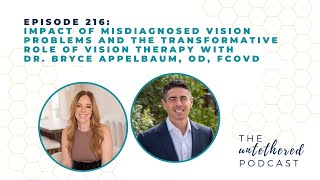
A transcript of Episode 216 of the Untethered Podcast (host Hallie Bulkin) featuring Dr. Bryce Applebaum. The conversation distinguishes eyesight (acuity) from vision (brain-based visual processing), explains vision therapy (goals, populations, and methods), provides simple home screening tests for functional vision problems, and introduces ScreenFit — an online vision-training program to reduce screen-related symptoms. The episode emphasizes multidisciplinary connections between vision, myofunctional therapy, airway health, sleep, and pediatric development, and advocates pre/post-operative rehabilitation around procedures.
Chapters
Hi and welcome to episode 216 of the Untethered podcast. Today we have Dr. Applebaum joining us. Dr. Applebaum is on a mission to join the way the world views vision. He believes there's more to vision than just 2020 eyesight, and he's developed programs to retrain the brain to revise the eyes. Dr. Applebaum has been featured on the front page of USA Today, on CBS, in the new York Times Magazine, Bethesda Magazine, and is the COVID story of OT Advance. He was a 2022 recipient of the Future of Health Award at the Mindshare Leadership Summit and has shared the stage with Dr. Joe Dispenza, Marie Forleo, and JJ Virginia. Dr. Applebaum is a frequent podcast and media guest, having recently been interviewed on mind BodyGreen, Chris Cressler's Revolution Health Radio, and Cynthia Thurlow's Everyday Wellness. Dr. Applebaum is a pioneer in neuro optometry, passionate about unlocking life's potential through vision. Quick Disclaimer all information, content and material of this podcast are the opinions of the speakers and is for the informational purpose only and not intended to serve as a substitute for the consultation, diagnosis and or medical treatment of a qualified healthcare provider. Welcome to the Untethered Podcast. I am your host, Holly Balkan. I'm a certified myofunctional therapist, feeding specialist, podcaster, business owner and mentor. This podcast is all about getting your questions answered and collaborating with colleagues to bring you the most up to date information in the orofacial myofunctional Therapy, airway, Tethered Oral Tissue and Pediatric Beating Therapy space. If you're new here, I challenge you to keep an open mind and join my mission to spread this message far and wide. If you've been around since June 2019, thanks for being a loyal listener. As we jump into today's episode, remember to listen with correct coral recipes. Posture, Tongue up, lips closed, teeth apart, Breathe through your nose. Let's get started. Bryce, welcome to the podcast.
Thank you so much for having me. It's an honor to be here, an honor to talk with you and your tribe.
I'm. I'm so excited that we're connecting. I know we were chatting before we recorded and we've, you know, we've known of each other, we've encountered each other. I think we've had patience between each other over the years and I think it's the first time we're actually sitting down and having a conversation. So I want this for us.
Well, I'll take the blame for that, but definitely this is a long time coming for this. So glad we're doing it.
It's a two way street. It's all good. So I would love to jump in and talk first before we go into other topics about the difference between eyesight and vision. So is that something that you can clarify for our listeners?
Yes, and I think I'm glad you bring this up. This should be the biggest take home of everything we're talking about today. Most doctors are solely focused on the pursuit of seeing 2020 and getting the small letters on a letter chart. But eyesight and vision are completely separate entities. And I would love if we can all start thinking of it that way. Eyesight's our ability to see whether that's letters on a letter chart or street sign or what the teacher writes on the board. In the classroom, vision is entirely brain and how our brain tells our eyes how to move together and converge and focus and process information and essentially how we derive meaning from the world around us and then direct the appropriate action. Eyesight is glasses and eyesight is a symptom. Vision is brain and vision problems are brain problems. What so many people are going to recognize today is there's a fix for so many brain problems that we maybe don't even know are brain problems through vision therapy, through certain other practices. Because vision problems are everywhere until you know what to look for. And then they're no longer hidden and then they're right in front of your face. So eyesight and vision are separate. And anyone who's had an eye exam, you need to have functional visual skills looked at. Not just making sure that we're intervening with eye disease and structure, but making sure that the brain and eyes are integrating and processing and coordinating information as best as they could.
I love that use the word function functional. That's something that I think will really resonate with our listeners because we talk all the time about how you can't just diagnose a tongue tie, you can't just diagnose a feeding disorder. You really have to look at what is happening inside the patient's mouth. What function is impaired? We can look in there and we can see what the anatomy looks like. We can see how the tongue may be able to go left or right, but is it functioning for what we need to do in our activities of daily living? Appreciate that that concept of function is function impaired. And then, okay, if it's impaired, where do we go from here? So as far as vision therapy goes, can you also just. I'm sure this is like, you know, explain an entire, you know, entire specialty in two minutes. As far as vision therapy goes though, you know, if someone was like, well, okay, well what do you do in vision therapy? Or what might that look like? Can you give kind of just a general idea of that for someone who's brand new to the concept?
Absolutely. Let's look at vision therapy as essentially physical therapy for the brain through the eyes, with the attention of teaching and training somebody to use their eyes to retrain their brain. We put a big emphasis on home therapy on top of office therapy, where ideally new learning takes place in office, reinforcement of that takes place at home. And just like any newly learned process, more you practice, the faster becomes habitual, automatic, unconscious, efficient things like that. Vision therapy has been around for 100 plus years, but it has continued to evolve, especially in the last seven to nine years, as research and studies have come out to really prove the efficacy of this type of work. But I would say from a vision therapy standpoint, at least in my practice in Maryland, we work with four main populations. We work with a lot of kids with visual developmental delays that are impacting reading, learning, and academics. Very often that can emerge as a cluster of symptoms, like what would be considered with add, ADHD or dyslexia, or the learning differences, but they're hidden functional vision problems causing those same challenges. The second would be we work with a lot of concussion and brain injury from a rehab standpoint. And there's more areas of our brain dedicated to processing vision, not eyesight, then all of our other senses combined. So it's almost impossible to not have a brain injury or a concussion and have vision not be impacted. It's just a matter of kind of at what level. Third area, we work with a lot of eye turns or lazy eyes, where it's a visual developmental delay. And when we're born, none of us have the ability to use our eyes together as a team. That comes through life experiences similar to oral, motor and everything that you work on, those skills can either be learned well or not learned as well as they could be. And that's when some interventions, attention is needed. So with eye turns or lazy eyes, you can literally rewire the brain to develop depth perception, sometimes even for the first time, and turn, you know, struggles or weaknesses into strengths or superpowers. And then the fourth area, we work with a lot of athletes, professional teams, individual athletes, anybody's visual skills can be improved. It's a matter of whether improving them does anything to improve life. And there's this huge communication problem in the medical world where all of our muscles in our body we can train, but for some reason we can't train our eye muscles, we can't train our brain's ability to use our eyes and have them coordinate as an efficient team with, with the inside and outside muscle systems. Completely not true. And when you know better, you can do a lot better.
It sounds like a similar struggle in our, in our space with. Absolutely, you know, and I think that speaks to just the medical community treating everything in silos and really having a hard time kind of holistic. And when I say holistic, I don't mean like woo, woo, sciency, you know, over to one side. I'm talking more just looking at the body as a whole, like looking at individuals, a whole person looking at the body as integrated systems. And I had, you know, there was someone who once upon a time sent to me way back in the beginning of, you know, my career, you cannot separate the sensory system from the motor system. And you know, but everybody teaches it as if they're two separate entities. And so, fine, teach it that way, but understand that it doesn't actually operate that way. Right. You got to bring it back together as far as function goes and the patient sitting in front of you. And that was, I think, one of the most eye opening lessons I ever learned because it really taught me about how. Okay, well if this is so integrated, then isn't everything else like, well, okay, yeah, that makes sense. The human body, you know, we're literally connected with fascia from the tip of our tongue to the tip of our toes. And then you've got the brain which is kind of like operating everything. And but it's so fascinating because that's just not, at least in the United States, that's just not how the medical system here works or approaches patients, of.
Course, and I'm of course biased, but visions are dominant. Sensory system, it should be what's guiding and leading. And so many sensory integration problems, or even just problems with ability to achieve at your potential has to do with your brain not filtering and processing all the sensory input it receives simultaneously efficiently. And you know, especially in my profession there, we're all very reactive and not proactive. And if we're addressing the symptoms but ignoring the problems, problems still exist. And at least from a vision standpoint, they get worse. So just being open to not kind of being tied to a diagnosis and being open to different perspectives and alternate opinions, not just second opinions, really important. And I think it definitely holds true in your field as well.
Yeah, I Love that. I always say diagnoses are great to get insurance coverage if that's what you're seeking, but beyond that, it gives you nothing else. Because every patient in front of you. Yeah, I mean, every patient standing in front of you is going to have their own set of symptoms. And like you said, it's all about the medical system treating the symptoms rather than getting down to the root cause issue. And if we can kind of figure out what that root cause is behind everything, we can get this patient truly functioning optimally versus, you know, in therapy for the rest of their life or whatever else they may need. They're not, you know, if we're just kind of slapping a band aid on the issue. So I can definitely appreciate that. I don't think I realize how much how many similarities, parallel universes we were living in here amongst, you know, the vision therapy world and the myo oral motor world. You know, it's definitely interesting. One of the other. Oh, go ahead.
Okay. I was gonna say what you brought up in school, you know, what we all learn in school is just a, a foundation that we then should continue to challenge ourselves and grow and learn from. And unfortunately in the I world, I mean, we're still teaching that neuroplasticity ends by age 8 and that a brain can't be retaught. I mean, we literally have a patient 92 and 97 in office based therapy right now developing depth perception for the first time. Definitely things slow down and we're less malleable as we get older. And both of us with young kids, we see how much our children's brains are like sponges. But, you know, with the right motivation, compliance, we can all learn how to do so many things better, more efficiently and even for the first time.
Yeah, yeah. No, it's. I feel like we could go back and forth this all day. It's the same thing with the ortho and dental world. A lot of, you know, traditional orthodontists are saying like, oh, well, we have to wait until all the baby teeth are out in order to do expansion embraces. And then, you know, but once you hit a certain point, you know, everything's fused and you can't do anything about it. And then there's the research now that's actually showing. No, that's not true. We should be getting in there between like 2 to 4 years of age and starting expansion because that impacts our entire mid phase development and their airway and their vision and all of these other things that are critical for development and we just really need to. Your molars for a fixed appliance to start expanding a child's mouth. Also, we need to be growing the mid face forward, not just laterally. And, you know, and then. But actually, even teens and adults can still go through expansion. We don't. We're not as fused as we thought we were. We can split a suture line so it's, you know, and develop, you know, additional cells down the center to regrow bone. So it's this whole very interesting conversation that, you know, the human body is a fascinating thing, but for some reason, so many providers are still stuck in what they learned in school or what was taught 50, 60, 70 years ago. It's. Yeah, it's one of the. It's like the bane of my existence. But.
But you and I are changing the game for both fields, right?
That's right.
And people are recognizing what we know doesn't necessarily have to be what guides us for the future.
Yeah. Well, and. And so you had mentioned. Right. So you work with. You mentioned the populations that you typically will see as far as, like, ADHD goes, because everyone on here knows, like, I've got ADHD that was diagnosed when I was 19, and I figured out what works for me. I know what my struggles are. I know how to turn them into my superpowers. And as an adult, I'm doing pretty okay. But beyond that, what are you seeing in the children that come in and what do you do with them to help get them functioning more optimally?
So it's estimated over 80% of what a child learns in the classroom comes from the visual processing of information. Sadly, 1 in 10 kids has a vision problem significant enough to impact learning when all of us, but specifically children, haven't developed the visual skills and abilities necessary to meet the demands they experience. Symptoms from a vision standpoint, that looks like trouble learning to read, skipping words, skipping lines, losing their place, words going into and out of focus, becoming double trouble, copying from the blackboard. And of course, challenges with concentration and focus. And just like what we've been talking about, the whole medical world is so quick to slap a label on behavior and say, oh, no, that's ADD or that's adhd, when these are hidden functional vision problems that are now made that much more of an issue where, you know, in today's world, where kids are being exposed to screens and technology earlier and earlier than ever before, and being asked to read in kindergarten before, they're very often even visually ready, if you know somebody who is a smart child who Loves to be read too, but is avoiding reading on their own or is real squirmy with their desk work or in a classroom? Seems like they're not paying attention, but instead they're looking up from the desk because they're having to rely on their ears to process input rather than their eyes because it's not providing the signals and feedback it should. Chances are there's a hidden functional vision problem and one that's very likely treatable with vision therapy. The frustrating part for me is ADD and adhd. It's not like you can take a blood test and say, oh, yes, you have this. And so many of the symptoms on the DSM 4 classification are almost identical to visual developmental delay symptoms. And at a minimum, ADD and ADHD, in my opinion, is an incomplete diagnosis unless we've ruled out hidden function vision problems first and then, okay, that applies, but this is all treatable. So to say, what portion is just vision or what portion is about chemical imbalance? Well, we can treat the vision and we can take a reluctant reader to an avid reader just based off of the ability to use their eyes together as a team. And then you see where the person's functioning afterwards. And we can even go over three quick screening tests if you'd like, for your audience to be able to identify those problems. Do you have a pen in front of you?
I do.
All right. So it's a lot easier if somebody is acting as a doctor and you're not holding the pen yourself. But even just moving the pen across midline and in a side to side and then up and down in a circle and watching the eye movements, There should be no head movements, there should be no body movements. We should smoothly and accurately track and follow by seven or seven and a half years old is when naturally, through vision development, we should have learned how to dissociate the two. We shouldn't see a face, we shouldn't see looking away. We should be able to track across our midline. And that relates to the tracking required for reading. Going methodically across a page, tracking a fly ball, or even any activity where your attention is on target as it's changing position. The second. Take that same very expensive piece of equipment here and look at the tip of the pen. Bring it down to your nose nice and slow. There should be smooth and effortless, or there should be one pen all the way in. We're looking at the ability to converge our eyes. National Institutes of Health, a mile from my Bethesda Office says that 20% of kids has a Convergence insufficiency. I think the number is probably double that now post pandemic, but it's still a high number. And what that means is not that there's trouble crossing the eyes or not that there's an issue with eye muscle strength or length. It's much more coordination and a spatial mismatch where if we're not able to see one all the way in, we're literally aligning our eyes or perceiving a target in a different position than where it is. Most reading, most writing takes place at this arm's length, distance. And if we've got fragile eye coordination and we can't even get our eyes to focus and align and converge and track appropriately, how can we then process that information at the same way if that was not the case?
Yeah.
And then the third one is. Is. Can be really complicated. Let's make it easy, though. So still hold the pen at midline. You want to cover up one eye, and the. The eye should not move, the pen should not move. Cover up the other eye. Same type of thing. If you can think about a laser beam coming out of each eye representing the line of sight, they should be pointing the same place. But what you're doing there, Hal, is if you go side to side, there should be movement. Okay, now the way to move if you're seeing. So we'll say this from. From a. Observing your child standpoint, if you're seeing the. The patient's eyes swinging in a large amount, that's a red flag. If you're seeing that amount of swing increase the longer you're doing this red flag. And if you're seeing any movement outward, also red flag. And you're looking at their ability to explore in your space to get their eyes to point to the same place. Those laser beams we talked about, when they're not able to align at the same plane, the brain either sees double, fixes the double, and fuses the images together, or ignores input from one of the eyes to get rid of the double. So often depth perception or strain or discomfort or inability to stay focused on a task at near is related to a vision problem, especially if somebody can then focus beautifully if they're watching television or listening to conversation. There shouldn't be selective attention for certain tasks, but there definitely is selective attention for certain spatial challenges. And the ones up close are very much related to vision. That helpful a little bit?
Oh, yeah. And it's so fascinating because, you know, you had mentioned at the beginning of all this that really, before an ADHD diagnosis, takes place. We should be ruling out these vision, you know, functional vision deficit. I would go even one step further to say we should also be ruling out sleep disorder breathing, because we see a lot of those same symptoms mimicked in children with any form of sleep disorder breathing, whether it's. It doesn't have to be obstructive sleep apnea. It could just be a sleep disorder where they're mouth breathing and they're not, you know, they're not getting restful sleep. And that then in turn also causes a lot of these behaviors that we might see that mimic adhd. But I'm just sitting here thinking, like, I would love to see somebody do a study where they're looking at vision and sleep and attention and, you know, like, all these things integrated, because I think there's so much more of an overlap than anyone even realizes, just in that if you are a child who's struggling with your vision and you're exhausted, what is your sleep going to look like? And do you even have the same type of restful sleep that your body requires at night to then be able to get up and do this all again the next day? So I'm sure there's some type of an integrated component here. And I. You might. I don't know if you. You look at eyes all day, so maybe you can see my face, but I have a droopy eyelid. I've got my left eye, thin skin. The age of five was, I think, my first surgery. The levator muscle is just weak. It would slip, you know, Parents took me to the best specialist, had the procedure done because they were worried that I couldn't see because at that point my lip was, like, below my pupil. So we had it done then. And then I had it at 12, before my bat mitzvah, and then I had it again in my 20s, before I got married, because those are really more cosmetic. The second and third time, as far as function goes, I. I can see, I'm okay. But I did notice that, like, in school, when my sleep was maybe impacted or I was a little bit more stressed around exam times. There were times where we went to have my vision checked because things were blurry. And, you know, I was like, I can't see the blackboard, or I can't really. I don't know what's going on, but something seems off, which then in turn would make me feel exhausted. And I just. I remember them saying, oh, this is which. Now looking back, it's sort of like I feel like I was very dismissed and didn't realize it at the time, but it was sort of written off to be like, oh, yeah, we get a lot of this in here. A lot of teens coming in who are just, you know, school fatigue and exam fatigue. And it's the stress that's causing this. And, you know, I give it three weeks, it'll be fine. Like, that was the whole treatment plan. And you know, as I look back and now where I am in my line of work, I'm like, gosh, like to be gaslit like that as a teenager and to not even know any better, to ask any further or to ask for like a second opinion or like you said, a different opinion, right? Different perspective. I'm like, oh my gosh, how many teens are out there, like, struggling with this thinking like, oh, I'm just stressed around exam time. But no, actually there's more going on.
And I'm sure you probably recognize your sleep and your symptoms were different on school days versus weekends when there's more visual demands. I mean, that lets you know this is like a glaring issue right in front of you. And stress in general is the root cause of so much dysfunction and the vast majority of health problems. And as humans, we have two options with stress. We adapt or we avoid. Well, we can't avoid certain things if we're in school and if we're having to move forward. But the adaptations, the maladaptations, that's really the root cause of almost every vision problem that's functional. We literally can get to a place where we establish the appropriate foundation visually to meet those demands so that we can thrive in an environment when we're staring at screens all day or when we're reading forever, even though we're not meant to be doing those things. As humans, we can train our brain and our body to be able to support those demands so that stress doesn't have the same impact. But I would imagine you're probably told Far Away is getting blurry. Here's a crutch, here's glasses to make Far Away clearer. That then becomes your new normal, and then you adapt to that, and then the cycle continues. This is mind blowing for most people. Your glasses prescription shouldn't really change unless there's a functional problem in place that's allowing for that distance blur symptom to emerge. And very often that's based off of up close, the different systems fatiguing faster than they should, disengaging, not maintaining flexibility. And then Far Away gets blurry. Whereas if we address the near problem, Far Away Actually gets clearer based off of the problem no longer existing.
The whole thing is so fascinating to me. I mean, and I actually am the only one in my family that does not wear glasses and has always had like 2020 vision or whatever, you know, or better than 2020 eyesight. Thank you. Yes. I say I'm still learning here. Yeah. So it's, you know, but it to then kind of separate the two. Right. Because that was where I was go with this is. I've always been told, oh, it's perfect, it's perfect. And then I'm over here, you're talking and I'm going to. I don't like reading books. I love listening to audiobooks. But I'm a very visual person normally. So for me to not like reading because I will sit down, read a book and fall asleep in five minutes because it's probably just too taxing on my brain. Whereas I can put on an audiobook and go for an hour long walk and I'm like super engaged in it now I might have to stop and like rewind. And you know.
You'Re a bright person, you want to, you want the information, but you're literally not relying on your dominant sensory system. And we kind of have a joke at least in my office where if somebody's using reading as a sleeping pill or is falling asleep with reading, that's a clear sign they have a problem that we can help with. And you brought up the only one in your family without glasses. There's so much myopia is increasing at a alarming rate right now, especially in countries that value technology and education. And I think currently about 42 to 44% of America is nearsighted. In 1970, when we landed on the moon, it was like 25%. And it's estimated by 2050 that half the world will be nearsighted.
Wow.
And there's lots. There's two main components, genetics and environment. But the genetics component, if two people were to have a child today and both parents were nearsighted, their child would have a 1 in 2 chance of being nearsighted. If only one parent was nearsighted, that child would have a 1 in 3 chance. And if neither parent was nearsighted, the child has a 1 in 4% chance because of the environment and the environment being so different for our kids today than when you and I were kids. And that's, you know, we're creating this nearsightedness. So you being born now, maybe you wouldn't be in this. It probably likely would not be in the same place as when you were born. When you were born? Yeah, 20 years ago. Because you're 20. 20 years old. So.
So obviously you don't know my case and we can, you know, we can go past this quickly, but, you know, as far as the eye surgery goes, like, is there a way to prevent an eye surgery and a five year old who may have like 8% with a droopy eyelid, you know, Levitter muscle that's supposedly weak?
Absolutely. For the outside muscles for eye turns. The vast majority of eye turns have nothing to do with eye muscle strength or length. They have to do with coordination, not developing the ability to use the eyes together as a team. It's a brain problem showing up in the eyes. So often when a child has an eye turn, the first questions I start asking is, tell me about overall development milestones early on, crawling, walking, walking, talking for so many reasons, but specifically crawling kids who skip over crawling or walk too soon, which crawling is now apparently not on the, the classification for what's needed for milestones. That's ridiculous. But they have a significantly higher likelihood of developing lazy eyes or eye turns. And honestly, almost in every case it's like, oh, yeah, we, he didn't really crawl, he was scooting or he just went right to walking. The world goes from being static to dynamic. And the fragile eye coordination means your brain then picks an eye so it doesn't have to use both together very often. With eye muscle surgery, best case scenario is a cosmetic cure. I would argue there's never a functional cure because learning needs to take place to develop depth perception and to develop these visual skills which can happen if things are rerouted. But we would never have knee surgery without doing PT first. Yet often we have eye surgeries without doing, you know, like phrenectomy for the top.
Yeah, we just go right.
It's ridiculous.
Yeah.
For the, for the levitor, for the upside muscle, the muscle that it sounds like you had surgery on, there's definitely conditions where, you know, it's structural and there's not much you can do. But the fact that yours was changing with time shows something had been evolving. Something had been changing. And we see lots of patients who even now come in unable to open an eye or unable to open both eyes. And the cases that we're working with are more complicated than ever. But we'll see people who almost have a visual mental breakdown from too much screen engagement or something traumatic in their life. And the referral is this person is unable to open their eyes and says, they can't in evaluation. I mean, we physically lift up the lids and we see maybe there's an eye in. Or there's a certain challenge that that's almost a protective mechanism in place. So you and I are going to talk after all this. I want to give you some stuff to work on.
Yeah. As I'm sitting here, I'm just like, wow, okay, well, clearly it's time to enroll in vision therapy.
Yeah. And then we have some other. With some online versions of Health.
And I know we'll talk about that in a mom. But it's just fascinating to me because when you said we are literally like our worlds are parallel, when you said that people go for vision therapy and you use that example of. Or, I'm sorry, for surgery, eye surgery, and there's no pre op, post op to even prep them or how do we know we're getting functional gains? We don't. We have no baseline. And we also. I love when people come afterwards and they go, so I had this procedure and now I'm being told I need X. And we're like, great, okay, let's see how we can help you. We'll do our best, but like, it would have been really great if you had the therapy beforehand and after. And that's. It's the same thing with the frenectomies. And this is why, like tongue and lip tie releases. Get there such a red hot topic right now because people just go in and they release. They're not always releasing. Well, depends on the provider. There's a whole big conversation around that. But a lot of them are not having the necessary pre op or post op surgery. And then we're seeing tissue collapse on itself. It's coming out tighter than it was when you went in. But the one thing we say to everybody which sounds like it's very similar is if we haven't trained the tongue in layman's terms, to basically attempt to function more optimally and to reduce as many compensations as possible before going for the procedure, how does the tongue know what to do afterwards? And we have seen this where we have patients, you know, we've had patients come after, like I was mentioning, that did not have any pre op. We've had patients who have had the pre op and you see a huge difference between those who are ready and we, everybody on the team signs off on the procedure happening when it needs to happen versus those who just go in for a procedure and then come to you several months later going like, this didn't work. And we're going, I know why. I know why it didn't work. The tongue doesn't. You know, tongue is just going to lay on the floor of the mouth if it's, if that's where it's lived its whole life, it's not going to know just because the procedure has released the tight tissue, it's not going to know where to go. It's not going to know how to function, it's not going to know how to move food around the mouth, prep a bolus, swallow. All these important reasons why we went into the procedure in the first place. And so that's sort of the bane of my existence in terms of one of the reasons why I even started this podcast was just the advocacy, the education. You know, having been there as a parent, I had a child where we went for a tongue tie release at 24 months and we had some gains. But I also then had to work with her afterwards and always to this day wish that we had done pre op, but I didn't know at the time. And so even being in this space and having probably the best access to this information, I didn't even know. And that's, you know, it's so prevalent.
The parallels are nuts between these fields. And I'm just thinking back. My three kids, when they were born, they didn't have the ability to use their tongues with intention and the control that they have now. It's learned. If there's certain roadblocks in place or we haven't learned how to do things naturally, why not teach it as the first step to avoid an unnecessary surgery? And not that we should ever let fear guide any decision, but I literally saw a two and a half year old last week who went in for a particular surgery that you've already mentioned and had an overdose of the medication. And she's now cortically blind and she's coming to us. So the parent can sit because the parents are saying that we're told by everyone at all the fancy hospitals here that she'll never be able to use her brain for vision or for anything else. And this young, young child can see her brain, just can't process it. And there are certain tests we did to be able to identify there is a prognosis that's much greater than where she is now. But we literally have to reestablish function and teach what has been lost or wasn't learned. And thinking back to all of this, I mean, the mom was in tears saying, if I hadn't done this this surgery for a tongue, I don't even know exactly what it was, but I mean, this would have been avoided.
Yeah.
So thank you so much. I'm so grateful for your education. And you don't even know this. I had one of my kids go through speech therapy at your practice.
Oh, you did?
Recently. Has. Now is with her orthodontist and he was blown away at the changes that they had noticed. And now she needs a palate expander. Embraces for way less time than she would have otherwise because of the work that you and your team did so well.
So I did know the last name just by nature of, you know, I. So I do have oversight over the practice, but I did not. That child was related to you. It's so funny.
Awesome. Well, we love the experience. And even I told her we were having this. This conversation today and she. She asked me to say hi.
That's so sweet. Well, I'm glad to hear that everything is going well. And it's. Yeah. I mean, when you look at the functional implications of what's going on and we work from a place of trying to regain function, that's going to look different for every patient. But there are ways that, you know, you and I, through the type of work that we're doing, we know how to accomplish that. And, you know, and my goal is always to avoid a procedure if we can. And you know, at the end of the day, do some kids still. Is a procedure still warranted? Yes. Now, we are not the ones who make that determination. That's out of scope. But we will do everything in our power to try and gain function to avoid a procedure. And then if a procedure is necessary, then the work that we're doing is really prepping you. It's like you said, it's, you know, you don't go in for a knee replacement without physical therapy. First it's the same idea. And now I'm like kind of going, oh my gosh, who is this person that you mentioned? And do I need. I need to know who this person is that overdosed this child. Like, where did this happen? I hope it's not one of our referral sources, but I mean, it was.
At a hospital that has a great reputation.
Okay, I will tell you, we do not refer to any of the hospitals in the area for these procedures. That is not where we have found these providers who are highly skilled in release it frenectomies and everything for neoplasties to be. Just as a side note, I don't know who this person is. We won't out them. But, you know, it's, it's, it's curious with.
Yeah, I'm curious with your profession. I mean, so for vision therapy, there's not, it's not like physical therapy where there's a sprained MCL and you need a dozen sessions. And here's what it looks like. There's not consistency on what vision therapy looks like. And Even in the D.C. maryland area, there's six or seven thousand eye doctors. There's only seven of us who are board certified in vision therapy and rehabilitation. Even among those seven, evaluation wise, it's very similar, but treatment and what's done, very different. And our model is we're integrating cognition and balance and movement and vestibular input from day one because our visual system doesn't operate in isolation from other systems. I'm in the process of creating protocols to train other doctors. But is that, I mean, I'm sure a lot of the work you guys do is kind of groundbreaking in terms of being progressive and obviously not what is considered a standard of care. Do you see that a lot as well, where somebody said, oh, I did speech therapy and yeah, I'm still, you know, noticing that I can't pronounce the R. Yeah.
Oh, yeah. So we, what we do, there's like a divide down our profession and we joke because there was a, an osteopathic doctor who said, tongue ties are not a religion. You don't need to believe in them. It's not like, you know, because people are like, well, I don't believe that tongue ties are real. Okay, that's great. It's physical, like physically there, tight tissue exists. Right. So it kind of goes the same way for our approach to treating feeding cases and myofunctional therapy cases. And, and myofunctional therapy has been around for like 117 years because there's such a void in, in the field in terms of finding providers who truly get it and can treat from this perspective. I basically went and created that course and then I was asked by everybody to create the myo version of the feeding course that I created and I adapted also, like the myofunctional therapy and tetheral tissue, you know, teachings, if you will, to the birth of 5 population. Because your traditional myofunctional therapy doesn't even start until you're around four or five years of age, cognitively, not chronologically. Right. It's like a cognitive age based on what we're asking the child to do. So what we have found is we get all kinds of kids who have been in 5, 10, 15 years of therapy. And I mean, one of my favorite cases that I personally treated was a almost teen who was about to go to high school who just wanted to be able to say Rich. He just wanted to be able to say his Rs. And when I looked back at the history, the kid had been in speech therapy for like 11 years. That's basically almost your entire life, right? You're now just going into middle school or high school. Sorry. And so the parent was just like, this is our goal. Can you help us? And I was like, I think I can, but like, let's, let's see what happens. So we took a myofunctional therapy approach. Now this kid did have an oral anatomy that required a release and went to an oral surgeon. Oral surgeon said, I've never seen like so much tissue underneath a tongue that basically it almost need to be reconstructed in the sense. So but the fact that nobody had ever looked in this child's mouth and he had been to seven speech pathologists in the D.C. metro area, I mean, it just, I was like, okay, enough is enough. Like this is, this is just mind boggling to me. Because once the, once we prepped him, he had the procedure, we did our myo and everything before and after. How much easier is it to then teach that R? And R is like its own vocabulary. There's like I always Forget but like 26 variations of R. You've got pre vocalic, post vocalic. You've got R in the beginning of the word. You've got like all of your different Rs. So that's one of the reasons why it's such a hard sound to treat and why I think a lot of people kind of like know R to be one of those pain points when you talk speech therapy. But we were able to have him work with somebody just to kind of do a lot of drill between our sessions so that we could just train his tongue. And yeah, I mean, he went from presenting as a two year old on our standardized test when he started with me to presenting at the age appropriate level within six months. It was like start to finish with six months. Now that was a more extreme case, if you will. But then we've got kids who are coming to us who have really inflamed tonsils and really inflamed adenoids, and we've got aunties who are saying they're fine. I mean, this happened to my own kid. They're sending them away. The kid's fine. They'll grow out of them. And I'm like, this kid's mouth is hanging low. Like, their mouth breathing, the tongue is on the floor of their mouth. They're constantly sick because kids who breathe through their mouth are constantly bringing all the viruses and all the germs in. There's nothing filtering it out because we're not using our nose properly. And they're just kind of pushing them to the side. And we're over here going, well, hold on, let's work on this. Let's work on teaching nasal breathing. But also we have to make sure that there is an obstruction that's working against us. We run into this in so many different, different ways within our practice, because the way that we approach every single patient that comes in is very different than your typical speech therapy practice. You know, we parent calls us and says, my child can't say R, or my kid's a picky eater, or we're struggling a little bit with language or whatever, and we're going, how does your child sleep? How does your child breathe? How does your child, you know, what does your child look like during the day? How does your child look in the afternoon versus the morning? How many buckets of energy do they have left, like, by the time they get to school, like, what? And it's just a very, you know, we still ask all those same traditional questions on our intake, but we're also, also asking all these other questions because in my opinion, and in my experience, if we don't take this holistic approach and really look at who the child is, how they're presenting and what they're struggling with, functionally, we're not going to help them, and they're going to stay in speech therapy for the rest of their life. And I mean, I always joke I would rather put myself out of business and not have enough clientele because we can get them and get them out much faster than have these lifers, as people call it in the speech therapy world, who are going to be on your caseload forever. So, you know, that's. That's kind of where, where I come from on the, you know, on this side of things. But, yeah, it 100%, and I will say more people in the D.C. metro area are taking the courses and they're starting to kind of open their eyes to this in the speech pathology world. And so we are increasing with the number of practices that, that understand, whether they offer it or not, they do understand airway, you know, functional airway, functional Feeding functional, you know, activities of daily living, which I feel like is always more of a ptot conversation and really needs to be brought more into the SLPS world because everything we should be doing is for function. Breathing, sleeping, eating, speaking. I mean, hello, stuff that matters. Kind of like what we do every day.
I love that you're asking these questions because you're looking at the child as a whole person. And I would imagine right from the get go, you're establishing trust with the families because they recognize you all are different. You're asking things that matter. And again, the exact same parallel with us. Like, I ask very intimately about motion sickness and avoidance of ball sports and balance and coordination and, you know, certain headaches and certain types of symptoms, because those are clear windows of. There is a functional problem here and one that we can help with, but that most doctors will say with motion sickness, oh, no, it's your inner ear or it's something else. About 80 to 85% of motion sickness has a visual component. And especially those that symptoms get worse when they're reading on a tablet or in the backseat of a car. And it's way better if they're over 16 and they're driving because they're overriding input in front of them. That has to do with faulty central peripheral integration and these two different systems in our brain that we're supposed to filter and use at the same time. But again, under stress, we shift to this focal central processing where it's like we're looking through paper towel holders with tunnel vision. And then all of a sudden our brain gets in this disconnect of what's moving, what's in front of me. And then that's usually the root cause of at least a large portion of that hypersensitivity to motion.
That's incredible. And then, so speaking to that too, like with car sickness, I saw that you kind of. You noted that here. So how does that relate to then people? So some people get car sick and some people don't. And would that be the same thing when you're on like a boat, like you're on a. And you get kind of like that, or is that totally.
It's definitely related. You know, in most cars you're typically going this way, so your vestibular systems activated forward and backwards. I have a gentleman in therapy with me now who's top goal is to be able to read on a subway, going sitting sideways or backwards, which were actually pretty much at his graduation point. So he's pretty much there, but. And he had Way other problems, bigger problems. I said these are all even, even more important. But I think depending on the positioning, definitely it matters in a car and, and if balance is impacted and if it's, you know, eyes open versus eyes closed, the symptoms are different. That's, you know, a slam dunk. Very often motion that comes with, you know, plane acceleration or deceleration or boats or other things actually has to do with inflammation systemically. And so often the neuroinflammation that occurs, especially after a head injury, shows up as vision problems. And that's just a piece of the puzzle. But that can be treatable if we're addressing this from a nutrition supplement, lifestyle modification standpoint on top of, of the vision that's needed.
Well, it's just also fascinating. I mean, it's, you know, I, I'm like sitting here as we're talking about this, thinking about being on a deep sea fishing boat and I was the only one who like did not get sick. But I went inside, I laid down, I closed my eyes, and I was like, just gonna chill here. I'm just gonna, you know, like I'm, I'm not getting sick like everybody else is. You know, it was. And I know deep sea fishing is its own beast, but, but you mentioned like, whether your eyes are open or closed changes things. And I'm like, like, hey, clearly, you know, I think I was 11 at the time or I mean, I was a kid. So for me to like even think, to like sit down and do that, just to kind of calm my whole nervous system, that was, that was really all I knew and it worked.
I would say it's very rare to have somebody go through office based vision therapy with a doctor who ex. Who started off with motion sickness and didn't see a huge improvement or resolution. And the cases where that doesn't happen is there's Meniere's disease or some sort of inner ear problem. But even with that, I mean, based off of how much how visually demanding our world is, there's almost always a visual component that's at least improvable.
I love it. I love it. Well, okay, so I want to shift here a little bit because I know that you've got something you've created and I think that it's a really good conversation. So I want to make sure we have enough time to discuss screen fit. So will you tell us a bit about what screen fit is, why you created it? I'll just, I'll turn it over to you.
Yes. So, you know, when you and I were kids, we played outside all day long and our parents had to drag us in to because it was dark out, it was dinner time and we're either playing ball or with friends or climbing in trees. It's now the complete opposite where our parents are dragging kids outside. And I'm guilty of this with three young kids as well, where social media and technology and tablets and gaming in the basement and doing God knows what else they're doing in the basement. I mean, it's a completely different world. And the visual world that our kids are growing up in right now is very different than it was a generation ago and obviously even more generations ago. Our visual system is intended to help us guide movement and to engage with a three dimensional world, not to be stuck in a two dimensional device. We could talk for a long time about the problems of screens and how that's impacting dryness and disrupted sleep and circadian rhythms and inflammation and lots of stuff. But for me, there was a clear moment in late March of 2020 where I came home early from work because work was hard at that time for most of us to even find work. I remember walking in and I saw my youngest, who was 2 at the time, on a play date. And what that meant was she was staring at a computer screen for two hours with her preschool class, having a get together and seeing her face, I mean she's like, what are all these buttons? What's this light? Why is Madeleine here? But she's not. She'd literally never seen a computer before. And then my twins, who are five at the time, were in opposite ends of the basement on their tablets, buried one in the dark and with a sheet over their head. And clearly we were not household that supported screen use at such a young age, much less at all. And yet here they were compulsively engaging with these tech driven devices, seeking out that dopamine hit. And for me that's kind of when the light bulb went off, when I recognized for them and for all kids and all men and womenkind, screens aren't going anywhere. And this is going to become a bigger and bigger problem unless we do something about it. And so, you know, at that point I was recognizing this is a whole new pandemic that's going to unfold right before us three years later. It is exponentially worse than I even thought it would be. And so that for me was when kind of the birth of occurred of screen fit. And so what screen fit is, is it's an online vision training program designed to minimize the damage that screens have on our vision, reduce symptoms associated with prolonged extended screen use and help establish more mindful habits for staring at screens. So it's a kind of revolutionary vision wellness program essentially where in our beta test group we had the youngest patient in, there was five and obviously mom and dad were helping them go through this. And our oldest was 89. And every single person in the beta test group saw reduction in symptoms. And now that we have, you know, a large number of people in there in the program and we're gathering all this data, it's crazy how effective this is at just kind of like viewing it almost as like sit ups, push ups and air squats for your body, but instead for your visual system. So it's a daily exercise, 10 to 15 minutes a day. There's two courses. Each course has 30 lessons. So if you did it five days a week, that would be six weeks long. If you did both courses, that'd be 12 weeks of programming. And it's intended to establish the right mindful habits in place so that bad habits don't become embedded and that we can learn how to use our eyes together as a team and we can develop the skills and strategies needed to stare at screens forever. And although promoting a program to reduce screen engagement, but relying on screens to do it is a little counterintuitive for many people. So we created these really short, powerful videos that limits the amount of time that the user spends engaging with the, with the screen and with the device. They're all exercises that many of which you can just do without even a tablet. Once you know what to do and how to do it, you can do it, you know, stoplight at night or in the morning, in between patients, or in after school. And it's, it's a wonderful program that I think a lot of people are going to start hearing a lot more about because of the attention. There's a very large government agency that's going to be mandating this for its employees. We have lots of other companies using this, but also functional medicine has really adopted this as their baby. Recognizing this is the problem. This is the problem we're all facing with this new pandemic. And we have a solution or at least something that can help move people along in a much more favorable, much more favorable path. So it's screenfit.com and we actually have a coupon code for your audience. Untethered will get them 10% off of enrollment. And it's ideally for major eye problems, Eye turns, lazy eyes, big head injuries, office based vision Therapy and getting an evaluation from somebody board certified in functional vision and vision therapy is the gold standard. That will never change. But a program like this that can have, that can help pretty much everyone and anyone without any negative implications we've created so that it's a lot of one eyed work and the other eyed work and then followed up by two eyed works that were equalizing skills between both eyes. So we're not making bad habits worse, but it's pretty powerful. And I'm so excited to have screen fit earn vision therapy and a lot of functional medicine, a more stable seat at the medical table. Because this is where we're all facing what we're all facing with life these days.
Oh yeah. I mean it's, it's incredible. I mean, you nailed it with. Well, first of all, screenfit. Yeah dot com. We'll make sure that that's in the notes so everybody, in case someone's driving listening to this. And then the, the code untethered. We'll put that all in writing. So if you're driving, you know, don't drive off the road. But thank you. Yeah, absolutely. But it's your. You nailed it. I mean, you're absolutely right in that when I was growing up, my dad would literally whistle. Like he would do his big whistle and I would be like, oh, that's my dad whistling. I have to come home now. And wherever I was at a neighbor's house, like down the street somewhere, I could be inside and I would still hear him whistle. It's like it was so loud. But I would know like, okay, it's time to come home for dinner. Right? We, that's what we did after school is we went and we played with friends. We were playing sports, we were playing, you know, in people's basements. We were like, that's just what we did was we. She interacted with other humans and nature. And now it's like the kids come home and they're exhausted and the first question my kids will ask me is, can I have iPad? And I'm like, get out of here. No, you can have iPad. And we recently. So I had, we kind of had fallen into this like, you know, is your homework done? Is there anything else that needs to be done? Okay, if you've done that, you can have some iPad before dinner. And I just noticed their behavior had really changed a lot. And so about a month ago I was like, I made a decision because it wasn't my own decision. A friend of mine has, doesn't let her kids use the iPad during the week and get iPad on the weekends. So I was like, oh, I like that idea. We're going to try this out in my house. So we implemented a little heart chart where they're working towards getting the iPad on the weekends so that it's not just a given that we get it because it's a Saturday or Sunday. But oh well, you know what, we did a good deed. And I didn't compare everything in life to my sister and all the other little pain points of being a sibling, being a child and you know, having it so rough. No. So they, at first, you know, they really balked at like wanting the iPad because I was like, no, it's a weekday. We're not, you know, you've got school tomorrow, you had school today. We really need to, let's go play, let's go do something else. Let's use our brain differently. And after about five days they stopped asking. And it wasn't really, you know, all of a sudden it was like, oh, well we can go and we can go to the playroom and go play with this or oh, can we go ride bikes outside or can we go in the pool or can we do that? You know, I was like, okay, that was much harder, like much easier than I thought it was going to be to kind of get them off of that. But it just kind of went to show me how unhealthy it was. And you know, and I'm not, you know, I'm not shaming anybody. If that's what you choose to do for your child or that's how you survive your, your, you know, your after school hours, that's by all means you do you. But in my household I was like, something has got to change because my kids behavior is atrocious and it's stressing all the adults out. We need some change. And it's really, really incredible to see how, you know, taking them off the screens after school has just changed them because they're on screens during school. Even my 5 year old who's in pre K is using some screens at school, much less than my other daughter, but she's starting kindergarten. And you, you said, you know, it's like they expect them to read way too early. They all of a sudden she'll be on a Chromebook come August. So that, you know, we went to orientation and the one thing they said was get your kid a Chromebook and, or at least make sure they know how to maneuver a mouse and a keyboard. And I'm sitting here going like she just turned five.
What you're bringing up is. That is the problem. Screen use has been on an incline for decades. That's nothing new. But what has changed now is in 2020, screens were catapulted into learning, into education, and now they're here to stay. And we now have researcher support that's impacting social development, emotional development, cognitive development, and of course, vision development. And then for all aspects of life, it's taken over the workplace, it's taking over shopping, it's taking over dating, it's taking over conversing with your neighbor.
And yet everyone's taking over a job now with AI. I mean, yeah, it's crazy.
Crazy. So. And what's an interesting stat? The average American spends seven hours and four minutes a day on a screen. I mean, that's average. Which means many people are way more than that. But I love what you did with your kids because, you know, it. There's so much benefit of doing that. And there also are, you know, certain protective things we can do from a. From a prevention standpoint. You know, there's digital performance lenses that I prescribe for pretty much every child, which is the. The least amount of. Plus magnification that gives the most improvement, that improves performance, along with a certain blue light filter, which literally acts as, like a spot. If they're looking at a screen, it's not a spot. If you're lifting weights, it's not doing the work for you. It's ensuring the right habits and behavior in place. You know, we can actually slow down the changes and with. With the right training, actually make it so we can handle those demands. But we need to get our kids outside and to get our kids playing and moving and taking as many breaks as possible with any screen engagement, much less near engagement. And you've probably heard me preach the 20, 20, 20 rule, you know, at the absolute most, not more than 20 minutes on a screen without taking a break for at least 20 seconds and looking something 20ft away and resting our eyes, resting our focus, and then coming back, but take a step further and just say, no screens on weekdays. Sorry.
I love that really cruel mom over here. Yeah, no, I mean, it's. It's been incredible. It's been incredible. And, you know, it's like my daughter had, you know, her friend's birthday was coming up, and we were trying to figure out what to buy her friend for a birthday. And so I, you know, I said to her, I was like. She was like, well, I'm not allowed to use my, My My screens. And I was like, well, this is a functional activity that we are choosing to do together. So you may have the computer for 15 minutes before dinner. Time to research, you know, basically do some research, like intentional research on what you want to get your friend for her birthday. And so she's like, okay. But I mean, it's, you know, I think also not just for me, it's a babysitter, right. That, that screen, it's so easy for me to allow it to become a babysitter, and so I can go get done what I need to get done as a. And, you know, no matter how many adults you have or don't have in a household, it's an easy babysitter. You know, I'm not going to knock that.
There's a time and a place for that.
Right. But at the same time, when I started to see the, you know, the glaring effects of what it was doing to my kids and how quickly that changed after I removed it, I was like, holy cow. Okay. I should have done that sooner. But, yeah, no, I'm. I mean, screen fit sounds like an amazing thing that we're going to implement asap, too, because obviously my kids are still spending plenty of times on screens. And, you know, it's. It's something that just by nature of, like what you said in school, if your kid gets no screen elsewhere, but they're enrolled in a public school or a private school, they're probably on a screen for a portion of their day. And, you know, this is younger and.
Younger, and it's not going anywhere. I think that's the other big piece is, like, this is going to continue, and there's definitely benefits of engaging with technology and. And pretty soon our young kids will know more than you and I do, Hallie. But at the same time, like, at what cost? And a lot of the problems that come with that from a vision standpoint can be rerouted. We just got to be mindful and jump on it quickly.
Well, this has been amazing. I know. We've covered so much. Is there anything that we didn't cover that you want to share or. Last note, you want to share with the listeners before we wrap up?
We got. We have another two hours. Right. There's a lot I'd want to share. I mean, I think, honestly, the big take home is eyesight and vision are separate entities. If any of this resonates with any of the people listening today, or if you're thinking of somebody who we've described with symptoms or behaviors you didn't know about any of this beforehand. But now that you know, we all have a responsibility to speak up and to act and not let people struggle unnecessarily in life because of hidden or misdiagnosed vision problems. So when somebody says, oh yeah, you see the tiny letters or they're 20, whatever, first of all, we should all be 20 happy. Rather than having to see the tiny letters perfectly. But you know, ask about vision, don't just ask about eyesight. And many of the people listening today who saw us do those exercises at the beginning or the screening tests, you literally know more than a lot of eye doctors do in terms of what to look for and then where to send them to or how to help. You know, there's a, an organization called covd.org, which is the international organization that board certifies doctors in vision therapy and rehabilitation. There's a located doctor section you can put in your address and it'll say anyone within a certain radius on who is there. You want somebody with the letters F C O V D after their name, which means they're a fellow of the College of Optometrists and Vision Development. That means they're an expert. And if they're on that website, they know what they're doing. But, but if you have a choice, I would say let's see an expert. And then from our practice standpoint, we're now seeing more people than ever flying in from out of state and out of country for boot camps or intensive programs. That's always an option. And if anyone wants to reach out to me, just mention Hallie's name and we will take good care of you and make sure we can get the care we need for all of that. But so much vision related and everything that you're doing is, can be looked at through a different lens. So hopefully that opened up everybody's eyes today.
I love that. Well, Bryce, thank you so much. This has been absolutely incredible. I'm excited for everybody to hear all about this because like as we've now, as we now know, there are a lot of parallels between both of our worlds. And I really think that at the end of the day there's a nice marriage here between both vision and the myo stuff and mid face development or deficiency and just there's so many interconnections. And so I'm, I'm excited to see where this goes. But I'm, I'm glad that you, that you joined us and you shared all this information because I think there's going to be a lot of light bulbs going off for our listeners.
Grateful to be here and honored to speak to your audience.
Thanks for listening to this podcast. If you found value in this episode and want to hear more of these Myotots, Airway and Feeding related episodes, be sure to leave a review on Apple Podcasts and share this episode on your social media platforms. You can access free resources and all I offer@halliebalkin.com or pop over to Hollybalken on Instagram to get all the latest updates.
More from Hallie



What I Was Missing in Feeding Therapy: ARFID, Airway, and Myo with Samy Hernandez





