Episode 218: The Three Pillars Approach with Jessica Altemara and Dr. Ray Tseng
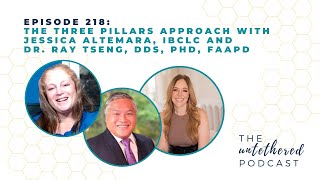
Episode 218 of the Untethered Podcast (host Hallie Bulkin) features Jessica Altamira (IBCLC, integrative tongue tie practitioner) and Dr. Ray Tseng (pediatric dentist, director of the North Carolina Tongue Tie Center). They describe a centering-style, three-pillar model for diagnosing and treating tethered oral tissues that combines structural assessment/release, functional care (IBCLC, SLP, bodyworkers, myofunctional therapy), and informed/shared decision-making with longitudinal follow-up and community support. The episode covers clinic workflow (group visits, prehab, manual therapy, frenectomy, 1/2/4-week follow-up and 1-year checks), data collection/research needs, interdisciplinary collaboration, informed consent, and the harms of ego/gatekeeping in this field.
Chapters
Hi and welcome to episode 218 of the Untethered Podcast. Today we have Jessica Altamira and Dr. Ray Zhang joining us. Jessica has been invested in helping families struggling with oral restrictions since giving birth to a tongue tied baby in 2005 while working as a Lelecha League leader and birth and postpartum doula medically complicated herself. She's an appreciation for seeking answers for her favorite question why. Her doula background added an appreciation for the importance of whole person approaches. She earned her IBCLC credential in 2009 and started a private practice in the Triangle area of North Carolina in the United States. She provides home visits there and also works regularly to provide integrative care for treatment of ties and infants through the North Carolina Integrative Tongue Tie Center. She's worked with multiple practices to initiate an integrative model in multiple geographic areas. She's excited to see so many families fully supported by the three pillar approach as well as enjoying time with her husband and four children ranging in age from 20 to 10. She's also on the Board of Directors for ICAP and passionate about creating community. Dr. Ray Zhang is a pediatric dentist and owner of High House Pediatric Dentistry with practices in Cary and Fayetteville, North Carolina. He's also the Director of the North Carolina Tongue Tie Center, a center for research and clinical practice. Dr. Sang was an NIH funded clinician scientist trainee and earned his DS and PhD in Oral Biology and Immunology at the Ohio State University College of Dentistry. He completed his Residency in Pediatric Dentistry and an NIH supported Postdoctoral Fellowship at UNC Chapel Hill and the Adams School of Dentistry and Gilling School of Global Public Health. Dr. Tseng is an Adjunct Associate professor at the Department of Pediatric and Public Health, Adams School of Dentistry, University of North Carolina at Chapel Hill. Dr. Tseng has been practicing pediatric dentistry for 11 years and diagnosing and treating lip and tongue ties in infants and children for five years. He started the North Carolina Tongue Tie center focused on research and clinical practice. Dr. Singh is on the Board of Directors for the International Consortium of Ankle Fragility Professionals, an international society for tongue tie clinicians, health professionals and researchers. He's also created and co chairs serious ICAP's Scientific Affairs Committee. He has created an evidence based practice and treatment protocol, produced clinical evidence related to lip and tongue ties, and continues to collaborate with other Angloglossia and tongue tie health professionals. Quick Disclaimer all information, content and material of this podcast are the opinions of the speakers and is for the informational purpose only and not intended to serve as a substitute for the consultation, diagnosis and or medical treatment of of a qualified healthcare provider. Welcome to the Untethered Podcast. I am your host, Holly Balkan. I'm a certified myofunctional therapist, feeding specialist, podcaster, business owner and mentor. This podcast is all about getting your questions answered and collaborating with colleagues to bring you the most up to date information in the orofacial myofunctional therapy, airway, tethered oral tissue, and pediatric feeding therapy space. If you're new here, I challenge you to keep an open mind and join my mission to spread this message far and wide. If you've been around since June 2019, thanks for being a loyal listener. As we jump into today's episode, remember to listen with correct oral rest. Posture, tongue up, lips closed, teeth apart, breathe through your nose. Let's get started. Jessica and Ray, thank you so much for joining me today. I'm excited to have you here.
Yeah, I'm excited to be here. To be here. Yeah.
So we're going to dive right on in and I, you know, you all were referred to me and you know, it was suggested to have you on the podcast because of this beautiful model that you have, you know, come together to offer your patients. And so I would love to dive into the history of that model and, you know, sort of how it came to be.
Hallie, I have to say, like, first, I feel like I need to start with how incredible it is that we're doing this on this day because 18 years ago today, my tongue tie journey started. And so it's just this incredible, like, full circle timing because I was in the process of becoming an ibclc. And as most people, but not everybody might know, it's the only lactation credential that requires people to have clinical hours of experience before getting the credential. And so I was in the process of getting those hours working as a leche league leader, a birth and postpartum doula. I, I knew, like more than most people, I consider myself an expert. As happens when you're new with things. I, I didn't know as much as I thought I did, but I, I was like, yeah, breastfeeding is going to be easy because I know a lot of stuff. And it turns out knowing things doesn't make your baby good at breastfeeding. But we were just such a train wreck and I didn't know why. And the other crazy timing thing is that Ray and I just got back from being part of strategic planning for the board of Directors for ICAP in Washington D.C. and it was six weeks after I had that baby, when we were still a complete train wreck, that I ended up at a conference in Washington D.C. where I wouldn't have gone except I paid a bunch of money before I had him to be at the conference. And I kind of ended up accidentally in this session where somebody was talking about tongue tie. And in 2005 there were not a lot of conference sessions about tongue tie. So it was like down a dark hall with three speakers, right? This was 13 people in the session. And that session was. The person who was talking about it was Kathy Watson. Jenna, who is now like a world renowned expert in these things and many other things. At the time she hadn't really published anything yet. You know, she was someone sort of just speaking. But she was incredibly generous with her knowledge with me from there. And through that connection and other connections I made, I started being able to collaborate with people all over the country and all over the world who are also engaged in like oral restrictions and everything that ripples out from that with feeding and airway and ortho and all of that and facial development and then that, you know, we started meeting virtually and then we started meeting in person. And that eventually evolved to ICAP where like I spent my weekend and it was at one of these like tongue tie conferences that I'm sitting there and I'm, I'm psyched because I'm like surrounded by people who get it, who are all for like an integrative approach. And we're talking about that, we're talking about how important it is to do like, you know, prehab, and that, that it's, you know, that every step is important and that this is a process. So I'm sitting there and I'm thinking about it and I'm thinking about like this concept of what I called a three pillar approach, where, you know, in an ideal situation you have somebody who's a structural expert, a functional expert and an excellent surgeon and that we kind of need all those things. And then I'm thinking about my journey as a mom and what it was like to have to like find this person and find that person, and how stressful every appointment you have to get to with a baby is and how that's really hard and, and my mind is just spinning with this incredible energy that I'm surrounded by at this like tongue tie conference. And, and I was like, this is too complicated for people. It's like we get it right, but when we ask people to do something where they just feel like this ping pong ball bouncing between providers and choosing providers and making these appointments. And I was like, we need to make this feasible. But my background was also in doing support groups. And I was thinking that the piece that we're also missing from this is the social emotional support that parents need. In fact, at the last ICAP conference there was a midwife IBCLC from who has a clinic in Iceland where they have a body worker and an IBCLC and a feeding therapist and a release provider and a psychotherapist. And, and she was talking about how like how they've integrated psychotherapy into their tongue tie clinic, which I was like, let's, like that's amazing. Let's upgrade this, right? So I think because of my doula background and support group background, I was really compelled to create something that was incredibly holistic. Not just sort of the clinical side, but to create community. And now I'm really glad because like after everything got chaotic and everybody was sort of minimizing time with other people during the pandemic, community got even harder to find. So this evolved into this, this model that we're doing that is inspired by the centering model of care. And centering healthcare has a lot of research behind it, but it's mostly been used with prenatal care, a little bit with pediatric care. And it's something where the social emotional support is actually the core of the care of what's happening. And it's like the clinical care is almost incidental to the social emotional support, which is a uniquely holistic perspective. So from that inspiration there, you know, I, I came up with this model and then I worked with several people around the country to start kind of implementing it with their own flavor. So you like Amy on earlier this year and was, she was talking about her model where that I worked with her with. But like to be the person who is like I've worked with several practices where it was a different lactation consultant, where it was not in my geographical area to be able to really deep dive into it. As you know, you have the theory and then you have the reality of things. And every community also has its own aspects that we have to think about. You know, a community where the only out of hospital IBCLC in the community is the one in the tongue tie clinic is a very different one from where we work where we have like a plethora of, of amazing resources. We have actually like tons of IBCLCs that are tongue tie savvy and.
Also.
Like several big Practices where lots of people know Mayo and you know, it's. We just have this wealth of tongue tie, savvy resources in our area. And so that's very different from an area that really has very little. Right. So everybody kind of figures this out for themselves. But, but that's like the history of it was the idea that we have a support group. Everybody kind of comes together and then each baby receives manual therapy or body work and then goes back for frenectomy and then comes back out for feeding. But the whole time that's happening, we are moving between like a classroom and social emotional support. Everybody's processing and talking, but it also gives us because we're all there together for about two hours. So typically if a provider were going to do a release for four to five babies, it would still take two, two and a half hours. This also still takes two, two and a half hours. But everybody's there together, which gives us the chance to do a lot more teaching. And also something that I'm sure you can appreciate is if we did this one at a time, then we typically. It's me the day of Ray kind of covers stuff before and recovers it after because people need to hear things multiple times. But the day of I'm doing a lot of the teaching and instead of having to talk five times about post op and post op therapeutic care and active wound management, I can talk about it once and be really thorough and not be exhausted by having and like I don't have to be like, oh, did I teach this? Did I say this? What did I say to this person? What did I say to that person? So it is more efficient, which is great. But I also think that it's just this social emotional support which is a piece that we don't really think about very often.
Well, yeah, I mean, I think the one thing that I was thinking of too, as you were explaining this is that holistic approach, which I'm a very holistic provider practitioner. So this really speaks to my heart. But I love that these moms, these dads, these caregivers, and whoever happens to be in the group that's bringing the baby, the support system, they're also able to connect with others who then are experiencing the same thing. And I think this can be very isolating for families and caregivers when you're going through this. Right. And I've been there as a mom. I had my 24 month old who had her released when I realized she was tied and then I had my second who was released at five days old, because I knew better then. But you know, even as a practitioner in this space and kind of diving into this with my first seven almost eight years ago, I was still, it was very isolating. Nobody was talking about this in my field. I didn't even know it was a thing until I took my bio course and heard about it and I was like, wait, hold on, I have to go home and flip my 24 month old over and look in her mouth. Because why has nobody done this? You know, But I think just having that, that group of individuals who then you can possibly connect with even after you leave on the providers, like you spoke about community, that connection, that community, that social emotional support is probably, I would venture to guess, and I don't know if you've kept any data on this, but I would venture to guess that these families, these caregivers, have more success than if you were actually seeing them one on one. So like, yes, it's more efficient for you. But I think also the beauty of what you've created is an additional support system for these families and caregivers to fall back on outside of just the providers, which I think is priceless. So, I mean, I love that one.
I would say that the post op, kind of like beyond when they leave, after they leave the office, right? You hear about these stretches that you have to do and that it might not get better right away and you don't know what the range of normal is and you're on your own trying to figure it out. So we do kind of continue our support group through a virtual support group. We currently use Facebook as a platform for that and people post videos of themselves doing stretches for feedback on it. But over time, when you have like, you know, 500 people in a Facebook group, it's not unusual for somebody to post and be like, hey, our baby had theirs done a year ago, we're still breastfeeding and it was really hard. But for those of you who just got started, it's worth it. And people would just spontaneously do that. The other aspect of it is that I think when you have like a per, you know, if, if the feeding expert refers to the dentist and then the dentist does the release and refers back, that's great and that's a viable way to do it. But then you don't have that communication and you can have the intention to do it, right? But when you're sharing space, like some of the best conversations we have are right after we finish clinic, all the parents leave and then we're Able to talk and, and figure things out, compare notes, you know, share opinions and those opinions don't always agree. And so being able to have a face to face conversation to figure out where we're going to land if we have different opinions about something is important.
Yeah.
The other thing that I want to like throw credit to Ray for is that follow up is often, maybe once most providers might do one follow up they're referring out. Some providers just leave the follow up to the IBCLCs and SLPs and OTS. And so like he's. Even before we were working together, he was doing three post op follow ups. And so to be able to follow these families this closely I think gives the provider a really unique perspective, you know. So I should probably throw this to you, Ray, like the perspective. As far as all of this from the provider viewpoint, Sure.
I can give some perspective. Coming at it from I'm a pediatric dentist. I should mention our practice. It's in Cary, North Carolina. Jessica had come to me. We had gotten into this because there was some pediatricians that asked if this was something that we could help them out with in terms of some of their babies who had initially been receiving scissor frenectomies but maybe had not had the best success and just wanted more providers. And then also maybe a different approach. A little bit about myself. I'm a researcher and a clinician as well. So I consider myself a clinician scientist. I come to everything I do in my practice and everything that we do when we're working with patients from half and half mind, we're half research based and then half clinical based. And so I'm an NIH trained researcher. So it's part of my training to approach things maybe from a little bit of a different perspective than others. When we talk about how we have this pipeline of patients that come from a variety of different backgrounds. Some have visited with an IBCLC, some have had some advice, some have had multiple IBCLCs. Tell them there's nothing wrong or pediatricians tell them there's nothing wrong or there's a little tongue tie. I think what we have to do is one of the things we do in our clinic is to assess each patient and where their knowledge base is. How do we get to where we're going if we don't know where we're starting from? Correct. That's one of the things that we do. And we try to get them as much advice as we can, as much information. Our practice is very built upon making sure that parents can make an informed decision. And so it's a combination of meeting them where they're at, identifying what their goals are, and then deciding what are all the options. And quite honestly, when we do consultation, so we do a consultation before they get to the integrative clinic. We do on occasion do same day rollover treatment, but that's far and few between. And usually what it is is that I come in early and there's one or two families that we not been able to work into their schedule. So we'll do their assessment before our integrative clinic. And then they of course still have the decision, have the option to say we want to do this today. And then we say, great, we have a spot reserved for you, or we need more time to figure this out. And then we say, okay, then the next clinic is on this day. And so, and so we try to meet them where they're at. But we want to make sure that our assessment really falls on making sure three different prongs, three different pillars than what Jessica has for our clinic. But we ask them, we do an exam, a clinical exam. So that gives us some hard and soft tissue data. So our first pillar is that there has to be some sort of anatomical structure in there that could possibly be responsible for functional restrictions. The second pillar is that they must have current symptoms that they care about or deem important enough to consider doing surgery or doing this frenectomy surgery. And then the third option is, third pillar is that parents need to be able to make an informed decision. And where that comes from for me is that we give them all the treatment options, which includes doing nothing and the pros and cons of that, or monitoring and doing the pros and cons of that, or sticking with an IBCLC or surgery or any of these other options. And we use that model across both our infant and toddler and child patients. We present all options and we just talk about the pros and cons of all that. Then we just give them time and space to make that decision. We want to make sure that we give them a realistic understanding of what they're getting into. And usually the biggest issue is what the stretches are going to be like afterwards and how much time and effort goes into that. From that perspective. I think that we are trying to meet parents where they're at. I think we do a really great job in terms of support during the consult. One of the. I think we do a great job of support all across the board from before treatment, during treatment and after treatment. And I think that's important to emphasize in terms of. It's not just the integrative clinic. The integrative clinic is part of a bigger model that. Where we demonstrate support consistently. Right? Like if there's a message we want parents to have, we do it, we repeat it, and we are consistent in that messaging. So I think support is the same way. We want to be comprehensive and open and honest with them. I tend to be pretty blunt, but professional and courteous as well. And I try to be very realistic about what we're looking at in terms of outcomes and so on and so forth. So I think that the fact that we provide them with support before, during, and after. During the consultation, one of the most common comments that I get is thank you for presenting all the information and going over it in a brief in an unbiased way. Like, I think there's this. You know, there is. I wish it was completely untrue, but there are definitely medical and dental providers, you know, dentists with a laser is kind of a thing. And so we're kind of fighting against that stereotype. But I think we do a good job of kind of considering all the information. And when I go through it, I show them what we're collecting clinically, we take a lot of pictures and then we show them here, we zoom in on the tie. Here's where this is. Here's the functional restriction it could cause. And if it did do that, then you might see these symptoms, which we've already taken down their symptoms as well. We have a checklist of about 20, 21 symptoms, especially for breastfeeding, that they go over and then it finally clicks for them. When I show them the tissue and I tell them this is what it could result in. This doesn't move as freely or the way we need it to. And the consequence of that would be you would see these symptoms. It kind of is a light bulb for parents, and I think they really enjoy that. So, you know, I think in terms of navigating referrals and assessments, I think it's an important part of doing this. You know, our integrative model is unique and I think parents love it. But there's a before, during, and after. That's important also and presenting that information in the right way. I was when I. When I got into this thing, you know, I've worked with jacksecture for quite a while now. And I think the reason that if you knew both of us, you would say that that's kind of a quirky or odd couple to be working together. But I think that the important thing is that we can both be very blunt and honest about it. Jessica definitely brings the holistic side of the relationship and I bring the more skeptical, cynical, evidence based side. And then we meet in the middle with the understanding that compassionate care for all of our patients and parents is the key. I think that we're in a really odd place right now. I think with this tongue tie correction and airway and how lips and tongues affects people, I think has been around for a while. We've got enough preliminary evidence, we've had people who do things well and maybe do things not so well where we can improve. And so now we're entering sort of a different phase where we can start examining different protocols, get the research done that we need to provide evidence. I really would love to see us be, when I talk to parents to say that to be able to go from this could reduce the chance that you would have speech or eating difficulties later in life. I really like to go from that to this will reduce your child's chance of having speech or eating difficulties by 10% or 5% below what we would see of the general population. And so all of our referral sources know that. I mean, that's our reputation. Our reputation is that if Dr. Uri doesn't think you need it, he'll tell you you don't need it. If he thinks there are alternative ways to tackle this problem, then he'll recommend those things. And I think just listening to parents and understanding what their goals are is an important part of that. Because not every parent, some of these parents will say, well, I'm going back to work anyway in a month and we're probably going to stop breastfeeding, but I want it to be an option. Then I say, okay, well, here's, you know, you may not need to do the surgery, then there may be other things down the line that will tackle those problems when we see them. I know there's a whole discussion about compensations and so on, so forth. And for me, I'm happy to discuss that with parents, but I want to make sure that we have at least some evidence or basis to discuss that without having parents or leaving it up to parents interpretation and ultimately having them go down the wrong road, which is absolutely not where we want to be. So in terms of managing the assessments and referrals, that's how we do that. We have a really great. Jessica's right. We really have a great network of lactation consultants, SLPs and body workers, manual therapists in the area and we have a really great understanding that all of us have something to contribute to this parent's journey. So we want to make sure that, that they get a chance to experience all of that. And I think, you know, one of the things that we are continually working on is making this more accessible. Right? So parents come, families. All these families come with a lot of different, from a lot of different backgrounds, a lot of different resourcing issues. So, you know, we want to try to make. Get them the best care that we can. And understanding that, you know, sometimes it's not ideal, but improvements in an ethical way are what we're aiming for, for here. Sorry, I'm meandering a little bit, but that's.
Oh, no, I love this. I mean, you both have touched on so many key points I think already in our short chat so far, just with this whole like, centering model of care and then also realistic understanding from the end of the family going, you know, that, that family unit going into this. Because like you said, there are some providers who will just say, oh sure, come in today, we'll laser that top. You know, we'll snip that, we'll clip that. And that just gives me like, chills because I'm like, oh, no, don't do it. You know, we need to make sure that not just the infant or toddler or child is ready to go into that procedure, but the whole family unit has to be ready. Because as you guys have both spoken to, there is, you know, one, the child really needs to be prepped. Like the full body needs to be prepped, not just the mouth. Sometimes we get neither. Hopefully we're getting both, you know, but then on the back end, that's really where a lot of the hardest work comes in. Because now you've got a child who may not be so happy with us going in the mouth, especially if we didn't do that, you know, as called it prehab. The pre op. You know, if they're not used to us going in, they're going to completely associate us entering their mouth with this procedure they just had. And it's going to be like, nope. And that's going to make it harder for the parent. We've got these maybe sometimes new moms who we know are in their fourth trimester. I don't want to hurt my baby, you know, and it's. There's just this whole cyclical thing, I think, that happens on the back end that that many don't think about or stop to take time to realize because they're not living in that right now. And so I think the beauty of what you all have done is, you know, you've taken all this into consideration. And I love that you're combining that, that social, emotional side of things and where the family unit is, you know, coming from, whether that's, you know, based on the age of the child, their, their own socioeconomic status, you know, their support system and so on and so on and so forth. In combination, then, Ray, with what you said, with, you know what, what does evidence show us whether that's the, you know, what is this evidence based practice telling us? What are we seeing? What do we know to be or believe to be true based on our experience? And what are we hoping now for more research on so that we can actually change that conversation and give parents a little bit more hope? But then also going back to your whole conversation on, in order to even proceed, there has to be these three pillars in place that even begin this conversation. We're not going to just go release because the child appears to have a restriction. If there's no functional impact, what are we doing this for? You know, and just. Yeah, I mean, just yesterday, last night, I got a message from an SLP who works in a NICU on Instagram. And it breaks my heart because I'm like, I can't diagnose from a photo and I won't. And, you know, and she starts telling me like, oh, and this is going on and that's going on. And I said, you really need a consult. Whether it's a professional consult with you and an SLP or the parent actually reaches out to somebody else who can actually physically go in and assess the baby or both, you know, so that you can learn and the family can learn or whatever the situation is. You know, it's a baby stuck in the NICU who has being treated for reflux. They're not having any improvement. You know, there's no improvements. And I said, well, are we.
Has.
Has baby spinning up a lot? Are we losing all of our feeds? You know, the baby's averse. I know baby's on a tube, but have they tested what's coming up to actually see the composition of what it is before putting baby on medication? No, none of this has been done. You know, and so I said, look, like, I can't, you know, I can't do this over Instagram, but I feel for you and this baby and I really, you know, I want to steer you in the right direction.
Sure.
That you get the help you need. As a provider and that the baby and mom get the help that they need. They happen to be in Miami. I happen to be in Florida. So, you know, I'm like, if you want to consult, reach out. But, you know, I'm not really doing a lot of those myself right now. But I was just like, anytime someone comes to me with a baby, especially like a NICU baby, I'm like, my gosh, I can't do this.
Yeah, it's difficult. It's difficult to say no.
Yes. But it's like, we have to take that. That right approach for that family, for that baby, for that child. And I really just. I think that what you all have done is just such a beautiful model of, you know, of that really, truly making sure that, hey, as we go into this, I want you to understand what it's going to require on the back end. And, you know, and some people come to me all the time, too, and they're like, so do we do this, you know, to prevent future speech issues and future feeding issues? And I'm like, I don't have a crystal ball. So, like, when you said that, I was like, yes, I would love more research on that to show the implications, because as a pediatric feeding therapist, I know what I see in these kids myself, too. And I know that the children who are tied have very different chew and swallow patterns. I know that they're like you said, there's that whole conversation of compensations. And so just kind of going back to all of that, I'm like, that would be incredible. And we can talk later. But I had a conversation with someone who does research in this space just a few weeks ago. Maybe he reached out to you guys, too, I don't know. But specifically about this and how he wants to do the research on this surrounding tethered oral tissues and speech, and then tether oral tissues and feeding. And I was like, more. More of this, please. This is where we need to head. Because that's, I think, exactly what this space really desires and requires at this point.
I think parents are so confused because they're on the Internet, they're on Instagram. What I say when we, like, open the support group is like, look, by the time most people have come here, they've gotten conflicting information or conflicting advice. You're having to sort through all of that. And we want to tell you what we know from what we do. Ray's great about collecting data. He's always collecting data about everything, like pictures, and it's all meticulous, and I think there's two advantages to that, right? One is being able to evolve as practitioners. We have. We all have our own cognitive dissonance, and we have our own biases about things. And we sometimes. One of the things that I was thinking, like I really wanted to mention while we were talking today is that. And Ray kind of referenced this, mentioned this a minute ago, but, like, you're not always going to agree when you have two passionate professionals who are coming from different viewpoints. You're just not always going to agree on things. And you have to be okay, having very direct conversations with each other and, and knowing whose lane is whose, and, like, having to accept who. Whose lane is whose, making sure the other person feels heard and respected. But also that at some point, if we know because we have research, like quality research, and we're like, yep, this is a defined best practice, we can agree on that. That's an easy thing to agree on. But there's a lot of things that we really don't have research about. We have very little. We have little to no research about active wound management, what type of wound care. We do like the timing. We have lots of theories about the best timing for release, about structural issues as they compare. Right. Torta colors versus tongue tie and that whole conversation. And so we have a lot of opinions. And like, he and I have our own opinions, and we do come from really different backgrounds. And I'm like, all about, let's. Let's consider the feelings and the experience of the parents as part of this. Right? And when we don't have research, but we'll be holistic about it. But also just having to, in the end, if we can't come to some middle ground, whose lane is this and who gets final say? And then we're going to pick one person and can we do so? Here's an example. Okay. He started using topical numbing during the procedure. And I said, oh, this is making a lot harder for babies to latch. And. And he said, okay, like, you. You think that? And I was like, yes, I think that. Right? And he's great about pointing out, like, okay, that, like, is that an opinion? Is that your opinion or is that a fact that, you know? And we, we call each other out on that stuff. And I was like, I'm pretty sure. And he's like, all right, well, let's. Let's gather data. And so we kind of informally started gathering data. He didn't tell me which babies were numbed and which weren't. And I made observations about latching and and it turned out it was not consistent in affecting that, but I think definitely has an effect. And then we have to think about the downside of it affecting latching versus the upside of knowing that it's a completely painless procedure by using that and where the efficacy and the ethics of that come in. And in the end, honestly, like, I would still prefer babies didn't have topical numbing. But you know what? I'm not the surgeon and I don't have to. I'm not the one that has to live with how that's done. And what I'm doing, like how the babies are experiencing a procedure I'm doing to them, right? In the end, if we don't agree, that's his lane and he makes a decision. And then I figure out how to work with babies where maybe we have to like figure out what to do when the numbing is still wearing off. And we, so we developed the system and, and we're having a ton of success with post op latching. We just do it a little bit differently to allow time for that. It's not keeping us from having success, it just means doing it differently. And we will keep talking about it because we'll keep collecting information and keep talking about it. And if at some point there's more research that we collect or that we learn about, then maybe things change. It's this constant evolution. But there's a real inclination to always want your way. Right. And what it comes down to is that I've worked with a ton of people who have started to implement this model and about half of them have managed to maintain this long term because a frenectomy practice is a lot. And I don't even mean like a lot of these people quit doing an integrative model. Like they quit doing frenectomies because they weren't really prepared for the whole picture. And the other thing is just the whole team idea is being able to be very honest with each other, being willing to have thick skin and get called out on stuff, and knowing how to feel heard. You don't have to get your way to be heard. So what I will say is that in the 18 years that I've been a part of the professional tongue tie community and working with a ton of people and seeing how things have evolved, I would say the biggest problem by a long shot, we have a really big problem with getting best care for these patients and it's ego. And when ego gets in the way and clinical care becomes a personal thing and we make it about us. We fail, families.
Nailed it. I love that. Yeah, I completely agree. I actually put something up recently on Instagram that I had gone to this mastermind, like more of a business mastermind. And my. My business, you know, mentor had said something surrounding ego, and it just kind of, you know, as I was sitting there, kind of absorbing this whole conversation from my own personal life, I then sat there and was like, oh, my gosh. I mean, I know I've said this for the longest time, too, about ego, but I was just like, you know, your ego wants to keep you safe, and it's sometimes, you know, as afraid. You're afraid to break out of what you know to be true or what you think to be true. And so I want to make this. This real on Instagram, and people are like, whoa. A way to call people out. I mean, not nobody directly, but it was exactly that. And at the end of the day, who are we doing this for? This isn't about us, right? This is about the patients. And I had also given a training. I had my own nose surgery about a year and a month ago, and, you know, septoplasty and the whole nine yards. And so I gave a training about my own airway journey and airway first and everything in December, and one of the big drive home messages. But everybody's like, well, how do you. How do you connect with your patients so well? How do you get them to do what you want them to do? How, like, what order do you do this in? What's the timing of this? What's that? And I said, look, at the end of the day, the timing and the order, that's important. But you'll know exactly what to do if you just listen to your patient. Because it really goes back to, why are they here? Not what agenda are you pushing on them, not what do you think to be best, right? Like, we can educate and like you said, you. You give them all the information. Informed consent is missing. And so many practices, whether that be, you know, the release provider, a body worker, ibclc, slp, I mean, it's. It's prevalent. It's a big issue. And if we can all just kind of get back to truly laying all the options on the table and truly providing, like, actual informed consent so that a patient can decide what's best for them, and then removing our ego, removing our opinions and stepping back and saying, okay, that's great, I'm here to support you in the path that you choose, you know, whatever that looks like, that to me is the best Provider and one of the hardest things to do.
Debbie Ray, how long does it take you to do an assessment?
Yeah, it could take about an hour. So I know that conversation generally could last from two minutes to an hour and depending on which, you know which provider that you're. You're seeing. So, you know, I think that we do a lot. Our practice is built on data and research set up to collect research. And so we do take a longer time where practice has never been really a high. Well, we've never intended for it to be a high volume practice, but we by reputation have gotten quite a few calls and growing pretty rapidly. And so we're trying to figure out how to handle that. But one of the things that our practice is dedicated to is not compromising in terms of our ability to collect research. I think we'd be remiss if we didn't sort of just generally describe for those who are listening and thinking about how to set this up in their own communities. I'd probably be reminiscing just saying how we do things, just some general features and characteristics. So for the patients that we get, we do have a frenectomy coordinator that handles everything from insurance to answering questions to setting everything up. And we have some assistance for her as well. We do run out of pediatric dental practice here in Cary. So we have two places that we, we actually have two practices, but all of our. For the actual lasering and the integrated clinic, we have that up here at our Cary practice. And so, you know, we do the consults beforehand. Those are usually an hour long 45 minutes to an hour long appointment. Just like a dentist would see a patient for a limited exam or a new patient ex. So we take those 40 minutes. It is much more labor intensive in the sense that we do. I feel like a talk a dentist sometimes because there is a lot of talking, but rightfully so in terms of again trying to figure out where parents are, how to meet them, where they are. We really need to take the time to do that. So I know there's some where it's like, oh, you want that clipped? If you pay me, I'll do it right now. And I know sometimes these patients are sometimes squeezed in between other dental patients. We for our integrative clinic we use our practice on Fridays, which were not traditionally open on Fridays. We actually essentially shut down the whole practice and just have one dedicated day just for frenec means for infants, which there's pros and cons to everything. And I know people set up their models differently so whatever works for them and whatever connections they can make. So we do those consults on Thursdays or so Fridays is our clinic. So when we come in we use our waiting room. We clear out all the waiting. We kind of rearrange the waiting room so we have sort of a circle of chairs. It's a little tight sometimes depending, because sometimes we have five or six babies and they bring both parents with them. And I love that we have dads and moms that are there to sit in a circle and relate to each other and get support. There is something comforting about knowing that just like when I was going through dental school, there's something comforting, comforting about 100 of your friends all in the same situation in it together in the same room. So we don't have 100 friends. We have, you know, six babies and their parents. But that still can be a lot of people. We do our manual therapy in the lobby while and it's closed off so it's not like people walking in and out. This is like our own building where we're locked in there. And so Jessica can run and facilitate her group while the manual therapist is going through and just doing some of that. Then as each baby finishes their manual therapy, then they come back with me. We have them swaddled, we bring them back, we do our laser for neck which is much easier. Some of the babies will sleep through this, especially after the manual therapy, which is always nice. Some are not sleeping or very far from not sleeping, which is ok. Also we do our lip or tongue or both revisions. We use a light scalpel, we give that shout out to lightscalpel. We use a lightscalp CO2 laser. But I think that, you know, there are a lot of different tools and techniques to accomplish this baby goes back out to the lobby where the group session is. And then we use all the different parts of our clinic. So even though they're not private rooms per se, there are sort of little alcoves or semi private areas. We do have private rooms also. So we have non private, semi private, private rooms. And we have our babies go off with the lactation consultants or Jessica's assistants and kind of have the space that they're comfortable in as much as we can accommodate them. We're a kids practice so it's a lot of fun little things and things to look at and it's pretty comfortable. And we've made some changes as a result of that. Afterwards, after that Friday of clinic we do do a one, two and four week follow up which is when I asked colleagues, I said, what do you do at your, how do you handle your 1 and 2 week follow ups? And the surprising answers I got were, well, why are you following up? We don't do that. I was like, huh, I've been doing it a little bit differently then I guess. So we treat it as a pediatric dental trauma. We do 1, 2 and 4. We follow up visits for pediatric dental trauma. So we do 1, 2 and 4. We follow up visits for these patients. It's evolved. We used to do all of them in person and that is a lot of appointments to squeeze in. But we find ways to do it. But now what we do is we do the one week, which I think is useful for making sure that stretches are being done correctly and that one week, if they haven't been doing it correctly, we can still course correct everything. And of course one week is our standard. But if on Facebook or on our Facebook support group parents are just struggling, I'll text them or call them and just say, why don't you come in Monday and let's just, you know, which is basically day three post surgery, you know, and I'll say, why don't you come in? Just pop on in. Well, just look over everything just to make sure things are going well. And that gives a lot of reassurance. I think the accessibility and being in constant contact with them and knowing that we're just a text away is really comforting, especially for a lot of our first time parents who, you know, this is all unique to them, right. They don't know if anything is right or wrong and they just don't want to make a mistake, so. And we also don't want them to make a mistake. We know stretches are difficult so we catch it at the one week follow up. Our two week, as long as everything's great. At one week we do a two week virtual which essentially is just me texting them and you know, we have our symptom list and we ask them how, how are these symptoms? Are they better, worse, the same, or are they resolved? And we do that for one, two and four week follow ups. And then four week is really just a quick take the pictures, check everything and then tell them how we're going to be on call for their babies up till one year. We do our dental home model or dental house model since we are a high house pediatric dentistry that helps make sure that parents understand we're done with this part of your child's journey. But we are still on call. We provide continuity of care from infants from when they're born all the way through young adulthood. When they turn 18, we are on call for you. I think that's consistent messaging. Again we talked about messaging being consistent and being supportive. And so that's what that four week is. We also, at one year, when their baby turns one year old, we'll do a free exam, cleaning, fluoride and medical assessment, checking on speech and eating and also checking to get the pictures at six months out or eight months out or 12 months or whatever. The one year, you know, they got it at one week and of course we're like 11 and 12 months out. And so I think what that does is that helps our research database in terms of now I can show parents here's what it looks like at 1, 2, 4 weeks and then also 6 plus months. And this is at 6 plus we're able to kind of feel. You said you can't diagnose from a picture and a picture only captures some of the information. But we can make notes about how does it feel, how does it stretch, is it as flexible or more or less than what we had during surgery? So from a research perspective, we have about five years worth of data now that we now can go back and we can answer some of those questions that you're asking or that you think we need to answer. And so that's how our clinic is set up. Everyone is going to do it differently because every city and area functions a little differently. Expectations and capabilities of parents is different. But that has, that's what's worked for us. At the core though, I think we have again, care, support and compassion from before, during and after. I think regardless of what it looks like in practice, as long as it has those characteristics, then I think that's what makes this model unique and successful.
And I'm going to, I'm just going to add real quick that like, I know like you love the value of the data is, is a big component. But I'm also just going to say from, with my colleagues when we start talking about this, we're also talking about the awareness that providers have of the journey parents are on and like how often the person who's really doing the release doesn't have any real sense of what things look like or they do a one week follow up. They think healing is successful. They're like you're good and they have no idea what comes after or what the full healing process looks like. And so it's great to have more, more data points. Right. And I think that's maybe the beginning of the inspiration, but the evolution for a provider of doing all of this, of seeing not just what people, where people are at one week and healing, but two weeks and four weeks and a year and. Right. Like I think I would love for more providers to be doing more follow ups and if they're collecting info, we can start developing research, which is great. Right. But in my mind what we can also be doing is evolving, helping people evolve to understand more. Because you're seeing people more than for 10 minutes one week out and then dismissing them.
Yeah, well, and to your point, you know, back when I was getting into this space, there were quite a few big names in the industry who would tout that they had like a 100% success rate with their releases. And I was like, what the heck does that mean? I mean show me the data, right? And then you learn that like they do a one week follow up and nothing else. And I'm like, you can't make that claim. You don't know that the functions actually been gained unless somebody's reporting to you like with every single case that you know, like an IBCLC and SLP and ot, a pt, whoever is working with this child, unless you have that hard data that shows that this child has functional gains and that they were sustained maybe like you said, at least a year following the procedure as healing. We know, I mean we know healing continues through that whole first year. It's a multi level process, anatomically, physiologically and it's just one of those things where it just was mind boggling to me as I got into this space and I was hearing things like this and I was like, wow. I mean it just. And it also just lends to the confusion that parents have because they and the, you know, full stop parents trust medical providers. So to put your trust into a provider because they make these kinds of claims and then to not have that experience is a very challenging process for a parent to have to experience. Especially for a young child, you know, that's struggling to feed and breathe and sleep and you know, and then the parent's not sleeping or feeding themselves very well or you know, taking care of themselves either. It's a whole cyclical thing. So yeah, I mean I completely agree with a lot of what you said, like your approach. I love that you have the data and I will, I can't wait to see like where that goes in the future and how that comes to maybe be, you know, shared on a greater level with others. Because I think that that is where we're Lacking in not just the actual data, but what is the model that then provides this data so that we can actually trust the data and we understand that, you know, this can then be applied in other scenarios also assuming that a similar model exists.
In that scenario we can start collaborating, right? Like providers can collaborate with each other to build out research. And you want to talk about that, Ray? I should let you talk about that.
I could go on for hours about research. So what I will say is that Jessica and I both sit on the finally now we have organizations, right? We have organizations that address this, bring people from all professions together. Like we all have our silo associations. So SLPs have their own IBCLCs, have their own pediatric dentists, dentists, everyone else. So we really need our organizations that kind of bring people together from different fields. So icap, which is the International Consortium of Ankylofedula Professionals, I think people probably know that or know that acronym at some point. One of the things that I am doing on there is I now chair our scientific affairs committee which is called Serious. It's the committee for cires. I don't need to go into the acronym, but it's our scientific affairs division. And so I chair that, I co chair that with two other clinician scientists. So we all have really a great balance between actual practicing clinicians and academic doctoral level training with research. And I think that you're all say that we're all PhDs. Yes. So we're all either DDs, PhD, SLP, PhD. We have a lot of different hats that we wear. But I think that, and you know, we brought this up in strategic planning yesterday is I think we really sit in a very, very unique position in this sense. We have three clinician scientists that are pro. We, we want the data to be there. We want us, all of us to be able to say we do myofunctional therapy and we provide frenectomies and this is what that whole treatment process looks like. Here's the outcome and here's the data to support that. Not, I think in theory that this is what it provides. Not I've seen it in my one practice as a biased clinician who has a financial interest or in terms of treating patients and doing that, we really occupy a unique space because we want this to work. But we are bound by our training to make sure that data is there, that we can give all of our professionals data that here's what you can say confidently, 100% confidence to your patients. Myofunctional therapy will result in a 73% better outcome in terms of these functions compared to not having myofunctional therapy after surgery. Right.
Beyond studies. Right?
Yeah. And we understand case studies. One of the criticisms of me, I guess, is that I tend to be. I come across as being too hardcore, like I'm on research, like I'm not going to accept anything less than a double blinded, randomized controlled trial. And I'm realistic, though, and I've had this conversation with others in the sense that I am someone here who is supportive of this field. I think we are on the right track. I think we're doing it. But if you really want to convince ents and pediatricians to come along with us and take this journey with us, you are going to have to present data in a way that they find palatable or credible. I think it's what we're looking for. Right. So Sirius occupies for. And this is my plug. I would love to have everyone join icap, join our committee at Sirius, and we bring together the resources to be able to say, you know, Haley, I know you're, you have your practice. Here's what you can do to just make one minor modification and then just scan us those pages and we'll take that data and then we can combine that with other people who have just a little bit of bandwidth to collect a little bit here or give some input and we can act as that coordinating body to move research forward. I think that what we have is, I would say most of our clinicians in this field are working in practices, not necessarily academics. And you have that bias. Right. Funding is difficult to get. Academics require much more. They require a lot of. We'll just put it that way. They require a lot for you. But we all have something that we can give. We just need someone to coordinate all those little pieces that people can give. You talked about someone who reached out to you and wanted to do research in this space and I certainly would love to get his information. I'm wondering if it's Richard Baxter, but I don't know. So, yeah, and I've talked with Richard as well. So, you know, we're, we're moving Serious is a slow moving thing, but we're doing it purposefully. And so I want everyone who listens to this podcast know we have an organization and a committee that is out there to support you and we're all on the same page and we're just here to vet the information. It's not that your individual perceptions are not valuable, it's just we have to be able to coordinate that with other people and have some sort of quantifiable functional outcome. When we talk about, you know, the data that we collect, and we looked at symptoms at 1 week, 2 week and 4 week, at the end of our data analysis coming up, I should be able to tell you what are the top 10 symptoms that people come to us with. Which symptoms are the ones that are most difficult to resolve, which are the ones that are most quickly resolved, and what are the average number of symptoms at 1, 2 and 4 weeks for breastfeeding moms? Like, that's the type of questions that we can give you because you probably get the question, or IBCLCs will get the questions. How long is it going to take before I see results? And how long will those results last? And so we can say with absolute certainty if we do the data analysis, that we can answer those questions. But like I said, it's really hard to collect all that data and get the numbers that we need. But if we collect across 20 different sites and we have someone who is really like, and I would say this absolutely about our three chairs that we have is we really straddle that line and we're very dedicated, both the clinical side and the research side. So if it says something, we're not going to overstate, we're going to give just the right amount of, here's how you can apply this, here's how much certainty you can put behind this information. And if we don't have enough information, then we don't want to say, well, it's not good enough. So I don't believe it. Like some of our other colleagues across the, you know, in medicine or in other fields, do we want to say, I think we're on the right track, but we still can only say we think this might help, and let's find a way to collect more data to say, we know that this helps between it could do this and it will do this. That's our goal. So in Sirius and in icap, that's what we're focusing on. And strategic planning just finished, so we're focusing on that over the next three to five years. Like you said, I think this is a perfect space or do that. If we just need someone to help coordinate all these little things. Everyone has something to give. And so that's what my role is in terms of running the committee, but also my hope as a provider as well as someone who's been in the space and really values it and thinks we're doing really great work, that's what I would say about the research.
And yeah, so yes, it is, Richard, which I was shaking my head on mute while you were talking. And it's. I figured both by location, by nature of icap, by nature of everything that, you know, we're all doing, I figured you all had connected. But that's where I do love hearing, you know, the efforts that are being made and the, you know, but also collectively. Right. It's not just individual efforts because as you mentioned, so many of us, you know, are trained in or a lot of medical community works in silos, and we all have our individual siloed professions and professional certifying agencies and bodies behind us and all that fun stuff. But at the end of the day, I think it really falls on us to come together and collaborate and truly bring that holistic, you know, like Jessica talked about, bring it back holistically to what are we seeing? Let's collect actual data. Because you're absolutely right. You know, people come to me and they'll say, well, I remember like one time early on, I had a father say to me, you know, well, does everybody need a phenectomy that comes to your practice? And I was like, okay, wait, first of all, that's not my. That's not in my scope to decide. I don't know that I refer out for that. And all I can do is assess functionally what's going on, tell you what I'm seeing and collaborate with the team, and then, you know, that decision falls on someone else. But in the same way, I've had parents who've said, well, does every baby that comes to your practice have a tongue tie? Does every baby. And I said, well, at the end of the day, I'd have to look at data and see what percentage we've actually diagnosed with ties versus not. But also, we're highly biased. We have to keep in mind that by the time a baby reaches my practice, they've been through five other practitioners, they've been through failed attempts at helping their baby through the parents eyes because they tried and they were turned away. Or someone said, your baby's totally fine and the parent is still advocating because they know something is not okay by nature. Someone said, hey, go to this practice. And so the type of patients that are coming in into my practice, oftentimes, yeah, we might be looking at ties. Now, whether we refer out to a release provider, we are doing, you know, referring to an IBCLC or collaborating with them, we're providing feeding therapy. If they're, you know, older and we're doing more of a MYO approach, you know, which I call it feeding with a twist of tots and MYO when I work with any age child, because that I think you really need the background of all that information. But it's one of those things where I'm like, I've never really taken that hard data because I've always felt like my practice is a little biased in that way. And that that's just who we're getting by nature of our specialty and what we do. And so I'm sure there's lots of conversations that we could have all day long on this and how we could account for, you know, that install collecting data and what kind of data and what type of research. And I'm, I'm all, I'm, I'm for it. You know, if there's something we can do in my practice where we could contribute to research and a very easy way like you said, like, well, if you just make this one little change or you do these couple different things, that's something that's probably very easy for us to do. We take very comprehensive intakes because we want everyone to go through that same process. We want certain data on the front end. And then obviously, you know, that follow up appointment, the evaluation then is a deep dive with, you know, an hour, hour and a half, sometimes with these families and the children assessing and gather background and data and understanding why they're here and what their goals are. But it's still a very systematized process, even though it's very individualized to the patient. And so, you know, if there's a way that we can improve that or a way that we could change that to help collect data, like I'm, I'm here for it. And I would imagine that a lot of others in this space would be too. So I absolutely love initiative and you know, everything that you shared ICAP is working on. And I think that there's enough of us at this point that we can all pull our heads together and really, absolutely some really valid information.
And I think there's. The other side of this is like the. As new professionals are coming into the field, how can we support new professionals in. Well, I mean, like even with this model, right? Like, has everybody who has an integrative frenectomy clinic learned? Like, have I worked with all of those people? Heck no. Right. Like, am I the only person who came up with this idea? No, Like I came up with it on my own and like, who knows how many other people did too. And when we meet and we collaborate with people, there are plenty of people who are doing this. Tina, who's the person in Iceland, like, I, I didn't know her until after she had this whole model developed, but it's a very kind of similar concept. So. So what I say to people is, it's not that you can't figure this out. You can't. It's not that you can't get to where we are. It's that by learning from the way, you know, there are things we definitely learned the hard way. Right. And you learn not to be too fast in doing a release and to think about the timing of things when you have a case where you do it too fast and things go like, get way worse before they get better. Right. We learn things the hard way. And so instead of everybody sort of plotting through and doing that, those of us that have more experience, that have flushed this out and like, had these hard lessons can share that with other people and save them a lot of time and trouble and save the families, you know, and then there's going to be fewer people. They're learning the hard way through. We're all always learning. We're constantly evolving how we do things and what we're doing. And I like to believe that everybody is, but we, you know, it also allows for teaching and it allows for sharing that and speeding up the evolution for people who have not. Like, I am not an eat the young mentality person. And, and honestly, like, as I've. I've learned from people more experienced than me. Right. Some people are very, they hold on tight to, like, what they know. And other people are really generous. And I think if there's any message, right, like, you have this amazing platform to coordinate with other professionals. You have an audience that is here to, to hear from the content that you're providing. And if there's one thing that I want people to, to hear from us is that being generous with our knowledge is better for everybody. It's not a threat. Right. Gatekeeping. Our intellectual property doesn't serve anybody. That if you're doing good work, you don't need to feel threatened or competitive with people. That we can all feel better when we collaborate together. And us working together. Ray and myself and Joanne, who's our primary body worker, right. We learn from each other constantly. But also we have people coming in. So pretty much every clinic there's at least one person shadowing who's another lactation consultant, body worker. We have SLPs and OTs and PTs that shadow. We have dentists that come in and shadow. And so it's like both a research practice and a teaching practice with patients at the very center and serving them and being a role model. Sure, some of those people will become your competition, but you know what? If you're doing really excellent work, don't worry about the competition. The athletes that win gold medals in the Olympics will tell you that they are always trying to beat their last score, not somebody else's. They don't look to the side when they're racing. They look right ahead and they run their best race. And they're always trying to be better than they were in the last race. And that's where we can come from, is not being competitive, but. But working together and we all evolve more. So that's my, like, cheesy message for everybody.
No, I love that. And I think you're absolutely right. And I always tell people the reason why I was so successful in private practice in the beginning was because I put my head down, I had blinders on. If I had known how much competition there was around me, I probably never would have gotten started. But I focused on how can I improve my clinic, my service to my patients, how can I make sure my patients are happy and getting the results that they desire? And it's. It's like exactly what you said. If we can just. Just focus on our patients and focus on improving ourselves. Ego aside, no gatekeeping. You know, I basically created this podcast. I went to look for it, it didn't exist, and I was like, oh, man, like, now I gotta do that. But here we are, like almost three years later and 210 plus episodes, and, you know, if you'd asked me three years ago, I would never have said that I'd be doing this now. But I love it because it brings the information forward, it makes those connections. I think it empowers patients to also listen in and understand what they can ask for, what they can advocate for, and how to get the best care honestly for themselves and. Or their children. So, anyways, all that said, this has been amazing. I know we're going to wrap up in a minute, but are there any last things that you want to share before we wrap?
I think the only thing I would say in the spirit of not gatekeeping, you have a contact information if anyone who's listening to this podcast wants to come. And shadow. We welcome professionals from every area and it's been super fun and super exciting for everyone because we get to meet people from all over the state right now. And maybe all over the country we've had a couple people fly from other states. So, you know, we're open to showing, sharing our model. And that's what I would just say is. And it just contact us and we have people shout out all the time. So that's it. Perfect.
Those direct conversations that we have with each other, like we're also happy to have with other people. Right. People have opinions and viewpoints. And I think it's really important to be willing to have just like very direct conversations about different viewpoints and how, how we can do our jobs better. Being questioned is not being threatened. Right. And so yeah, we're just love to hear from other people.
Love that. And we'll make sure the contact information is below this episode everywhere that it appears so they know how to reach you. And thank you both so much again for joining me today.
All right, thank you for having us on.
Thank you. This has been great. And I look forward to hearing this in all the other episodes that I've already enjoyed listening to that you're working on, I suspect your primary motivation was starting this was other professionals. But I also just hear a lot about parents and the value that they get from being able to hear things and learn how to be advocates for their own care. Right. And so I, I feel like this is a professional resource, but also just like a community benefit. And I really appreciate the work you're doing with this podcast.
Thank you. Thanks for listening to this podcast. If you found value in this episode and want to hear more of these Myotots, Airway and Feeding related episodes, be sure to leave a review on Apple Podcasts and share this episode on your social media platforms. You can access free resources and all I offer@hbalkin.com or pop over to allybulkin on Instagram to get all the latest updates.
More from Hallie



What I Was Missing in Feeding Therapy: ARFID, Airway, and Myo with Samy Hernandez





