Episode 221: “There’s nothing wrong with [me or] my baby” with Casey Masalehdani
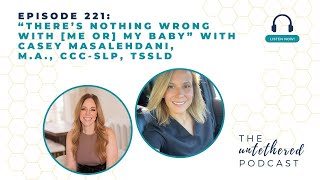
Casey Masalehdani, a speech-language pathologist and feeding therapist, discusses her daughter's lip tie and severe constipation, which led her to research tethered oral tissues and holistic feeding approaches. She and host Hallie Bulkin explore why clinicians miss these issues, the gaps in graduate training, and how breathing and sensory regulation matter for development.
Questions this video answers
Episode 221: “There’s nothing wrong with [me or] my baby”
Recorded July 18, 2023; last edited January 21, 2026 (per frontmatter).
Owner of Explore Speech; nationally ASHA-certified; licensed SLP in California and New York; feeding therapist; orofacial myofunctional therapist; Breathe Institute ambassador (joined fall 2022).
Chapters
Hi and welcome to episode 221 of the Untethered Podcast. Today we have Casey Masledani joining us. Casey is the owner of Explore Speech. She is a nationally ASHA certified and State of California, New York Licensed speech language pathologist, feeding therapist, and orofacial myofunctional therapist. She was born and raised on Long Island, New York and attended Hofstra University for both her undergrad and graduate studies. She graduated with her Bachelor's in Speech Language Hearing Sciences and her Master's in Speech Language Pathology with a TSSLD certification. Casey has gained experience by working with early intervention, preschool and school age populations within a variety of settings. She works with a variety of populations and disorders including children with developmental delays, feeding and oral motor disorders, down syndrome, autism, childhood apraxia of speech, language based literacy disorders, fluency disorders, and speech sound disorders. She has received specialized training in autism spectrum disorders, motor speech disorders, prompt training, feeding assessment intervention, myofunctional therapy, the sensorimotor feeding approach, the floor time method, play based therapy, dyslexia intervention, and more. She took a special interest in tethered oral tissues and became an ambassador of the Breathe Institute in the fall of 2022. Quick disclaimer all information, content and material of this podcast are the opinions and of the speakers and is for the informational purpose only and not intended to serve as a substitute for the consultation, diagnosis and or medical treatment of a qualified health care provider. Welcome to the Untethered Podcast. I am your host Holly Balkan. I'm a certified myofunctional therapist, feeding specialist, podcaster, business owner and mentor. This podcast is all about getting your questions answered and collaborating with colleagues to bring you the most up to date information in the orofacial myofunctional Therapy, airway, tethered Oral tissue and Pediatric Feeding Therapy space. If you're new here, I challenge you to keep an open mind and join my mission to spread this message far and wide. If you've been around since June 2019, thanks for being a loyal listener. As we jump into today's episode, remember to listen with correct coral Rest posture, tongue up, lips closed, teeth apart, breathe through your nose. Let's get started. Casey welcome to the podcast.
Hi Hallie, so great to be here.
So I always love these kinds of chats where we get to talk about, you know, another SLP mom's journey because obviously I've had mine and many of us have had ours. But I want to hear you know all about yours and really learn about like your your back story and how you Got to where you are today.
Yeah. So, you know, I always like to start with this fun fact or icebreaker that I actually met my husband while I was studying abroad, communication disorders in Sydney, Australia during my undergraduate in 2011. And we met out one night, I was with other SLPs and he was with his friends. And long story short, a few years later we got married and we were in lock distance while I was in graduate school. So we had quite a journey during those times. And after grad school we got married and we had our first daughter and then the pandemic happened. So I always love to share that fact because I feel that speech pathology brought me my two loves of my life, which is speech pathology and my husband and then my, you know, my two children, which I from that as well. About a year and a half ago we moved from Long island, which is where I did my, all of my education. My husband's from Sydney. He moved to be with me in Long Island. I was finishing my grad studies, I did my CFY in New York City, got a whole bunch of experience, started my own private practice, explore speech on Long Island. And then the pandemic hit two months later. Of course, of course at that time I was doing, I was, I had a in home private practice at my, in my home and on Long island. And I was seeing moms and their children for speech therapy. And I was also running a mommy and me group, which I was really, I loved because once I became my mom, I just, I morphed the two together. I was an SLP mom because I just, I just loved everything about, you know, reading books to my kid, expanding her language. And my first daughter was your typical, your perfect like speech student. Like I would model a word and she would say it, I would model a two word phrase, she would repeat it. She was my little sponge. And we just had so much fun being together. And my first year with her, I was out on maternity leave and I went back to work and then I just couldn't help. I just wanted to be home with her more. And then of course the pandemic hit and I had so much time with her. So I really saw like that language development and feeding development and everything and I just was obsessed. I went to Asha that year, I met Melanie Potok and I bought my munchbug and I just started establishing my, my brand and making this niche combination which is feeding speech and language. And eventually getting to my story today would add in the breathing, but back then was just really feeding and speech and Language and being a mom and SLP mom. So then the pandemic hit and I was working from home. That's why I started doing telehealth instead. My private practice really took a pause. There was no, you know, communication. And then about two months, three months into the pandemic, I was pregnant with my second baby girl. And then we had her the nine months later and my husband starts saying, hey, what if we relocated to California? And I was like, are you kidding me? I just had a baby. What are you talking about?
We're in a pandemic.
And you know, so forth. So I looked at him like he had three heads. But you know, we met when I was studying abroad. We travel all the time, we are really spontaneous. But when I became a mom, that changed, you know, but mom's brains change when we have babies. You know, my husband's brain didn't change as much. So he said, why, you know, you're, you know, the girl I met, you know, takes chances and whatnot. And he really encouraged me to see a life at that time that I had no idea that I could fully achieve, which was my dream come true. Living in a beautiful place with a great climate and an opportunity for outdoor lifestyle and giving my children a really active and fun and well rounded life. So I listened to him, despite my pregnancy hormones telling me no, no, no and all that. So we. And he, you know, he applied for some jobs out here and to be honest, the first couple were a no go and then the last one was actually a promotion and it all just fell into place and it was in a really great location. I really love where we relocated. So he interviewed on Zoom. This is still pandemic. And he got the job. He flew out here and was looking at houses and on and showing me on FaceTime and I have a three month old and a three year old and I'm just like, that one looks good. And we're so priorities, right? This was, you know, September of 2001, so about a year and a half ago. And so his company relocated us. We got a big old truck. I never saw anything in my life like this. I lived on Long island my whole life. You know, I traveled, but I went to school in Long Island. I was a suburban girl. That was me in Maryland driveway. And same as you, you know, I know your story, I followed it. But it's just so funny how, you know, can't believe this commonalities now that we get to chatting. But our furniture, everything, a big team, they packed everything, our cars on a truck. And, you know, my family, it was really hard to say goodbye to all my family and friends who I'm really close with, but we knew it was going to be a really great move for us. So I.
You're in L. A now, right?
We're in L. A.
And you love it.
And then. So that kind of brings me to my early days, as my daughter was only six months old at this time, and I had breastfed her all in New York. But then when we moved, I transitioned to formula. Just because I had so many plates in the air, something kind of had to fall. So we transitioned to formula and we moved out here. And I notice that she started becoming. She was colicky and she was crying a lot in the car, and she wasn't an easy baby. And I don't like using those terms because I feel like this is why moms have shame, because if your baby is crying, other people say to you, oh, what's wrong with her? She's not an easy baby. And again, when you have another child who was that typical easy baby, it's hard not to compare. And I hated that I was starting to do that, but it was my motherly instinct that I knew something was wrong and I wanted to help her. So, like you, I started doing everything I could, but I. But being in a new area, I didn't have my pediatrician, I didn't know any of the medical providers out here. So my first step was pediatrician, and I was very much dismissed, and it was a very bad experience. And I actually started water.
Yeah, well, And. And just to kind of like interject there. That's common. Unfortunately, it's very hard to find a pediatrician who gets it. And, like, you know, and I'll turn it back over to you, but that's what. Even when you have pediatricians who are, like, all ears and they're, like, open to hearing it, they still are not in this space daily.
And I just.
I, like, had to share this because last week when I was doing a free training and somebody commented or asked a question, like, I always, like, open up for questions at the very end of the training, and they said, you know, well, what do you do when you can't. Like, when the pediatrician just dismisses everything that you say as a provider and, like, you're referring patients and maybe you are the patient. And I said, look, at the end of the day, with all due respect. Respect. Because we love our pediatricians. They are not feeding specialists. They are not myofunctional therapists. They are, like, if you find them, that is by all means, like, hang on tight because that is rare gem that you're going to find at the bottom of some random mine on the other side of the world. Like, that is not your norm. That is not what you're typically going to see. And if they understand it or they're open to it or they're able to make a referral, like that's a beautiful thing. But like, keep in mind that as the SLP, as the OT, you know, some PTs, like you are the specialist in this feeding space. You are the ones who've done all this extra, you know, CEU work. And, and so I always like to kind of like share that. I think especially with parents who are not in our field, like, who are not in this space, like they don't realize that they, you know, we see our pediatricians as like the end all, be all, know all and they are generalists. But when you are, and there's some pediatricians who are specialists and who are highly specialized in a niche, but for the most part a lot more generalists and there is absolutely no way that they can look at your child in an appointment and know if their feeding skills are good or not, know if their airway is healthy or not, know if they are tongue tied or not. Because that comes down to function and all. Like I said, I'll turn it back over to you.
I'm like, yeah, this is that conversation that I'm so excited to be having with you because it is a tough one to have because I feel and I can even hear when you're start to speak of it. We have to then backtrack and say some pediatricians are really good and they do know everything, but we are the specialists and this is a space that we know and we deserve to speak up and talk about the normal development and what is meant to occur and give this information to our patients and their parents and be respected and validated and heard instead of constantly dismissed, missed. And you know, that is one part of my job that I don't enjoy is constantly having to defend myself. Which is what really prompted me to wanting to email you and like get together about chatting about these topics that are like taboo that no one and even myself with my things that I like to talk about or share about social on social media. I have it all in my heart, but I don't want to share something too taboo because I don't want the drama because I'm too busy. But every night I go to Bed. And I'm like, but you have to share these things because there's moms out there like you. Just because, like, for example, if you didn't start what you did, I wouldn't be able to know someone's gone through it. Like me. Like you. So, again, I appreciate you beginning to talk about these things and I now have confidence in as well to talk about these topics because they should not be taboo and they should not be stigmatized against because they're real diagnoses that have real symptomatic impacts and affect daily life for my children, myself, my clients, my friends and so, so many people. So I'm so. And I want to just put a positive spin on it that down below I even wrote this song. It comes into my head all the time, you know, why can't we be friends?
I don't know why.
Why we all need to just come together. We all have, you know, or be in your. Stay in your lane. Respectfully. You know, we have our areas that we're niche specialists in and we deserve to, you know, share this information. I don't any other area that is under such scrutiny. You know, you Google back pain and a million suggestions come up. But you want to talk about tongue tie and everyone say, no, that it's not that. Don't say that. You know, it's just so.
Well, even within our own field, even within our own field, it's like just as divided. And I'm like, until the speech pathology world can get their ish together, like, we can't. It's like, oh, no wonder everybody else, like, you know, doesn't know which side of the conversation to be on because we have so many SLPs who don't even believe tongue ties are a quote, real thing or that they don't impact babies after they're done breastfeeding, feeding, if they do quote, unquote, believe in them. And I always love the quote from Daniel Lopez, who is a do. And you know, he once said, like, you don't have to believe in. Tongue ties are not a religion. Like, there it is not a matter of believing or not. It's a funk. It's a anatomical, you know, your body. It just has to do with whether that's tight or not. And like you said, you know, sometimes we have fascia tight elsewhere in our body and nobody.
Every other muscle in our body that we talk about, we go get massage for our. And we have, you know, knots in every other muscle in our body. We massage. But we. But the tongue and the Florida, Not a thing. Oh, that's. I have a whole section on that that I could talk about so much.
So tell us first, like, tell us so your own child. Right. So that kind of was like your catalyst to fall down this rabbit hole.
So she started suffering from constipation and she was only seven months old and she had only been on, excuse me, nine months old and she been on formula for three months at that time. And I was making all of her baby food homemade, organic, because I was at home at the time and we had just moved to Cali and I was getting great produce, mango. I wasn't giving any carbs much yet. So when she started having constipation, I was very perplexed because I said this is not typical constipation, like a toddler diet where they're having too many white starches or something. I said, this is unusual. And I did prune juice, I did everything added in water, all the peas, peaches, hairs.
Prunes, Right, exactly.
But it was to no avail. And she was having severe. Which I now know was actually withholding of her bowels. Where she would go in the corner, it would look like she was trying to go. She would cross her leg, her face would be red, like, you're like, oh, she's going to the bathroom. But no, she was actually holding it in. She must have initially had one bout of constipation due to something again, potentially, because she's lip tied. She does not have a tongue tie, which is what she's. Again, she's the anomaly. She, you know, we talk about. Again, people talk so much in black and white about tetherella tissues online. If you have a lip tie, you must have a t. Everyone is an individual and everyone. Your baby come out and you don't know what's going to happen. They can have. She also has a congenital birth defect called cuticiplasia, which is very rare. It's like 1 in 100, which is just a little tiny actually scab on the tip of her head. It's in the neural tube defect family, but it's actually not a neural tube defect. She's my little miracle baby because it's essentially just the skin. So if it would have been more, it could have been impacting her skull and her brain, but it didn't. So she has a little tiny birth mark here. But it's just. I share that as well because it's just a rare congenital birthday defect that I had a lot of shame about when I had her, that I thought I Caused or why do these things happen? And you know, you don't expect when you have a brand new baby, anything to go wrong. And it's hard on moms. And it's even harder when you don't want to talk out loud about things because you're shameful. You have shame or guilt feeling like you caused it when that is not the case. Yeah.
And that's hard too, just to kind of speak to that for a minute because, you know, however you feel about it, you also then are dealing with like the fourth, fourth trimester, right? Your hormones are not in a normal, quote, unquote hormonal state. Like, you're basically still working through all the hormones of pregnancy and delivery and now maybe breastfeeding. And if you're not breastfeeding your body, you may still be going through these changes to stop producing milk because it started producing. I mean, there's just so much going on that I don't think anybody can appreciate until they've gone through the experience themselves. So to have that in front of you, like it. If I got a diagnosis of my child who's failure to thrive right now, I probably would not feel great about it, Right. But if she's four and there's something going on, I am far enough away from that baby stage where I'm like, I think my head would be in a very different place or I'd be like, okay, wow, like, well, what do we do and how do we approach this? And you know, I saw that in my newborn a couple days, a couple of days old. And I was like, I have one job, my only job is to feed this baby and keep her alive. And the pediatrician just put FTT as a diagnosis on here. And I just opened that on my phone. Nobody told me about it. Nobody's talking to me about it. It's one in the morning, I can'. Call anybody about it. And I'm sitting here kind of just going like, okay, I'm failing at life, right? And so it's like you have that with the hormones. And I think it's just a very real emotional experience that is not discussed. And then, you know, moms kind of like suffer through it in silence because they don't know that they can talk to other people and they don't also know that this is normal. And we all go through it in different ways. Even if your baby's perfectly healthy, you're still going to go through a lot of this same type of, you know, and then anything is then, you know, maybe not quote Unquote typical. You're now down this whole new rabbit hole of emotions and experiences and feelings and, you know, and how everybody embodies that or how you experience that is probably going to look very different, one person to the next, but you're still going to go through a lot of like. Like you said, that mom guilt, that. That shame. And, like, did I do something wrong? That something that I did wrong before I was pregnant or while I was pregnant, or did something happen during delivery? I mean, you just. The question doesn't stop, no matter who.
You are, especially when you're an overthinker.
And welcome to the SLP world.
Exactly. You know, that is the blessed curse of being an slp, I suppose. You know, we know so much and it's hard not to, yes, again, have that shame and suffering in silence and being a new mom and wanting to keep up a Persona for other moms, but yet being so confused and alone yourself was a really challenging time in my life. And I just. That is why I have this purpose now, because 18 months ago, I was in a really difficult spot and I had no one to talk to because my family, I love dearly. They don't understand anything in the medical realm. I moved away from all my professional contacts. I was in a completely new area in a completely new setting as well. You know, Los Angeles, the South Bay where I live in, in the suburbs, however, it's also the city. You know, it's totally different to where I'm coming from. You know, just going into a parking lot with two babies and a double stroller up to go to see a chiropractor on my little baby. This was all new to me, and it's. It was hard to stay sane at times. And I just, again, appreciate my husband for being so supportive and as well as the SLP community, because if it wasn't for me doing my research and finding the tethered oral tissue community and understanding the correlation, I wouldn't be able to start getting my child the help that she needed and then getting into working and getting my passion back. And once I started helping others, that fog started to lift because I said, okay, there is a purpose, there is an answer. There's nothing wrong with my baby. Everybody's different, you know, and that's, again, my passion. Like, we talk about neurodivergency and accepting all people, and I'm so passionate about that. And ADHD children who are neurodivergent, they are neurodivergent from birth, if they have these differences and they're Sydney, too. Yeah.
So I.
That's all in my story. I have it kind of, you know, written out here in different little folders that are in my mind, I suppose, of topics that I like to discuss that I, you know, when I start to talk to people who are not quite in this space, I start talking and they're, like, looking at their watch. Okay, she's retelling. So I appreciate communicating.
Yeah, no, it's. I, I love how you said that. You said two things that I like. One, you said, there's nothing wrong with my baby. And, you know, when we look at it through that lens, there's nothing wrong with my baby. Right. There's nothing wrong with me. There's nothing wrong with this child who has whatever diagnoses they have. At the end of the day, I look at a diagnosis as a way to get insurance coverage, period, end of story. Like, whether you're in network, out of network, it can help people. And sometimes it makes sense in the medical community to help drive certain services. But every single child, as you spoke to earlier or person, adult, who may have a diagnosis, presents differently how we present.
Right.
Like you said, your daughter, she has a lip tie. Someone's like, oh, she's got a lip tie. She got a tongue tie. And that is usually the case. But obviously in real life, we're going to have outliers. We're going to have to do things where, you know, what, the function of her tongue is fine. Right. The function of her lip. And that's why we always say, you can't just look at a picture. You can't just look at the tissue. You have to look at function. What is the impaired function? And I think that really speaks to anybody. Like, for me, I'm adhd, so, hi, I have that diagnosis. But that's going to mean something completely different than the next person who has adhd. And so how does it impair my function on a daily basis? Like, how does it impact my ability to parent, take care of myself, like, run my household, run my business, treat patients? Like, how does that impact my ability to basically get done what I need to get done every day? Like, what are the. What's the impact on my activities of daily living, my. My own health? Like, whatever those different nuances are? And so that's where I think if we go back to that conversation of just like, there's nothing wrong with us, it's just that there's differences. And the autism community actually was the first. Like, even being adhd, it was more the autism community that opened my eyes to this, like, 15 years ago, where I kind of started to go, there's nothing wrong with these children. Like, it's that these kids are being put in a box and looked at as if there is something wrong with them. And as if, like, we all need to make them conform to some set of norms that somebody out there created that. Don't ask.
Yes.
I was like. I was like, okay, hold on. Like, let's take 10 steps back here. Because for someone who's not familiar with this conversation and does not, like, understand a lot of, like, what we're talking about, I'm like, I like to speak in, like, very, like, I don't talk in very big, fancy words in this. In talking about this. I'm like, I like to talk, like, very, you know, one to one. Whoever I'm talking to is going to kind of get what I'm talking about, right? So at the end of the day, everybody's different. It doesn't matter if you carry a diagnosis or not. What I do when I encounter anybody is I go, okay, like, what's going on? Who are you? What are your goals? What. What is hard for you that you want to work on? Because as a provider, I might have my own ideas based on my background, my knowledge, my training, whatever. None of that matters if I don't know who you are and what impact you're trying to make in your life and, like, how you're trying to help yourself because. Or help your child. Right? You know, and that's like, I did this training in December where, like, I was like, yes, Airway first was like, the title of it, and the whole focus was like, let's look at the Airway before we address anything else. But the number one thing I told everybody, I was like, if you want to change your practice and you want to change how you impact people's lives, you need to ask that person sitting in front of you, whether it's a parent or an adult patient or a teenager, why are you here?
What is your.
What is it that you're looking for help with? And then you shut up and you be silent and you don't interject. You don't, like, try to drive the conversation. You just sit back, you allow that silence. You give them the opportunity to speak. Because if you don't address why they're there when you're going to lose them, they're out faster than they walked in. Like, they may not tell you that. They're just not going to call you back, like, and to. At the end of the day, who are you helping? Yourself. Like, they're not here for you to help you. They're here for you to help them. And so, you know, and maybe some people don't want help because maybe they don't feel like, need it, and that's okay.
Not always a good fit. That's okay, too. I think everything you're saying is just so important, highlighting the fact that that's what we are trying to do. We are looking at patients holistically, and that means from head to toe. That's all we're saying. We are looking at everyone as an individual, which is what speech language pathologists promote, especially in the autism community and across the board. So I'm not sure why there, again, there is this negative stigma, and the only way we can get rid of it is to talk about it. So my. I'm so thankful that you just expressed about your adhd, because I also have adhd and I wasn't sure if I was going to. I've never publicly stated that because my family didn't believe I had it ever. Looking back my whole life, you could see that there were signs. However, I was one who was very much able to compensate. Math was my weakness. However, I was great at writing English, and I was also very personable and outgoing, and I kind of just was able to fit that mold, and I worked my way through school. However, different things happened in my life. And then when I was in graduate school is when it was really apparent. And I was diagnosed at that time. But when I talked to my family about it, they didn't want to hear it. They didn't believe. They said, how could you be in graduate school?
I was. I was a freshman in college when it all came to a head. Like, I was 19, so. And. And they say this about a lot. There's a lot of females who, whether it's ADHD or even autism or like, somewhere on that spectrum, you know that it gets diagnosed so much later because sometimes, like, if we have the social skills or we have these certain, you know, aspects that we're able to kind of, like, we get really good at compensating, like you said. And. And it's exhausting at the end of the day. Like, we don't realize it at the time, but, like, once you're on the other side of it and, like, you kind of get the diagnosis and you kind of go like, oh, oh, oh, okay.
It's.
It's almost, like, freeing because you're like, Wow. I mean, it doesn't change me like who I am to get the diagnosis, but I feel like I better understand myself and now I also feel like I now better understand how to find the things that help me function and everyday life a little bit easier 100%.
And it's just, yes. Not having that shame and the stigma against adhd. There's many different mental illnesses and that's where I tie into my explore speech, which eventually will be explore speech and wellness. Because I want to promote mental health. Being regular health, you know, it's starting to be talked about, but not nearly enough. You know, every single person on the world, in the world has a brain and we all have feelings and emotions, so we all have mental health. You don't have to have mental illness to need to worry about your mental health. And I'm very passionate about that because I feel there's so much negativity that we don't talk about it. And especially for moms. And again, back to the hormones and all the changes. We need to prepare moms for the negative feelings, to let them know it's okay, there's nothing wrong with you. It's going to be okay. Here's something that helped me XYZ to let them know it's going to be okay and how to get through it and give them the skills. And again, yes, support resources.
Why are we so far away from the same.
Why are we so far away? And everything that I want to start talking about, there's so much shame around and. And my perspective is I just want to help moms. There's. I understand having to do what you have to do as a mom. And you know, we're not perfect and the goal is not to be perfect. There's no such thing as perfection. And I finally have realized that after nearly 34 years of, you know, the first 33, I'd say I was worrying about that. And now I am excited to.
Kids do that for me.
Right. I'm just excited to embrace myself as a mom and as a human being. And I just want to give back to others and help people as much as I can. Avoid the negative symptoms or the difficulties by putting in place, like you say, those strategies and the health, of course, you know, sleep, disordered breathing. We didn't. And again, in the birth, the 0 to 3 population, this is early intervention is my perspective. You know, we need to end the stigma and end the tone debate. End talking about non speech oral motor exercises. Can we just delete that term already? No one's out there doing nsomes. We're doing evidence based practice based on each individual client. So it's not fair for others to use us as a butt of a joke and to constantly compare good SLP work and then plug, you know, versus tongue tie. Like we're some crazy cult.
Like also like who gave them the license to go and police something that, you know, I think at the end of the day we forget that so much of the SLP world doesn't have level one evidence. And we're not over here in the tongue tie OMD eating area going, hey guys, you don't have level one evidence. So we don't believe that the work that you're doing with your patients is actually helpful. Like, exactly. We're not saying that. We're saying, wow, you guys are doing incredible work and your patients are really benefiting. And we understand that research is expensive and research is 17 years behind.
Right.
And you can't study everything ethically. So you're not always going to see all these things that you're asking for.
Absolutely.
Like I'm a story, like I was just talking to, I won't say his name, I don't want him to know if like people are doing this. But like a very well known pediatric pediatric dentist in the tongue tie space and he called me and he called some colleagues and he was like, hey, you know, I want to do some research, it's privately funded. Like I want to hear about what you would want to see.
Right.
And we, we talked in circles for like a couple of minutes because I was like, okay, hear what you're studying. But like how would you even assess that? And if you were to use this assessment, it's never been tested on tongue tied individuals so like they're going to have a problem with that. But it's still your best bet because it's one of the most commonly used articulation assessments. Or you know, it's like, right what you do, it's going to get picked apart. Like let's do the research anyways. But I gave him some ideas. I was like, you know what I see in my practice, I see a lot of these kids not chewing their food properly. I see a lot of them like you talked about with your daughter of the constipation struggles with. And, and you know, I know that you haven't talked to this yet, but like one of the biggest recommendations is Miralax. And if you're in the holistic space, you don't want to feed your kid. Miralax as part of their diet every day. Because you see what's in Miralax, you know, and I'm not shaming anybody who wants to use it. But I didn't.
You did.
You know, then it's kind of like, well, why don't you want to use Miralax? You're like exact voice as a parent, like, why do you have a problem with me not wanting to use it? Give me something else.
Right?
Let's figure out some, you know, why this is together. Right. You know, so it's all of these, like, I feel like we talk in a lot of circles. Circles. Because it's so.
I feel, I find that, you know, medical professionals and SLPs, it's as if everyone has their way almost of doing it. What they know, what they studied, they're setting. And I feel that their setting really affects it as well. SLPs who are working in hospitals with babies from the NICU or failure to thrive, you know, those early babies or with babies with different syndromes, that's a completely different space than SLPs who are working in homes with 0 to 3 year olds with OMDs. And again, there's so many different avenues that I'd love to discuss, but that's the biggest issue is the fact that SLPs themselves are confusing motor speech disorders with oral motor disorders. And this is why I emailed you on the other podcast you began to discuss this. And what I'd like to add is that, you know, grad school is heavily taught in motor speech, which is apraxia, stroke, dysarthria. We were not taught anything about orofacial myology. However, why, if you go to school for physical therapy, you learn about the muscles. You know, I always say it's as if we learned about, you know, the mouth and the throat, but we missed the nose and everything else, you know, and even my own work with Mayo, I was doing myo and talking about lip seal and all of that for my first couple of years. And then it wasn't until a little bit while later when I realized, why are we doing lips? Oh, it's nasal breathing. You know, it's all about the nose too. We got to get these kids noses clear. And now that's why I'm so again promoting nasal breathing. And like, why don't people know this? This is important. It's so simple to add into your children's daily routine and life. And it's. You said it.
They teach in silos. And that's also how the medical treats in the U.S. you know, and so everyone's kind of like, in their own little. Even within a profession, it's like, you're in your siloed area. And that was why, like, when I created, like, my course, I was like, I want people to come in who are not me because I'm not the NICU slp. I'm not the OT who works with, you know, children. Like, I do treat children on the spectrum. I was working with autistic, you know, autistic individuals. Children with especially surrounding language and feeding and like, they're. Honestly, that's one of the reasons why I felt deeply in love with. Trying to figure out the root cause was because of these amazing kids. Because I was like, they're struggling and nobody can seem to help them. And I don't like the whole approach of trying to get them to conform to our ways. Why are we not entering their world and figuring out what they need from us to help them thrive? And, you know, I would get down on the floor and I wouldn't even talk to a kid, and I would just kind of see what they were doing, and they may be spinning something or rolling something around, and I just get down there and I kind of imitate what they're doing, and they kind of look over at you like, oh.
Like, you do what I do. You're like, me, okay.
Like, I'll let you into my world. And, like, I could do that in a matter of minutes. Whereas people were like, I've been working with this child for weeks. And, like, I can't get them to, like, do anything. I'm like, well, did you try to connect with them? Did you try to, like, enter their space?
Absolutely.
And I'm like, but any child. That goes for any child. I'm like, if you go in with your own agenda, you're never going to get anywhere because they're not going to. They're not going to connect with you. They're not going to trust you. I'm not going to trust you. I wouldn't trust you if you walked into my office and told me to start doing something like, get the heck out of here. Like, who are you? You know, something like the connection and the rapport and the trust has. Has to be there with the child, with the family. And, like, you got to figure out what that looks like for that kid. Like, I've had kids who are not autistic line up toys across an entire classroom and have an entire meltdown because somebody moved one plate that was touching the fork and the cup, and that didn't make the child autistic. That made the child, you know, they were kind of set in their ways, but that was what was safe. That's how they knew how to play. And nobody seemed to understand that. They just wanted to give them some kind of a diagnosis. And I was like, but who is the child? Like, who are we talking about here? And, you know, and this kid obvious. This. Not obviously, this kid also had an OMD and some tether tissues and feeding stuff. That's not why I was called in.
Right.
You know, it's always so fascinating to kind of like, just connect with the human in front of you if they're an infant, a toddler, you know, older, an adult, whoever you're working with. But again, like, realizing that we all have our niches, like you said, and you're going to have a very different experience based on where you work, who you work with.
And.
And that was part of the reason why I was like, we all have to come together. And like, in creating my Feed the Beats course, I was like, I need to bring these different, different individuals and therapists and specialists in, because we all have different experiences and see things through a different lens. But if we can come together and create something holistically that offers these different experiences that we can share with other providers in our space, then, like, maybe we can start to bridge this gap and start to help therapists think more critically and creatively. And I always say it's a dance between art and science, and if we can't marry that art and science together, like, you're never going to be able to reach your patients. You're never going to make change. It's just going to be literally kill and drill throwing stuff at your patients and being frustrated because you're not making any progress, which is why kids end up in therapy for years at times when they don't always need to be. So anyways, that's my whole soapbox. I'll stop.
But no, I cannot agree more. And everything that you just described is my passion and what I. Why I feel again. And my purpose is to bring it back to the fact that diagnosing this is early intervention, no matter what the child's diagnosis is going to be down the line, whether it is autism, adhd, or none of the above. Children need to be looked at from the beginning with these. Looked at these issues from the beginning, because this is early intervention. If we are able to help them in any way, it can change the trajectory of their entire life for the good, not to make them conform to others but to help them thrive what is best for them because it goes back to their sensory nervous system. I love what you said about lining up the toys and the way that different children act because my daughter doesn't have autism, she doesn't have any developmental delays. However, she has a disordered sensory nervous system due to her tethered oral tissue and prolonged pacifier use. And you know, I got rid of the pacifier about six, seven months ago because I, I as an slp, I always knew pacifiers weren't great for palatal development and, and maybe speech. But again, you use your own instincts. So my first daughter had, she was fine, she was hyperlexic, she's spoken five word, six word sentences at 18 months. So I was like, pacifiers are fine. This is what moms do. This is what we have to talk about and be honest about.
But it's our experience, it's our experience.
Part of the evidence based triangle. Again, I love that we're talking about these things because yes, we want high level evidence, but we also accept all levels of, you know, the evidence is evidence, evidence is evidence. And our clinical experience is one of the most important. That's what we share on social media is our tips and tricks how to get a kid to make the K sound by yes, doing our prompt tactile cue and showing this. But also because we call it the coughing sound or because I put a toy on my head and I go and then he laughs. There's no evidence that putting toys on my head and coughing them off is scientifically proven. But I can tell you for the past 11 years, everyone has left and it worked and I will continue to do so.
And you know, part of it too is like you have combined so many different systems but what you're also doing is you're helping to bring them back down. And from a sensory neuro in a nervous system, right, you're going from like overactive nervous state and that fight or.
Flight, that's what we're talking about. We're here. That is what we're talking about and that's why we have to destigmatize this for others who think that we're trying to just over diagnose or calling tongue tie fat. They need to understand that we care about children and want their lives to be better and give them strategies and things that can help them. That's, that's all it is at the end of the day. And we're passionate people out here. We're the, I think one of your podcasts mentioned, you know, the boots on the ground soldiers, you know, we're the people who are in our free time making spreadsheets like this and who have, you know, books like this all over our desk and talk to our friends and family about facial muscles, muscles all night long. And they're like, okay, can we talk about something else? Can we talk about something else? But I'm sitting here like, no. My life could have been a little bit different if I knew I had sleep disordered breathing when I was nine years old. And when I look back at pictures from when I was three years old, I know I had these problems and I can go into my own story that could be another time. But you know, I'd like to bring up, you know, the sleep disorder, breathing and population based cohort study, the Bunuk study from 2011, you know, and Robin Merkel Walsh's article about diagnosing in the 0 to 3 population, you know, and how this is about differential diagnosis, making sure SLPs know the terminology and understanding that if we don't, we have research indicating that sleep disordered breathing causes adhd. So we need to get ahead of this and work to help our clients and their families. And that's why, you know, I have my website, you know, Explore Speech and I have my teachers pay teachers products that for mindfulness and breathing and my social media Instagram, Explore Speech just promoting, you know, wealthful, excuse me, Mindfulness, wellness, motherhood, relatability, honesty, decreasing shame, no stigma, supporting each other, connecting like this is a dream of mine to talk to you and share our similarities and our vulnerable parts of our personality that for many years of our life we didn't even know and probably felt pretty bad about. You know, I could go into those stories as well. Teachers and difficulties that I've faced and I had to overcome and I was scared to talk about it, but I'm proud and happy that I have because I know I can inspire others to do the same and to be open and know that neurodivergence is not a dirty word. We, there's nothing wrong with us, everybody is.
And if you have time, I mean, I would love for you to go into that because I think, you know, we do talk about a lot of the kids on here a bit, but we don't always dive into. Like, I've shared a little bit about my story, I've shared everything. But like, I just think, you know, even for a few minutes, what, like if you could share with us whatever you're willing to. Like, if there were Certain things that stick out in your mind that were really hard as a child growing up that you now look back at and you're kind of like, wow, I. I wish that I knew. I wish I had the tools. I wish that someone had just kind of been like, hey, I know how to help you, and here's things that'll make your life a little bit easier. Like, are there things like that or experiences that really are kind of into your mind?
Yeah, absolutely. So I actually always share this with my clients when I start working with them. I don't say that I have ADHD, but I always tell them, you know, hi, I'm Ms. Casey and I'm your speech therapist. And I just want to start off by saying that you're super awesome and great at so many things, but one thing we're going to work on is your speech. And everybody has things that they work on. For example, I wasn't really great at math, and I can remember my learning difficulties starting in third grade when the times table started. And thank you, 1990s for those, those charts where they would go across and the teacher would time us and we had to do the times tables, all.
This memorization, really all by memorization.
And as soon as that started, I remember not being able to do them and telling my family and they tried to help me. However, I just compensated because I was really great at reading and I was really social and outgoing and I was even a teacher's pet, maybe one would say, grew up. I had two older brothers, so I was the youngest. My brothers are 12 and 16 years older than me, so I grew up with a lot of adults. So I was very advanced for my age. And I had a very big personality. I was, I did theater and dance, and I was always a creative mind. However, again, back to the math was where I, I began my struggles. And then in fourth grade, I remember being in. That's when. Again, thank you, 1990s, they used to just separate the kids by advanced on.
Grade level and below grade level. Okay, you go, you group go.
Here you guys go. Hits.
You're like, okay, well, now we can just, like, shape.
Now I know you know which group I'm in. And, you know, there wasn't any discussion, there wasn't any talk about, okay, you might learn a little bit differently. It was just, you're in the low group. I don't really remember getting any extra intervention. And then I remember by six, seventh grade, we started doing fractions and advanced level math. And I just remember struggling so hard and Having to go to extra help and my parents couldn't help me, you know, they were amazing. They were always supportive. However, when I would go to them about my struggles, it was kind of always like, well, you're good at English, you're good at this. How could it be like. But it was all compensations. But I remember it affecting my self esteem and my emotions. I was always emotional kid and a very creative thinker. Like, I always joke that I feel like I'm in the movie of my own life. And I was a narrator and I would be thinking about myself and I was just. As soon as I knew I was different than others, I just tried to compensate even more. And I just started to focus on my appearance and fitting in and really, really caring about what others thought about me. And that's why in middle school that's really hard, you know, because middle schoolers are really cruel. And when you don't fit in, you feel really bad. And no matter what, you could be the juiciest peach, but some people still don't like peaches. And I learned that the hard way because I just kept trying to conform, all while still bolstering my creativity through cheerleading and dance and my writing and my academics kind of took the sidebar because I'll admit I was very concerned what other people thought about me in school. And that affected my academics and I just continued to do so again. I was always great at English and even science. I was really good at, you know, like biology, anatomy, all of that. However, anything that had math, I hadn't had those basic concepts. To this day, I always joke, I'm like, catch me on the street. Don't. If someone had a gun and said, do your times table, I'd be like.
That'S it, I'm done. No, this was me, though. Like this. My dad was a math whiz and so, like, he could do stuff in his head. And I would sit down and I would be like, I need help with my math homework. And we would get into like, arguments because I would leave the table crying because I'm like, I don't think like you. I need a calculator to do this. Why won't they let me use a calculator? Like, my brain doesn't think this way. Like I said, yeah. I was just like. I was like this. He'd be like, well, how did you. I'd be like, I'd get the answer and he'd be like, well, how'd you get the answer? And I'm like, well, I Don't know. He's like, we have to work. And he's, you know. Or he would just get the answer. And I'd be like, how'd you get the answer? And he'd be like, I just got it like this. And I'm like, hey, slow down. Like, that makes no sense to me. Like, I just. My brain does not think in numbers in that way. And still, numbers are hard for me.
Like, I agree. And by high school, you know, I was still doing well in school. I had, you know, A's and B's in every other subject except math was like, season D's. And then once it was like, AP classes and, like, getting ready for college. You know, it was a big concern. Somehow I, you know, I made it through. Wasn't the top of the class because I wasn't great in those subjects, but I went to Hofstra University, and I started off, which I really appreciated. They had, like. My initial classes were kind of like a transition class just because my GPA was like, an 87.9, which, again, not bad. It was like a B plus. But the scrutiny and the way the system of college and testing and they don't look at you as a whole person. And my GRE scores were very poor because of my poor math. So, you know, it was hard for me to get into a college because of this. But again, so many great strengths. However, they look at people on a piece of paper, not as individuals. So I made it to Hofstra. Great success. And I was originally gonna go for teaching. I always loved, you know, working with kids.
Wait, I was gonna go into teaching, too. I started a business and then was like, nope, these classes are not for me. So I switched to teaching.
Yeah.
And then ended up becoming a speech pathologist.
Same. So I was, you know, going to Hofstra, doing well, and I started. I was. I had got a job as a nanny part time because. And I remember nannying, and the children had speech delay, and the SLP came into the home, and I was like, wait a second. What's her job? And my. The people I was nannying for said, oh, she's an slp. It's a speech language pathologist. And I said, what? So that is. That is my dream. That's. And I looked it up, and I.
Remember I was a junior.
I was nearly about to graduate almost. And I switched my whole major in true ADHD fashion, and I became completely hyper focused.
Wait, my aunt was a speech pathologist. I had no idea that's what she did. No idea. And I went to intern with her at like, this after school kind of program that she ran in a private school for kids who, like, some of these kids were getting like, kicked out of their elementary school programs. And I fell in love and I was like, what is this? I need to know about this. Like, why did I not know what you did your whole life? And same thing. I was just like, okay, we're changing from. Because I'm like, I don't really want.
To be a teacher.
I kind of like, need more like, entertaining that's going to keep me on my feet every day. I can't be the same classroom every day. Like, I'm too ADHD for that. So, like, this seems like a dream, right?
Oh, how funny. That's exactly the same Parallel lives. We have some parallel.
And I always joke, I always, like, I always joke. I'm like, I know SLPs and OTs are like, not math wizards. Like, we did not get into these professions because we're good at math. And, and even speaking to like, you know, I compensated and did really well throughout school too. But by the time I was like a sophomore, like junior in high school, I was like, how can. I basically went and I talked to the administrators. I was like, what are the courses that I absolutely have to take to graduate and what are the courses I don't have to take? And so all my friends were going. Like, I took some. I took AP English and AP whatever and like some AP classes and everything. But I didn't take a lot of more advanced math classes, so I never took calculus. I never took like. Because you didn't have to. But nobody told you that I was like, smart enough to like, be like.
Hey, how do I know? Instead.
And so I, I did take like macro and microeconomics because I think that that was like, like an option. And I ended up getting tutored through that because that was hard for me. One of them was harder than the other. But it was hard for my friends who were like, not, you know, struggling too. We all had it. Like, we had a group tutor, but I ended up being. So I ended up doing like, like two periods in the morning on, like, where I. I was an assistant to the assistant principal for one of the periods and then for another one, I was an assistant in the attendance office and it was part of, like, an internship. And then my senior year by. I did an afternoon internship working for like, a family friend, was an event planner. And I got to leave after lunch and go to her home office and Basically, I was already working for her on the weekends. So it was like I actually just got to work in her office, like during the week. So I figured out from me, like what I needed to do. And then that way I was able to like graduate with like a 4.05 or whatever the silly numbers were. Because I figured out a way to like basically work the system and get there with meeting all my requirements to graduate.
What was best for you?
And it was just like, you know, and you know, the silliest part was because of my internship. That's where they exposed us to things like balancing a checkbook. And you know, it was almost like for me, they called it like remedial math. And I'm looking at the kids who are going out on these expeditions, quote, unquote, removal math that's like, that's required for you to have an externship or, you know, outside of the school. And I was like, wait, you guys are dumb. Like, everybody needs this information. This is not right. It's a real life math. Like, the calculus is remedial. Like, you're never gonna do anything with that unless you actually are like going to school for like one of two things. We're gonna need this information. And that's my biggest, like, I think going through that like now looking at like my 7 year old who, you know, math is not easy. And you know, my husband is very much so like, oh, we got to get her. Like, she's got it. I'm like, dude, she's on grade level. Like, what do you want? Like, she's doing freaking fantastic because she's like very, very advanced with like her reading and writing skills, but like her math. She struggles to keep a tutor so that she, someone else is helping her basically. And she's doing great. And I'm like, at the end of the day, I'm like, do not say a word to her because we do not define her white based on her math skills. I could care less if she was below grade level as long as they're passing her to that next grade so she can continue moving up. I never want this to be a thing that she sees as a weakness because I don't think it's ever going to be something she needs in her life. Like after she knows her numbers and she can do some basic math and she knows her shapes and like, she can, you know, fit some things together in a room functionally. Like, I'm good, like, move on.
Exactly. And it's so great that we're talking about these Things, because again, these are the things that people don't want to talk about. Because we all, you know, imagine life in this little box and we're supposed to check off the boxes and we rush our kids to grow up and achieve all these things, but we don't look at them as individuals. And I want to end that because there's so many people out there who are working to break cycles and to treat everyone with respect and individuality and understand that, you know, life is not like this finish line. We're trying to rush towards and check all these things off. And when we talk about your wonderful successes by what you did, as you just described, you are very successful now. You're a speech language pathologist and feeding therapist, and you're very fulfilled as well, which is very key. We don't teach kids you can be happy in your career when you grow up. You can do something you love, that sparks your creativity, that fulfills you, that helps you give back. It doesn't just have to be. You have to grow up and become this because of that, you know, we have to end that. You know, even like asking little kids, what do you want to be when you grow up? Like, they don't know yet. Let's just let everybody find out. And like, why don't we just say what makes you happy? Because when you grow up and you are struggling, you know, what you think about? What did I like when I was a kid? Oh, yeah, I liked to do cheerleading and dance. So let me put on some Disney music and dance like crazy on my kids and get my adrenaline pumping. And now I'm in a good mood and that's not weird, you know, and people, everybody should be doing these things so they stay regulated as we're talking. I was holding this little squishy ball. You know, I'm a grown up woman, but I can use a sensory toy to regulate myself when I'm a little bit nervous. Doing a podcast. I've never done such a thing before. We have to talk about these things instead of act like acting under a facade as if we're all these robot individuals whom don't have any emotions and can just succeed under any circumstances. You know, we have to even our kid, our clients, you know, some days they may be sick. We can't do speech therapy if someone's not feeling great. You know, like, we have to look at patients holistically and get to the root cause. And again, getting back to the term holistic, I remember on the previous podcast when you were discussing this, I'D like to just highlight to other professionals and families, like, the word holistic doesn't mean far out hippie. It means whole body. We're just looking at people from head to toe. And I want. I coined this, like, phrase, you know, if we, as speech pathologists or medical professionals neglect to look at the child's mouth and the tissues in there and the nose. We are teaching a kid to ride a bicycle without looking at the bike. We're just putting them on the bike and just go, you know, and the bike's breaking down, but they're still riding okay. They're fine. They got their articulation, they're feeding. They're okay. They're okay. Oh, but then they're gonna be 34 years old and they gonna have TM.
I'm still gonna be on the bike.
And the bike is not really.
The brakes aren't working.
You know, I try to make these little phrases and, you know, ways to explain it in a positive way and to get, like, some positivity and lightness back into this topic. Because, you know, again, there's nothing wrong with these kids. There's nothing wrong with having a tongue tie. There's nothing wrong with needing support. And it can help people breathe better and like you say, help our patients not just survive, but to thrive. And you cannot. You can thrive in your health, but I also think your social, emotional, and your creativity needs to thrive, to be the best mom, parent, person, whomever. Because that is part of our brain. Our sensory nervous system is our. Our entire being. And if it's not regulated, we're not going to have a fulfilled life. You know, there's going to be ups and downs, and we have to talk about the low days, the high days, and all the in between. Because mental health is health. And that's why I created my company, Explore Speech, to help people explore the connection between speech and language, feeding and breathing. Because they are different entities. However, they are all one and they're all interconnected. And it is the speech language pathologist's job to differentially diagnose these and to share information online about the differential diagnosis of. It's not just motor speech articulation and dysarthria. It's rarely dysarthria. There is weaknesses and oral motor dysfunction in children. It doesn't always have to be dysarthria. Excuse me, not rarely dysarthria, but there's this whole tone debate. You can't change tone this and that. I don't understand why we are not acknowledging and sharing the research, the fact that children can have low tone. Everyone has differences in tone.
That's low tone.
We all have differences. I have high tone in some spots, which, you know why? We all have tone differences. The fact that there's SLPs out there sharing. You can't change tone is blasphemy to me because it's like, yes, you can. Like, you know what I mean? You can't change. If you had a stroke and there's a. Excuse me, I'm getting off topic. Erase that.
No, but, like, to your point, right, so there's things that you can do, right? So, like, I, for example, my aunt was said to my mom when I was little, she's like, halle is the lowest home baby I've ever seen. Like, I did a lot of my gross motor things late. I didn't roll or, you know, and my mom's like, oh, I took you to the doctor, and, like, you literally rolled over, like, in the waiting room, and you were, like, three months behind. And then the same thing happened with, like, your other gross motor skills. She's like, you also said hi for your first time to a stranger in the pediatrician's office. She was like, basically, I had to take you to the pediatrician or a specialist. And you did the thing in the waiting room at that appointment because you're like, fine. You think something's wrong with me. Like, I'm just going to do it for you now. Leave me alone. I'm like, that's basically how I go through life. Don't tell me what to do. I will do it on my own time. Like, it's not going to happen. Yeah, no, but it's. It's one of those things where I tell people. I'm like, you know, the whole tone debate thing, I think that there's a lot of confusion around it because you see a lot of professionals who don't understand tone, whether it's in our space or outside of our space speaking about it is if, like, oh, we're going to change tone, we're treating tone. And so, like, what I like to tell people is, you know, whether tone is something you can't. You can change or not change. The way that you help someone who's low tone, for example, is you build muscle strength, so you have to work on the muscles to support it. And then we can get to a point of being functional and truly functioning. And like, you said, like, my phrase of, like, going from. From surviving to thriving, like, it's really caught on. I'm starting to See, more people use it. And I love that because I'm like, yes, because if we are. We're struggling, if we're just focused on survival every day, as parents, as humans, as patients, as whatever, like, that's not.
You're.
You're working from that fight or flight. You're not in that rest and digest, Right. You're not in that healthy nervous system that's going to allow you to make change. But if we can start focusing on, like, what do I need to thrive, what do I need to function? Right? That's where that whole paradigm shift starts to happen, where we kind of go like, okay, deep breath. Let's put ourselves into a state where, like, we can actually even have this conversation and where we realize this is possible. Okay, now that we're working there, let's talk about how we can shift from where we are now to where we would like to be and what that requires. And so it's the same thing when it comes to motor speech disorders or it comes to tone or it, you know, everybody talks about things like, they're so black and white.
Exactly.
We're talking about the human body here. Like, there's no black and white to it. And yes, you know, you. If you're going in for surgery, you want the best surgery. Who knows their skill? And they're going to be really good at, you know. Yes, there are specialties, and there are people who are going to hone in on things and they're going to be so black and white about it sometimes, because that's just how they make sense of it in their head. But I can guarantee you, like, when a surgeon gets into the body, it's not always black and white. And they have to know what they're doing. And with experience, they will, because then they're like, oh, I've seen something similar to this before. I kind of have an idea of where to go. You watch these shows, which I know is like, not real life, but surgeons have conversations, but in the room to be like, okay, real life?
Yeah.
Like, you're kind of like, you're having to shape shift in the moment. And that's like, what we do. That's why I say it's a dance between art and science. Like, we're not surgeons, but we are working with. We are medical providers, and we are working with humans. And we're talking about health. And that is, like, you've talked about every facet of health here. Like, just because we're not a neuropsychologist or a psychiatrist or A psychologist, we still have to be aware of the mental health of the patient sitting in front of us and the fact that, like you said, we all have a brain and mental, you know, the mental component of it is there for everybody. We don't have to wait till there's mental illness to refer somebody before even talk about it. Right? So, like, while that may not be my scope, if somebody's struggling with something, I may not be going and saying, hey, you have XYZ diagnosis or you need this approach or you need that, but I'm going to sit there and listen to them and I'm going to take in what they're saying and I'm going to go, okay, this person really needs this from me right now. And this is what I can offer from my area of expertise and from my scope. And if I need to refer them somewhere else, I will. But it all starts with listening to that person. Like, what. What is their brain telling you right now? What is their brain, their face, their body communicating to right now? And you would think I always go back to this. As SLPs, as speech language pathologists, you would think that we would be the best at the communication aspect. But I am telling you, so many SLPs struggle to actually communicate with their patients.
And.
And it's like that to me is like the funniest thing.
That is the funniest thing. And I'll bring that back to my story with my struggles. So, as we know, graduate school is very rigorous for slp. And as a person with adhd, I did struggle. However, at that time, I had worked so hard to not allow myself to struggle by, you know, adapting some unhealthy habits like studying for hours on end, not talking to anybody, locking myself in a room. And I wasn't going to let anything get in the way of my dream. And there were many times where, you know, professors told me, I don't think this is for you. You're not smart enough. You, maybe you should go back to teaching. That. That might be a little bit easier for someone like you, you know, and I hate. It's hard to talk about these things because I'm not trying to, you know, out anybody, and I love my university. However, there were experiences where I almost, you know, there was a time where I had to retake a course, which is funny because it was pediatric language disorders, which is what I am now, 11 years experience and done well in. So anyways, I was always very a great clinician, though, despite my challenge in the pediatric language class, which is where we did the evidence based practice assignment, which is why I was struggling because the courses were structured, was like four assignments and if you do bad on one. So to make a long story short and to talk about why research changes and we need to be constantly abreast of research and not focus too much on that level. One, that project was on pecs, mind you. I almost failed out of grad school because I didn't do a great job proving that pecs was amazing. We now know pecs is horrible and no one's doing pecs anymore and we're some high tech aac. What does that show you? You know, is that right? Is that. I remember sitting in my academic, in my professors in office hours and her saying, you know, I don't know. I don't know if this is the field for you and me. And all of this time I was no. 1 in my. I had never told my university I had adhd. I just was suffering in silence. I went to the doctor, but nobody knew. I didn't have accommodations. I didn't, my professors didn't know. The only thing I at once shared with a professor was that, you know, I had some difficulties at home as well and completely brushed off. But there were, there were two professors who had faith in me and understood where I was coming from and knew I would make a phenomenal clinician because like you say that connection. I, for some reason, not to toot my own horn, but it's as if children can see into my soul. I'll be out at the park and kids come up and just hug me because they know I promote connection first. Like I get down on my knees and I say hi to any kid. I don't say hi from up here. And you know, there's been multiple times where I've just been out in public and I'm talking to my own kids and another kid sees me and they're like, hey. And they try to just like start talking to me and I'm like, you know, I talk to kids like they're human beings. I don't talk down to them. And so my. That's again, what I'd love to talk about is the disconnect between the grad in graduate school and how we don't, we're not taught any of this. And the like grad school is like that you take your classes over here and then the clinics over here. Literally totally different buildings nonetheless in mind. And I know this is a very similar experience across the board with other SLPs about not learning about OMDs and having a disconnect in the clinic regardless across the domains, not just omd. So this is a very important topic. So again, I was great in the clinic. Like, my supervisors really supported me. I remember I created a infant observation Scale. I was always like, going above and beyond because I was just always so obsessed with everything and hyper fixated on anything. I started doing EI and I was like, I don't want to just do therapy groups, write reports, go to grad school, study for the PAC stand. I also want to invent the Kim the con. My last name is Conis. The Conice Infant Observation Scale. And I worked with my supervisor to like, make this checklist about how we could better document infant skills. This was when I was only my first year in grad school. You know, I've been.
People don't realize that the ADHD brain, like, that those brains are the brains that have given you everything that helps you function in your daily life. Like, everything from your, your phone to your computer to the car you drive to the music you listen to. Like, so many of these highly successful individuals have these ADHD like presentations or even autism, right? And so, you know, at the end of the day, it's like, why are we trying to shapeshift people into these little boxes when, like, this is actually our future? And like, we, we need people who are innovative. We need people whose brains work at a mile a minute who are constantly going, oh, should I do this idea or that idea? And it's like, okay, let's just quiet the mind for a minute, Hallie. You know, but it's like, that's where for me, I have to reel it in because people come with. Come at me daily with like 10 ideas per person, plus I have my own ideas. And I'm like, at the end of the day, I'm like, there's just no time or enough humans in the world to do all this. So, like, we actually need to do, like, right now, today. Like, let's focus, right? But no, I love it because that's. That is what brings change. And that's where a lot of these highly educationally based individuals miss out because they. They, like, people go for PhDs on, like, the clinical side. So people, there's like, PhDs for, like, business actually for SLPs, which I think is super cool. I never knew that was even a thing until, like a couple years ago. But people who go back to do, like, just research, and then they want to sit here on social media and harp at you because. And they're not even working with patients. Like, you don't even have the experience to talk about this. So just because you have a PhD that you're getting or you're doing some sort of research, or you're going to have a PhD after your name, that does not make you superior to the person who works in this specialty day in, day out, treating hundreds or thousands of patients. Like, just, you know. And that's where I think needs to be discussed publicly. Because people just see credentials, and they automatically think credentials mean, like, better or more experienced or. And so that's what they always say. It's Alphabet soup. All the letters after your name. I have certifications that I don't even put after my name because I don't. I don't want people to look at me as that certified person. I know five certifications. I want them to look at me for who I am and for what I offer and for the experience that I have. And I don't think I need all those extra letters. And people will go like, well, why did you create a certification, Hallie? Why are you creating another one? I'm like, because people are asking me for it. And because I am able to better shape education in a way that I think is functional and that actually mentors individuals and to get further into their specialties. And so if that, I will tell you, I'm the worst salesperson when it comes to, like, my own business and certifications. So I'm like, you don't need the letters, people. You don't need the extra for certification. You're already an slp. You're already an ot. You're already a pt. But, like, hey, if you want it, by all means, go for it. You know, for me, what it really means is a deeper learning in a specialty. However, most certifications don't offer that, unfortunately. You pay a lot of money, you invest a lot of time, and you still are more confused at the end than when you started, especially in the MYO space. Which is why I was like, all right, you know what? Y' all are asking for it. I feel like I got to do it because I. Like, we need to change. We need. We need change in the space. We need people to actually, like, deep dive and understand and get mentorship and also feel safe, because if you don't feel safe, you're not going to learn. So that's got to be a part of, like, you know, the whole educational trifecta, if you will, as well. But anyhow, absolutely.
How can again, you know, say, how. What a Tremendous job you've done in doing that, in doing so, and how I hope to follow in your footsteps. And I've been creating products to, you know, digital book books for parents because I feel I could talk about this till I'm blue in the face and sometimes I'll leave and I feel like my parents of my clients still aren't always fully quite sure. I teaming up with another colleague here in California to write this ebook that I've already started and a children's book, Franny Gets a frenectomy. You know, helping kids understand these topics and more products to end the stigma. And, you know, I'd love to collaborate with you again on the podcast and talk about more ways that we can do so and collaborate with universities and get this information out there to change, to make change for the better, to make the world a better place at the end of the day, because we're supporting the sensory nervous systems of ourselves, of mothers, of families and of children. Because individuals with OMDs have very different sensory nervous systems than those without. And I've seen it in my own daughter. And I know for a fact if I didn't advocate early for her, her trajectory would be very different and she would have much more behaviors that would make her look like a quote, unquote bad kid. And I am grateful that I did that. I was able to figure out what I needed to do to. And we're. It's still a journey. We are not done. You know, but again, promoting this concept to other SLPs and to families. I mean, my main goal is just to, to, to. To do that and with my teacher pay, teachers products, to kind of just, you know, have SLPs who are confused and, you know, understand the differences between and the terminology and referencing the studies. And here's the research, because there is.
Research, I mean, the entire Journal of.
Orofacial Myology, I don't understand. Like, you know, again, I'm sitting with textbooks on my lap.
Well, and Mayo's not new.
What do I have to do? Do a song and dance, you know.
And I has been around for 117 years. People like. It is not new. And there is a ton of research. So. Yeah.
Yes.
Like, thank you for plugging that.
Yes. And I, and I just wanted to say, yes. That, you know, the field of speech language pathology already has several strikes against it. One being that we are extremely broad and no one knows what we do. It's a joke, but it's really not funny because we're very important and people often don't know what we do because we do several different things. And the lack of diversity in our field, you know, we already have, have this major issue that we do not have a diverse field. There's not individuals of color and it's just predominantly, you know, white fields. We don't have enough voices speaking up. And I feel that's the same with like the neurodivergence. It's coming. Neurodivergent individual professionals such as ourselves are sharing our stories, but it's not as common. Most often people still are not quite open with their stories and you know, another strike. You know, Asha, our governing body doesn't always even embrace us. There's sometimes misinformation on our own website. Unfortunately, with the OMD space that. And there's, you know, there's these therapists out there like Robin Merkel Walsh and yourself and you know, Dr. Zaki at the Breathe Institute and everybody else. I could go on forever who is like working so hard to get these things published and to change this. And I just am so inspired by all of you and I want to do the same thing, you know, and be that person who helps others and puts the research out there. And I have my own research that I can, you know, publish. Like what I've seen is unbelievable. You know, starting post pandemic, like 15 out of 15 clients having breathing dysfunction, you know, 10 out of 15 having tethered oral tissues. You know, that says something. That is a case study. No, this is a little off the. You know what I mean?
No, but I think that's incredible.
You know, this is just my little line about like how, you know, the field of SLP has, has strikes against it and enough is enough. You know, we need to work to, to at least those are very big topics that are being tackled and we need to talk about. The one topic we can tackle right now and just end is the non speech oral motor exercises debate and acting as if there's SLPs out there doing inappropriate non evidence based therapy. If there's an SLP out there just blowing horns and bubbles and not doing anything for a purpose. Talk about that SLP, right?
That's not 99.9%, that's not 99.9% of.
The SLPs who are using those tools in conjunction with several other techniques such as prompt. You know, I have training in multiple different areas that I use altogether and offensive to me when I see people, you know, laughing about using oral motor tools. That's another thing. Destigmatizing oral motor tools in general, because, because the children with the sensory nervous.
Disruptions, they need that.
They need that it's okay to give it to a child who are older have chewies. Maybe if we started checking their mouths.
But wait, why, why is it okay to give a child who's teething a chewy, but you can't give a child whose nervous system needs to be regulated a chewy.
This is a point of contention myself as well. You know, we always want to do functional. We want to use things that are functional. Right? So some therapists will say, why would you use a chewy when you can use food? Okay, well, my daughter has constipation. How much crunchy snacks would you like me to give her? Or.
Or the child's gonna vomit the second they see the food. So let's, let's start a therapy session with vomit. All involve her that's really gonna accept their nervous system upright. Like, how about. Most kids are not always. They're not even ready. Why don't we meet the kid where they're at? Because to me, a therapist who is so hard like, like, excuse my French, hell bent on using foods instead of non food items, tells me that that therapist has their own problems that they are projecting on their patients.
Thank you.
You need to be able to look at your patient and, and understand who that patient is and what they're ready for. And the best therapists are going to go, you know what? I may have been taught one way because I went to University of Maryland and oral motor was a dirty word. Like we did not. Oral motor was not okay. And I did not learn any of this stuff there. And like, I loved my school and I loved, like one of my professors said the best therapists can do therapy out of their purse. And that has always stuck with me. Another one of my advisors basically took away my whole checklistic checklist of questions walking into screen or to assess my first kid with the fluency disorder. Because she was like, what do you think a 16 year old's gonna do if you walk in with a clipboard and write down everything he says? And I was like, she literally took it away. I didn't know she was gonna do that. And I was like, but these are the kind of people who did help shape me into being the best clinician. And so I do value them and I value what I learned. But I also realized that that university program did not believe in oral motor. They did not believe, you know, it was like we only learned adult dysphagia, we did not learn pediatric and so.
And that motor speech, apraxia. We did a whole semester on the differences of apraxia versus dysarthria. Yeah.
And I get one minute now. I get where people are coming from. Like, I understand, I understand why, I understand that. But also, if you are so stringent that you cannot break away from what you learned 15 years ago to understand that, you know, think times change. And also, maybe this was present, but it wasn't taught where you went to school, then I don't know how to help you, but I will show you grace and I will be here and ready and willing to talk to you when you want to have a conversation. Because I hope the day comes that that happens for you. Because it's all about the patients at the end of the day.
Exactly. That's. I love that point. Again, bringing it back to the patience and the fact that you know the same thing with my university. And I love Hofstra. It brought me my love of my life and so many good things. So this is again, not knocking anything that we must talk about things in order to inspire change. And if you are one minded, you'll never inspire change. And you have to be open minded. So in Hofstra, we took articulation and phonology was one class. And motor speech disorders, which. And dysphasia. Again, we talk about swallowing, but we totally miss feeding. Again. What about this part, people? We talk about the throat first.
I can read an mbs, but I can't. I don't know how to teach them.
How to chew, kid how to chew and talk about the fact that there's erotic, you know, rotary chewing should be developed within the first how many months of life. And if these kids. Three years of life. And if these kids are six years old and they're still biting like this, there's a problem, you know, dissociation, elevation, depression. All these things we did, we did not talk about. So what was my point about that.
You know, universities are great, but they're not teaching even still today.
Oh, yes. And the fact that it was a dirty word you said. Yeah, I remember the. The class where they told the tale of the therapist who was selling products in band aid boxes. This is how it was told to me. I remember it.
Oh, we were just given articles to read that basically, you know, was all on Loft's, like his whole camp. And that was all we were shown. We weren't shown both sides of the story or we were never introduced to both sides of the conversation. It was just like oral motors dirty don't ever do it. Okay, goodbye. Moving on.
Yes. Is that so is that like where the controversy started?
Called Gregory Law?
Like, yeah, the article that he sent that, the article.
And that's still like, that's what a lot of the therapists today still, that's.
What they're going off of.
So that's like you realize this is old, right? Like, you realize this has been 2007.
Yeah. So that's my. Again, this is my promotion that I want to stop the social media gaslighting and end this controversy that has been going on from 2007. Because it's an SLP's job to collect our own research and when we know better, we must do better. And we cannot solely rely on old research. For example, again, my graduate school project was on pacs. We know now that was a high level of evidence. You know, my project was to write an EVP on it. There is evidence on it. But we know better now. Technology, things evolve, information evolves. So you know, if again, looking at the SLP setting, if they're in the hospital or in a NICU or an intensive feeding unit, their specialty is not feeding toddlers or, you know, babies. So when in doubt, refer out. If it's not your specialty, that's okay. We don't have to know everything. SLP grad school made us think we have to know everything. I love how social media has been highlighting the fact that grad school is difficult and, and hard on people. And we're unlimited as well. We're highlighting all these topics and it's just like we need to promote the fact that SLPs, we don't need to know everything. It's okay. We all have niches. Some people do motor speech. Motor speech is a huge area. Some people do omd, some people do both, like myself. And if I got a client, I can differentially diagnose motor speech and apraxia versus an OMD versus perhaps both. Both, because that happens. Every client presents differently and I'm sick of having to defend myself. And I try to think about these savvy posts to get them out there to show others that, hey, no, there's just different areas. I'm not doing the wrong thing. I am doing evidence based practice, you know, but social media is hard to navigate and like, I have two kids and a business and I'm working out there. I'm the one who's at home reading the books, you know, at night. Who cares deeply about this stuff.
Okay, so we're going to hit pause on this conversation and continue it on next week's episode where we're going to have a little bit more of a business focus and you're going to hear Casey and I go into a business topic that will be followed by a mini business series that I will be doing in the upcoming weeks. So I invite you to send me a direct message on Instagram at Hallie Balkan and let me know what business topics you want to hear about. So far I have had inquiries about hiring, but I would love to know what you want to learn about in the upcoming business series because this is for you all and I love to create content that is going to be useful and functional for you. So again, DM me directly Hally Balkan on Instagram. Let me know what business topics you want me to talk about and join me back here next week to continue the conversation with Casey. Thanks for listening to this podcast. If you found Value value in this episode and want to hear more of these Myotots, Airway and Feeding related episodes, be sure to leave a review on Apple Podcasts and share this episode on your social media platforms. You can access free resources and all I offer@halibalkin.com or pop over to @hollybulcken on Instagram to get all the latest updates.
More from Hallie



What I Was Missing in Feeding Therapy: ARFID, Airway, and Myo with Samy Hernandez





