Episode 41: The Tongue Ties To The Rest Of The Body with Brian Tuckey, PT, OCS, JSCCI
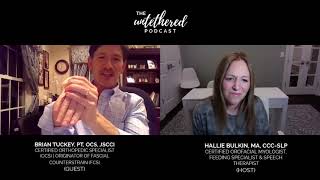
This podcast episode (Hallie Bulkin interviewing Brian Tuckey) introduces fascial counterstrain: a modern, anatomy-focused evolution of Jones counterstrain that treats fascia, vessels, lymphatics, nerves and viscera via indirect, painless positional releases. Tuckey explains the physiological rationale (fascia as a sensory/contractile organ with myofibroblasts and proprioceptors), contrasts indirect vs direct manual techniques, and describes a rapid cranial scan diagnostic ("under one minute") that narrows which of ~900 techniques to use. He presents multiple anecdotally successful cases (pediatric feeding and torticollis, TBI visual recovery, systemic inflammation with CRP reduction after treating adrenal/vascular/splenic pathways, chronic bone edema resolved on MRI), discusses central sensitization/vascular dysfunction of the spinal cord and brain as targets, and outlines training eligibility ("license to touch" — PT, OT, SLP, MD, dentist, massage therapists) plus course resources (tuckypt.com, jicounterstrain.com, counterstrain.com). The episode emphasizes team-based care, the need for more trained practitioners, and plans for research to build evidence.
Chapters
Brian, thank you so much for joining us on the podcast. I'm really excited to learn about your techniques today.
Oh, thank you. Thank you for the opportunity to share fascial counterstrain with a new audience. I always appreciate that.
Yes, I want to dive right on in and really have you explain to us what fascial counterstrain is and why somebody may need it because this will be a term that is newer to some of our listeners.
So you heard the bio and basically fascial counterstrain is the modern version of the osteopathic technique strain and counterstrain. And what your listeners need to understand is that there are really two different types of manipulation. There's direct techniques where you find a barrier, you engage it and you try and force through it. It's somewhat of a scar tissue paradigm. And then the osteopaths really develop indirect techniques where we basically slacken the tissue, decompress the pain receptors. This relaxes the tissue and then we drain the inflammation. So it's the opposite direction. It's completely painless and it can be worked or utilized on any system in any tissue in the body.
It's fascinating. And I've actually had this work done with one of your colleagues, so I'm very familiar with it. And I know how I joke. I tell people. It's like the first time I went to him, I felt like I left and I had a full body massage and he barely touched me. It was like, you know, he did the cranial exam and he went down here on my leg and released something and he went over here. It was pretty cool though because I could feel things flowing better and I could feel whether it was he's working. I was working on my face. I definitely felt things drain. I felt like I could breathe easier when he was letting some of that lymphatic drainage happen. But I also have personally have misaligned hips. So I could also feel the difference in my body when he helped to just release certain, certain areas. You know, I don't know all the terminology, but.
What you experienced was the fact that it's a multi system approach. So it has musculoskeletal impact and we have classes in that arena. Then there's the lymphatic, there's the arterial, neural, visceral and you know, classic counterstrain utilized a tender point diagnosis. So there are neuromuscular tender points. You know, you can feel them, they're palpable, they're tender to patients. And Dr. Jones identified about 180 of these at that time. We Knew that when we treated them with his approach, the outcomes were spectacular. But to be honest, we didn't know, tissue wise, what the heck we were doing. And the other three or four certified instructors really weren't all that interested because we're having great results. You know, why do you care? And I was always the guy that I'm like, you know, if we can figure out from a tissue, you know, physiological rationale perspective what we're doing, this thing could blow up. Because, you know, it has to have some direction in anatomy sense. So really, years of looking at anatomy, tissue science, pain science, I finally came to the conclusion about 20 years ago that we were in fact addressing the deep fascial proprioceptors. So if you look at any type of fascia, and fascia is a big, big thing, now everybody's talking about fascia. Back when I started lecturing on fascia, it was kind of like, what are you talking about? You know, fascism, nerd. It doesn't do anything. But, you know, the science was there, it was emerging. And if you agree with the concept that fascia is a sensory organ, which it has been proven to be, so it has all the nociceptors in it, so it has all the pain receptors, it has all the mechanoreceptors in it. And it also, you know, connects via reflex arcs to smooth muscle and skeletal muscle in the same region. So it can create skeletal muscle spasm, it can create smooth muscle spasmodic. The smooth muscle part, again, allows us to address viscera, organ stuff and vessels. We can address arteries, we can address veins, and we can address neurofascia. So that's the exciting part. We talk about the speech therapy population. We'll get into that. But you can take an excited, inflamed nerve, which, if you were to stretch it, that person would have a significant amount of pain, decompress it, drain the edema off of its lymphatics and shut it down. And the other part of the puzzle besides the fascia research, is that fascia is involved in fascia research is fascia is intrinsically contractile in itself. We now know this as well. So there are myofibroblasts, little contractile, smooth muscle cells in all fascia. So what that means is nerves are actually contractile because they're 50% fascia ligaments, tendons, the periosteum of the bone, the vessels themselves. So everything in the soft tissue arena that is associated with fascia is actually contractile. And if you're a practitioner of any level and you've got good hands. You've had some training. You know, when you're in there, you're deep in the area of veins and nerves and you're like, you know, it's. Some of the stuff that's tight is not the muscle. Okay. That's the contractile, smooth muscle, and it's the fascia itself, which is intrinsically contractile. So now realizing that you can slacken and drain inflammation off all these tissues, the scope of the work becomes immense. I mean, throughout the entire body.
Yeah, yeah. It's incredible. The more that it's been explained to me and the more that I'm trying to learn about it, it's very fascinating. I think it's really cool to see the work that you guys are doing. So we talk about this fascial counter strain, and I know that you're talking. This is different than the older techniques. This is more modern. From what I understand. If you explain to people the difference between, like, modern counter strain as compared to what people might know it as.
So people who have studied osteopaths, pts, you know, strain and counter strain, as it was called in the day, again, it was about a 200 tender point examination. And we would literally check 200 tender points in people's bodies, treat them out, and we had signs and symptoms associated with each release. Now, it is an anatomical model, and that's the thing to understand. Over the last 20 years, I've put a, you know, anatomical structure name to every single tender point and expanded it from 200 to 900 techniques.
Wow.
They're now taught because they're anatomical structures in the various systems. So we have our lymphatic and venous class, we have arterial class, our two nerve classes, et cetera. So they're taught by system. Then the first thought, you know, you're going to say, wow, that's overwhelming. Can we do this 900 tender point assessment on somebody or a little kid? No, you can't. So over the years, I realized because of these embryological connections into the dura, that cranial rigidity, the actual cranial bones, specific cranial bones, become rigid, tight, tender as well, depending on which embryological structure is dysfunctional. It was an accidental discovery that happened 20 years ago. But once I realized that it worked, it became the diagnostic. So now we motion test the parietal bone for musculoskeletal and lymphatics, the, you know, the mastoids for viscera. And I have this cranial scan that you can do in under one minute that will tell you with a quick motion test, which systems are dysfunctional and where is it? Edema or lymphatic dysfunction of the head, foot, hand, viscera, all through the assessment of that bone. So it allows us to sift through 900 techniques in a matter of seconds.
This is so great. So now when I tell people what I do, I'll be able to have them listen to this episode because I can never explain it as beautifully as you just did, no matter how many.
We get that a lot. Everyone says. I mean, you can look at my website and, you know, people talk about, you know, magic and it's like, it's not magic, it's science. It's definitely science.
That's pretty cool. And I can, you know, I can feel it. I can feel when things drain. I can feel when things become more mobile. You know, I can feel if it's asymmetrically more, you know, strained on one side than another when that test is being done. So it's, it's pretty cool to experience it, you know. And I know you're definitely not trying to drum up business because you're, you're booked every single hour of the day.
But I'm a bit busy, you know. So in the end, the reason that I appreciate you allowing us on is that what we really need are more practitioners. Because, you know, everybody who does this at a high level, when you can assess and treat every system, you're plenty busy. And everyone's like, I have a, you know, a colleague in this town or I have my sisters in this town, and we need more of it. So the training is the part that we're really starting to roll it out. It's gotten to the point that we have maybe 2, 300 high level people in the country. We need thousands. I mean, we need thousands. And we are teaching it in other countries, but as fast as we can get people trained, they're booked. Yeah.
And who is a good candidate for this training as far as professionals go?
So really, anyone who has a license to touch can train. So it could be all the way up to an md. We have dentists, we have acupuncturists, all the way down to even a massage therapist. So massage therapists, although the physiology, you know, it's a little bit new to them, but we go through that. They have wonderful hands and, you know, part of the skill, as you would know with your hand, you have to assess the tissue and feel what the science is telling you and put the two together. So really, license to touch is all we need. OTs. You know, again, speech therapy is probably a place where in some areas they're not allowed to do manipulation. More exercise based. I mean, it's probably state by state. Having said that, many of the speech therapists, I treated one this afternoon. You know, she. When she realizes that she has somebody who has dysfunction and the exercise is plateauing or going slowly, refer to a fascial counter strain practitioner, unlock some things and bring them back. And we work together.
Yep, absolutely. Team approach. I love it. And I think, yes, you're right. It would absolutely depend on where they're located because I know there are some speech therapists who also do like they've done myofascial release or they do cranial sacral therapy, or they're able to do bring things into their practice that are definitely manual therapy techniques. So I'm curious about that. I'd have to look into that, but yes, that's very helpful. Thank you. So let's see. I know that it can be applied to structures in the central nervous system, as you shared with me. So how does that work? Yeah, how does that work? Tell us a little bit about that.
So in reality, complex patients, which it sounds like their caseload is my caseload, really have one of three different things going on. You have peripheral dysfunction, which might be in any system, okay. Could musculoskeletal, visceral, vascular, etc. Then the nociceptors or pain receptors, when they fire, they go into the spinal cord and they release neuropeptides, you know, like glutamate, substance P. They're inflammatory chemicals. When the nerve fires, the pain fires, it dumps this stuff into the spinal cord. So the last several years, you know, I have found this group of people who, I can tell no matter what you do to the body, they only get partly better and they plateau. And I realized that those associated segments were where the rigidity was and the dysfunction and the tender points. So fast forward. This is a lot of lecture to really go through this. Right. But turns out that that inflammation is creating dysfunction in the vessels of the spinal cord.
Wow.
So we're getting, you know, anytime you have inflammation, tissues contract, including the vessels. So the epidural veins, the sulcle veins of the cord, the radicular arteries. You had those?
Yeah, that was. This is all me. Yeah.
So that is the second part of the dysfunction. It's central sensitization. Again, what I'm saying on this thing is not proven yet, but somebody one day is going to get a great PhD, you know, doing What? I'm just telling you it is due to vascular dysfunction of the cord. So now even if you fix the body, they are still getting the message from the dysfunction and the inflammation at the cord. Perfect example of that would be your phantom limb pain. Okay, so if people don't know what phantom limb pain is, that is, you know, you can have damage to your leg, they end up amputating your leg, but the person still says their leg hurts. So that means you're getting no input from peripheral proprioceptors because they don't exist. But they're still saying, my foot hurts. Okay, so that is coming from the levels of the segment where those neurons were dumping the inflammation in the landing zone, I call it. So we treat the landing zone. So now that's the spinal cord level. So central sensitization of the cord. So treat the body, treat the cord. Now we take it all the way up into the secondary neuron, which fires once the first one fires, that goes up and dumps inflammation into your cranium, brain, thalamus, all these areas of pain, those vessels in dura become dysfunctional. So I have classes that we already addressed that, but some other ones coming out in the next few years where we're going up and treating the vasculature and the fascia of the brain to calm it. Another level and when you can assess and treat peripheral spine and brain cns. Now, you know the world's your oyster. You know all the patients that no one else wants to treat. You're starting to see where this is coming from.
This is so interesting. So do you get a lot. When you say complex cases, are you able to share, you know, a case that you.
So it's really. It's really all I treat all day. Okay. So, you know, what's nice about this anatomical model is that we can target structure that we know is breaking down. So, for example, you probably want me to see this with a thing. I just got this, this email today from a patient. We'll see if this shows up. But you can see.
Can you see that it's glared out?
Okay, you see the dots there? Anyway. Anyway, what this is, is this was a complex patient who had global inflammation. She flew in a few weeks ago, and she had C reactive protein levels were actually elevated in her bloodstream. And they were. That chart shows that they were, like, at 6 or 7, which you want to be under 3. So the inflammation wasn't just in the interstitium, which we release. It was in the bloodstream, which is really rare. So her doctors were like, you're going to have a heart attack and you got to get this down. And she had a little dip in some of her numbers over the months in that chart from going on an all plant diet. Then she had a little fall and you can see her CRP jumps way up. She gets referred to me and what I did was I targeted the inflammatory pathways. So I worked on the adrenal gland to help it. I worked on the arteries to the adrenal gland to help it produce more cortisol, which is anti inflammatory. The vagus nerve has an anti inflammatory pathway. When it works well, the vagus is strong. It produces vip, vasoactive intestinal polypeptide, which is anti inflammatory. So I also went to the spleen and the sympathetics to the spleen were overactive. Well, then the body through the spleen dumps out tumor necrosis factor, which is inflammatory. She had all of these three or four problems. So I targeted those inflammatory organs with the anatomical approach. And the next thing you'll see the doc go from six straight down because he had it done within two weeks, all the way down to three. And my two treatments right in the middle there. I mean, the graph is crazy. So she went back and I said, go get another test done, because she could tell her body wasn't inflamed again, it doesn't really matter what comes in because we just assess the anatomy. If someone says, look, I can't swallow, okay, so if you're already speech therapist, all right, is that weakness or is it hypertonicity? Okay, so that we, that changes how we treat it. If it's hypertonicity, then inflammatory pressure at the vagus nuclei or the vagus nerve is inflamed, glossopharyngeal, and everything is hypertonic. So we'll treat those. If the vagus is weak, that is a lack of arterial flow into the vagus nuclei through the basilar and posterior inferior cerebellar arteries. We open those up and we strengthen the vagus flow from the nerve so everything wakes up. Okay. Exercise is way, way down the line. You follow me?
Yeah.
We go to the source of the anatomy and we change the anatomy, which is. And the great thing about this technique, it's indirect, it's painless. So you have an infant, you know, you just shorten and hold, shorten and hold as long as they stay still, which isn't always easy. You can treat babies, you can treat people with chronic pain. It does not hurt. And so target the anatomy. Think about the Anatomy, which really is what you guys can probably sense the passion in my voice when I talk about this stuff, because it's fun when you understand what's really wrong with your patients and you've got a tool that you can pull out. I mean, it's really fun to do. Okay, again, you could just name a diagnosis, and I can tell you how we would approach it.
I'm thinking, like, there's a couple different, you know, common scenarios that we might. That I at least see in my office and that many listeners can relate to. So, for example, I do feeding therapy. So a baby who comes in, who maybe we decide has tight, tethered oral tissues, and let's say they get released, we do the pre op, post op, we're doing feeding therapy. Baby is still not making progress, cannot do the suck, swallow, breathe pattern. The tongue is just kind of hanging low. And maybe if we get a suck going, it might be a weak suck or it might be like a suck, suck, suck, suck, suck, swallow. And then, you know, it's just not a good pattern.
So, you know, again, we discussed several things, but if you diagnosed that the swallow reflex was weak, okay, so again, weakness, we bring blood. So we look for arterial dysfunction at that basilar complex, vertebral artery, basilar all the way up. And we would, you know, if you see it, you treat it, we have a scan, we have tender points. Okay, so the diagnostic points, you don't have to be an anatomical genius. You know, if I say go to the inferior aspect of the. Of the cervical spinous process at C5, and if they say ouch versus type, that's your vertebral artery, and then you glide the artery. Okay, so you also could say, you know, our, you know, the musculoskeletal world exists, but what you're talking about there again, is the smooth muscle world. You follow me? And, you know, I've had infants that are hyperextending and tongue thrusting, and you can just see that their dura is tight because they will not flex. So again, we don't have to stretch the baby. We actually hyperextend them more the slack in it. So when you go into the release to decompress and drain the inflammation, they like the position. Dr. Jones termed it positions of comfort. Okay, so torticollis, if they're here, you take them into more. You don't crack them the other way. It's completely backwards.
Well, and that's the opposite of what most physical therapists are doing.
Oh, yeah, yeah, right, Exactly.
I took My daughter for that therapy. And they said, well, she doesn't really have it, but she kind of does, so let's do this. And, you know, and we were constantly going this way, and her, she was trying to go this way, and she was uncomfortable. She did not like it.
She's actually telling you the treatment. She's like, I want to go here. So it's like if you take your own thumb and if you flex your wrist really, really far, you can't bend your distal digit.
Okay.
It actually, it unloads it so much, it goes limp versus up here. You could fight it, but if you go like this, you can't bend it anymore. So we basically slacken things up until they literally just drop out and we drain them.
So.
Cool. That's how it works. Okay. So I had, you know, a example patient two that I treated last week that I did write down. And I'll tell you this little story, too, just because it's in your arena. So there's a therapist in Baltimore that I treated for a traumatic brain injury, and she was a very interesting case herself. She had a severe tbi. And if I showed you the picture of the car crash, you would say, I don't know how she lived through this thing. So she was ironically sent to me as a fail case for a frozen shoulder. And, you know, everyone tried. No one could help her. And as soon as I did my assessment, I'm like, you know, your real problem is your brain. And she's like, yeah, you know, I have damage. I'm never going to work again. She failed 16 out of 18 visual tests and from her neuro ophthalmologist. So I said, look, your frozen shoulders can wait. Let's see if we can get you back to work. So, long story short, I managed to get her back to work. She's doing great. So she now understands like you do from going through the work, you know, when kids have this brain dysfunction, what they look like. So this little, little tyke she sent me, he was not babbling. He was sort of wrote down the diagnosis that she sent me. She said, let's see here.
Praxic, or was he just speechless?
Yeah, so he was. Lost my page. So basically, he had a torticollis speech delay. He had. Oh, here it is. Okay. Yeah. So he was 1 year, 20 months, Torticollis developmental delay, verbal delay, loss of hearing at specific frequencies, and hypotonia global. Okay. And her main thing was that he is in, like, a stupor and he literally, when the mother brought him in. He was. He just stared straight ahead. Like people with Lyme disease that I treat, when they have the disease, they're, like, looking right through you, and the brain is just not firing. And he has his pacifier in, just kind of hanging there, staring into space. And I said, so, you know, Maria, I can say the therapist name. I said, says that he doesn't really babble. And she said, you know, occasionally. Occasionally he'll babble. And at that age, we would like to see that. So anyway, she said, well, how does this work? I said, well, if you can distract him and I can get in and do my assessment, I'll start at the base of the neck where the sympathetic nerves are. I work my way up. It's very gentle. And you can distract him. It'll go great. She said, well, I put this one video in with the bouncing letters, and he'll just stare. I said, you could do anything. I'm like, perfect. So she puts this video in. I had him sit on her lap. She turned on her video, and it's like Alphabet's bouncing. He's just staring at it. So I started down in that T1 where the preganglionic sympathetics are. And he had a problem. When you release those, it opens up both sides of the vascular bed. And I'm probably about four or five releases in. And he starts bobbing his head to the music. And I'm still working. He's not paying attention to the thing I'm doing. It doesn't hurt. And I work my way up, drain some pressure off his head. Then he starts trying to say these letters. He starts babbling. About 10 minutes in, the mother says to me, she goes, oh, my God, can it work this fast? I'm like, well, you tell me. You're the mom. And she's like. She goes, my God, it's working. So anyway, I have the letter from Marie after she saw him the next visit. Okay. So she says, thank you for seeing my little patient. I was so relieved that mom came. She was very anxious and texted me the day before with second thoughts about driving all the way to Frederick. And I really encouraged her and prayed that she would show up. Said she is very grateful that she did. She came. She called me from the car on the way home and couldn't believe that she was noticing change already, particularly how much he was babbling. He wouldn't shut up, and how well he tolerated the treatment without any pain. I saw him for my regular visit on Friday, and I instantly saw the change. He had a Clear sparkle in his eye. That's what I saw, the same thing. It was just he was staring right through and smiled as I came in through the door, which he never does previously. He wasn't consistent in noticing me even enter the room. And when I came, he would have this hazy look to his eyes, sometimes a very distant look. His posture and neck looked straighter, longer, and he sat straight functionally. It was the first time that he sat comfortably and long, sitting on the floor while playing. He was able to crawl multiple times through a pop up tunnel. Before, when he would try, he would crawl partway through and stop from fatiguing. And it would take him two attempts to get through or he would just give up and we'd have to get him back out. What was even more remarkable was how much he was babbling, imitating words, spontaneously using words. He was overall so much more engaged and attentive to what was going on and sticking with pain much longer, blah, blah, blah. So, but anyway, this, what I've come, that was venous pressure in the head. And it is so common in developmental delay. If you have post concussion syndrome, which adults have all the time, it is exactly the same feel to a counter string practitioner. When I put my hand on someone with this, you know, pressurized cranium from lack of venous drainage post concussion, it's exactly what these kids feel like. And so apparently birth is a major trauma because a lot of these kids through the twisting neck in the pole, they're getting vascular dysfunction and that whole neck and cord and it's lasting. But as soon as you get rid of this in adults, they'll tell you their brain fog disappears. They'll say, I was so foggy I couldn't remember words and I'm back. So apparently again, I'm just telling you from results, these kids have brain fog, but they never do. So it's getting in but it's not coming out. It's like an expressive aphasia.
Yeah. That is fascinating. As a speech pathologist, that is fascinating. I'm sitting here going, oh gosh, I should refer this kid to you and this kid to. And this kid to you.
Why do you have colleagues? I have colleagues. If I'm too busy, they do the same stuff.
And you're like mindful, so.
Well, the other thing too is that, you know, the scope of this stuff is crazy. But there are entire classes. For example, I have an entire class, musculoskeletal 2 on the treatment of bone.
Yeah.
And so you say, well, how do you treat Bone. Well, turns out there are nutrient vessels. So the vessels vasospasm exists on both side of the bed. They go into the bone, it creates pain and dysfunction. Literally inside the bone, they literally feel more rigid. They don't bend and give and they hurt. So I have recent opportunity to prove that this year because I had a patient who had two and a half years of chronic edema in her great toe from osteomyelitis. The infection was gone and you can see it on mri. Two and a half years. And she was in one of my class, she was a massage therapist. And she said during the break, she said, can I speak with you? I said, sure. And she said, they want to cut my toe off. And I was like, what? She said, I have chronic edema. You know, I can't walk anymore without pain. I want to run again. And do you have any idea what could be causing that? Well, so I did a quick cranial scan and she came up bone of the foot. So I said, look, I'll do a different class work on you during one of the breaks. Five minutes. If you feel any better, come see me. But she showed up six weeks later and she said 70% of her pain dropped after that five minutes of work on her toe from the bone. What was cool about though, I said, okay, this is the opportunity because it's two and a half years of edema in the bone. I sent her back to get another one. Once again they wouldn't do it because her pain was gone. But so then I private paid for it and I got the radiologist report and the before and after and the edema and the bone is gone. That is cool. And it occurred exactly, you know, following.
The day, keeping all these records so you can start to have that evidence to support what you're doing.
So this, this needs to be evidence based medicine. That's my goal. That's why it's an anatomical model. That's why I keep, I've got into the tissue science. It is the last is the furthest thing in the world from the woo woo myofascial stuff that was taught back in the day, okay? It is not what this is about. And if we want to be mainstreamed as manual therapists, number one, we need to be more effective on a consistent basis. And that gets into treating every system, every structure and all the way through to the central sensitization. That's how you get consistently successful. And number two, we have to be able to explain how this stuff works. That is pain science, tissue science. I read all of it. Whenever I can talk to researchers, because I read all of it. When you look at the modern tissue science, it matches exactly what we're doing. And now we just have to get diagnostics, right, some case studies and some funding. I've actually had an email this month from a really rich person in the United States who's the families actually offered to fund four studies privately. They said, you guys have done so much for my family. Brian, you find the researchers, I'll fund the first four studies.
Incredible.
We'll get it done.
That's exciting. And so I don't know that all of the other techniques out there outside of the counter strain world that do, you know, body work. I don't know that they're all evidence based either, but kind of in summary, how would you say this is different from them? If someone said, well, why should I go do this? I gone to a craniosacral therapist or an osteopath, how is it different?
So again, this is recently developed. So it's really in late developmental stage. As of 2020, this is late developmental stage. Of the eventual 11 classes, there are only, you know, eight that you can take. Okay. So in the next three years, I'll be rolling out three more in that central sensitization world. So the reason a lot of people haven't heard of it, because it's new. Okay? Now what is different about it is first of all, it's indirect, like I said. So decompression, no pain, that takes, that makes it different from 99% of the things that are out there, which are direct. Number two, every anatomical structure you can name, we've got a diagnostic point for name the artery, name the vein, name the branch, and I can tell you where the diagnostic point is. So it's an anatomical model number three. It has an assessment tool, the cranial scan that allows you to take that huge body of knowledge and very quickly say, oh, I need this class or do I need that class? Which that sets it apart. Okay, because it's diagnostic built in diagnostic tool. And then the real power is again combining systems. So like I always like to say, I just, I just assess the anatomy. Someone says, you know, can you help tinnitus of the ear? Okay, so well, let me, let me do a quick scan and we check, you know, the venous drainage of the ear, we check the vestibular cochlear nerve, I check the malleolar ligaments of the inner ear, I check the eustachian tube cartilage, and yes or no and about four or five little assessments. Yeah, I can help that case. So we just check the anatomy and that makes it very unique. Okay. So like craniosacral, I can actually tell when someone has seen a good cranial sacral classic therapist, but it works on dura and it works on lymphatics. That's what it does. But it doesn't work on the periosteum. It doesn't work on the cranial nerves very well. It does not work on the arteries. Okay. And then they don't typically treat the sympathetics and things that drive the blood flow in and out of the head very well. So I'll see missing systems in somebody like, wow, you should have this. And they'll say, well, I saw a cranial therapist, so it's good stuff, but it's incomplete because it doesn't treat all systems.
And what about compared to like osteopathic work?
So this is osteopathic work, but this is a very modern version. Like I said. I always say that Dr. Jones is counterstrain and any osteopath, they know Jones technique. Okay. But again, it was 200 techniques. No anatomical names, no assessment short of poking. And he became world famous with those 200. Okay, this is 900 broken down. The systems and everything we talked about, so exponentially more powerful. I always say to people who have taken strain, counter strain. I said, if you like that, that is a dial up telephone. This is the smartphone.
I love it, I love it.
Anyone who's done the work has said that's a very good analogy because it does so much more.
I think that's great. And I ask that because I think that those listening to this for the first time are going to kind of be like, wow, this is so fascinating. But I think just breaking it down again in that summary you gave us again of how it differs and how much more integrative and holistic really your approach is, I think is really helpful for people to fully grasp and understand. So is there anything else that you want to share about it or any other interesting cases that you want to share with us?
Yeah, I mean, I could, I could go on all day, but I'll just say that, like looking again back at the, you know, population that you're talking about, you know, you could people I say, well, that's a really an overwhelming amount of material, but you don't have to be, you know, eight, nine classes in to use it. The first class you take, if you took the foundations of fascial counter strain, we'll Talk about if you want to train how to do it. What we do in that class is we teach the physiological rationale, what I just said, but with lots of science and studies and you know, where I got all this information from in the research. And then the rationale, then we teach the cranial scan, how to do it, the basics. And then we give people 10 techniques in each system, 10 nervous system, 10 lymphatic, 10 arterial, 10 visceral, 10 musculoskeletal. So you realize, wow, you know, my patients have visceral stuff. I didn't realize that. Right. My patients have nerve stuff. And if someone comes after that class and says, all right, Brian, I'm a pediatric, you know, therapist, works on swallowing predominantly, what should I take? Well, then we just direct you. We'll say, you know, what you need to get the upper Cort nerve so you can do the cranial nerves and the dura and get the lymphatics class so you can drain some pressure out of these kids head. And if you had those two classes in your, in your armamentarium, it would change everything. And then you can follow with your exercise, you can do, you know, add this stuff to your current skill set. Eventually as you get more and more counter strain, you do less and less of your other stuff. But everybody mixes and matches at first and you just add that lymphatic skill, right. Until you learn more. So that's how you integrate it.
Fascinating. I love it. And I know you described it as a team approach between that other therapist that had referred to you and always people who may not be interested in doing this level of work, I think still should be highly aware of, you know, who is, I know we need more therapists, but know what's out there because if we can support and potentially lessen the amount of therapy they need with us, because we're able to support them with other, you know, manual therapies, then I think that that's, it's fascinating, but it's also fantastic.
I think that, yeah, and it goes into the physician realm. I mean, I had a physician several years ago who a lady had bilateral avascular necrosis of her shoulders. And it just was setting in. And so she's looking at, you know, it's an early stage, but both sides it was progressive, looking at bilateral shoulder replacements. So he said to her, look, I know a guy in town who treats vessels. So he goes, give it a try. What can you lose? And so I treated her a few sessions and went back and it was gone. Basically restored It. So physicians, once they understand that you can treat vessels and they understand the paradigm, they'll work in a team approach. Now, if someone has signs and symptoms of severe pain, for example, and I don't find it, and my scan, I said, well, I don't see that. I do the opposite. I said, look, you're the first person I've seen. You're in serious pain. I don't see it. I'll start working on you, but I want you to go get a workup. You follow me? And so I see this as being. It is a unique thing in medicine. Surgery, surgery, meds are meds, but being able to fix the anatomy and a dysfunction. Dysfunction separate from pathology, but it leads to pathology. You follow me? So if you have 25 years of poor nutrition into your knee because you sprained it in high school and had vascular spasm that no one corrected, you get a degenerative knee. That's what you get. That's the end product of, of having vascular dysfunction for 20 years and no one corrected.
That makes a lot of sense. Well, thank you. That is helpful. And it's again, it's just, it's such a fascinating topic. So if people want to learn more, where can they go to either learn more about this and. Or sign up for one of your classes.
So if you. My personal practice website does have links to all the places I teach. I have partners in different countries. So that is tuckypt physicaltherapy.com tuckypt.com and then you can go to teaching and I have links of my international partners. But for those of you in the United States and it is the Jones Institute from Dr. Jones, it's the jicounterstrain.com.
Perfect. Yeah, we'll put that in the show notes. So if anybody's listening, you know, you don't have to pull over to write this down. It'll be in the center.
Last thing I'll say about that is the older version of strain. Counter strain is still taught. So when you get on that website, you can hit Jones Counterstrain or Fascial Counter Strain, which is my stuff. And when you hit that link, the first class you take is the Foundations of Fascial Counter Strain.
Perfect.
You've taken that class and you can go through the curriculum again. Talk to us about what you know my TAs and I would recommend that you take from there.
Perfect. And I know you. Actually, for those who are local, you have an upcoming course that I know that my dentist and her partner are taking.
Yes, yes, there is a. That's at my clinic. So it's in Frederick, Maryland, and it'll be on the website. It just says it may say Baltimore Frederick. That's my clinic. And again, looking at the roster there, we have a few slots left as of today in February. But we have acupuncturists, OTs, we have massage therapists, we have multiple PTs, PTAs, dentists that are all coming because again, it's an anatomical model, so you can use it for tmd, you can use it for swallowing, you know, podiatry. Just attack the anatomy. That's how it works.
Very cool. All right, well, we will include all of that in the show notes. I really appreciate you being on the podcast today. This is so, it's so informative because like I told you, I'm a patient of this work. And so I think. And I've also been with a practitioner that I'm working with now for a couple years because I actually started seeing him before, before I got pregnant with my second, who's about to turn two. So it's been more than a couple years, probably been three and a half years that I've been working with him on and off over the years and for different needs and different things. And I've also seen how the work has evolved just in the past three and a half years. And it's really, really cool to see. You know, it's just been very cool to watch it evolve. So, yeah, I do encourage anybody who's interested in learning more, if you're a practitioner to definitely check out the course.
And I would mention one more thing as far as website wise, my website has some educational things on it, but there is a pure educational website designed for fascial counterstrain alone and it's called counterstrain.com and it's, it's a pure 100% educational for fascial counterstrain. And you know, it's a put on by Tim Hodges, developed it. He's one of my teachers. Outstanding website and his is very in depth with, you know, lots of videos of people talking about technique and everything. So that's counterstrain.com as well.
Awesome. Well, thank you, Brian. It's been an absolute pleasure having you on the podcast. I appreciate your time.
Well, thank you for the invitation. It was a great time and hopefully we'll get some more people doing this work.
Yes, absolutely.
All right, take care, Alex.
More from Hallie



What I Was Missing in Feeding Therapy: ARFID, Airway, and Myo with Samy Hernandez





