Episode 62: Breaking the Myths of Bilingualism With Jacqueline Bancayan-Tomlin, M.S.,CCC-SLP
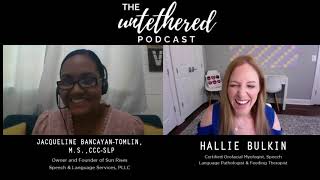
Podcast episode (Untethered Podcast, Ep. 62) hosted by Hallie Bulkin with guest Jacqueline Bancayan-Tomlin, M.S., CCC-SLP. Focuses on cultural & linguistic diversity and 'breaking myths' about bilingualism for SLPs and related clinicians. Main takeaways: code-switching is rule-governed and not confusion; bilingual children do not have higher risk of language delay when conceptual vocabulary is considered and reach milestones at similar ages; clinicians should not recommend dropping the home language and should value home language for identity and family interaction. Practical guidance includes assessing both languages, preferring assessments normed for the child's background or treating non-normed tests qualitatively, using dynamic assessment, contacting teachers, using interpreters, and pursuing CEU resources (Bilinguistics, ASHA interpreter guidance, 'Intervention with Linguistically Diverse Preschool Children' article, courses on cultural humility).
Chapters
Quick Disclaimer all information, content and material of this podcast are the opinions of the speakers and is for the informational purpose only and not intended to serve as a substitute for the consultation, diagnosis and or medical treatment of a qualified healthcare provider.
Welcome to the Untethered Podcast.
I'm your host Hallie Balkan.
I'm a certified orofacial myologist, feeding specialist, SLP and Mentor.
This podcast is all about getting your questions answered and collaborating with colleagues to.
Bring you the most up to date information in the orofacial myofunctional therapy, oral tissue and airway space. I challenge you to keep an open mind and join my mission to get this information out to the masses. Let's get started.
Quick Disclaimer all information, content and material of this podcast are the opinions of the speakers and is for the informational purpose only and not intended to serve as a substitute for the consultation, diagnosis and or medical treatment of a qualified healthcare provider. Welcome to the Untethered Podcast. I am your host Hallie Balkan. I'm a certified orofacial myologist, feeding specialist and Mentor. This podcast is all about getting your questions answered and collaborating with colleagues to bring you the most up to date information in the orofacial myofunctional therapy, tethered oral tissue and airway space. I challenge you to keep an open mind and join my mission to get this information out to the masses.
Let's get started. Thanks for listening to this podcast.
If you want to hear more of these myo tots, airway and feeding related episodes, be sure to leave a review on Apple Podcasts or pledge a small amount on patreon.com the untethered podcast if.
You found value, others you know in this space will too.
So be sure to share this episode on your social media platforms and join us over on Facebook, on my Facebook page at Halibalkin Biz, on Instagram at Hallebulcan and you can head over to theuntetheredpodcast.com to grab a copy of the Show Notes where you can also subscribe to be kept up to date on the latest podcast episodes.
Jackie thank you so much for joining me on the podcast today. I'm really excited to continue this conversation on cultural and linguistic diversity, but with a focus on bilingualism today. So thank you so much for being on the podcast.
Thank you so much for having me. I'm so excited to be here to continue this dialogue. I think it's an important time to keep talking about culture, online, linguistic diversity, and I hope we've all been taking the time to self reflect and become more self aware of our own biases as clinicians, educators, and overall human beings. So thank you.
Absolutely. It's definitely something that I have been taking some time each week to sit with and just listen and try to elevate the voices of our colleagues and even people outside of our profession who I just think have some really great messages that need to be heard and really trying to mix that in. You know, my, as far as my social media goes, like, I don't really have a plan as to what I share. I kind of do it day by day. And so, you know, I've started following more people who are, you know, more people of color, more black individuals both, you know, in the SLP world and outside of the SLP world. Some more of our Asian, you know, SLPs, some more just black and brown in general, people who identify as Latino and multiracial. And so, you know, I really, I know you're going to talk about this, but I know that there are not. There isn't a lot of representation in our field, and that's definitely issue number one. But I think that we all have a responsibility to elevate these voices. And so I really, you know, I'm trying to do my part, but I'm also just trying to sit back and listen. And I think that having you on here is just such a amazing, amazing opportunity for me to learn from you, but also to share your voice with our listeners.
Yes.
Thank you.
Beautifully, beautifully put.
Thank you so much. And so I wanted to Dominique Kennedy, which is another SLP and I graduated or her and I went to Florida State together and you guys started the conversation on cld. And I just, when I saw the her name on your podcast, I was.
Like, I know her.
And I was just so excited, you know, because I know your podcast is mostly seeing on Myoin feeding.
And I was just so excited to see that. And so I thank you so much.
For including other topics in your podcast so others can take a listen.
Absolutely. Yeah. Well, and I think it's obviously important to have that conversation because no matter what topics we're talking about, we have patients that identify. Right. That are culturally or linguistically diverse. Tongue twister and even bilingual as well. Trilingual sometimes or, you know, or there may be more languages in some of the homes. And while we ask about these things on the intakes, it's definitely not something that I admittedly am always. I try to be sensitive to, but I know it's an area that I even need to learn more about to better serve our patients. And so I think it doesn't really matter what type of therapy you're doing, right? It really matters like who is the human sitting in front of us and what do we need to know about them so we can provide the best services to them. So that's a big area that I'm personally trying to advance my own, you know, understanding and right now, because I like to believe that I had some understanding, but I know I did not have significantly or, you know, enough understanding in that space. So. So thank you. So I would love, I'm going to turn it over to you and let you, you know, share with us a little bit about your message today.
Yes, thank you. So as you were saying, you know, we live in such a beautiful, diverse world where half of the population is bilingual. And in the US there's a large and growing number of bilinguals specifically living in California, Texas, Florida, New York, New Mexico and Arizona. There was an article done in 1995 by Garcia and colleagues that stated that 50% of children enrolled in kindergarten in California by the year 2035 will have grown up speaking a language other than English. And so that's a large number, right? And we have all become very aware of our profession and that 92% of SLPs identify as white. And I have the breakdown here. And only 1% identify as multiracial, 3% identify as Asian, and 4% identify as black or African American. 6% identify as Latino. And so there's a huge racial discrepancy in our field and our profession. And until those numbers can change to become more representative of the world we live in, until we can have more black and brown, Asian and other indigenous races join our field and join our profession, US as SOPs at this moment need to step up, need to do the work, need to become educated on cultural and linguistic diversity, on bilingualism, differential dialects, and enhance their cultural humility. Because like you said, we need to do better for the, for the children and the individuals that we serve who come from a diverse background. So also because based on those numbers, if you think about it, there's a minimal chance that we as SOPs will finish our career without having served a client that comes from a diverse background or doesn't, or only speaks English or is only a monolingual, English speaking child or individual. So in order to do our job correctly, appropriately, ethically, we need to, we need to do the work now. So the things that I want to focus on today, they are three myths. And those myths are so the first myth that I want to talk about is.
Okay, so I want to talk about three myths on bilingualism. There are many myths out there, but I want to focus on three specifically. And the first one is going to be that bilingualism causes language confusion. And there is no scientific evidence to show that this true. There is a misunderstood behavior that's interpreted as language confusion, and that is code switching. And so code switching refers to shifting between one linguistic code, language or dialect to another. And to give an example, I speak to my daughters in Spanish, and I may say, por favor, go put on to zapatos. And so I just used English and Spanish in one sentence. And this can happen in a conversation. It can happen in a phrase, in a sentence. And studies have shown that code switching follows strict grammatical rules. It's not random, it's rule governed. And it actually requires a great deal of bilingual competence. So if an SLP who doesn't, who isn't aware of this, I mean, it could easily be misinterpreted as the child is confused. You know, the child doesn't know to use English or Spanish. And so bilingualism is causing this. And so here to tell you, there's no research, no evidence behind that. So the reason why kids code switch is because they hear other parents, they hear their parents, they hear other adults in their language community code switch. And so obviously, naturally, kids do what they hear and what they see, right? And so that's the first myth.
Can I ask you a question? So on that topic, and I don't. I don't really do a lot of, like, the language treatment myself anymore, but back when I was doing a lot of that, especially in early intervention with our little ones who were, you know, learning language for the first time, and they were in these bilingual or even trilingual households where maybe mom spoke one language, dad spoke another language, you know, but then they're also speaking English as the third language to the child. And we. So we saw, you know, quite a bit of code switching. I was always taught, and I'm curious to know your opinion if this is a good strategy or if this is, like, harmful to actually how they're developing. I was always taught, well, let's speak in language one during bath time, let's speak in language two at dinner, and let's, you know, focus on English because that's your goal for the child the rest of the day or something. Or when they're with mom, they speak this language with dad, this language with the nanny, this language with their daycare, school they'll get their English. What is your opinion on that? And like, is that actually harmful? Because, you know, it makes sense what you're saying, that code switching is actually a higher level skill, that they really have to be competent in both languages in order to follow those grammatical rules. And I'm starting to think, like, maybe that's not such a great strategy to recommend.
Yeah. So, you know, I think dividing it into different routines, and when you use the language, there's no evidence, usually there was research or a myth also that says you stick one parent, one language.
Right.
But there no evidence that shows that that's gonna be, that that's gonna be supportive. Children are going to maintain their language based on their need. And obviously we. They acquire language based on what they hear. How much language stimulation is being given in the home and the school. And so to answer your question, I don't really, the way I did it with my children, I spent Spanish because my husband is black, and so he's an English speaker. He doesn't speak Spanish. And so I wanted to make sure that I gave my children that language. I wanted to make sure that I provided them with that Spanish stimulation. And so I would say that the family should really focus on what language they feel most comfortable speaking. Speaking with their child. If that's Spanish, then, you know, go ahead and speak to them in Spanish. If that's English, go ahead and do it in English and Mandarin, whatever language you want to speak to your child, they're not going to become confused. Like I said, they're going to go ahead and speak the language that they feel is needed or they will make sure. Also, a phnomatic phenomenal thing is that, for example, my daughters know to speak to me in Spanish, but they know to speak to their dad in English. And so they know who to speak the language to or with. And so I really recommend, like, when a parent asks me that, I recommend, stick to the language that you feel comfortable with. Speak to the language that you know you feel in your heart you want to speak to your children. And so because it's not going to cause language confusion, they acquire language the same way monolingual children acquire it. So the more stimulation you give them, the more they're going to use that language. So that's really.
Yeah, no, that's super helpful because as soon as I heard you say that, I was like, okay. So I didn't realize, I actually didn't realize that it followed strict grammatical rules, but I always felt that it did take a higher level. I Didn't think it was confusion per se, but. And I knew it definitely took a higher level of, in my opinion, cognitive ability to be able to switch between two languages and actually form a cohesive sentence, for example. But I guess I never really, I think, I don't know if I've heard that somewhere or someone else taught me that, but it's definitely a strategy I picked up on and definitely one that I recommended to a number of families. And so, you know, I almost feel guilty now. It's like, well, no, if you speak in the language that's more native to you or that you feel most comfortable with, you know, that, you know, like the way that you split it with your husband, where you speak one language, he speaks the other. My husband speaks Russian and I don't. And I begged him, I'm like, please teach our kids Russian. Like, but you'd have to speak to them primarily in Russian for that to happen. And he just doesn't. So they get like bits and pieces from my mother in law. But I can definitely appreciate that, you know, one. One parent in the relationship having one language and one parent not. And the importance of also trying to teach that to your children. So thank you for that.
Yes, you're welcome. And I think the important thing is also that I wanted to carry on, you know, my culture as well. And so I wanted my children to be exposed to my culture and to be able to communicate with my extended family. And so that's something that I think parents need to also kind of decide. If, you know, they are bilingual, how is your child going to communicate with the extended family if they're only speaking language? And so that was really my basis for continuing. Okay, I want to speak to them in Spanish and I want to stick to that. And they're going to receive their English language stimulation from my husband. And that's kind of how we decided to do that.
Awesome. Thank you. So let's jump into myth number two.
Yeah. So bilingualism causing language delays. And bilingual children are not more likely than monolingual children to present with a language delay or disorder. There is no evidence to suggest this bilingual children know fewer words in each language compared to their monolingual peers, which may cause the misinterpretation or misperception that bilingualism is causing a language delay. However, if you take into account a bilingual child conceptual vocabulary, meaning that you take into account and calculate the child's vocabulary across each language, making sure that you don't double count cross language synonyms, so you're not going to count the child saying dog and perro, dog in English and pero in Spanish, you're not going to count those as two words. Right. They're going to be one word then. Bilingual children. Research shows that bilingual children will have the same number of vocabulary words, if not slightly more, compared to their monolingual peers. So this is why it's also crucial to assess a child, a bilingual child in both languages. And so we'll talk about that a little bit later on, too. What I did want to take into account or what I did want to state is that I don't know if SLPs are aware that bilingual children reach their developmental milestones at the same rate as monolingual peers. So, for example, a bilingual child is still going to have his or her first words at 12 months. It's still going to be 50% intelligible at two years, 75% intelligence, about three years. And so it doesn't really matter what two languages they speak or how many languages they speak, it's still the same rate that they reach their developmental marks or milestones.
Amazing. I mean, I don't think I've ever questioned that. I think I actually just assumed that. But it's good to know, like, that's actually a fact that the bilingual children reach those developmental milestones at the same rate as their peers, their monolingual peers. So that's, you know, I'm just trying to think back to cases where I don't. I don't think I personally ever looked at a child as, like, oh, they have two languages, so, well, you know, they need more time to catch up or anything. But I know that that is a discussion out there that I've heard where, like, oh, well, they're learning two languages, so it might take a little longer. I've definitely heard that. I think it is a pervasive and incorrect message that is in the SLP world. So I think that's really amazing information. Thank you.
Yes. And the third myth is sticking to the majority language, meaning sticking to only English if the child presents with a language impairment. And so some professionals may suggest to drop the home language, thinking that the child may make more progress in the school if they're only exposed to one language. And when this is recommended, it's not based on any research, any evidence to show that this is true, that only sticking to English will help improve a child's language skills. It's not based on any evidence. And when it's recommended, when professionals recommend this without really having anything, any research to back it, Up. I don't, I also don't believe, first, I believe that that's, you know, a bit irresponsible to do. And I also don't believe that professionals are taking into account how that family dynamic is going to change. Like, how is that going to affect the child's social and emotional well being in the home? How is, how is the parent and child interaction going to be specifically when parents are only monolingual Spanish speakers or their language is very limited in English. And so the parents want to do everything to follow that recommendation. And, you know, the language exposure isn't there for the parent, so how are they going to provide that language stimulation with their child? And so that's something that I really need, I really think needs to be taken into account. I think that's when, you know, SOPs need to really do the research before that's recommended, which, like, again, I said it's not based on any research or any evidence.
So.
Early childhood educators and bilingual experts have actually recognized, based on research, the importance of accepting and valuing the home language and the home culture and typically developing children. However, there's also been so much advocacy done by bilingual experts to provide intervention in the home language for linguistically diverse children who present with language impairment. So this needs to be taken into consideration. There is an article called Intervention with Linguistically Diverse Preschool Children, a focus on developing home language. And this was published in 2005. And I have the authors here if you need them.
We can always put that in the show notes if you send an article so that we can reference it. Yeah.
And I wanted to quote it because I don't want to do it a disservice. I think it's so beautifully written. And so it states, this language is a major vehicle for communicating the family's values and expectations, expressing care and concern, providing structure and discipline, interpreting world experiences. Therefore, it seems absolutely necessary that children with language impairments and their care providers share a common language. Failure to develop and maintain the language spoken in the home and by extended family may result in, among other things, loss of culture, identity and reduced contact with family members. So this is why it is crucial to understand what the myths are behind bilingualism. So we can make appropriate recommendations that aren't based on myth but backed up by research.
Like I've been saying, that's amazing, that third one, I actually am like, I did know that one in some sense that, you know, I've. I've never told a family to stop speaking the language. And I've always been very Sensitive to the fact that, like, if that's how you communicate at home, you need to continue to communicate. That's most important, you know, however you're currently communicating, what does come naturally to you, you know. But then I've also, like I said before, would guide it with if you feel like it's confusing or you feel like, you know, it might be easier for your child to, you know, learn this other language, maybe we have that designated bath time, whatever, in which I will not do that anymore. If that comes up, I will just say, you know, you do. You. You keep doing what you're doing and just provide lots of different, you know, in the same way that we would give recommendations in general for a monolingual child, just in terms of how to model for a child or what, you know, what to say, what to have them repeat, you know, things like that. But with all of this in mind. And so thank you. Because I think that, you know, you've really opened up my eyes, and I know there'll be a lot of listeners who definitely have their eyes opened as well to these myths and the realities. Right? Like what? How do we actually approach our clients or patients, and how do we approach these families who have more than one language in the home? You know, even if they're only speaking Spanish at home and now the child's learning English at school. Like, it just doesn't sit right with me to then say, well, I'm sorry, you can't speak Spanish at home anymore. You should only be speaking English to a family who doesn't speak English in the home. And that's not their goal. And that's too bad. So it's almost like, so, sorry, but hey, don't speak. Don't speak at all. I mean, how stressful is that? And you pointed out a really great point that it can have a very significant impact on social emotional development and the child's relationship with not just their immediate family, but their extended family. So, you know, it's so much further reaching than just making sure they're hitting their IEP goals or they're making, you know, if it's a private practice, they're making, you know, some strides in speech therapy. We really need to make sure that it's functional for this family and that it's speaking to both what goes on in their home setting and even beyond their home setting and supporting them there, as well as, you know, in the school setting or other environments they may be in, in the community. So really, really, I'm like, I've chilled like this, this is the kind of stuff to me that, you know, we all set out to become speech pathologists because we want to help people, we want to help them communicate. And what good are we doing if we' one of their primary means of communicating by telling them they can't use their primary language in their own home. So I think for me, that's a huge, huge message that you've shared here, and I really hope that that hits home with our listeners. And thank you for that. So I know we're going to move on and talk about, you know, what do we do when we actually encounter these children in our practice and these families who are bilingual. And so I'm going to turn it back over to you and let you share a bit about that with us.
So assessments. I took a course on cultural and linguistic diversity and the speaker mentioned that and it stuck with me. And so I wanted to share that with you all. And he said 80% of our job stays the same and only 20% changes. And so there's not going to be very much change when it comes to assessing children who come from, who are dual language learners or bilingual. And so, you know, we're going to do what we know how to do already. We're going to go ahead and do take a thorough case history, language history, health history. We're going to include some extra language, some extra questions, like what are the languages spoken in the home? You know, is the child sequential or a simultaneous language learner? What languages are being, what languages is the child receiving in school? And so those are some questions, some extra questions that we want to ask. We also want to try to get in contact with the teacher and try to see, you know, if there are any concerns at school when it comes to, you know, what kind of what's, you know, what's the child's social pragmatic skills in school? You know, what, what are the concerns at school? And so that's what we want to ask as well. And then when it comes to assessment, we want to do formal and informal assessment. We, and this is something that I want to kind of really, really focus on is the fact that we must evaluate in both languages, like I said before about conceptual vocabulary, we have to evaluate in both languages or else if we only evaluate on one language, we're going to be missing a large piece of that child's language ability. And so both languages need to be assessed. We want to make sure that we do formal and informal. So we're going to take a language sample, a speech sample. You know, we can. Based on the standardized assessment that we use, we want to make sure that it is normed for that child because we know that standardized assessments are biased. And so we can also, aside from just using the quantitative data, we can use it as qualitative data. You know, we want to make sure that if we use it as quantitative data that it is not on the child, on that specific bilingual children or linguistically diverse children. And so those are some, some pieces we wanted. You can do dynamic assessment as well. You know, that'll give you good information on how fast the child, you know, if you test, teach, and retest, how is he. How is that job doing during that process? And then. Can we pause for a second or can.
Okay, so really helpful. And I think my big question that some people may be wondering too obviously, is, like, what do you recommend? And maybe you don't even know the answer to this, but if you do, like, what do you recommend for those assessments that are only standardized on monolingual children? Like specifically children who speak English and, you know, they may consider it diverse in the sense that they've looked at different socioeconomic statuses, but they haven't actually used. Or this assessment on children who speak other languages, because I know, you know, we can bring in an interpreter and have them translate the test. You know, is the recommendation then just to use the qualitative. Qualitative data, because then we can't really truly represent, you know, the quantitative side of things. Is that big message or what do you recommend?
Exactly. So it wouldn't be fair to use the quantitative data because it's not normed on that. On that child, on that linguistic background. And so I would use that assessment as just qualitative data. I don't find it to be fair. It's not appropriate. You know, you're basically comparing monolingual children to a child who is bilingual. And that. That just doesn't add up. You know, it's going to do that child a disservice. It's not going to give you the correct representation. Representation of that child's language ability. And so I would only use qualitative data. If you can only find an assessment. If you, if that's the only assessment you can use.
No, that makes sense. Thank you. And I'm, you know, I'm almost thinking like some action points for individuals who are listening. Who do, you know, language assessments would be. You need to. And we do this, but you need to not only ask on your intake, like, what languages are spoken in the Home. But also, what languages is the child exposed to on a daily basis? Because I don't see that in every intake. And I do see some intakes because I coach people on a business side. And so people have shared their intakes with me in the past. And usually there's that question, like, what languages does a child speak? But not always, what languages is the child exposed to outside of the home? Because it's important to know inside. But also, if this child's in school for a majority of their day, well, what language is spoken there? There are different programs that are not all English. So I think that's super important. And then, you know, I think actually having a conversation with the parent before even picking out the assessment tools or just designing the assessment is probably really important so that we know how best to assess this child. And if it's going to be a combination of quantitative and qualitative or mostly qualitative, because how many kids are getting flagged as having delays or disorders when there may just be a difference and. Or maybe there isn't even a difference. Maybe this child is just bilingual. And so we are not correctly representing them because we're looking at quantitative data that is actually completely invalid for this particular child. So thank you for that, because that's a big conversation that we need to have. Despite the fact there might not be a large representation yet of SLPs of color, there definitely are a lot of children that we service or that we assess that may not even need our services. Maybe there's other services that would be better suited for them, you know, based on some of this information and how many as deleting disorder that may not actually be.
Yes, exactly. And I think that's the problem with using assessments that aren't standard or that aren't standardized for children who come from a diverse background. That's exactly the problem, that there is so much over identification.
And then also, I guess on the flip side, we could argue that maybe it's missing some kids who do have delays or disorder, because maybe the numbers are not, again, truly reflecting those kids. So I do feel like this conversation could go both ways. And there might be over diagnosis, but there could also be under diagnosis. And I've seen that conversation happening a bit. And I think in the beginning, I was a little bit confused by the conversation. Like, well, how do we have both under and over diagnosis of these popular, you know, this population of children that we are treating or assessing? And it really starts to make sense when you really pick apart the conversation and really actually take A deep dive into what is the first encounter with this child? Well, it's usually an assessment. So if we're not assessing them correctly from the get go, we're just setting them up for failure in general because we're not actually giving them what they need. So. Yeah. So again, thank you for kind of opening my eyes to that on a deeper level than I think I've really been able to dive into on my own. And I'm hoping that it'll really open up our eyes to others. You know, I could even relate this to my orofacial myofunctional evaluations or my tongue tie evaluations. You know, just. Am I. Is it, is it being presented in a way from a linguistic standpoint, you know, that's culturally sensitive to that mom of that nursing who's nursing that baby or that child who may appear language delayed and may also have some tether oral tissues? You know, it just really makes me want to sit down and kind of like comb through everything, every tool. Most of mine is qualitative data that I'm gathering, but it makes me still want to go back and just comb through everything and make sure that I'm really being sensitive to different. Because different cultures approach breastfeeding and feeding differently as well. It's not just language. Right. There's a lot to be said and even surgical procedures and what they may be open to discussing or not discussing, and how quickly can I shut somebody down if surgical procedures are not culturally accepted? Right. You know, like, well, hey, we don't want to hear anything else you have to say because you just went way beyond anything that we're willing to consider right now for our child. So, you know, definitely some big conversations to be had in this space.
Yes, definitely. Exactly. Thank you for looking at it like, with much wider eyes, you know, because it definitely goes beyond bilingualism. And that's why we must all expand our cultural humility because, you know, it's so we can become more open minded and more compassionate and have more empathy, which are qualities that we really all need to enhance when we're working, you know, just not only as working as SLPs, but just as people, you know. And so I think it's so, so important to continue this, to continue this education, this conversation. And so. Yes, thank you.
Yeah, no, thank you. I know that you had some resources that you wanted to share with us, so is there anything else before we jump into resources?
No, I don't think so. You know, just really make sure to assess them both languages, check out your Assessments, you know, select assessments that are, that are normed if possible on that child's linguistic background, ask questions and you know, and it's impossible really to learn all these languages, you know, when you're going out there and working with a child, but becoming familiar with the language, you know, before you go out there, becoming familiar with the course culture. So you can, like I said, be open minded, open hearted, serve the family in the best possible way, respecting their culture, respecting their language. And then when you become familiar with a language, for example, like Spanish, you know, there are, if you kind of familiarize yourself that in Spanish there are only five consonants that occur in the final position of words compared to English, becoming familiar with those types of parts of language that you know are in Spanish or in Mandarin before you go and treat the child, I think that's, that's really going to be helpful and it's going to be very valuable. And then using an interpreter right. When you can, when you need to, certainly when you don't speak the language. Asha has, if you go to Asha, they have a list and it explains the roles of us as SLPs when we work with interpreters. And so that's a really good resource to look at.
That's great in the show notes as well. So we can make sure that people are able to find that. We'll track down that resource for you and link it. Fantastic.
And then some more resources that I wanted to share. Bilinguistics is a company that's based off of Austin, which is where I'm living and they have really great and inexpensive courses or CEU credits that you can take. And there's one specific course that I've taken with them and I believe it's a 10 hour course and you can, it's all online training and possibly they offer you 10 or 12 CEU credits and it's a certificate, it's called Certificate in Cultural Linguistic Diversity. And it's wonderful and valuable information. Talks about assessment, talks about speech sound disorders in bilingual children and then how to talk to teachers and just really it dives deep into dod and so that's a really great course. They also have, they've also published many books that will be very helpful and resourceful for to continue your education on bilingualism and dual language learners. Yes. And I also wanted to share some more courses that I have found on Instagram and there's one in regards to cultural humility and I believe the IG page is, or the website is SOP private practice in color and they are doing a five part course on cultural humility. And I believe it's $25 per course or you can become a member and you can have access to all the five part. The five courses and you know, really partake into in this continuing education on cultural humility.
So thank you. I actually haven't seen that one yet, so I'm gonna go check that out myself. But we'll be sure to share it so that others can find it. And you know, even if you're not a speech language pathologist, you know, but these are topics that interest you. You, if you're another professional listening to this or you're even a parent, you know, who is interested in learning more. Because we do have a whole mix of people who listen to the podcast. Definitely check out the show notes for these different resources to see what might speak to you because I think there is a lot of, you know, as speech language pathologists, our job, first and foremost, you know, aside from feeding everything else, our job really is communication. And I think that we have a big job to be communicating in a way that's effective and that, you know, I want everybody to be themselves, but at the same time, I want people to realize that people learn differently, people listen to different voices and gain different things from different voices. And so I think it's so important for people to hear from different people. However, I also think that as speech language pathologists, we have a big job to step up to the plate and, you know, speak to other SLPs, but also just speak to the general population as a whole because, you know, if not us, then who, right? Like, we understand cultural and linguistic diversity and even bilingualism and maybe we don't all understand it the same. There's definitely people who understand, you know, like yourself, like, you really understand it, you live it, you, you treat it, you, you know, you can speak on it. But I think that, you know, we can definitely elevate like your voice and other voices if it's not something that we specialize in and as SLPs, because this is something the general public needs to hear more of. It's something that all practitioners in the medical field need to understand. And I think it should be SLPs leading the way and helping them better understand that since we do understand it on a deeper level than other practitioners. So thank you so much for this because it's been so informational. I learned a ton from you today. It really just helped me get my wheels turning and you heard me kind of like talking through some of it with my questions. But yeah, I mean, this has been absolutely amazing. I love all of these resources. Like I said, we will link them up in the, in the show notes. Now, if anybody wants access to you as an SLP for your services, where can they find you?
Yeah, so I have, My website is www.sunrises teach therapists. And I have a Facebook page, which is also Sunrises Speech Therapy and an IG page, sunrisesspeech Therapy.
Awesome. And we'll link to that as well in the show notes. So if you're driving and listening to this or something, you know, don't, don't.
Drive off the road.
We will get you all this goodness in your show notes. Anything, any last things you want to add.
It has been great. It has been wonderful speaking with you and I'm just, you know, truly grateful for this opportunity to shed a little bit of light on cultural and linguistic diversity and hopefully it can help someone out there and to open their eyes and like I've been saying, opening, you know, their hearts. So thank you so much. Well, and thank you.
Thank you. I mean, it's really my goal to continue this conversation because I think it is a deeper conversation that we just, you know, we should be talking more about. And so thank you, thank you, thank you so much for starting, you know, for continuing Dominique's conversation, but then also adding in the bilingualism combo, you know, on top of it because there's, there are so many pieces to this puzzle. And so, you know, I'm also going to encourage any of our listeners that feel that they have something that they could add to this conversation to reach out because I would love to, you know, it's my goal right now to have at least one person on the podcast a month who can speak on this topic on cultural and linguistic diversity, whether it is, you know, more on the bilingualism side or if it's just how we go about this and just the different areas that we as speech language pathologists or OTs, or registered dental hygienists or dentists, you know, anybody who can, who really practices in the speech language, ot, myo, tots, airway, any of those fields, any of those topics that we talk on. If you can bring the perspective directly into the work that you're doing and really demonstrate for others how they can also impact their patients lives in a more culturally sensitive way, I think that's the big goal because we all, it's really the little changes that are going to lead to the larger changes in the end. And I think it all starts with us as practitioners and being more sensitive to our patients and their backgrounds. So again, thank you so, so so much. Jackie. It's been an absolute pleasure having you today.
Thank you so much for having me.
Thanks for listening to this podcast. If you want to hear more of these Myotots, Airway and Feeding related episodes, be sure to leave a review on Apple Podcasts or pledge a small amount on patreon.com theuntetheredpodcast if you found value.
Others you know in this space will too.
So be sure to share this episode on your social media platforms and join us over on Facebook on my Facebook page at Halibulcan Biz, on Instagram at Alibulcan. And you can head over to theuntetheredpodcast.com to grab a copy of the Show Notes, where you can also subscribe to be kept up to date on the latest podcast episodes.
More from Hallie



What I Was Missing in Feeding Therapy: ARFID, Airway, and Myo with Samy Hernandez





