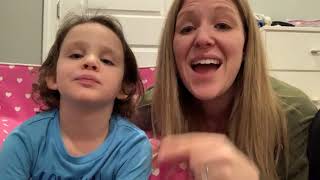
This content was created by Hallie Bulkin. This content was uploaded by Hallie Bulkin. This is a YouTube video titled "Orofacial myofunctional therapy with Lily: week 5" (created 2020-02-28). It contains an informal practitioner-led instructional session between Hallie Bulkin and a child named Lily demonstrating orofacial myofunctional therapy exercises and practice (phase progression from phase one to two, a new straw exercise, posterior release/pop, tongue-on-the-spot, suction, forming a central bolus, nasal breathing, and swallowing/posture). Hallie explains the therapy rationale, individualized approach, practice frequency, and considerations around readiness for procedures like frenectomy. The recording is conversational and aimed at parents and clinicians.
Chapters
Hi, guys. Hallie and Lily here. And we've got Lily sitting in a nice chair today in her room with her feet flat on the floor and her knees at a 90 degree angle. We've kind of. We figured out a solution for how we can do this in her room. And it's a little bit late. She should be sleeping. But she was begging me to make this video because I promised her we would. So here we are, right? Lol. So we're coming to you from her room. We did practice this week. Week. And especially yesterday, we actually introduced a new exercise. So do you remember what the new exercise is? No. No. It uses a straw. So basically what we've done is we've already moved Lily from phase one of the program to phase two. Now, if you remember, I've shared this before, the way I structure my program with mayo is phase one is basically pulling everything apart, right? Making sure that the tongue, the lips, the cheeks, the jaw all work independently of each other, especially without any other facial muscles supporting those movements. We do that first because it's really important that everything can function properly on its own. But we know that nothing truly does that, right? Everything works together. It's just a basis kind of building those building blocks, and then we kind of build on them as we go through the program, right? So in phase two, we pull it all back together and we start to integrate food and water, which Lilia and I will do on the next video. Cool. Yeah. And for this one, as we start to pull it back together, we are going to work on putting our tongue up on the spot, closing our teeth, putting this on our teeth, plugging the end of it. We're gonna use our lips, But I'm starting to work on. I'll help you. So she needs a little help holding the end. It's brand new. We just introduced this last night. Most of my 4 and 5 year olds can learn to do this themselves, but she has not really had the opportunity to do that yet. So for the purposes of this video, I will hold the end of her straw and do that with her. But before we do that, should we show them the other one? You got really good at the posterior release. Remember, we pop off the back of the tongue and keep the tongue on the spot. Remember that one? So she got really good at that, really good at controlling that. This is important because this is a movement we do when swallowing. And for proper formation of a bolus, you need to be able to create a bowl with your tongue, suction into the top of your mouth. And for proper swallowing of that bolus, we need to have a correct swallow pattern. So that's part of what we're working on here. Now with popping or not. So not popping, but with this pop that we're doing here, we're starting to keep her tongue on the spot, integrate some suction of the cheeks. And what's really important is that if you have a kiddo. And this is something I really love to do in feeding therapy and myo. If you have a kiddo who has food that's all over the tongue, right. It's scattered, it's. There's no cohesive bolus. Something that I love to work on with them is I love to teach them to do a smooch and then a. Can you give them a smooch, Willy? As you can see how she makes really nice rounded lips. A lot of the kids I work with do this. They put their teeth on their lips, right? We see their. Their upper central incisors impinge on their lower lip. I did. You did it. Or sometimes they meant to be like, right? So sometimes they do a. Sometimes they might do a nice quick little kiss like this. Like a. But then they can't maintain it like that. The reason why it's important is that we have to use our muscles to suction with our tongue up, because that's actually goes into how we form that bolus centered on our tongue to swallow. And so that is something I will do is just like fishy faces and trying to pull. What you do is that your cheeks are pulling the bolus onto the center of your tongue. And this is something that is very easy to work on with most kids. You know, it might take a couple sessions, but they can see very quickly how they can get the food from all over their tongue into a central bolus on the center of their tongue. And it's very, very, very powerful because it's something that we can go, oh, let's open our mouth and check. And they see that bolus on their tongue, and they're like, oh, wow. And it's very rewarding for a lot of them. So I love doing that. But this exercise essentially achieves the same thing. It's a little bit more fun, right? We were having fun with it. So let's show. Let's show them how we do it. So come here and remember, tongue on the spot. Close your teeth. We're going to put this on your teeth. Good. And then keep your tongue on the spot and pull the air in. Good. I don't know if you guys heard that pop, let's do it again. Tongue on the spot. Close teeth. Oops. Open your lips, but keep your teeth closed like this. Good. Close teeth, open your lips for this. And good. So she's doing a really good job of pulling those cheeks in while keeping her tongue on the spot. That's really, really, really challenging. For some people, especially little kids, it is hard to train that tongue to be up on the spot, to keep it on the spot and to do some of the work we do in myo. So that's why we often will say cognitively for these types of exercises. It's important that a child be at a cognitive level of a four year old on up and anyways, but that's, you know, for this traditional type of myofunctional program with these specific exercises. I typically do these with the kid who's at least four years of age. So what we'll do next week, we're not going to sit here and bore you with like repetitions and repetitions, repetitions of the same thing. But we were going to check on a couple exercises in a second. And then next week, like I said, we're going to integrate food and water. After phase two, after we've reintegrated food and water and we're maintaining correct tongue position and swallowing properly and our oral rest posture is improved and we're breathing through our nose, then what we do is we move into phase four and then. I'm sorry, phase three. I just added a phase to my program. Tired three phases, phase three. And that's just making sure it's a new habit and that we've habituated all of our new, our new patterns and correct, like I said, correct swallowing posture, correct oral rest posture, mouth posture at rest and lingual posture and also nasal breathing. And you can see while Lily's sitting here, her lips are beautifully closed. She's breathing through her nose, which is quite amazing to me because she has had some congestion. Right. Especially in the beginning in the morning and at night, just based on the type of cold we've had over the past few weeks. But she's doing really great with that. So Lily, will you show them how we worked on. Also the other thing was relaxing our face and moving our tongue side to side because we know you can go in and out, we know you can go up and down really well. You know, you can suction, but you can see her face is a little bit more relaxed. She doesn't have to open as wide as she did. We've Been working on that. Very good. You don't have to go so super wide. You can go a little bit more close. Uh huh. Good. And she's got a lot. Like you can see. The lingual control there has actually improved a lot. I don't know if you can see because she's sitting far from the camera, but she's been able to go from doing that where she really needed the support of her jaw, to building up what she's able to do with her tongue and going like this. You're so silly. So I'm really proud of her. Am I proud of you? Yeah. Are you doing an awesome job? Yeah. And so if you're somebody like me who is trained in the myofunctional program with Sandra Holtzman like I was, you'll notice that Lily and I are not doing every exercise. We are not doing everything in every phase. I'm doing what she needs from the program. And we also modify things and we try different things that may not even be part of that program per se as far as an exercise goes, because there's no cookbook recipe and not every child gets every exercise. Quite often I'm asked, what exercises do you use and what are your pre frephonectomy and postphrenectomy? You know, your pre op, post op protocol. It's whatever the child needs. It's individualized therapy. And there is no set of exercises that everybody gets. I might have a general set that I pull from, but again, sometimes we have to modify that and looking for specific things to be in place before referring for a frenectomy or before checking off the box and saying this person, whether child or adult or baby, is ready for frenectomy. So I want to just put that out there because I've been getting a lot of questions about that. And again, not a cookbook recipe. We're using what we know as far as what our end goals are and figuring out the best way to help Lily get to that end goal, which could be very different than another child her age who's in an alf who had a tongue tie that was released. You know, they could have the same exact profile, but we might be approaching the therapy very differently based on their needs. So I hope that that's helpful. Proud of her. Did I just kiss your eyeball? Kiss my eyeball? Oh, it felt funny. All right, guys. Well, this is Lily and Hallie with another successful week of mayo under our belts. We did practice this week. Yay us. You guys struggle is real, right? Like as a practitioner and a parent. I fully understand when sometimes my families come back and say, we really didn't practice this week. And I respect that. I respect the honesty, and I know how hard it is as a parent to get in that practice. Lily and I have been doing this once a day, and she's been making really good practice. So it also makes me realize that while we tell our families to do it a lot more frequently, I also try to meet families where they're at. And sometimes therapy takes a little bit longer when you can only do it once a day versus three times a day and. Right. Just reality. And schedules. All right. Just reality. All right, guys. Lily and Halle signing off. Bye. Bye.