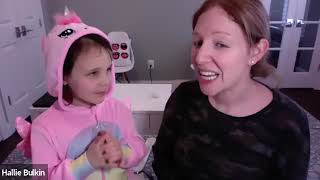
YouTube therapy/update ("Orofacial Myofunctional Therapy with Lily ~ Week 8") led by Hallie Bulkin working with child client Lily. Hallie uses a throat-scope to check inflamed tonsils (noted as "size 2") and coaches orofacial myofunctional exercises—water slurp, water trap, squeaky swallow—to train tongue elevation, prevent tongue thrusting, and stabilize the jaw. Session notes quarantine-related practice gaps, use of a job board/calendar to increase practice, possible dairy/allergy contribution to tonsil inflammation, and a plan to add food trials next week to practice tongue/saliva-based food breakdown.
Chapters
Okay. Hi, everybody. Hallie and who are you? Oh, okay. Hallie and unicorn here. And we are doing our update on mayo. So let's see. Do we have everything? We've got our spray bottle here, and Lily wanted to use a throat scope today, so we brought the throat scope with us. Right. What is it you want to show them with the throat scope? Lol. I forgot what we do with it. You forgot what we do with it? Well, why don't we take a look inside your mouth? Can you stick your tongue out? Good. And you guys, I'll hold this here so you guys can kind of see. Let's do it this way. Can you go, ah, really big. You gotta go so big they can see in your mouth. Yeah. And like this. Bend back a teeny bit. Teeny bit. There we go. And let's see if we can illuminate back there. So if you guys can see my hands in the way, let's do this. Hand. Ah. Tongue out. Good. And then back a bit. I've got you. I'm gonna see if we can show them what's going on up here. A little bit hard to see on the video. I'll probably take some pictures and put them on Instagram. Go. Ah. Again. There we go. So turn this way so they can see. And go Whatever you guys can see back there. But we're able to see the back of her throat. Show me real quick. I'm going to do a check in. Stick your tongue out all the way. Good. And go. Awesome. Nice job. And so what I can see, and I can take pictures for you guys and post them. I think that might be easier. There you go. Is I'm constantly monitoring her tonsils, and they tend to get inflamed when she has a cold or if there's allergy season. I also think that dairy, and I've said this before, might be an issue. So we're monitoring that because they tend to be, like, right now, they're not kissing and touching, which they were when we started our journey a couple years ago. But they're definitely a size 2. So they're inflamed. But they're not so inflamed that they're completely blocking her airway. So that's. That's the important component of that right now. All right, so Lily and I have been working on her exercises. Not as much as we should, because life in quarantine, that's just how things go. Right. We even added it this week so we could be better about it. We added it to Lily's her job board, right? You have a job board. We ordered a calendar to work on every day since we're not going to school. And with that calendar came a really cool job board. So we just thought, let's try it out. And it's been kind of fun to reference that throughout the day, help keep things on track. So that's been cool. All right, so we're just going to do a few quick exercises today, give you a little catch up on where we're at. We know that previously we've been working on, like, a water slurp. And so with that, we were. Right. So one of the components for that was a slurp. So we would go like this. But we're. We don't have to do that one anymore. So beyond that, now she can do what I did first. Which was actually the. Which one was it, Lily? The water trap. Not the water trap. I'm forgetting all my names today. It wasn't the water slurp. Let's see. No, it was the water slurp. The squeaky swallow is the one where we go and then the water slurp is where we go. We swallow with our tongue up, up in the palate. So let's try that one. Can you show us how you do that? What I'm looking for with Lily is that she pulls up all the tongue, all the water on top of the tongue, holds the tongue up, and I'm watching her jaw. There's a lot of anterior, posterior jaw movement when trying to swallow. Let's try. Good job. Let's do it again. So I'm just kind of observing right now, so I know if we need to work on anything and address it or I know if all looks good. You did it. I wasn't even paying attention because I was talking to everybody. Let's do it again. Also a good way to get in more trials. Oops. What did you see with the tongue that time? I was looking at the screen. You weren't looking. Could you feel what happened with your tongue? I'll tell you, if you couldn't feel it, I couldn't. So what happened that time was the tongue actually went and it came out between your teeth and over your top teeth. So it was thrusting forward. Can I try it again? Where do we want our tongue? Up on your palate, right behind your teeth. Not touching the front teeth a little bit.3 millimeters behind those teeth. So to keep it back. Right now she's doing this. Jutting that jaw forward. I did it. You did it. Let's do it again, but this time we're going to try and keep our jaw in one place. Okay. So I'm going to put my hand here to help keep your. Just use your tongue. I did it. You did it. Okay, let's do it again. And so this is where we had a little bit of a standstill because we've not been so good about practicing. Good. And swallow. Got it. Yay. So now she can do it. So I'm going to try and this is quick, but I'm going to try and back off the support and see if she can keep it now that she's done two correct in a row. Now, in therapy, I might see if you can swallow the tongue back. Oops. So now the tongue wants to sneak forward. It's okay. Let's try again. I'm gonna help you. So I'm gonna go back to giving her a little bit more support. Good. Awesome. So the jaw and the tongue stayed in place. I did feel a teeny bit of push, a little bit of resistance against my finger, but not a lot. So that's really good. But until I feel no resistance, I'm gonna keep my finger there. Let's do three more. Ready? Good. Swallowed. Oops. I think the tongue came a little bit forward. Try that one again and look at the camera so they can see us, too. Good. Oh, that tongue is sneaky. Sneaky tongue get back in the mouth. All right, this time we're gonna do one more. That tongue talks. Your tongue does talk, but we're going to tell your sneaky, talking tongue to stay behind the teeth, and I'm going to help you with your chin. Okay? All right, let's do this. Don't do anything yet except for pull the water on your tongue. Pull it up. Good. You ready? Keep the tongue back. Swallow. It snuck forward again. So that's okay. We're going to keep working on that one because that is if that's telling me that the tongue is not ready to complete this on its own yet without the jaw. So because the jaw is not being stabilized, even though we got a couple correct productions, it's in the works. Right. The jaw and the tongue are still trying to work together. So when I'm holding one steady, the other one is now not able to complete its job. If we try to keep the tongue up there and we're able to keep the tongue, then the jaw has to push forward because they truly are not working separate of each other yet. They need to support each other a bit. And so that's why we're seeing either or. Right tongue is either pushing forward or the jaw is pushing forward. Okay, so wait, we have to do another one. I want to try one more thing with you. I just want to see. Can you show them? Can you trap the water on your tongue? Do you remember how to do that? Like this? Did it fall on your left? It didn't. Do you want to try? Okay. Okay. Pull all the water on your tongue. Good. And so the whole point of that, and why I ask kids to do that, is to show me if they actually have good control of the water between their tongue and the palate. So watch me again. And then eventually we swallow with the same exercise that I was just doing with Lily. The point here, though, as I mentioned, is to see, does the tongue have good control over that water? Is it able to form into a bowl up against the palate, hold the water in the middle and not let anything leak out because of the tongue is actually, I get a lot of kiddos who do tongue to spot. And you can see the tongue is elevated, but it's not up against the palate, like when you look when you do this. So they're just doing tongue to spot, that water is going to fall out. And so that's something we always want to check on. We're going to stop our session here today because we're at a little bit of a standstill until we really get good control over the jaw and the tongue. I don't want to go any further because the next exercise builds on this one. And then once we've got that, over the next week, we're going to add in some food, some snacks, and see if we can break those down using our tongue and our saliva. So that will be fun. So that's what we're doing next week, and we will see you guys later. Bye. Bye. Bye, unicorn.