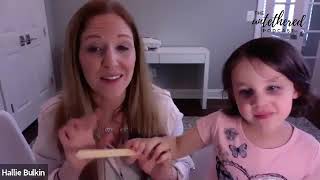
Hallie Bulkin (speech-language pathologist/myofunctional therapist) demonstrates early-stage therapy for a child, Lily, with a frontal lisp. She uses a tactile cue (popsicle stick/tongue depressor) as a physical block to keep the tongue posterior during S production, runs guided S repetitions, and explains that speech sound work should be done by an SLP (or an SLP trained in myofunctional therapy). She notes Lily’s ALF appliance expansion is progressing well, plans to continue myofunctional work and daily practice that week, and expects to fade the tactile cue once the tongue no longer contacts it. The clinician discusses when direct speech therapy is appropriate (after adequate tongue positioning and sufficient oral expansion).
Questions this video answers
June 11 (video recorded June 11)
Lily is four and will be five in August
About two months out (next appointment ~2 months)
Chapters
Good. Okay, Ms. Lily, we are working on our sound, right? Right. But what happens with our tongue? Is it supposed to come this way or stay back? When we make a stay back. Back behind our teeth. Right. It doesn't go back. It just stays back. Right? Yeah. Okay, so can you show us, Lily, how you go S In hit. Show us. S. Now we're making a s sound. Oopsies. That tongue snuck forward between your teeth. Try again. S. Good. Now do you see it? Look. Look at mama's mouth. Ready? S. S. Is it behind my teeth or is it in my teeth like this? Yeah. So I don't. I don't want to see your tongue. I want your tongue to be where? Back, Back a little bit. Okay, so here's a trick that we use. Now, Lily and I, as you notice, are working on her sound because she's developed a frontal lisp, which means that the tongue is pushing between the teeth. Now, I understand that not all myofunctional therapists are going to use this strategy or even work on a speech sound per se, because registered dental hygienists and dentists are not trained in speech. That is for the speech language pathologist. They should not be treating speech sounds. Right. So speech sounds are going to be specifically for your speech language pathologist or your speech language pathologist who's also trained in myofunctional therapy. Hi, Mia. So here's what we need to work on. We're going to use this as a block to keep that tongue back. So I'm going to have Lily bite this. And now go. Oh. Did your tongue feel anything? Only this. Oh, your tongue felt that? Okay. Can you keep it behind that? Do it again. What happened? It felt that again. So this is brand new. Lilly and I have not worked on this yet because I wanted you guys to see what would happen in the very beginning with us trialing all of this out. What's going on is her tongue keeps coming forward. We don't want it to come forward for us. We want to kind of hang in the middle of the mouth. Like some people will say. Oh, the tip of the tongue goes up. Some people say the tip of her tongue goes down. I'm not here to debate that today, but we know that we do not want the tongue coming through the teeth or pushing against the teeth. Right. If we use this as a. A tactile little helper. Right. Something the tongue can feel. I'm going to do it on the other end where she didn't do it, we invite it. This is Flavored. We bite it. If your tongue is coming forward, it's going to hit that wood. Even though I made a nice sound. So just because the sound sounds good. S. That S sounds good. Doesn't mean it's being made appropriately. And this is the problem with a lot of S is treated in speech therapy, is that we are not always looking at where or how it's produced. We're only listening to hear if it was produced correctly. And a lot of speech therapists will check off that sound just because it sounds like it's being produced correctly, despite the fact that there's a lot of compensations. So, Lily, let's try that again. Let's show them. Where's your tongue now? Is it back or is it touching the popsicle stick? It's still touching. Yeah. So the point of this is that with practice, the tongue comes forward, it touches it. This is a good tactile cue. They're so used to touching their teeth that they don't even recognize they're doing it anymore. So this is a new thing we can put in there that they're gonna feel right. If you try this yourself, especially you therapist watching, do this, try this. You're going to feel your tongue touch the tongue depressor the popsicle stick, and we're going to feel that tactile input, which is going to tell the tongue. Oops, you went forward. We need you to go back a bit. Okay, so, Lily, let's do five of them. Okay? So open, please. Open. Close your teeth and go. Let's do 5s sounds. Ready? Good. Good. Two more. Good. Now, was your tongue touching or was it back? Touching? It was still touching. So she and I are going to work on this this week. Now, I know this is not like traditional myofunctional therapy, but once we get a child at a certain point in the program, if they have speech sounds to address that are not yet correcting with the myo work, then because I'm a speech pathologist, we will start to address those as well, which is exactly what Lily and I are doing now. For Lily in particular, s is the only sound that is impaired right now. Lily, can you say hair? Hair. Can you say air? Air. Say ear. Ear. Fire. Fire. So her R is even sound really good. And she's not. She's only four. Four and, like seven, three quarters. I don't know. She'll be five in August. Right? And then we're making this video right now, and it's June 11th, so. So the point is that her other Sounds sound really great. But her ALF appliance, we just had a follow up and her expansion looks beautiful. We're really pleased with it. We think that at the next appointment in about. I think we actually made it for two months out. Just timeline wise. Our goal is for her to potentially be done with expansion. So we have got to work on this now so that when that alf comes out, she does not continue to push her tongue into her teeth at rest for speech sounds or when swallowing. Because we don't want her to undo all that beautiful work that we just did with the alf. Right? Lol. Right. So right now she's using this. It's giving her a nice tactile cue. Once we can get that tongue a little bit further back and she starts to report. And I'm looking too. Cause she's got spaces in her teeth so I can see. But once we start to notice that the tongue is further back and it's not hitting this anymore, we're going to fade this away so that. Because we won't need it anymore if the tongue is no longer hitting it. But that does take sometimes just a couple practice sessions or a couple days before we get to that point. So that is what we're working on. We're going to do that every day this week. And we're going to continue with our myofunctional therapy program which we have taken a week or two break from within the school year. We're going to resume that now and revisit our daily practice with. Can you show them how you suction your tongue program that are not correcting themselves? Because I'll say for half my kiddos, sometimes those sounds just correct themselves. Once the kids are able to move their tongue where it needs to go, they have enough space and they now have reprogrammed the new patterns. And the tongue can go and knows where to go or where it needs to. Sometimes those sounds do actually just improve. But. And these are made up numbers. But the other half of the time, right, it's not really 50 50. I haven't really measured that. But for those other cases where it doesn't happen, they do need direct speech therapy. And the best time to do it is once we know the tongue knows where it should be going and we know there's enough expansion so we know the tongue can fit in the mouth where it needs to go to produce these sounds. So I hope that's helpful. If you have questions, drop them below and we will chat about it. This is Hallie and lily signing off. Say bye. Bye, guys.