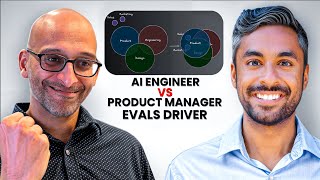
Hamel Husain and a co-speaker break down how PMs and AI engineers should split evaluation work. PMs write labels and evaluation prompts as domain experts; engineers own the final prompts and ensure feasibility. Three key questions: how many labels for statistical significance, what to do when automated scores conflict with human judgment, and who decides the tiebreaker.
and say like, you know, as much as like the PM is the right person to write the label, they're also probably the right person to kind of help write the eval here to some degree. And so I think that there's like this, this good kind of healthy tension of like, maybe it's not as mutually exclusive and it's a little bit more collaborative in terms of a workflow where, you know, the PM takes on some of the labels and then the AI engine kind of can help iterate on those.
I would like, I would like to see the PM. I think the closer you can get the labeling to the domain expert, the better. And usually the PM is more of a domain expert than anyone else, if things are going correctly and organized correctly. Right.
That's, that's exactly right. And then, and then at the same time, if the AI engineer is the person accountable for the end product delivery, then the eval prompt and the final prompt that goes into the system also like kind of rests on the AI engineer, but it also is a little bit of like some domain expertise should enter that as well. So like you should see, you know, a little bit of that like back and forth, I think in a typical workflow, we see this a lot. We see human, we see PMs writing labels. We also see PMs writing eval prompts and writing the end prompts, um, quite often. Okay. What I want to kind of, where this kind of leads me is like, I'm not sure if we're going to get a packaged up answer. Of who writes the labels and who writes the prompts necessarily, though I do think that like leaning towards PM should write labels is probably a fair assessment. Like the PM needs to be in the details of the data. The PM needs to be in the details of the eval, but kind of who does what and what that split looks like. Your mileage may vary at your company. What I would urge people to do is think about these 3 questions, which is when you go back and you leave this course, and you move on to like writing and building AI products, I kind of ask people, how many labels do you think are good enough? And for each example, how many labels should you have? And so this is a really important question because like a lot of times people will come to us and say like, do we do, you know, is 10 labels enough, 100 labels, 1,000 labels? And I think that this is a question that PMs should be working with their AI engineers on, which is what is statistically significant for you to know that this eval is good enough? And what, you know, does that matter per row? Should you have agreement between all of your subject matter experts, or are you okay with disagreement in your human labels? So think of this as like, what's the quality and quantity of the human labels that we have? The second is, what happens when the eval says that the output is good, but the human label disagrees? And what happens during this tiebreak scenario? And you'll kind of see this when you actually get your, your, your product into production. It's going to happen a lot where your eval system is going to say this went well, but your human in the loop or your feedback from your end user is going to say this was a bad response. So who takes a look at those examples and what happens and who's the tiebreaker there? That's a, that's a really important question that comes down to like your team.