Peter Antevy leads a walkthrough of the CARES cardiac arrest registry, showing how Florida EMS systems track neurologically intact survival. Florida now covers 59 agencies and 246 hospitals with roughly 1,100 cases per month. National survival to CPC 1-2 (neurologically normal) sits at 6.3%, but the presenters say 14% is achievable with local benchmarking and peer support.
Questions this video answers
January 19, 2024.
59 agencies and 246 hospitals; ~1,100 cases per month.
20 agencies and 50 hospitals.
6.3% (2022), anticipated to increase to about 7% after late case updates.
~100 total cardiac arrests per 100,000 people; about half (≈50) are 'workable' (attended/worked by EMS).
Chapters
All right, welcome everybody. It is what is today? Today, January 19, 2024. And I am really excited about today's webinar. I've stressed my guests to the max because I basically called them last night and said, you're on a webinar with me today. And this all stemmed from a conversation that I basically had on an airplane with Chief Coyle last week after coming back from the nmsp, which was a fantastic conference. The Florida NMSP chapter was incredible. We had quite a number of people and I challenged everybody by saying that you really need to know your CARES data. That I realized that, well, maybe there are a lot of people who maybe don't know how to get to it or that type of thing. Let me just admit these people. Okay, so today what we're going to do is we're going to give you the kind of the outline about what to do, how to get your data, and actually we're going to give you some ideas about what we think you should do and how you should look at your data, which version of the data you should look at. So.
Oh.
Sorry. Okay, so let's just get here for the goal. So by the end of today, you should one thing know your agency's cardiac arrest survival, not the overall survival. I want you to know your CPC 1 and 2 survival have ideas and next steps on next steps and conversations. You're not going to solve the world today, but you're going to have a lot of ideas of what to do next. And then you should have Devo, Chief Moran and Chief Cortlandt speed dial because if you want to fix cardiac arrest at your, at your location and there's other people on this call who could help. But I'm going to really pinpoint on these guys here because they've really done a lot of work and you'll see why. But before we get started, I'm going to give a little bit of a preamble and I'm going to bring in Chief D. Bernardo and I see here there's still people trying to come in for some reason.
So real quick on how we got here.
We started in 2016 and really it all started because our current fire chief, Chief Downey.
Who'S really, oh, this thing is going on its own shoot. Our incredible fire chief, Chief Downey really challenged us several years ago and he said to Chief Gonzalez, hey, what's going to be your project? What are you going to do to make things better? And this thing is going again by itself. Sorry, it must be on auto. Auto Train. But. And so essentially in 2016, Chief Gonzalez and Chief Moran went to Seattle, went to the recess academy in Seattle, and they came back, you know, really excited about what to do next. And what I didn't know back then, and which is a very touching story, I know Chief Gonzalez is on the call today is that Chief Gonzalez's father passed away from cardiac arrest when he was a young man. So Chief Gonzalez was only 18 when his father passed away. And he, he saw the medics come into his house. I mean, he, he tells the story better than I can. But really this is something that Chief Gonzalez is doing in his father's honor. All the survivors that come out of Davy and come out of the rest of Florida, maybe even the country, he, he's really had a big hand in this. So before we go to Chief D. Bernardo, Chief Gonzalez, are you there? And would you mind making a couple, saying a couple of words?
Is Chief on.
Maybe I don't see him. Dan is Chief.
I'm not sure if. But, but I'll tell you, it was, it's a touching story. You know, we've heard it at every event that we've had. And you know, basically he witnessed his father going to sudden cardiac arrest and he witnessed EMS arriving and working to save his life. And we honor his memory every training that we do. So it's a special part of our history.
It is. Thank you so much, Dan. And so then we said, we need somebody, someone special who can really take this bull by the horns and actually make it happen. And there happened to be a fire chief from Sunrise who's a data guru. He's a brilliant man, and he just couldn't stay out of retirement, so incomes. Chief Tom DiBernardo. Chief, please come on in and tell us how did you get involved in all this and tell us where you are now at the state level.
Good morning, everyone. Thomas DiBernardo, Florida Department of Health, your Florida cares coordinator. Well, exactly that. I was retired and, you know, we all tried to get into the cardiac arrest registry in the state of Florida for years. And it was around 2015. We had some pilot agencies join the registry. And in 2017, the state committed to full time employee to push out the registry. And I was given a five year goal to get 20 agencies and 50 hospitals. And this June will be five years. And we have 59 agencies and 246 hospitals. And we thought we'd be at 500 cases a month. And we're at basically 1100 cases a month now. So we're far exceeded our five year goal already. I don't know if that was terms for me to retire again yet. So I made my new retirement goal at CPC score of 15 to 17% baseline Florida before I'm allowed to retire.
Now that, that would be amazing. I want to take you to Morton's if that happens.
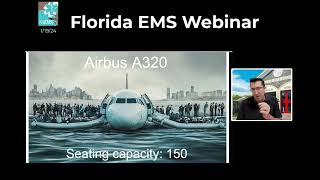
So, so chief has been just an incredible powerhouse, let's just put it that way in getting Florida to where it is today. Thanks, thanks to the state, everyone at the state, including Dr. Shepke, Steve McCoy and many others who actually made us a priority. Even Joe Nelson beforehand who initiated this. But there's many people involved so we're very happy where we are today. So let's keep moving on because we have a lot to talk about. I really want to give everyone just a quick breakdown of the numbers. So if you have a population in your city or your town of 100,000 people, this is how the number is going to break down. Ready? So you should expect about 100 total cardiac arrests. So again whatever your population, if it's 300,000 and 300, 400,000, 400 et cetera of the total arrest that you'll get called out for that you'll have, you'll typically work half of those. So Davy town of Davy has a little over 100,000, let's say 110,000. So you know, we should be seeing about 55 arrests. Sorry, about 110 arrests and work 55 of those and that's kind of where we are. Of the workable arrests the state of Florida, I should say that nationally this past year, 2022, 2023, sorry, the CPC 1 and 2 survival, not overall survival was 6.3%. When you do the math on that one, a town like Davie should have three neuro and tactic survivors. Not a lot. However, what if I told you that with a little bit of work you can get to 14% and that's what Tom just mentioned. Then you could have seven people come out. Right? So three to seven doesn't seem like a lot but like we talk about in our resuscitate Florida, you know, events, if you had 25 years in your service and you, let's see, only six saves a year, that's 150 lives and that's basically an Airbus A320. That's you're Sully right? So over your career and by the way the arbitrage there was 75 additional people because it was only three, it's 75. But if it's six it's 150. Just think of how many families, how many. How many weddings, how many birthdays you. You've made a difference on. So the numbers aren't that big if you're a small town or small city, but they do definitely add up. So this is 2022 data. Look all the way to the right. And by the way, these are the states that are in cares. There's still some that are not. Look all the way to the right. This is 2022 data. As of today, 2023. The numbers, Tom, are we at what, 6.3% for CPC 1 and 2 for that for National?
That's correct.
Right. And that's going to increase as the. As these kind of December cases get pushed in and we get the outcomes for those cases. So we're more than likely going to end up at like 7% where we always end up. Correct?
Correct.
Okay. So basically, did the patient get discharged neurologically normal? In my opinion, that's the only number you should be looking at. And we'll talk about that here in a little bit. We're going to keep moving on.
So I've asked Chief Moran here in a minute to go over the CARES modules. There is data that goes in. It's very important that you know what data goes in, you know how it goes in, you know who does it at your agency. And there are some issues with some of the data elements, in our opinion. But we're going to go through these in a little bit. I'll start with the dispatch. I'll pass it over to Dan for ems, and then we'll talk about the hospital.
So dispatch has five data points that they can put into cares. Here is the cutout of how it looks like.
Was the call transferred to them? And by the way, Tom, if I'm making any mistakes, please just pop in. Did they transfer the call? If yes, the time elapsed before the dispatcher first addressed the caller. But these are the three most important times. When did they recognize cardiac arrest? When did they give first instruction, and when did they time to first compression? There's really only two ways of you getting this information. Listening to the call yourself or getting the case sequence, if you have mpds, so you can ask them for the case sequence, and it's basically a PDF of this information. But at the end of the day, someone's got to go in and answer these questions manually. This doesn't just get populated on its own. Chief Di Bernardo, did I miss anything there? Is that true?
That is true.
Okay, if you do not do this. You will not know how you're doing with telephone cpr. Here's the problem. When you go to dispatch and say, hey, I just heard this webinar and they want you to put in every time for every cardiac arrest, they're going to go right away, they're going to say, we don't have enough people to do that. So you're going to have to make a decision at your own agency whether you input this information on your own. And if you do, then you'll get the data. I'm going to warn you right now, you better be prepared for what you're about to hear once you start listening. This is an email I received from years ago where one of my chiefs emailed me and said, what's going on here? And it's because you start to see things like this. The first time CPR has begun was 6 minutes, 18 seconds after the call. That no longer happens thanks to people like Roach, Pete Clark, Bernardo, Steve Moran and many others who have really Dr. Roach from BSO who's really helped us fix dispatch, Chief Coil up in Palm beach county and many others. So you have to fix this badge for that to happen and collect the data. Then you can get your own dispatcher cares report. So if those five data elements get put.