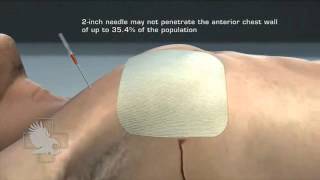
Peter Antevy explains North American Rescue's ARS needle decompression system, designed for tactical use with a 14G 3.25-inch catheter. Standard shorter needles often fail because chest walls are thicker than expected. The longer needle reaches the pleural space in most patients and comes in a rigid case with a red grip cap for speed under stress.
Sa.
Introducing the ARS Air Release System for Needle Decompression from North American Rescue Incorporated the new and improved ARS for Needle Decompression from North American Rescue is the result of a two year collaboration with tactical health care professionals worldwide. Through this effort, North American Rescue has been able to identify developers, test and deliver a product that has a direct correlation to decreasing the second leading cause of potentially preventable combat death. Built with requirements for protection, intuitive use and functionality during stress, the ARS is equipped with the following special features designed to help achieve a successful procedure in the most austere and demanding conditions. The ARS Needle Decompression Kit comes specially packaged in a rugged, rigid case which eliminates common pitfalls of conventional packaging such needle bending contamination due to open packaging difficulty opening with gloves on. The ARS Needle Decompression kit includes a 14 gauge 314-inch-needle catheter with the flash chamber cap removed. Unlike a conventional angiocath system that incorporates a flash chamber cap intended to prevent excess blood loss during vascular access procedures, the cap has been removed from the ARS due to reports that during heightened stress there were occasions that the operators did not remove the flash chamber cap from the standard angiocath, rendering the procedure unsuccessful. The easy grip, easy to open container has been designed with a red cap for enhanced identification and manipulation during stress when a rescuer's sympathetic nervous system response limits color recognition and inhibits fine motor skills. The ARS Needle Decompression Kit is intended for use in the management of casualties who present with signs and symptoms of a tension pneumothorax. Research data from the US Army Institute of Surgical Research has shown that chest decompression with a 14 gauge needle is as successful as a chest tube in relieving a tension pneumothorax and that the therapeutic benefit persists for at least four hours. Recent studies conclude that chest wall thickness is generally greater than previously thought. A study published in Pre Hospital Emergency Care measured chest wall depth on CT scans and found that needle decompression with a standard 134-inch angiocatheter would be unsuccessful in 50% of trauma patients on the basis of body habitus. In a study published in the Journal of Trauma, it was found that a 2 inch needle may not penetrate the anterior chest wall of up to 35.4% of the population, depending on age and gender. A study in Military Medicine recommended that the procedure for needle thoracentesis to relieve tension pneumothorax should be performed with a needle of sufficient length and that a three and a quarter inch needle would have reached the pleural space in 99% of the subjects studied. A presumptive diagnosis of tension pneumothorax should be made when progressive respiratory distress develops in the setting of torso trauma. In tactical environments, one should not rely on such typical clinical signs as decreased breath sounds, tracheal deviation or hyperresonance to percussion because these signs may not always be present and even if they are, they may be exceedingly difficult to appreciate in a tactical environment. A patient with penetrating chest trauma will generally have some degree of hemothorax or pneumothorax as a result of his primary wound and the additional trauma caused by a needle decompression would not be expected to significantly worsen his condition should he not actually have a tension pneumothorax. This casualty has sustained a penetrating injury to the chest and an occlusive dressing has been applied in order to stop air from being drawn through the defect in the chest wall. Here you see the air pocket known as a pneumothorax that developed from the air that entered the chest cavity through this injury as well as air that continues to leak from the damaged lung tissue. As the air pressure in the pleural space increases, a tension pneumothorax can develop causing respiratory compromise and shock. This life threatening condition must be treated before it creates an excess pressure that compresses the heart's ability to pump blood effectively. The rescuer decompresses this tension pneumothorax by performing a needle thoracostomy commonly referred to as a needle chest decompression. Step 1 Select Site Affected side Second Intercostal Space Mid clavicular line for reference, you should never insert a needle closer to the center of the chest than a line drawn from the nipple straight up to the collarbone. Step 2 Cleanse site with antimicrobial solution.
Step 3 Remove red cap with twisting motion.
Step 4 Remove ARS from case.
Step 5 Insert the needle into the skin over the superior border of the third rib mid clavicular line and direct it into the intercostal space at a 90 degree angle to the chest wall. An audible rush of air may be heard from the needle. Step 6 Remove the needle and leave the catheter in place. Consider securing the catheter to the chest with tape. There is no need to create a flutter valve or attach a three way stopcock for this catheter. Remember to periodically reevaluate the casualty if progressive respiratory distress redevelops. Assume that the catheter is no longer effectively ventilating the pneumothorax, the rescuer may either attempt to flush the catheter with sterile saline or other sterile IV solution or repeat the procedure with another ARS placed adjacent to the first ars.