Audrey Blewer PhD, MPH - Implementing OHCA Interventions (4/5/2024)
Audrey Blewer presents evidence that bystander CPR and early defibrillation save lives in cardiac arrest, then describes a North Carolina trial testing community and EMS interventions. Interviews with paramedics, firefighters, and hospital staff identified what actually works: simple messaging, regular feedback, data sharing, and ongoing meetings to keep programs running.
Chapters
Welcome Everybody. It is April 5, 11am Another Friday. We have another amazing guest today.
Our guest happens to be a Florida native. I just learned Audrey bluer is a PhD. She's got her MPH. She's an epidemiologist and resuscitation scientist at Duke University School of Medicine. And we always have these brilliant people who are not front facing clinically but really help us clinicians out by doing the work that they do. Many of you know Tanner Smita, he's, he's similar in that regard. He's done some great work. And so I reached out to Audrey after seeing her publication and, and reading it and thought it would be very interesting for us. So, Audrey, thank you for joining us. If you want to give any further introduction and then you can share your screen and take it away. Thank you so much for joining us.
Yeah, so just as a little bit of background on myself, I have had the opportunity of being in the resuscitation field for about 10 to 15 years now, but just, you know, more formally as part of, as far as my credentials. Yeah, I'm a PhD epidemiologist and have my Master's in Public Health and really enjoy approaching these questions from what I'd like to call just more of a public health perspective. And these are my disclosures as it relates to this current presentation. But more specifically, the way in which I've structured this presentation is, you know, kind of going, going back to the science of what we're doing, why we're doing what we're doing, and then talking through a little bit of our current project that is being conducted in North Carolina and the manuscript that Peter identified and asked me to share today. But as I walk through this, I'm sure that this may be.
Possibly redundant to some of the knowledge that you all have, but hopefully the presentation of it is stimulating and motivates some conversation. But as we know, out of hospital cardiac arrest is a huge public health problem with over 350,000 individuals experiencing out of hospital cardiac arrest annually and less than 10% surviving to hospital discharge. For me, this just really encourages and motivates me to think about, you know, how can we increase survival more generally? And specific to the research that I do, I think, you know, many of us are aware of the chain of survival, but more broadly, we know that, you know, out of hospital cardiac arrest survival depends on several existing therapies and links in the chain of survival, including, you know, rapidly calling 911, prompt delivery of cardiopulmonary resuscitation and early defibrillation, all of which have motivated a lot of my line of research. And just going back to a bit of the science behind this, what I'm highlighting here is a article published in New England Journal of Medicine in 2015 and this publication was out of Sweden and used a registry in Sweden. And as you can see, bystander CPR is associated with more than a doubling in survival. So this right here with the Y axis, we see the survival rate in the population and the green line shows CPR before EMS arrival contrasted to the individuals that did not receive CPR before EMS arrival. And then in addition to that, we know that there is just.
Huge precedence for thinking about.
Early defibrillation. And what I'm highlighting here is, you know, one of the earlier publications around, around early defibrillation in the PAD trial that was published in New England Journal of Medicine. And again, we're really encouraged to see that the survivor number of those in this particular cohort that received CPR and defibrillation as compared to those that just received cpr. And again, just reinforcing the importance of early defibril.
So I think, you know, more, more generally this has motivated many of us to think about, you know, what can we do to increase some of these bystander focused interventions more generally. And I had this publication with a team in Singapore as part of my appointment at Duke University. I also have a joint appointment at Duke NUS and Singapore, which is also a medical school in Singapore. And Marcus Ong has this, this robust infrastructure out in Singapore really motivated around pre hospital emergency response and out of hospital cardiac arrest. And we had this publication looking at the impact of bystander focused public health interventions on CPR and survival. So in their particular population, over about approximately a 10 year period of time, they rolled out EMS interventions, dispatch assisted cpr, CPR training, and then what I'm highlighting here in the final line was also a crowdsourcing mobile application. And what we saw was again this is an observational cohort study, but we saw that the rollout of dispatch assisted CPR and CPR training, in addition to the crowd sourcing app that's similar to our pulse points, all was associated with an increase of bystander CPR and survival as well. And again, I'm highlighting the limitation of this being an observational cohort study, but I think it still speaks to the importance of these community interventions focused on focus on the bystander and also arguably what they had done as well as EMS interventions as well as. So this brings us to our publication where we were looking at how this is. You know, this is really well and gutted, and this is important. I think all of us really acknowledge the importance of rolling out these types of interventions. But how do we generate and facilitate support across communities and EMS agencies for these interventions, and how do we promote and and sustain the implementation of these interventions? These are all real, true knowledge gaps and important for us to understand because as many of us probably know, it is tough to maintain enthusiasm for these particular interventions. So to examine this, we leveraged the infrastructure of the race cars trial, and I'll tell you a little bit about the trial in the next few slides. So, as I highlighted through the previous publication that we had in Lancet Public Health, we recognize that there's evidence supporting that the community interventions work and that they're important. But there are very few studies out there showing demonstrating effectiveness of these particular interventions through a randomized control trial. And that's where this race cars trial is. That's kind of the knowledge gap that this, this race cars trial is addressing. So we are in year four of a cluster randomized trial in North Carolina, which is.
Looking at, looking at the impact of community and EMS care improvement and feedback interventions. And this is being conducted in 62 counties within North Carolina with the goal of enrolling about 20,000 patients. And again, we're in year four of seven. And the intervention, again, is specific to community and EMS interventions. And the control is usual care, continuing standard quality improvement efforts. So the primary endpoint is hospital survival with good neurologic outcome. And the second outcomes are rates of bystander CPR and defibrillation prior to EMS arrival. So the PI of this trial is Dr. Chris Granger. He's in the DCRI and also at Duke and must acknowledge the many, many individuals that are working on this trial and are necessary to make this happen. I'm just one of many. So, as you can see here, this is.
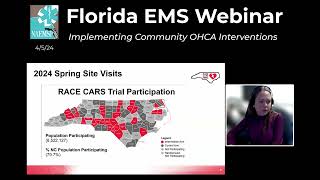
The participating counties as of spring 2024. The red are the intervention arm. The dark gray are the control arm. The light gray are those that are not participating. And what's important to identify through this is that it's a good mixture of both urban and rural populations that are participating in this particular trial.
And the four interventions include rapid cardiac arrest recognition protocols that trigger immediate priority EMS first responder dispatch by 911 telecommunicators. The second is systematic bystander resuscitation instruction by 911 telecommunicators. And the third is comprehensive community training of laypeople and CPR and AED use and the fourth optimized first responder performance, including earlier use of AEDs. So again, just getting at a lot of, a lot of what I mentioned earlier with the science.
So for the purposes of the paper that I'm presenting, we were looking at factors impacting support for.
For in both the community and EMS agencies. And for the purposes of this discussion, where opera we're using the definition of support of the act of agreeing to or accepting an idea. So this is particularly based off of prior knowledge, knowing that obtaining support from key informants is critical to the success of new interventions. And this is largely drawn from the implementation science research.
To inform our interview guide. We use the consolidated framework for implementation research. So this framework actually consolidates a lot of the known theories and models and developed.
Quite a few constructs that cross several domains of importance. And we can think of it more generally as kind of the community and then the interpersonal and inner settings.
And highlighting the sampling framework. And this is important for our knowledge, just more on the clinical side that when thinking about the individuals that we spoke with, we first considered the county's just overall cardiac arrest performance. And this was based off of prior years of data and counties entering into the CARES registry. But it's important to note that we considered cardiac arrest volume, their CPR performance and survival as well. And then we also spoke with the care with the implementation coordinator to gauge perceived engagement of these counties. And then the counties were then divided into high and low. And then we randomly selected counties within this breakdown. And then as you can see here, we interviewed EMS telecommunicators, fire first responders and hospital representatives within each county.
And then more broadly, we were really interested in looking at adoption of interventions and then just more generally how we can increase reach and adoption specifically to CPR and early defibrillation. And then we also considered other subpopulations. So more specifically, we were really interested in looking at differences with regards to race, ethnicity, socioeconomic status and gender. And this is a subject.
Another paper that we're working on currently.
So it's important to note that this is being conducted as part of the larger race Crush trial. And what we are doing is as part of the implementation science team, we're working with the trial to share back information about what's working and what isn't working. So that can kind of inform your thinking about how we're looking at this question of buy in. So we were rapidly analyzing the data and feeding it back to the racecars team.
And as you can see here we were able to speak with an arguably pretty balanced representation of participants in both high and low performing counties across all of these different affiliations. And then as you can see here, we got a decent balance of urban and rural as well as well as senior leadership and then people that were and other roles within the agency as well.
So I'm going to walk through this particular slide in a little bit more depth and then happy to discuss it a bit more once this presentation concludes. But these are the summary of the findings around initiating and maintaining support with EMS agencies. So in one of the low performing counties we saw in terms of initiating support agencies that there's initial resistance to changes or new interventions, but one strategy was identified holding meetings with stakeholders either as a group or one on one to build foundational relationships. And then as far as similarities in this column we also saw people expressing the need to be creative with presenting the rationale for new changes or a new intervention, introducing the intervention or changes by someone who is very familiar with or has experience with the intervention.
In terms of obtaining support from emergency response teams, it was emphasized to maintain simplicity when explaining the intervention, ensuring the team members clearly understand their role in assisting in implementing the intervention before launching the intervention, training and education.
As well as creating an outlet for free for frequent communication about the intervention and develop easily accessible detailed explanations of the intervention. As far as maintaining support, as far as similarities, we saw individuals expressing providing regular updates to the emergency response agencies, including quantitative and anecdotal data that shows patient outcome improvement. And then lastly in terms of obtaining support from agency staff and obtaining support from senior leadership, we saw differences from high and low performing counties. In terms of high performing counties, they expressed some barriers including needing approval from multiple people, especially if the emergency response responders working in a hospital based system, the inability to collaborate with health departments and financial challenges that was expressed by multiple people. In addition to that in low performing counties, we saw agency leaders need to set a positive and collaborative attitude in order to generate support from teams.
So as far as some of the quotes, what I'm highlighting here is just I'm going to highlight one quote and this largely motivated a bit of the direction that we're taking as far as our current analyses and looking at a bit more at fire engagement in this capacity. But an interesting quote we received is I've got guys that have spent their entire careers in the fire service that have never run medical calls. So they've been a little reluctant and I'll be honest, it can be a little scary because now you're not putting water on fire, you're putting hands on people and their lives depend on that. So it's just getting over that change and working through the education piece to make sure everybody understands what the goal is and why you're doing what you're trying to do. And this was a fire chief from a low performing county and that really spoke to a lot of us and resonated with the Racecars leadership team as well. And then another quote that we received is you have to be open to feedback. You have to establish a feedback mechanism. Because we got people that were like, yeah, it makes sense that you want it to go, but that's also where you, where we put our drinks and our gloves. It's like, man, we made this change, but it doesn't seem like things are changing or we're getting poor compliance with people following the directive. That's probably a reason. So again, this I think highlights the importance of the feedback loop. And I think just me as a researcher working in this space, I've seen this and multiple projects that I'm working on, you know, just the necessity of that feedback loop when it comes to out of hospital cardiac arrest and also helping people understand the importance of the change and where they fit in the bigger, bigger projects. So in conclusion, we saw that effective implementation of community based out of hospital cardiac arrest interventions may be facilitated by training, good communication, effective data sharing and regular meetings with teams and stakeholders. And we're now focusing a bit more on FHIR buy in, but more as far as practical next steps. I'm highlighting a bit of what we're doing in terms of those four buckets that I just outlined. This is work that's currently being done. So as far as training, we have a manual of operations that's shared with ems, that's shared with EMS to share with partners, and also hard copies taken to site visits, regional meetings and state meetings. And it's written in simple terms. With ongoing updates of latest science and best practices. We're encouraging EMS and FHIR to.
Work together on team based CPR and EMS to train FHIR on team based cpr.
Also integrating FHIR in the community, training partners for teaching hands only cpr and then more generally, a letter is sent out to all partners. As far as communication, we're working to close the feedback loop on outcome, which I think is something that I see is very important. You know, across, across the board.
The Duke team travels to all the sites to help facilitate engagement. There's a slide deck developed and tailored for Sites to use for training and approach and engage fhir. More generally, a quarterly newsletter is sent out to EMS Share with partners and that includes things like, you know, success stories, best practices and EMS is the liaison to FIRE to share trial updates. And everybody's invited to state meetings which is held.
In two locations in the state. As far as data sharing, this is, this is data that's being taken from CARES and is sent out quarterly to EMS and 911. And it has specifics on things such as CPR, ad application defibrillation and response times. And more generally in terms of regular meetings, a lot of what we, you know, continue to stress and I think this is also, you know, taken more generally from some past initiatives including heart rescue is survivor celebrations importance of highlighting the bystanders meeting survivors, staff recognition. So this is something that we've been thinking about a bit more and I just, you know, how to recognize 911 and all of those that are integral in the, in the chain of survival.
EMS is being mentored in how to engage local and state government resources including county commissioners and legislators. And there's also monthly calls that occur that includes 911 EMS and then fire as well.
And, and they when meetings are done are created or initiated by the Duke team. It involves, they try to incorporate a survivor story at the beginning and if a survivor is unable to attend, EMS often does a case study of their arrest. And so this is highlighting some things that have been recently been conducted through some of these counties. So Hoke county is a rural volunteer fire county and they just started a deputy medic program. So as you can see here, this was published March, March 19, 2024 and that was picked up by Spectrum Local News, which is really exciting. And then this is an image of a recent survivor celebration in Davidson County. And as we can see here, the middle is the survivor with some of the staff that took care of him and.
The representation of all staff including in this particular image, including 911 EMS, fire law, hospital.
And other individuals that were instrumental in the chain of survival.
And then this is a hearts and heroes celebration that was recently held in Carabas County. And this is actually I think the funny picture that was taken from the particular celebration. But I think what's really encouraging to me is just the number of people that that came together, the diversity of the backgrounds that was included in this particular image. And just it's really exciting to see people coming together and just celebrating survivors success stories and just highlighting the importance of, you know, working to improve this chain of survival more generally for out of possible cardiac arrest.
So these are.
These are key members of the Racecars team that were really instrumental and.
A lot of what was represented just here. And again, Chris Granger is the PI of this, but there's many investigators involved. And then more generally, the implementation science team is listed here as well. And yeah, happy to take any questions.
Wonderful. That's an amazing presentation. I have so many questions and thoughts and I know, I'm sure other people have a few questions as well, but I'll start.
First of all, I can't even imagine being the quoted fire chief of a low performing county. So how did all that go down? How do you say, okay, you're the low performing guy and you're the high performing guy. Can you, can you kind of explain that aspect of it and how has that impacted those folks?
Number one?
And then number two is what I really think is happening here is that this is. You guys are really creating like a leadership playbook, right, of basically how do you make a low performing county high performing. And I would be fascinated to understand what are all the items that are making these people low versus high performing.
Yeah, no, that's a great question. So I.
More from Peter




Melissa Olen MSN, FPN-C, CCRN: Sudden Cardiac Arrest Training in Schools (Project ADAM) 4/25/25



Pediatric Hospital Readiness: How Teamwork & CPR Metrics Drive Better Outcomes



Chelsea Kadish, MD & Kyle Goodknight, EMT-P, RT: Pediatric CPAP in EMS (3/14/25)