Brian Driver, MD: Does Dose of Sedative Matter in RSI
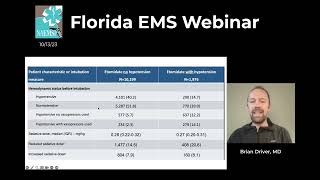
Dr. Brian Driver analyzed 14,000 intubations from the National Emergency Airway Registry to see if sedative dose affects post-intubation hypotension. Neither etomidate nor ketamine dose correlated with low blood pressure after intubation. Age, pre-existing shock, and pre-intubation hypotension mattered more than dose.
Questions this video answers
Etomidate 0.3 mg/kg; ketamine 1–2 mg/kg.
NEAR registry ≈19,000 patients total; ≈14,000 received etomidate or ketamine (≈12,000 etomidate; ≈2,000 ketamine).
Etomidate: ~16% post-intubation hypotension; Ketamine: ~29% (as stated in Q&A).
Post-intubation hypotension was reported by treating clinicians as systolic blood pressure <100 mmHg.
Five EDs (≈4,000 patients) that used a fixed 20 mg etomidate dose for most intubations (median dose ≈0.25 mg/kg), permitting dose variation by patient weight rather than clinician titration.
Chapters
Welcome everybody. We are back for Now Fridays at 11:00am.
First of all, a big thank you to all of our speakers who have had to modify their schedules from Tuesday to Friday. And Dr. Driver is no different. He was very kind. When I reached out to him, he immediately wrote back and said, absolutely, I'm in to giving this talk. Obviously this is a very important topic. I've always been very curious about this topic because you hear a lot about it and I think people don't really understand what to really do in these situations. And so I think it's a great topic. While Dr. Driver is speaking, I will be putting in the CME for today, which I believe is 17439, but just hold on and I'll add that in. But without any further ado, everybody, welcome Dr. Brian Driver from Hennepin Healthcare. So Brian, if you want to make a further intro, thank you so much for joining us and take it away.
Yes, thanks for having me. So I'm Brian Driver. I'm an emergency physician at Hennepin County Medical center in Minneapolis. So a little colder than Florida right now. It's 40 and raining. So I'm dreaming, dreaming to the beach. But thanks for having me. And we'll talk about sedative dose and RSI and post innovation hypotension.
I have no disclosures.
We all know that hypotension is bad for, you know, in general, particularly in trauma patients and patients with tbi. And as clinicians, we particularly want to avoid worsening or causing hypotension in someone who's sick, injured, in shock. And of course that's something we prioritize a lot of our resuscitation around. When people are performing rsi. The most common meds are automidate and ketamine. The normal dose for etomidate is 0.3 milligrams per kilogram. The normal dose for ketamine, as you guys all know, is 1 to 2 milligrams per kilogram.
But even today, and but more, more often historically other agents were used for induction for rsi, propofol, midazolam. These are drugs that have a more strong dose dependent relationship with hypotension. So when these are used in patients with shock, there is a very clear recommendation to reduce their dose. Thankfully, these are not used as often for RSI induction. But that sort of thought process of hey, we better reduce the dose has actually carried over to automating ketamine. And so the question is, should we reduce the dose of etomidate? Should we reduce the dose of ketamine in someone who's either in shock or at risk of shock. And there's not a lot of data, but there actually is some pretty strong recommendations. Life in the Fast Lane, which is an emergency medicine sort of blog and online textbook, there's other blog posts and even the up to date section on this for induction agents, recommends reducing the dose of ketamine and etomidate in the setting of shock or patients at risk of shock. And so without there being a lot of data out there, in fact there's almost none, we thought we'd take a look at, see whether this is true. So we really sought to determine if the weight based dose, the milligram per kg dose of etomidate or ketamine. We're not looking to really compare the two drugs, but these are drugs of interest since this is what's used if the milligram per kg dose was associated with hypotension shortly after intubation. And we use data from the National Emergency Airway Registry, which is a big conglomeration of centers that all.
Basically have the clinician complete a detailed data collection form after intubation to give details on the patient, who they were, what their hemodynamic status was, how'd the intubation go, what was used, what were the complications. And so it's a really big database. You can get some really detailed data from this. So in this database, we looked at patients who were 14 years and older who received ketamine or etomidate for intubation. We excluded those who really didn't fit in the population of interest, like those who had topical anesthesia approach. We also excluded people if we couldn't figure out, you know, whether they had hypotension or if we didn't know their weight or their dose or what they were like before intubation. There is a sensitivity analysis that includes all these patients we'll get to later. But in general, we wanted to figure out, we wanted to only include patients if we could actually figure out what happened to them.
So as I said, the intubating clinician puts in detailed data right after intubation. And this does include what the patient's hemodynamics were right before intubation and whether they met the outcome. Of course, they also include sedative dose, patient weight, that sort of thing.
The main outcome we were interested in is post innovation hypotension and secondarily, whether this hypotension was treated with something like fluids or Vasopressors.
As I mentioned before, we analyzed etomidate and ketamine separately. There's a lot of data out there comparing the two. But because this is not randomized data, we didn't want to.
Try to make any comparisons. We're really just interested in dose and the effect of the dose. And we did build a multi variable model, adjusting for things like age, gender, how quickly the patient needed to be intubated, what was their hemodynamic status, was it difficult, and then what hospital were they intubated in.
So it's a big data set. 19,000 patients in the registry, and of those there were a little over 14,000 who received etomidate or ketamine, being much more common with 12,000 compared to about 2,000 patients who got ketamine. And we'll look at etomidate first here. So of the 12,000 or so patients who got automody, about 2,000 had hypotension. So about 16% hypotension rate with automaty. One of the biggest differences between those who didn't have hypotension and those who did was their pre intubation hemodynamic status, not surprisingly. So those who were normal, they were more likely to be normal, intensive or hypotensive. Compared to the patients who didn't have hypotension. Sedative dose really was pretty similar, 0.28 versus 0.27. Reduced sedative dose was a little bit more common in the hypotension group, but increased sedative dose was roughly common at 8%. Roughly similar.
This graph really, I think, tells the story of dose and hypotension. So the Y axis is the weight based dose.
And the x axis shows on the left, those without hypotension, on the right those with hypotension. And then each dot is a patient. So you can see the spread of doses looks really similar between groups. Like there's not a big difference in spread for, you know, if we were going to say that hypotension or the, that automata caused hypotension, we would expect maybe the average dose to be a little bit higher on that side, which we're not seeing. And indeed, when we adjust for all of these other variables, the adjusted odds ratio for automata causing hypertension is 0.95. So really close to one with a 95% confidence interval that spans one essentially saying, okay, the automata dose is not what's associated with hypotension it's something else.
Looking at ketamine, we see a very similar story of pre intubation hemodynamic status. We see the sedative doses are really similar. 1.34 milligrams per kilogram without hypotension, 1.32 with hypotension. Again, reduced sedative dose, a little bit more common in those with hypotension, but not drastically so an increased sedative dose, roughly similar. The graph has fewer patients, but it really looks similar to the automata graph. You can see there's a big spread of doses all over the place. There's no clear dose relationship here. Indeed, we look at multivariable modeling, really similar to etomidate odds ratio near one confidence interval spans one by a good margin.
The variables we did see that were associated with hypotension were age. So if you're older, you're more likely to have hypotension. If you're intubated for shock, you're more likely to have hypotension, of course. And if you were hypotensive beforehand, which a lot of times, as you all know, we try to correct this before intubation. So some of these patients who are listed as hypotensive actually were corrected before RSI but still had post intubation hypotension. So those are the factors that were associated, which of course none of those are surprising.
But sedative dose was not one of those variables that was important.
We also did a few sensitive sensitivity analyses to make sure our findings were actually robust. So first, first analysis we did is we took out anybody who had hypotension before intubation because that, that might bias it if they already going to be the primary outcome at the time of intubation. Second analysis we did, we included only patients intubated for shock. So that highest risk group, which is ostensibly when you're reducing the dose, is most important.
Third analysis we did was actually a natural experiment. So there were a few centers that basically only gave 20 milligrams of tomato. They didn't go up, they didn't go down. They didn't do it for patient weight, they didn't adjust for patient human dynamics. They're basically like, hey, we're just given 20. So it created a natural experiment where the dose depended on the patient weight rather than the physician decision or anything else. And then the fourth sensitivity analysis is more boring. We basically just use multiple amputation to include all patients who got a Ketamine or automata and had the computer model fill in the gaps so we could include all 14,000 patients.
We were basically able to include a lot of patients in each analysis. I'll go through them all. But.
The first analysis where we excluded all patients with hypotension, similar results, no difference, the dose was not associated for either drug.
Second analysis where we included only patients with shock, again dose not associated with hypertension. The third sensitivity analysis I think is one of the more interesting ones because it is this natural experiment. So we found five EDs totaling 4,000 patients where basically most doses were just 20 milligrams of tomidate. Just kind of taking that thinking off the table, given 20 milligrams of time to everybody. 1ed even did that for 95% of intubations.
The median dose for all these patients was similar to the main cohort, 0.25 milligrams per kilogram.
A good portion received a reduced dose. The post innovation hypotension rate in this, in these centers was really similar to the, to the overall cohort, 15.6%. And in the multivariable model, again, dose is not associated with hypotension. So kind of looking at all these data, these are observational data, but lot of patients and a lot of sensitivity analysis that really showed the dose of the medicine was not associated with post intimation hypotension, which sort of makes sense because there's not a strong pharmacologic basis for automidate or ketamine to cause hypotension like propofol or midazolam do. There's some notion of does ketamine depress myocardial contractility? Does ketamine worsen shock? There's some data out there, but it's not as strong of a pharmacologic basis. And the question is just sedation in general cause hypotension because patients are losing their pain, their sensation of hypoxia. Is that what's causing hypotension in these patients? Or is it a directive effect of a drug on a receptor and is the dose going to matter? And I think these data argue that it's not really the dose that does it, it's something else. It's either their underlying hemodynamics, they're not feeling pain anymore, something like that. But this study included a lot of patients. I think we can say that there's no large effect of dose and that these findings don't support current expert guidance to reduce the doses of these agents in critically ill patients with or at risk for hypotension. So thanks, I'm happy to discuss this further. Take any questions.
Brian, amazing. Thank you so much for doing that and for contributing to the evidence base on this. My question is, and again, I know you had it up there, maybe I just missed it. Overall hypotension rate with the time of day was around 6, 15, 16%. What, what was the, the, the ketamine total percentage?
Yeah, ketamine was something like 29%.
Right. So that, that, that's, that's my question. There is that although there was no difference with, with the dose, what do you make of that differential there?
Yeah, I think that's a little tricky. I know there, there was another publication within the past couple years, by April at all that looked at it and found that ketamine had a lot rate.
And I think it's a little tricky because I think people maybe more often reach for ketamine in those shocked patients. And so you can't, that selection, that selection sort of bias, you can't just get rid of it in a multivariable model because all the randomized trials, you know, I think there was, there's a large one out of Texas in the past couple years, there's one out of France, there's some smaller ones don't show that big difference in hypotension rates.
So I don't know quite what to make of it. I'm skeptical that there would be a big difference between ketamine and etomidate, like a 13% difference. I'm thinking that probably is more likely explained by just difference in patient selection. But it's, I don't think we know definitively. And then.
Great. And then the other one is with respect to peri, intubation, arrest, do you have any detail or data on that variable with respect to each of these medications?
You know, we didn't look at that in this trial.
There was a publication in resuscitation again by April et al. And I can't remember which variables. I don't think drug type was one of the variables that was associated with arrest, but that is a good question. I'll have to look into that because.
When you look at the Jeff Jarvis, you know, paper and looking at, you know, RSI versus DSI and you know, which is what we've now moved to giving the ketamine and then using that three, that three minute period to make sure that the patient has oxygenated adequately and making sure that the blood pressure is adequate, which includes giving fluids, giving push pressure before we give the paralytic. And so, you know, really my. I have two questions. Number one is.
Is the hypotension occurring because of the positive pressure ventilations that are maybe being given inappropriately or because let's say the patient is a severe asthmatic and then you paralyze them and then you effectively cut off their RV filling, you cut out their cardiac output immediately afterwards. So and ketamine would be used, for example, in that, let's say severe asthmatic. And potentially that could have been the reason why there's more post intubation hypotension in that subgroup. So did you look at patient type or etiology of intubation that required intubation here as well?
We didn't, we didn't drill down to that level. I think we looked at medical versus trauma and there was no difference. We didn't drill down to like asthma versus others. I don't know if there's enough patients in this database to do that. But that is an interesting question. I'll have to, to look and then.
And then last one, that I'll shut up because there's some really smart people on this call that I want to hear from. But what about the patient who is hypotensive? And obviously the goal would, would be to correct that hypotension before you them. But you know, based on this, on this data, what would you say to us regarding the hypotensive patient and should the dose be reduced in that patient population or not? Or does it matter at all?
My reading of this data and the existing literature is that there's just no strong evidence that reducing the dose is going to.
Make a big difference for hypotension. I think it's much more likely that you need to make sure they're fluid resuscitated suppressors if you need to.
And whatever other resuscitation they need, whether if you can, you know, I don't think there's a huge downside to reducing the dose necessarily, but I don't, you know, there's already enough going on in resuscitation. You don't want to do math. You don't want to do something that's not going to be beneficial to the patient. I, I don't think there's enough support to reduce the dose that it's worth that extra step during the whole resuscitation process. Perfect.
I was hoping you would say that. I'm a believer in that too. And I love this kind of standard dose of etomidate. I'm going to call on somebody because I know he's out there and he's very well respected when it comes to pre hospital airways. Eric Jaeger, you mind unmuting yourself and giving us your input on this?
Eric has joined our webinar. He's been a speaker on the webinar. I value your opinion. Eric, what do you think about Dr. Driver's research and any comments?
Hi Peter, I think it's fascinating research and I think it is going to better inform our practice I suspect. But we don't have the data and it would be great to get it that the positive pressure ventilation just both poorly performed and even appropriately performed has a bigger impact than we had anticipated. And this just adds to the data that as you said, pour some cold water on the practice of cutting the ketamine dose in half for the automated dose in half for patients that you know were concerned or older or shocky to begin with. It's just awesome to get this data.
Fantastic.
Thank.
Thank you Eric. So Brian, we have a question from Dr. Daya out of Portland. So do we know how the blood pressure was measured since accuracy is often an issue? And he asked did you see if the double, if double dosing of paralytic was also something that was a factor. So if you can address those two things.
Good question. So this, there was no standardization of blood pressure management. So it's basically, you know, basic standard of care ED measurement and we relied on the treating clinician to report whether there was post innovation hypotension defined as a cesolic of less than 100. So I don't know for sure. I don't know for sure is the short answer. I assume that the, the clinician put things in the right clinical context and only selected that they had hypotension if they actually did. And it wasn't a spurious reading. But I, I can't say that for sure. And then we did not adjust for the actual dose of the paralytic here. We do have that in the data set but we didn't incorporate the paralytic dose into this analysis. But that is interesting. And was that just thinking that maybe increased paralytic dose has some negative hemodynamic effects.
And also I'm going to add on to that because, and I know that some people don't like to hear when I say this, but we have in our protocols, in our DSI protocol the ability for our paramedics to go ketamine only, especially in the cases like the severe asthmatic. And we're in the process of looking at our data, but we have a lot of ketamine only intubations. I'm wondering were there any in this data set, and I'm curious if that had an impact on the blood pressure findings.
There were some ketamine only in this data set. And actually we published a paper on those patients in the Journal of Emergency Medicine maybe a year or two ago. Oh, only like 60. So it's a really small number. And when we looked at those 60 patients, they had lower first attempt success.
More complications, more hypoxia. Whether that's just because they were. They were already tough to begin with, it could be, but we didn't see any sign in the. In that data set. And there's not that. Not a ton of patients. It is more patients than it's ever been described before, but still, it's only 60 patients. So we can't say anything too smart about that. Except for that. Definitely more data would be helpful.
I have to look at that paper. You're saying that you had more complications because of the fact that either the patient still had a tight jaw, they still had a gag, they ended up becoming hypoxic. That's what you're saying? More airway?
Potentially, yeah. I think the title of the paper is Success and complications of the Ketamine Only Intubation Method. I'm pretty sure that's the title of the paper. And we don't know. You know, this is just. This is a registry. The ketamine paper I'm referring to is from this same data source of the NEAR database. So we don't know if the complications were because of the ketamine didn't allow enough relaxation and that's what caused the complication, or if the patient was, like, so hard to begin with, and that's why they used ketamine only, and that's why it was hard. So we can't distinguish those two from the data set, just that it didn't seem to be a panacea like the ketamine only didn't seem to just miraculously solve the problems.
Gotcha. All right, I'm gonna bring and see Dr. Pepe. Apollo, you available? Based on what Eric mentioned with the positive pressure ventilation, you know, this is something that you've been talking about for quite a long time. Would you mind adding some color into that as far as.
Yeah, they brought up all the good points, like, what tool are you using to measure the blood Pressure and was that standardized and was it the same thing? That's one thing. And I think the thing we brought up of that, it wasn't surprising with our age because sometimes people won't drop their blood pressure up if they can hemodynamically accommodate that by like getting their heart rate up. And you can't do it when you're on beta blockers and all that. But the most important part I think you're getting, as I think is the biggest issue is that people are not controlling for, you know, how they do positive pressure ventilation. And you know, in the studies I did back what, several decades ago, you know that even if you were at a point where you looked where you might not have even innovated, that person, they had severe hemodynamic effects when your preload is down. So in animal models, when we just gave them moderate hemorrhage, it severely impaired their coronary blood flow, brain flow and all that kind of thing. And that in fact the patients who were sick enough that we would have innovated, at least in the laboratory, what we found was that was lethal essentially most of the time to get the positive pressure breaths, at least if you're doing it at a level of about, you know, like what people consider normal breaths once every, let's say, I don't know, 10 seconds or, I mean, sorry, every six seconds or so, versus and we also look at brain oximetry, et cetera, during that period of time, all the above. So, and so we are very sensitive to positive pressure ventilation. You just have to give them enough breath to keep the lungs in inflated state and allow blood to flow through the lungs and not have them deflate and cause increase in pulmonary vascular resistance. And the last thing is that you. Hey, by the way, nice presentation today. This is really great stuff and very thoughtful over the way you did it and especially introducing the various issues about survival etc, but the I, I did do some studies, we did some studies, this very same thing in more of an in hospital circumstance for these patients in various ICUs and operating rooms and so on. And what was very interesting about that is that we did find more hemodynamic effect from ketamine. Right. But the irony of the whole thing is we had better outcomes with it. And this is a well controlled trial on a lot of levels. And so I'll try to get that paper to everybody if I can find it somewhere. We did at UT Southwestern some years ago, so it was interesting. Our conclusion was that it appeared to be acutely less stable, heavily than etomidate, but we had significantly higher likelihood of survival after emergency ventricular intubation. And I don't think it was because the people using. When we use ketamine. Ketamine, we are controlling for the ventilation. I think once you get that done, it's all healthy. Breaks loose, you know, once, you know, someone gets a tube in, because now they have a. A tool to get positive pressure in there easily. People.
Oh, we lost Paul. Let me. Let me bring in. Let me bring in Ken. Ken, you. You've been using ketamine in ems maybe longer than anybody. What are your thoughts on ketamine if you're there?
Well, we already knew the answer. Ketamine is the right medicine in all situations.
Seizure, violence, pain control. I mean, we already knew that answer.
But I do appreciate the extra data showing that backup. And one of the areas we specifically use it is for hemodynamically unstable patients.
Because of its favorable profile.
So it's. It's good to see the building back up.
Awesome. Thanks, Ken. Paul, we lost you.
Yeah, I know. I don't know what happened, but at least my base. My face is back, right? So, yeah, once again, everybody can now feel. Was that too long winded or did you hear everything I was talking about? About all the various things that alter this. Okay, good. But I was saying in the end, I should come back and talk about ventilation, particularly in people who have no preload, etc.
So I was going to say. I was going to say, yeah, we ought to have that. You come on and just do a talk like that specifically. I'll. I'll set you up with a date on that. That's okay. All right, well, listen, we're at the bottom of the hour.
Yeah, Peter, did you hear about my thing about that?
You know, that we did this other study and that it actually showed that there was a survival benefit to ketamine, even though acutely, in the acute period, there were some hemodynamic, you know, problems.
Okay, I definitely want to see that as big as a big proponent of ketamine as well. I want to see that as well. All right, well, Brian, it's bottom of the hour. Give us the last word. If you're talking to EMS leaders, medical directors from across the country here, give us a last word on what your thoughts are here.
Yeah, thanks for having me. I think, uh, my last word would be what we do at Hennepin, I think, is a pretty reasonable practice, is pick a standard dose for adult patients. Whatever you're gonna use for RSI and just ditch the weight based dose. Give a standard dose. That's gonna work and simplify that so you can focus on more important things.
That's a great, great words of advice. And again, thank you for taking the time out of your day to, to join us. Thank you for your contributions to the literature. I'm gonna check out your other paper as well and hope to stay in touch. And feel free to join us every week, every Friday as well. Thanks, Brian.
Thanks, guys.
Yeah, very thought again. That was done in a very thoughtful, really good banner. So thanks again, really. Okay.
So my pleasure. Thanks for having me, guys.
More from Peter




Melissa Olen MSN, FPN-C, CCRN: Sudden Cardiac Arrest Training in Schools (Project ADAM) 4/25/25



Pediatric Hospital Readiness: How Teamwork & CPR Metrics Drive Better Outcomes



Chelsea Kadish, MD & Kyle Goodknight, EMT-P, RT: Pediatric CPAP in EMS (3/14/25)