Bryony Gilbey - Honorable but Broken EMS in Crisis (8/2/2022)
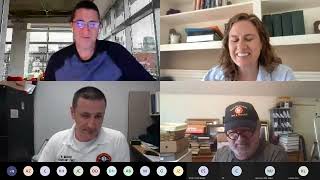
Webinar (Aug 2, 2022) hosted by Peter Antevy featuring producer Bryony Gilbey presenting a preview of her documentary about crisis in EMS. The film documents pandemic-era strain on EMTs/paramedics (trauma, burnout, financial hardship, suicides, overdose response), structural causes (funding model, fragmented governance, lack of "essential service" status), and state-level advocacy efforts (Westchester senator bill). Panelists (Dr. Pepe, John Kramer, Robby McHugh, Joseph Zalkin, Chief Cardona) praise the project and offer practical support (advocacy, outreach, funding, licensing). Gilbey requests funding and distribution help (licensing archival footage, original music, festival/streaming placements) and is compiling a final cut and script.
Chapters
Good to go.
Good to go. Awesome. Okay, thanks for doing that. All right, well, this is exciting. Welcome, everybody. And let me just get my other screen up here. One second. So, everyone, welcome to the Florida EMS webinar. For those of you who is the first time joining us, this started a couple years ago during the pandemic where Dr. Pepe, who is now Dr. Tiny Rugburn.
Came up with the great idea of getting us all together weekly through Covid, which was very helpful to our mental health. And I ended up saying, hey, let me try to one up Paul and bring and do the 11am portion where I brought in just spectacular people from all across the country and really over the world to present their data or their documentary in this case. And today we're very, very privileged to have Bryony Gilby, who is a producer who is really helping our profession. And you'll see why in a minute. Her children are all in the profession she's worked for, I believe, abc, cbs. She's done it all and now she's really making the move to help the profession of ems. So without any further ado, Bryony, if you can give us maybe a better introduction than I gave you, and then we'll start the preview and then we can go into a discussion about the documentary that you're creating. Thanks for joining us.
Okay, sure. Thank you for having me. It's a real privilege to be in your company.
Yeah. I don't know if I could do better than your introduction, but yes, I am former 60 Minutes alum and ABC News productions and I've worked on a number of documentaries.
This one is a very special project for me because as Dr. Entevi said, I have three children that are in EMS in some form, particularly my older daughter who is a paramedic. And really she was the genesis for doing this project with what she went through during COVID And I can tell that story in detail. But it just kind of got me thinking that there was something wrong here.
And the more I dug into it, you know, the deeper it went. And it was hard to kind of distill it down, which is what we have to do to present to an audience that isn't. Most of them probably will not be an ems, but most of them will know somebody who is.
So, yeah, I mean, this film kind of took off and it had different tangents at different points. We've kind of distilled it down.
We've talked to a number of EMTs and paramedics to kind of get a day in the life what they face, the joys, the traumas. We talked to a mother who, her son took his own life.
In April of 2020, three months after graduating the academy.
And we talked to a union president of New York Fire Department EMS who talks about, you know, how people can't, his EMTs can't afford to pay the rent, he's got some living in homeless shelters.
So there's a lot to talk about. We also look at how EMS got to this, into this problem and kind of the history of EMS and how it developed differently from fire and police, what that means and why the system now is so updated, outdated, sorry. We talked to NAMT board members from around the country to see what are they seeing in their states.
And there were, there was some variation, but a lot of it was frighteningly the same. Obviously workforce critical workforce issues and you know, drug overdoses, burnout, you know, just, and just not being able, not finding people to hire. So yeah, and then we kind of looked at efforts in New York to address that. And we looked. There's a senator in Westchester who is trying to bring a bill to the New York assembly to change the law in New York to make it an essential service. And the phrase essential service is a whole can of worms. Every time I think I have a grip on some of these terms, somebody else will tell me that I don't. So.
Yeah, so that's, that's basically, it's a, it's an educational and.
Advocacy piece. Hopefully we're looking to tell people what, what the issues are and hopefully advocate for change if we can do anything in that, to do that.
So before we get into the details and to perhaps how we can help, we have very big group led by Dr. Pepik, really worldwide with spectacular people who all of us really care truly in our hearts about this profession and about the service that we're servants to. Our people here who, who are in our communities who are here to help. And so anything that we can do to help. But let me do this, let me share the PowerPoint the window here and then we'll watch this four minute clip, the preview and then let's get into some questions and just some more discussion. So if you guys are hearing this, please let me know. I'm going to get it started right now.
I worked in New York City in spring of 2020 and we were pretty hard hit. It was kind of like a 911 every day.
It was so bleak during that time.
Seeing the cries and screams of people, seeing the disparity that I'm the One working on the road, no one else is on the road. And I'm taking people to the hospital and that maybe the last time they're interacting with that family member or their loved one.
It got to a point where I broke.
You can freak out in the ambulance and then when we're inside, then we're like calm and collected because we have.
To reassure them that we are there to help them.
And then we know what we're doing. And even if inside we're like, oh my God.
When the pandemic hit, many people worked from home.
That wasn't an opportunity that 911 EMS was afforded. They're the third uniformed service. Their job is as dangerous as police and fire. They have been right up in the front lines taking care of very sick COVID patients constantly exposed to infectious disease.
We met people who have been in.
It for a lifetime and they've never seen it more sort of broken than it is now.
I think many people assume incorrectly that EMS is considered this, quote unquote, essential service. And unfortunately, in many of the legislative.
Frameworks, EMS was just left out.
One of the biggest challenges with ems, the way that it is structured today is the funding mechanism, the economic model.
All across this country, EMS agencies can't recruit, retain and staff ambulances to a point to ensure the public safety.
One of the biggest disservices that I believe as a very high productive and financially sound country is when we can't take care of our own.
I believe our rural areas are the alarm sounding. We want people to know that this is a crisis that they need to pay attention to.
Particularly rural areas don't have the required EMS coverage. When someone calls 911, there's no assurance that they can get an ambulance.
People always want to talk about the cost of responding to the call, whereas we should be talking about the cost of readiness to respond to the call.
We need to have full time paid personnel that get adequate salaries who have.
Chosen this as a profession.
This is a noble profession.
As an EMS worker, it's very difficult to live off of one salary.
Therefore, I have to work at several.
Different agencies just to pay my bills.
EMS has not been considered and viewed as a required essential services for what ifs. And is that as a society something that we are willing to fund and pay for? That's where it starts.
All we're doing with essential services is saying that this is a critical piece of public safety, much like fire and police, and that we want to bill to be able to make sure that this essential service gets funded appropriately and it can deliver the service that the public expects.
It doesn't translate into money per se under state law to simply call something an essential service. We have to rebuild the EMT EMS system from the ground up to create a system that has enough money to sustain itself.
Wow.
You have tackled a huge problem. A huge problem. And what I want to do is bring in. We have some incredible people on the call today. But Brianny, before you got started, I wanted to get Dr. Pepe in because he has been a mentor to many of us. He's been everywhere. He's researched and led many, many people in this profession. So Dr. Pepe, what are your initial thoughts on this?
Well, first of all, I agree with you. You said there's incredible people, it means they're not credible. Incredible. Right. So just want to make sure that that got clear. Yeah. But to be on a serious note. No, it's great. And that's actually an issue that really came out during COVID because when funding was going down to help out various things during the COVID crisis, I was the first time I found out that we were technically not called a essential service. But the key thing here is beyond that sort of recognition and the implications for it was what the senator said from Westchester County. Is that so what. What if you are. Is that going to change anything as well? And so, because right now there have been very powerful unions obviously that help out on the police and, and the fireside. And we don't have, let's say, a similar kind because a lot of times we fall under fire departments, but then the fire services get there, you know, will get. Usually still lean towards equipment, you know, getting engine companies or whatever, which I understand that's cool, but I want to make sure that's not at the expense of not taking care of our folks here that really take care of people on a day to day basis. Cause the mission of the fire service is to save lives and protect property with save lives being first. So that's my first, you know, like whatever opening salvo. Because I hadn't thought about it much, but I think it's a. It's a good start. Briding. One thing I want to say is that are you able to get translators for all those New York accents? That's what we heard there.
I need them myself.
Hey, no. What's your accent from, by the way? Just out of curiosity.
It's originally England, but I. I spent a lot of time in Australia, so sometimes people can. People can hear.
I picked up what I'M saying I thought that, but I was. It was kind of different. That was kind of fun.
Yeah. It's all over the place, so.
Yeah. Yeah. Okay.
Distracting. I apologize.
No, no, not at all. It doesn't bother me at all. I just. I was just. I'm just curious, you know, it helps me with knowing about people's backgrounds.
It's really good.
All right.
So anyways, let's go on to other people, though, Peter. And this is a great start, by the way. Okay. It's a fantastic piece. I think the production was done really well. I can tell how you did some of the things, so I was impressed. Very good. And it's probably better when you're not transmitting it over streaming here as we're doing.
Right? Yeah. And the actual link I've sent out to this group. But, Brian, if you wouldn't mind, I know that you're in the midst of making this, and so I know that you're interviewing a lot of people. You need lots of help. Would you mind taking us through where you are with the project currently, what you would need from a group like ours, and really at 11:30, Dr. Pepe's group, where he really has an international voice there. But can you give us some information about where you are, what you need from us?
Absolutely. We are in the process of writing the final script.
We're putting it together. We actually just made the first. What's called a paper cut, the first full length.
It's too long. We got a little bit excited about how much material we had, but so we've got to cut it down. But it's. It's compelling. And, you know, as I said, I added two more interviews to. Or we added two more interviews to what you. You've just seen.
Up until this point, with the exception of a little under $5,000 that we've made through Forgiving, I've funded this entire project myself.
So the bottom line now is we need.
We need money really more than anything. Because to get it to the point where it looks polished and we're going to get outside footage. I want to license some footage from the show Emergency, which I think inspired a lot of people from certain generation. I need to buy a lot of outside footage that has, know, Covid and the Parkland, the Marjory Stoneman Douglas Parkland shooting that.
Juan Cordona attended and refers to in the full piece. That. That's expensive. Licensing outside footage, licensing original music, if we can afford it. But yeah, it's. It's funding and, you know, getting. Getting it out there, getting it shared. Because what we would love to do is say we got 200,000 followers on Facebook and take that to Amazon, Frontline, PBS, wherever it is and say you've got a built in audience here. And I think that's not out of the realm. I think there are a lot of people in EMS that are curious to see this. We've heard from people all over the country, in other countries who are excited.
And you know, I think the general population is probably interested in this kind of topic. I mean, you see about the TV shows that, you see that in the ER and the Chicago Fire, people love this stuff. So I think we can get a good audience. But yeah, those are my two wishes, money and attention.
Okay, well, and I'm sorry because I just took a call from one of my medics, but I was trying to listen in the other ear. So is your ultimate goal. And I'd like to bring on Dr. John Kramer in a minute. He's the former office of the EMS medical director from nhtsa. He's a former director. He's on the call today. But is your goal here to affect change somehow at the level of the federal government, at the level of the states? What is the ultimate goal here in your quest here to make this documentary?
I'd say first and foremost, even ahead of producing a great film, is that I want to advocate for these people.
It's not just my children, it's a lot of my friends. Dan Blum, who you saw in the piece, was my neighbor and he is the one that got my kids into Chappaqua Volunteer Ambulance and it literally changed their lives. So we have a lot of, you know, I have a lot of dogs in the hunt, if that's the right expression with this. We're working very closely with Senator Mayor.
And we're hoping to go when she actually presents the bill. We're hoping to go and film. We've been talking to the Westchester Business Council, anyone who'll listen to us that this bill is out there and they should put, you know, get attention to it and try and, you know, advocate for it. And we've been in touch, we've tried to be in touch with Senator Schumer's office.
Yeah, I'm trying to think. We've, we've got, we've been invited to be part of the Leadership Academy Summit in September with a booth. So they'll do another interview with us and share the film again. And we're hoping to get some more attention and more interest that way. But yeah, it's very. You know, I come from a. I come from a policy background.
I have a master's in international political economy, so my first love is policy.
Yeah, we could. But, yeah, I think if I'm invested in this topic, for sure.
Yeah. Well, you actually mentioned the EMS Leadership Academy. So before we bring Dr. Kramer in, let me bring Robby McHugh. So I've known Robby for a long time.
He's an assistant chief. But, Robby, you're here. You've done a lot of work in this area. You are drafting some letters which hopefully we can send out to the Eagles with Dr. Pepe's permission. But you want to come in and talk about how you're looking to support Bryony and the project?
Yeah, actually, thank you, Dr. Antebe and Dr. Pepe, for the opportunity. Bryony and I had a chance to connect a couple weeks back and talk about all of these issues. I mean, it had to be about a month or six weeks ago when I saw the video premiere, that I kind of jumped right on board and tried to find ways that we can advocate. As my other hat, the founder of the EMS Leadership Academy. Our goal is not only to provide leadership education for emergency medical services around the globe, but it's also to advocate something I'm very passionate about. I've watched the inequities in public safety between fire, police and ems, the inequities of funding. So a lot of every one of these issues reach really, like, rings true. What I've seen in New York, I mean, we have, you know, paramedics working it without health insurance. We have.
Services that are operating without any municipal funding, you know, people working in the industry that have no retirement. So certainly I put together some resources. I've dropped a link in the chat and I've basically calling on the Eagles Coalition of Medical Directors to really promote this with their services, help spread the word. Contact any advocacy organizations and associations. I've called on my organizations that I'm a part of to, you know, contribute $1,000 to this project. We don't want this project purely funded out of crowdfunding out of the pockets of EMTs and paramedics that are chipping in $5 or $25 that really this should be coming out of the organizations, the associations. Recently, over the weekend, I put together a petition for the NAEMT calling on them to fill the gap as well. So emsleadershipacademy.com advocacy has links to the letter, the petition trailer, and an opportunity to crowdfund so that was a mouthful. But certainly appreciate the opportunity and the platform here.
If you could add those links on Robby, we greatly appreciate all the work you are doing and what you've done in the past for the profession. Let me bring in Dr. Kramer. Dr. Kramer, that's.
John will have a good idea about how this all works, especially policy wise. Okay, so go ahead, John. Well, thank you.
I'll.
I'll echo a lot of the comments that have already been made with the exception that if your focus is in international and national policy, we need to talk because you need to have a mental status exam.
Right.
There are really some issues associated with that. No, I'll be very brief but, but really compliment you on this project, both in concept and in what you have produced so far. You know, in. In a very short number of minutes, you have highlighted so many of the issues that surround this. The reason I made the comment about both federal and state legislatures is. And part of it reflects the, the quandary that you reflected on essential services. The federal government will not define EMS as an essential service. They just won't. That's a state responsibility. But as others have alluded to, defining it as an essential service only offers states and local jurisdictions the opportunity to fund it. There is no funding associated with defining it as a federal service. You've reflected on.
You know, the public private issues. You've reflected on the toll that it's taking on individual clinicians financially and psychosocially and all sorts of things. So I would, would applaud you on this. You really need to hit up national EMS organizations like NAEMT and NAEMSP and those to financially support it, as will private entities like Amazon and Walmart that you've alluded to. So please share with me your contact information and I would like to help support in any way I can.
Getting this out and providing other support. So great job. It is technically very impactful and you've hit on the issues that need to be addressed.
Thank you.
Thank you. That's great to hear.
He says that that's a good thing. Just want you to know he knows.
What he's doing.
And he'll be extremely helpful to you as well. So go ahead.
I was going to say that I am open to all kinds of suggestions and corrections. I certainly don't want to put information out there that isn't correct. I'm actually currently working on exactly which states do declare EMS essential because apparently Florida is a big question. And I have to. You may know that actually. But.
Yeah, So I do, I do want to, what I want to put out there is accurate and also, you know, comprehensive to people that aren't in ems. But, you know, you're exactly right with the, with the federal level, I think probably the best thing that could happen is that EMS is put under one federal entity as opposed to the six or seven that it's under now.
At the state level, we can talk about that as well. You know, Congress needs to change the Medicare, the cms, authorizing legislation, and that will make significant, that, that's the first step in making significant impact.
Yes.
Hey, Peter, I switch over to the other side.
Okay.
And Brianny, I'd like to get your contact information. And Peter, it is 15274 for today. If you want to put that in the chat.
15274, let me put that in right now. Hold on. 15274, let me. We only have a few minutes left, but I wanted to bring in. I know. I saw Chief Cardone on the call. He was in your video. Anybody else on the call? Joseph Zalkin, who is part of the namsp. And I know several people on this call are. Does anybody else want to.
Hey, Chief Cardona, could I get your autograph later? Or maybe a photo op? Even a photo op. That would be really great. Okay, go ahead.
For a small fee. Dr. Pepper.
Okay. All right, I'll see you guys later. I'm going over the other side.
Take care. Okay, we'll be right there. But, Chief Cardona, did you want to make a few comments just real quick? As you guys saw, the NAEMT supports this project. We believe in it. We think it's important for all of us nationally and internationally to support it. I think it's important for us to promote this video and, yeah, let's find ways to help fund it. I don't know how, but maybe our unions, maybe our, you know, whatever we can do. We need to help.
Chief Cardone, can I ask a question then about. Are you a part of the NAMT or on their board at all?
Yes, I'm on the board of directors. I'm the director for Region two of the two directors.
Yes. Okay. Like I mentioned earlier, we have letters put together in a petition basically to ask the NAMT to fund this project. It's an advocacy tool, for sure. It's a tool that we can use in New York State to advocate for more equity, more change in the local legislation. And again, certainly, we've got a lot of letters out there to other associations. Like I mentioned in the chat NAEMSP asap and we certainly would appreciate any funding that NAMT can put behind this aside from just having people being interviewed.
I agree 100%. Yeah, thank you for that. I'm personally going to be donating to this cause, Bryony, and looking forward to seeing what you guys can do. This is a mission obviously that we're all really.
Impacted by. It's what we do every single day for a living.
I also see here and I'm not sure if he's on the call. Let's see, did he drop off.
Ryan Himmel from Coral Springs? Looks like he dropped off. How about Joseph Zalkin? Joseph, you want to come on? You have many, many years in this field.
And let's see, is Joseph still on the call? Yeah.
What are your comments?
My two cents. Great project. This is also something I think your vendors could support. I agree with Robbie. It should not come off the backs of those who are doing the actual work if possible. But there are a number of large medical supply groups and others out there if you're not on slate to be at the next major national conference, which is EMS World in October in Orlando.
If you speak at the next meeting, their coordinators usually attend. But I would really seek support as support to those who do the job. And of course you, you. What I saw in the clip was there are a thousand different ways that EMS is provided in this country. Some are governmental, some are volunteers, some are hospital based, some are fire based, some on and on. So there's a great diversity out there and we do have issues with recruitment. We definitely through Covid have issues with retention and it's just a really unique workforce. I encourage your efforts. Thank you.
Thank you. Appreciate it.
Thank you, Joseph. So we're over the time limit but again, I really wanted to say Bryony, huge project, so important. It's, you know, you, you put on, on film what all of us think every single day. But I would love to give you the last word. Thank you so much for joining us. Take us out and tell us, tell us what you want us to remember.
I think that the situation for EMS professionals right now is inexcusable.
I say that as an outsider, but it just, it, it breaks my heart. I cannot believe no one else has taken this topic and made a documentary about it.
It's appalling. And I hope, I really hope that with this film and with help and we can put something out there and continue to advocate for change because there's, you know, there's no choice really. There's no safety net. So.
You know. Yeah, this is crucial.
Well, we are committed to you in this project. Robbie and I have been in communication prior to today. He's generated, like he said, letters that will go out to everyone on this call, everyone on the coming call, which you're more than welcome to stay on. And I hope that Dr. Pepe will also try and get you on his main call. So stick around, if you wouldn't mind, while we switch over. I don't know what your schedule is like, but if I can, I'll text him in the background to see if maybe we can get you that other link for the zoom call and perhaps you can come on that call as well. So if you can stick around for just a few more minutes while Dr. Jamison gets us over, he'll restream the Eagles call. To start off, I would just like.
To say that if you want to put my contact information.
I'm open to anybody reaching out and suggestions, you know, it's an open dialogue.
So I will do that. I'll put your email address right now in, in the. In the email, in the thread here.
That I hit send on that letter, too, that you asked for. So.
Perfect. Oh, perfect. Beautiful. Thank you. All right, so Angus, take us to. To Dr. Pepe's webinar. And Brianny, I'll. I'll be in touch with you here real quick to see if we can get you into the Maine Eagles webinar in a second.
Okay, thank you, everybody.
Thank you.
Thanks, Peter.
Got it.
All right, I'm going to stop recording and.
More from Peter




Melissa Olen MSN, FPN-C, CCRN: Sudden Cardiac Arrest Training in Schools (Project ADAM) 4/25/25



Pediatric Hospital Readiness: How Teamwork & CPR Metrics Drive Better Outcomes



Chelsea Kadish, MD & Kyle Goodknight, EMT-P, RT: Pediatric CPAP in EMS (3/14/25)