Carolina M. Gutierrez, PhD: Florida EMS Webinar (5/3/24)
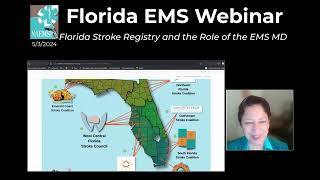
Carolina M. Gutierrez explains Florida's stroke registry, which tracks 180 hospitals and gives EMS leaders dashboards to see how hospitals handle stroke patients. The registry started with a 2017 mandate and now reports 11 measures, with plans to add door-in/door-out times and link data with EMS records.
Chapters
All right, welcome, Everybody. It is May 3, two days away from Cinco de Mayo, and we have a very special guest today. This is someone that many of us have worked with for some years to make something very special happen in the state of Florida. Carolina Gutierrez is the Associate Director of the Florida Stroke Registry, has done an immense amount of work, and this is really her passion to really improve the outcomes for stroke around the state. And then I think she's making an impact nationally. She's such an amazing job, and we're very privileged to work with her alongside her. And I wanted Carolina to come on today to talk to all of us in ems, because what's been done in the Stroke Registry for the last couple of years now, really, we have insight into that as EMS medical directors, as EMS leaders. And so if you're not involved yet, if you don't have a username and password yet, listen to the conversation, and then Carolina will give you some insight as how to get involved and how to get the data from your own region. So without any further ado, Dr. Gutierrez, thank you so much for joining us. And take it away.
Thank you. Thanks so much. And, you know, I'm very honored and privileged always to be able to talk about the Florida Stroke Registry. I feel like it's a special piece of work that I've been handed over and so always very happy to be able to talk about it. So can you see this the full screen? Yes, yes. Okay, perfect. So I know that I don't recognize some of the names on the call. And so what I'm tasked to do today is to talk to you a little bit about the Florida Stroke Registry, but very specifically tell you about what it is that the Florida Stroke Registry can do for ems, for EMS directors. Let me get rid of this thing here, which I'm seeing myself. There we go. So what we can do for EMS directors, some of the reports that we're producing, that is hospital data that can come to you, that you can see, and then ways that you can, you can be a part of our, of our FSR and join and collaborate with us. So for those folks that maybe are hearing about the Florida Stroke Registry for the first time, just a quick overview of who we are. You know, we have about 13 years now of existence. We were started as an NIH funded grant under the leadership of Dr. Ralph Sacco. Many of you knew him, know him, or know of him. And of course, the foundation that he, that he established for this Florida Stroke Registry is one that we still keep and hold very near and dear to our hearts, but mainly because it works. It's a. It's an idea of tracking and measuring to improve the quality of care. So I'm not a clinician, but I can understand that. And I know that that particular methodology has been really, really useful and important in the past 13 years, in the past approximately 10 years that I've been with the registry. So some important points about the registry that I want you all to know as well is that we don't just collect the data. I mean, it's registry, so that means you collect data. But I think that what's been really amazing and valuable about what we've done with the registry data is that we've actually been able to impact policy. One of the important places where this has happened is in 2017. So when that NIH funding ended, some of the network and stakeholders from the registry, which it wasn't called Florida Stroke Registry at the time, it was a more complicated name, Florida Puerto Rico collaboration to reduce stroke disparities. That funding ended and those stakeholders got together with advocacy, went to Tallahassee and were able to, to help develop and actually bring into law the idea that any hospital that sees a stroke patient and that calls themselves a nationally certified or certified hospital should give data to a Florida Stroke Registry. That was super important. It came from data that we provided showing that providing data to a quality improvement program was most likely to give you the best kind of performance from that. That hospital. So 2017, we became a mandated legal Florida Stroke Registry. From that point on, we were able to become nationally awarded by the CDC Paul Coverdale Acute Stroke Program in 2021. This is, this is obviously a prestigious award. In this year of 2021 through 2024, we've been in a cohort of 13 states nationally. Again, all states can, can try to get this funding, but for those three years, it was 13 states. It ends in 2024, and we're currently applying for the next round. We're very confident that we could be part of the next cohort. A lot of what we've done in the past three years is actually stuff that's written in the NOFO for this next 2024. So in the, in the funding opportunity, they talk about stroke coalitions, they talk about a lot of the things that we've been doing in the past three years. So I think we've really imp. Cdc. I think that the direction that we're going in with regard to our Coverdale and our Florida Stroke Registry is being very impactful. I also Wanted to let you know that. So we have a website and if you go to the website and you click here, you'll get these slides. There's more in the slides than we'll be talking about. But there's this website, there's a lot of information there that I'm talking about. Now we have a little video. So Dr. Sacco was our executive director and now we have Dr. Amano, who is the executive director who's also been involved in the registry for many, many years from its initiation. So you can see a little bit about that. And we have information about us. So you can go to the website and this will be an important point of our conversation today. I think another point that I want to make for you all is that the essence of the data that we got when we first started was hospital data, acute stroke data from initially, as you saw in that first slide, about 50 hospitals. But very organically, even though we're mandated by the state that hospitals are supposed to give us data, we're now at 180 and that's of the possible 185, give or take 10 on every other day. Sometimes hospitals, they get bought out, they turn into ERs. Things happen in a month, in a quarter period. We follow these hospitals regularly, but we have about 180 on our website as well. If you go to this section here that says about the fsr, you're going to see a lot of information about the hospitals. You'll see another video, you'll see a little bit about the Department of Health who oversees what we do, who also funds our infrastructure as we are now, the infrastructure that we have to maintain these 180 hospitals and the data that we have for them, some of the other data that we're collecting and the reports that we're creating. But here are the hospitals. So you can see this in any. And the general public can see this as well. This is an open piece and so the little dots represent the certification levels of the hospitals. These are all the hospitals that are giving US data, currently 180. If you scroll down, you can see the specific hospital. If you click on it, it'll tell you where it's located. So it's really just a geographic map of the hospitals that are giving us data. But importantly for you all is potentially the level of certification. So we have it listed here and we follow this on a quarterly basis. These can change as well. So we keep that available to our stakeholders and for you to see.
I think the other part that's very important for me to express to you all is our advisory committee. So on the call, I saw Dr. Sand, I think I saw Dr. Shepke. Of course, Dr. Jamison is there and Dr. Antebi, and they're all longtime members. Oh, sorry. Dr. Pepe as well. They're all longtime members of our advisory committee. And they're really important in the stuff that. That's the actual essence of why I'm talking to you today, these regional dashboards and the stroke coalitions. But you can see the highlighted yellow here. Basically, we get together not as often as we would like to, but because they're all volunteers actually to this advisory committee. But they help guide the Florida Stroke Registry in terms of the kinds of work that we should be doing for the hospitals and for ems. In terms of our work for ems, they've been essential. They let us know, what is it that you need in ems, in emergency medicine, physicians, what do they need from the data that we're collecting from our hospitals? How can we be of service to you all in terms of the work that you're doing? So our advisory committee is super important in terms of guiding us. So now the essence and the heart of the matter is we have stroke hospital reports that we create from the 180 hospitals. We create stroke hospital reports. But there's a second kind of report, and this is this regional dashboard. So the first kind is very specific to the hospitals. It goes specifically to them. It lets them see how they're performing in terms of quality metrics. It's just for them. But the second one is this FSR regional dashboard. This grew out of, again, a grassroots kind of effort really, thanks to Peter Antevi and Brijesh Mehta, Niles Mueller and a few others out of South Florida and Broward. They came to us, to the Florida Stroke registry and to Dr. Sacco in particular and said, we need something that lets us see. This was in 2016, that we need something that lets us see how well the hospitals are doing, the hospitals that we're sending our patients to. We need some kind of visualization. And so that's what initiated this idea of creating these reports. They also had the idea of coming together with the hospitals and seeing the reports together in the coalitions that they were meeting. So this was in 2016. What's significant about that date is that that was the time period when hospitals in Florida were not mandated to become nationally certified. They were still able to self attest. So they could say to the state of Florida, to aca, I see patients at the highest level, and I have a notarized statement here, I don't know exactly if that's how they did it, but they didn't have to provide any data to actually show the quality of care that they were giving. Because of the data that we have, the Florida stroke registry in 2019, we were able to turn that into law that says that any hospital that says that they are of some level of certification, the highest level being the comprehensive stroke center type, they have to get their certification from a national agency. So again, important about this particular grassroots effort is that it was during a time that hospitals were saying they were given the best quality of care, but there was no tracking and measuring of how well they were doing. So we created these dashboards. A sample of the dashboards is at the website. If you click there, you'll end up on something that looks like this. You don't need to have an account to see this. Anybody can see this. It's a, it's a quick overview of why we did this, what are the dashboards, where they applied and basically what they look like. As EMS directors, you, you do have an account? I have 250 accounts that we created when we first started this, thanks to Dr. Shepke and Dr. Anteby who were saying we need our EMS medical directors to be able to access the website and to access these reports. And so I know that we got some names and, and numbers and email addresses from bmo and these were all the medical directors that they, they gave us that, that contact information so that we could actually create accounts so that you could come into this back end. So not to confuse you too much, but this is basically an open ended area here, the homepage, and then this Florida Stroke Registry piece here. But if you go to this link, account holders only, you have to have a pat, an account ID and a password. And we can help you with that. It's super easy once you, once you get it, but you click in here and that's what's going to get you to this page. What's significant about this page is that these are the stroke coalitions that the FSR recognizes. I think as EMS directors, you all probably know of many stroke coalitions that maybe are not listed here. We're not saying we invented them, but we, the Florida Stroke Registry likes to help facilitate the meetings, help facilitate the reports and the information that's being transmitted in each of these, and also helps to facilitate the creation of them. I'll tell you a little bit more about that, but what's significant about these stroke coalitions. It's that it's in these stroke. It's hospitals that participate in these stroke coalitions that get these regional dashboards. So if you're a medical director from, let's say, Miami Dade and you are part of the South Florida Stroke Coalition or even, well, Miami Dade would be this one or the Phone D Stroke Coalition, which is mainly EMS guys, you would go to our website, you'd click on any one of these two, and then let's go to this one. You would see this landing page. The Florida Stroke Registry has created landing pages for each of the stroke coalitions. Some of them allow anybody of you know who's got a secured link to see what's in there. Some of them only allow their members. So if you're part of the South Florida Stroke Coalition, they're very open and transparent. They let anybody see their stuff.
Stuff.
We record the meeting. You can see the older, older meetings. You can hear what was spoken about. You can see agendas. And some of them have the old recordings here. More importantly is this tab here, which is the EMS hospital collaboration chart, because South Florida Stroke Coalition sees three counties or serves three counties. We see these three counties here, but we're talking about Miami Dade. You would click here and.
You would get to this page. I'll explain this to you, but you should see your name, your EMS system. What's important about this? Again, this could have a little bit more help in being a little bit less complicated. But the reason why we created this was so that the EMS directors would see what hospitals they're sending their patients to. And again, I know this will change. This could include more hospitals. Maybe it doesn't include all the hospitals. We got this information from bmo. BMO will update this, I think, on a quarterly basis or as often as we need it. It's a big data set, so we probably can update this a little bit more frequently. But the real point here is so that you as EMS directors can see the hospital, see the contact, and then let us know whether or not they shared their code. I know I'm getting ahead. This is where you're going to be looking. These are the dashboards. So the dashboards, there's 11 measures that we show. We show thrombolytics and it's reperfusion therapy across these particular.
Stroke coalitions. So it's clumps of hospitals within those stroke coalitions. Again, if we're looking at Miami Dade county, let me just refer you back to this page here.
So right so we're looking at this coalition, and we're only looking at that county dashboard. And so these are the hospitals within that, that county. And what we do basically is we show these different panels. There's. There are 11 different measures that our advisory committee agreed, and also the hospitals agree these are the most important ones for this kind of performance that we're looking for locally. It's mainly about how much have you given of this treatment, how many, how fast did you give it, and then how well did the people do after you, you gave them the treatment. And so how you're seeing this data, you can focus in and see a bigger image of this. In this case, we're looking at overall IV thrombolytics at these different hospitals in Miami Dade County. The colors represent the size, the ischemic volume per the time period. In this case, it's 12 months. So this would be smaller, this would be medium size, and this would be larger. And then the hospitals can benchmark across themselves as well as benchmark across nearby counties. Again, we do this for these different stroke coalitions. Only the hospitals within these areas can see this. They're blinded because of an ongoing data use agreement that the Florida Stroke Registry has with the hospitals. And so this is the part that we're still trying to work through, which is trying to make this data more transparent for you all so you don't have to go through the rigmarole that I just explained here.
Where is it.
With the charts here?
So that's part of.
What we're doing with these dashboards. Here's the 11 measures. Here's the stroke coalitions where it happens. If you want to see them. The best way to do it is either to join a stroke coalition where you can see these reports live and in person, sit at a table literally across from a hospital that's showing you the report, talk to the hospital, get input, or provide feedback to the hospital about why they're not doing so well or why are they doing really great. Or you can get access through the website. Again, just getting a simple account. You can email us. You could try to go to the link and see if you can log in using your email address. I know for most of you, we have like, they look like personal email addresses, Gmail or Dot. They're these kind of email addresses. We like for them to be more professional, but we've included whatever email addresses BMO gave us for you all. Again, this is what that, that, that that chart looks like, which will include your name, the hospital that you're you're, you're delivering patients to. We'll update this. We, we can't know that this works or doesn't work if you don't use it. So I really implore you to please try to use this. If it's terrible, then I need to know so we can make it better. I know that it's got probably too many layers to get to. We're trying to do better with that as well. But we really need to know how you like it or how you hate it, if it's useful to you, if it's not useful to you. So I implore you to please use it. This is just to show you that despite all of the complications and getting to the data, we're doing better. So we keep track of our measures, our performance across the different years. So 2010 is the latest data, the earliest data set that we can get for all the hospitals. This is again, acute stroke data from hospitals that are giving us data. And this is through the American Heart association get with the Guidelines stroke database. That's how we get the acute stroke data. And that's why we have these duas. So if you pay attention to the green bars, you can see that if you compare from 2010 to 2022, the green bars are a lot larger, a lot longer, a lot bigger. So we're doing a lot better in terms of the amount of treatment we're giving, like for endovascular and then for the thrombolytics as well. You see 2% in 2010, 15% in 2022. We'll have the 2023 data very soon. And again, in terms of time, we're doing really great. We're about to publish a paper. Well, we're about to finish getting the paper together, showing the impact of regional dashboards on time to treatment, looking specifically AT treatment within 45 minutes. And what we found is that there's a significant, a statistically significant difference in hospitals that are in regional dashboards versus those that are not at treating their patients within 20 minutes of arrival. So, I mean, it's even less than the 45 minute, I think, quality measure. We're going to publish that very soon. But apparently we're doing a pretty good job with these regional dashboards and with tracking and measuring, being able to see the reports, being able to say, I didn't do so well last last year, I'm doing much better this year, or maybe talking to the neighboring hospital to find out, why are you doing so much better than I am, or even yet speaking to your EMS director and getting some advice from the EMS director. So some of the other things that we're trying to do to improve these dashboards and to include you all is enhancing these dashboards by, by incorporating measures that are important to you all. We have a task force that has been looking at inter facility transfer measures. So the easiest one right now is the door in, door out. We're about to incorporate that into the regional dashboards as an extra measure. So we have 11 panels, we're going to have 12. We want to add in one that's important for the EMS folks as well. So it could be a door in, door in. But again, we continue to figure out what's the best way to show this and what's the best measure to develop. The other thing that we're doing is linking data. So through our relationship with the state, we now have EMS MSTARS data. Right now it's a limited data set. We're about to get a fuller data set of stroke data.
Right.
And so the idea is to link the data with the acute stroke hospital data that we have across pre and then post. So the post data that we have is from ahca. It tells us about stroke outcomes and ultimately it's again to see where are their gaps, where are their successes, what are some of the gaps that we need to address in terms of the systems of care, who do we need to talk to to maybe improve, who do we need to talk to to maybe give us those best practices and then finally some opportunities. This is a document that will I'll share with you. It's, it's really four pages. It's pretty simple, but it basically tells you how to get to those regional dashboards. Again, if you get frustrated, you can just call us. We'll walk you through it. Once you do it once, it's easy to get to, but it's an easy how to log in, where to go to on the website, how to get there, and finally how to look at your dashboard. And so this is something that I can share with you all electronically or again, if you reach out, I'll be happy to give it to you. And again, go to the website, go to this email and just tell us I need an account and we'll make it for you and walk you through. The other important way that you can collaborate and start to work with us right away is again, either get involved with one of these local stroke coalitions and or get involved with the groups that are trying to develop stroke coalitions in these Areas that are highlighted in yellow. This is in Tallahassee. We have Tallahassee Memorial is trying to create something there. It's dependent on getting data from some of the local.
Freestanding hospitals, which we don't have that data yet. So we're working with the AHA to see how we can make that happen. But they're very interested in developing a stroke coalition there. A slightly different model than what we're used to. And then here, thanks to Dr. Antebi's push, there's probably going to be two coalitions. One's going to be a central and one's going to be an east central Florida one. But we've been begun speaking about that. There's a lot of hospitals involved there, so if you're interested, let us know. And then of course we have this big swath here. And then finally, we would love for you to join our annual meeting. It's free. I'm trying to see if there's a way that we can do a kind of a participation certificate for ems. It's two days. It's going to be in Fort Lauderdale on the first day. It's a lot of networking. So we have the input and the. Thank goodness, the collaboration of again, Peter Anteby and Brijesh Mehta, who are going to give a workshop that they've given before at EMS World, I think, and it'll be available between 10:30 and 12. We have another workshop that's going to happen earlier in the day that's more about community education. So it's for those who want to do community outreach. It's more of a well rounded education course. A little bit of stroke, but a lot more. Paul Pep, you have your hand raised. So let me, let me talk.
I'm sorry, I didn't mean to interrupt your talk. I was going to tell. Signal Peter to talk. Why don't you finish though?
I'm done. I think this is the last one. And just use that QR code. I'm. My mouth is dry and I know I'm talking a lot, so I would love to be able to interact with you guys.
Yeah, please stop talking. No, you got great. Carolina has been great. I mean, she's really the heart and soul behind me. We do have to give credit obviously to the, our founders that she was talking about before. But the other thing is, besides Brijesh and Peter and Ken, there's someone that really is an important hero in all this that I want to recognize. Peter, can you tell him a little bit about Charlie Sands and His role.
Peter Anteby, if you're there, you're on mute. Yeah, sorry. Sorry about that. Yes, absolutely. So Charlie's on the call today and very grateful that many years ago when stroke care was just evolving, Charlie went to the legislature early on and he'll have to remind us what year that was. It was in the late 90s, I believe, and got something into legislation to allow that first kind of ACA attestation to happen. So, Dr. San Charlie, great to see you on. If you want to talk about those early days. And we are very grateful for all the work you've done.
Yeah, no, I appreciate. No, Peter and Paul, thank you. I appreciate it. And wonderful talk. Carolina. No, there was a team effort. We actually, a lot of it started with Florida Association EMS Physicians. We did position statements and through American Heart. We didn't get much push for change. And we went legislatively in 2005, passed the first, first law in the nation to, for EMS to take people to the most appropriate center. And then we, with every many people's help, including many on this call, we updated that, as Carolina said in 2019, I think it was to get rid of the attestation. So, but, but a lot of people were involved. But I appreciate it. You guys do a great job.
Excellent. I appreciate that, Charlie. So, so, Caroline, I have just a kind of a small recap so everybody on the call knows. So if someone's a medical director on this call, they need a username and password. They need to belong to a coalition. They can then get access to the dashboard. They look at the dashboard, they look at the metrics, and they can see all of the hospitals in their region that they transport patients to. And they can look to see of those metrics are all the hospitals doing what they're supposed to be doing with respect to outcomes. But just to be very clear, in order for you to know what letter those hospitals are, you have to go to the hospital, talk to them, or just send them an email and say, hey, I'm the EMS medical director. I want to know what letter your hospital is. 99.9% of them will say, here you go, I'm letter A. If the hospital says to you, I'm not telling you, oh, you probably got to go in person and, and figure out there's probably something wrong there. But Caroline, did you want to, did you want to mention, do you want to expand on that at all? Did I get it right there?
No, that's, that's perfectly correct. And the only thing I was going to Just as I'm saying that is to show you again on the website based on your. I'm also where's my zoom? Based on your suggestion on how to track this. Again, it's a little cumbersome, but you know, if, if you, if you can let us know this. Yes. No, basically is what lets us know that Patti was able to tell the director, which probably have to update this, you know, who their hospital is on that report. And so that lets us know that there was some collaboration but ultimately really the goal is, is that we're trying to, to really encourage the hospital to collaborate with you. Yes, we're sorry that it is that cumbersome and, and definitely they're very willing to let you know. And I think that as we get, we move forward, a lot of the hospitals are saying just tell them. I mean just report it, just put my name there. You know, it's more problematic. But you get to talk to the coordinator, you get to have that relationship with the hospital in this way. So I think there's some benefit. Even though it's a little bit cumbersome. But yes, that is exactly the way you do it.
Awesome.
We're getting a question here. So Tyrone Wilson, you want to come on, unmute yourself and let's get the question answered.
I see you unmuted yourself. Tyrone, can you. So I'll ask a question. He says now that we've made advancements in tracking stroke afflicted patients, where is evidence based medicine and resource support direct us to reduce reoccurrence and decrease comorbidities? What do you think is the best approach to reduce morbidity?
Right. Well, so we're doing a lot of work in terms of transitions of care. We also are trying to work with some of the, I guess the mobile integrated health providers. We're tracking and measuring there as well. And the opportunities are to talk about what's happening locally in terms. Because obviously it's different in the regions that you're in and it's. The populations have different needs. There's also social determinants of health which has become a very important topic in hospitals and I imagine in your profession as well in ems. Social drivers of health. So identifying where can we maybe impact with regard to social drivers of health and each of these kinds of issues that we're talking about here. But the place to talk about this is in those stroke coalitions. I think there's a lot that can still be done. Tracking and measuring is always a great way to approach this.
So do you think that every medical director should at least be looking at these dashboards every quarter, because you release them every quarter. And for the most part, once these dashboards have been going for a while, the hospital has improved their care, you should see that there should be hospitals who are doing a great job and doing the right thing. If you see an outlier, you really need to go in and actually talk to the hospital. If everybody remembers and why this is such an important thing is that if you remember, the only way back then that we were able to get data on our patients is when, when a medical call and say, hey, I just transported Mrs. Jones. I would love to get feedback on Mrs. Jones. And that's, that's not good feedback. Right. And so now we're actually having hospital level feedback. And because the data transparency now, the hospitals recognize that they, their data is being shown to people who actually understand what's going on and they're hiring the right people. I mean, South Florida and Florida in general has really bolstered the care for stroke because of these dashboards. So if you, as a medical director or an EMS leader aren't going in, so if you're an EMS leader, let's say an EMS chief on this call, call the medical director and say, hey, let's take a look at those dashboards. When is that next coalition meeting? Let's go to the annual FSR which is right here in Fort Lauderdale. You know, we could really impact thousands and thousands of people based on the work that Carolina, Dr. Romano, many of folks have done that we never used to be able to do. So I'm ranting a little bit, but I want people to really get involved, at least look at the data that is out there for the taking.
If I may just add to what you're saying, Peter, I think the main point is that you interact with these hospitals. The data could be there, you could look at it. But if you're looking at it in a silo and you don't interact with them, then none of what Peter has just mentioned can happen. It's really, that's, it's that communication, that direct communication that really allows improvements and, you know, identifying where there's gaps.
Excellent. And then, Eric, do you want to come in and ask your question live.
Sorry, sorry.
Repeating here. So can you guys hear me? Okay?
Yeah, now we can hear you. Perfect.
Yeah, perfect. So my, my big question here, and it might be a little out of topic, But I'm glad Dr. Shepke's on board, is I know that American Heart has adopted A preliminary assessment tool for stroke assessment. Correct. So this stroke assessment tool, one of the, the events that I see happen a lot is different organizations are different using different stroke assessment processes. So it's difficult to correspond from one to the other and how to relate. Has the state considered making it where we adopt as a state this, or do we say, hey, EMS and hospitals. This would be the ideal way to use an assessment tool so that we're all on the same page. Whether it's since American Heart adopted that one, would that be the one we consider.
Carolina, did you want to take that. Which specific tool are you, are you talking about that they recommend talking about like a, like a pre hospital score, like a race van or fast td?
Yes, sir. Exactly, Doc. So there, there's one that American Heart is, is supporting as the one for nationally and I'm not sure why they picked that one, but I just know.
Which one, which one? Because I'm not, I'm not aware of that.
Okay. So it's going to be coming out for the next American Heart Update, which will be, I think it's the one that, um, developed.
Okay. Okay.
Well, I know that we, we want to, we want to check that, we want to see which ones who's using what throughout the state. Obviously we, we will just be able. The data. I don't know if there's any interest in creating just one. I know that making everybody use just one. But first we have to see which ones are mainly being used throughout the state, who's using them, what is the success rate in their use. I think. Isn't there a lot of education that needs to go around the use of these anyway?
Oh yeah.
I think it's a lot of levels and layers that have to be addressed before saying just one. But again, we're here to look at that data, we have access to that data and be able to provide it to you all. So if this is an area of interest, definitely we can focus on it.
Yeah.
Because for me, like one of the things I bring in a patient and here's the assessment tool that I use. So, and I, I transfer the information over, give a good report to my. Receiving a nurse and she comes back, she's doing grip strength, she's doing a few other things and I, I'm pretty familiar with all the different stroke assessments. How did you pick the assessment tools you're using? Oh, I don't know. I said, well, how do you quantify that in an hour from now if you don't have an assessment specific tool and Relate that to the next transfer of care right at the end of the shift. So if there's any drop in that, how do we determine that? Says, well, we really haven't been trained. I go, well, what do you use? Right. So that's where the, I think the losses of information or changes in a patient's outcomes may be related to that.
Yeah.
Well, I think I want to bring Ken Chepky in, but I think that the hospital, they're moving to the nih, right. In the pre hospital setting. We're using any number of tests, but happy to take that offline with you, if you wouldn't mind that. We can do that. But let's get to Dr. Shepfi. Ken, you've been a very big part of this at both the local, regional and national level. Let's hear your thoughts.
Thanks.
That's a good question. First, I just wanted to say those of us on the call who are in a position to improve the stroke system, you have a roughly one out of four chance of having a stroke yourself. So you're improving it for yourself and your family members. So don't ever think this is for some stranger. It's not abstract. This is for your own benefit. We have the in state statute, the Florida sampled EMS triage. I might be seeing getting the word wrong. Let me see if I got it right here. Stroke triage assessment tool by all EMS agencies across Florida must use something substantially similar to that. The last time we developed it was in 2019, I think was the last time we updated it. And it includes both a screening tool which we use as the bfast, as well as a stroke severity score, which we listed all of the stroke severity scores at that time that were validated. So maybe it's time for us to look at it again. Based on what we just heard, Dr. Jameson was on the call, but he's probably jumped over to Eagles now. That's where it would go through because he's now our state EMS medical director. But certainly something we can bring up for the state EMS medical director to look at and see if it's time to narrow it down for everybody to use just one tool.
Perfect.
Thank you, I appreciate that. And so, Eric, we'll get back to you who wanted to say something. Go ahead, Peter.
Can I just, can I just join you really quickly.
At this time? The air doesn't pick a specific stroke screening tool, neither screening tool or the severity skill it allow you to use, which whichever one you, you think is best for you in your region.
And so it could change in the future. We'll gladly look at it, but at this time.
There'S a screening tool and there's a severity tool. If you want to use one tool for severity and screening, that's fine. If you want to use two, like the state of Florida is using, that's also fine. That's it. Thanks.
Yeah, yeah. And I think, Dr. Job, thanks for clarifying that there are people who are trying to work on these tools like a headband. We've had. Dr. Dunn. Come on. I think there's going to be tools in the future that will allow a machine to predict stroke severity rather than. Because, you know, like Carolina mentioned getting the training. As many of you know, it's. It's hard. You got to keep doing it over and over again. The race score is not an easy thing to do, so. But we're going to keep following the science. And again, just want to thank Dr. Gutierrez. So I'm going to give you the last word. Carolina, There's a lot of folks who are going to be listening to you now and on the YouTube. What's really the first step that maybe someone should take if they haven't done any of this is the first time they're hearing about it and they're in the state of Florida. What recommendation would you give for EMS.
Or for anybody, really? Just email us a simple question. We're live. And answer all of the requests as promptly as we can and we can get you to the website. Just email us with your question. More than happy to include you. I think one of the main things that the FSR wants is to increase the interdisciplinary representation of our stakeholders. So we're really, really excited to have you join us. Let us know what we can do for you to better serve you.
Is it okay if I put your email in the chat?
Of course, yeah. Put the Florida Stroke Register. Okay. Or mine.
I don't think I have.
No, no.
Let's see if I have your fsr.
It's on the. The. This one's fine, but it's also on the presentation slides that I'll give to everybody.
Okay, perfect. All right. If you want to send them to me and I'll forward them away to everybody else. Awesome. Thank you so much, everybody. Dr. Gutierrez, amazing presentation, and thank you so much for joining us. I'll put this on the YouTube hopefully within the next couple of days, and you can click on the link in the chat to get over to Dr. Pepe's webinar. And I appreciate everybody coming on today. Thanks, everyone.
Have a great weekend.
More from Peter




Melissa Olen MSN, FPN-C, CCRN: Sudden Cardiac Arrest Training in Schools (Project ADAM) 4/25/25



Pediatric Hospital Readiness: How Teamwork & CPR Metrics Drive Better Outcomes



Chelsea Kadish, MD & Kyle Goodknight, EMT-P, RT: Pediatric CPAP in EMS (3/14/25)