Chris Gage: The Expanding Work Environment of EMS (12/20/2024)
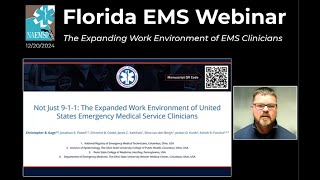
Chris Gage analyzes work environments across the EMS workforce using National Registry data from 100,000 clinicians. About 75% work in 911 response, but roughly half need two or more jobs to make ends meet. The median EMS clinician is mid-30s with 3-4 years experience and 70-80% are male.
Questions this video answers
Over 54 million calls in 2023.
About a 5% increase by 2030.
About 100,000 EMS clinicians were eligible (recertifying Oct 2021–Apr 2022).
One-time response rate ~34%, approximately 39,000 responses.
About 55% of the national EMS workforce (~489,000 of an estimated 891,000).
Chapters
Welcome everybody. It is Friday, December 20th. This is our last show before the end of the year. Tanner Kamita And I and Dr. Paul Pepe welcome you to the Florida EMS webinar. Just a reminder, the NAMSP is happening on the week of June 6th, January 6th, the Florida EMS group is going to have a meeting at 6:30 and then we're going to have a dinner at 7:30 at the Argentinian Steakhouse. So hopefully all of you Florida folks can make it. And hopefully we'll see everybody at NMSP today. We have a great group of guests led by Chris Gage. And what I, what I've learned here and I wanted to share real quick is that.
And I kind of knew about it, but Chris and I were just talking before the show started that he is the NREMT research Fellow. So I started asking him about it. Essentially it's a very long process, a four to five year process. They become.
PhD candidates through Ohio State University. And some of you may know some prior names of the NRMP fellowship. Tony Fernandez at eso, Remlee Crow, who's at eso. Rebecca Cash is our Harvard Medical School. Jonathan Powell who's now who will be going to Image Trend. And then upcoming will be Jacob Campholt who is actually on the show today and Chris Gage. So it's a, it's an amazing program. It ends up putting out incredible EMF researchers, obviously our very own Tanner Smita as a PhD student and a very prolific researcher. So you know, I love everything that you guys are doing and I love the paper that you're about to talk about. So Chris, let me pass it over to you if you could make any further introduction, talk about your paper and I know you have a slideshow. Thank you so much for joining us today. To you and your entire team. Take it away.
All right. Well, thank you so much, Dr. Antebi for the opportunity to present our research here with our team. There are a couple of us on so we're very excited about this, which highlights our roles at EMS clinicians in the United States. Like Dr. Antebe said, my name's Chris Gage. I'm an EMS research fellow with the National Registry EMTs and I'm a PhD student at the Ohio State University. So our study was recently published in Cureus Medical Journal and it's titled not just 911 the expanded work Environment of the United States Emergency Medical Clinicians. If you want to follow along with the manuscript, you can use the QR link in the top right hand corner of the screen and it's on each slide in case you miss it.
All right, so we have no disclosures to report. So EMS plays a crucial role as the first point of contact in urgent care in many situations. Just in 2023 alone, EMS clinicians responded to over 54 million calls. And the demand is only growing. So by 2030, the workforce is expected to increase by about 5%. But despite these projections, many communities are still struggling with clinician shortages, which makes it harder to deliver timely care. So over time, the role of EMS has evolved beyond the just responding to regular emergencies. Clinicians are now integrated into hospitals, home health care settings, outpatient clinics, and even specialized industries. But these changes reflect a broader vision from the future of ems, but they're also reshaping how agencies respond to community needs. But one challenge we still don't have a clear understanding is of the new roles and diverse roles. Traditional 911 response happens in unpredictable settings and many of these newer roles, like working in hospitals and other industries, they offer more stable environments. While this diversification is important, we lack data on where these EMS clinicians are currently employed. And without that, it's tough to predict where workforce needs or understand how prepared the system is to handle these different emergencies. So our objective was to explore and clarify the diverse work environments where EMS clinicians operate. We feel that by examining the primary roles EMS clinicians hold, we aim to capture a clear picture of these varied settings. To do this, we use the most comprehensive EMS database in the US which allows us to survey these roles across different environments. By identifying trends and patterns where EMS clinicians are working, we are able to provide better insights to help provide the workforce planning and better address the growing demand for EMS services. So in this study we used a cross sectional survey to look at the work environments and roles of EMS clinicians across the U.S. we focused on demographic and workforce characteristics. The data was collected as a part of the National Registry's EMT recertification process, which included the single delivery survey as an optional component. So the National Registry certifies EMS clinicians in more than 46 states and we specialize targeting those completing the recertification between October 2021 and April 2022. So around 100,000 EMS clinicians were eligible to participate and previous research has shown that this group provides a good representation of the broader workforce. So our survey focused on civilian EMTs, AEMTs and paramedics aged 18 to 85 with at least one EMS related job. By targeting this group, we aim to capture a comprehensive view of civilian pre hospital workforce in the US the clinicians who are on the front lines, responding to emergencies and transporting patients to definitive care settings. So we gathered information on both demographic and job characteristics. For demographic, we measured binary sex minority status, which we actually grouped into minority and non minority based on self identification and education levels ranging from high school diploma to bachelor's degree. So the different job characteristics included certification level, years of experience, employee type, either full time or part time volunteer status. The number of current EMS jobs characterizes either one or more. Respondents also self reported the size of their community using U.S. census classifications for urban, suburban or rural. Our primary focus was on the main work environment roles of EMS clinicians. So respondents chose one primary role such as emergency response, non emergent transport, medical services, mobile, integrated health with subcategories for more detailed descriptions. For each one of these, we also asked the EMS clinicians how many jobs they needed to maintain financial stability, adding another layer of insight into their work situation.
So we started our data analysis by using descriptive statistics to get an overview of the characteristics of our study population. For continuous variables like age and years of experience, we calculated medians and interquartile ranges. And for categorical variables such as sex and education, we reported proportions. To summarize the data, since there are known sex based disparities in EMS roles, we took a closer look by performing a stratified analysis by sex. This allows us to better understand how primary roles may differ between male and female clinicians. All right, so let's get into the data a little bit. If you follow along in the manuscript. This is actually in Table 1. So this is really just going to be your normal population of EMS clinicians that we have in the registry database. And honestly throughout the United States. So a largest proportion of our group are males. You can see it runs from around 70, a little more 70 to 80% males. The average median age is in the mid-30s. So that's pretty standard. Most are going to be non Hispanic, white and you can see they're upwards of about 80%.
For education it differed just a little bit. EMTs and AMTS had some college and the paramedics had more college, those being bachelor's degree. This group median years of experience is, you know, three to four. So you can tell that there's not a lot of, not a lot of long term experience. Overall full time. Most of them are full time and you can see it's about 70%. Some volunteers, the number of EMS jobs, majority of them just had one EMS job. So you're looking upwards. 60 and 70%.
Their community size makes sense. Most are urban. That's where majority of your EMS clinicians are at. And then jobs to make ends meet. So you can see about 50% of the EMS clinicians in this survey actually need two or more jobs to make ends meet. So that's pretty shocking. You know, you really wouldn't expect to have a job that you needed to work another job just to make, just to make ends meet.
So then we move on to table two. So this is your overall population. You can see it's broken down emergent response, medical transport, clinician services, mih, community paramedicine, education, administration, other. And you can see the majority, 75% are in emergency response. So that makes sense. You're riding on the, you're doing 911 response, you're working for a 911 system somewhere. So that makes perfect sense. But about 7% are just in medical transport. So these are non 911 services that just do medical transport only. And then actually about 7% are in the clinical services. So that's quite a lot. That 7% are actually not working in any kind of more or less emergency medical services business. They're working in hospitals and doctors offices and clinics. So that was something pretty, something that we saw that stuck out when you broke it down into the different, different EMS certifications. Again, about 70 to 80% are still going to be in emergent services. Then you can see EMT actually has a little more on the medical transport, so about 9%. And when you switch over to clinical services, you can see amt. Your ALS providers are about the same, but again, EMT is a little more in your clinical services. And it kind of makes sense because they're working in, you know, again, the hospitals and the clinics. They're doing some of those lower end jobs that are definitely needed though they found that role. So we look at just the subcategories of the two ones that we really focused on was emergent response. Most people are working on ground ambulance. You can see the ALS roles. They're working more on the ground ambulance side than say the EMTs. But then when you flip to the second most common subcategory of rescue and fire, that kind of makes sense because about about half of our population, about 40 to 50% of our national registry population, are actually associated with fire agencies. So this kind of makes sense that a lot of your EMTs that are doing these dual roles, they're firefighter first and EMT second. They're pretty much being mandated. A lot of them are to get their EMT as well. So that makes sense that a lot of the, the EMTs are actually in these rescue squads and fire positions. So one thing that we kind of pulled out is talking again about clinic clinician services. These are hospital roles and doctor's offices. So these are the ones that they're not doing any kind of ems. They're not an admin, they're not educating new clinicians. You know, they've actually kind of stepped out of the EMS role and they're working in emergency department outpatient clinics. And you can see that about most of them work in either the emergency room and then the second highest subcategory is your outpatient clinics.
Now this is a little bit of breakdown. This really looks about like we saw earlier when we look at the males category. So you've got about 79% that are in the emergency response, again, 5% that are in medical transport and about 6% in clinical services. That's pretty much exactly what we saw earlier. But when you bring the females in and you do a subcategorization of them, you can see there's a big difference right here. So they're actually double in the medical transport and more than double of the, of the females compared to the males are in clinical services. So we can see that there are some shifting roles that are pushing some groups out into different areas more than others. And we don't really know, is this the environment, a different environment? Is this about, you know, better resources for daycare and keeping kids, you get off on time, you know, more pay? So we're not really sure about exactly why, but this was a pretty stark difference that, you know, nobody's really reported on before. So it was, it was pretty shocking.
So with the ongoing workforce shortages in ems, you know, it's more important than ever to understand the wide range and the role EMS clinicians take on. Our data showed that nearly a quarter of the workforce operates outside of traditional EMS or 911 roles, emergent roles, and almost more than half need more than one job to make ends meet. So historically, EMS has been centered on an emergent pre hospital care. But as far back as the 1996 EMS agenda for the future, there was a call for EMS to branch out into other public health care and other public health care sectors. Well, we're seeing the shift now because our findings show that approximately 7% of EMS collisions, and even more than that, if you just look at the females, they're actually working in hospital and clinical settings. So while this diversification is promising, it does raise questions about how clinician shortages might impact emergent response capacity. So we also noticed some clear differences in roles by sex which we talked about. Women are more likely to work in clinical and hospital settings while men tend to work in more fire based EMS roles. So these differences could stem from various factors, again like physical demands traditional perceptions of EMS roles. Understanding these patterns is key and effective to effectively talk about workforce planning, especially since the diverse EMS team helps improve the quality of patient care.
So though this study focuses on civilian EMS clinicians certified through the national registry, it does exclude only those certified at the state level only. So since the national registry covers about 55% of the national EMS workforce, approximately 489,000 clinicians out of the estimated 891,000 from the NASEMSO 2020 evaluation, this may limit some of our representation. So our data rely on self reported responses with a one time response rate of 34% and it's around 39,000 responses so we feel like that's really good. Still, while this response rate may seem modest, it's notable higher than most national EMS surveys. It's particularly impressive since given that the survey was only offered to participants one time and there was no follow up conducted for any kind of non responders. To address any kind of potential bias in the manuscript, we applied a survey weighting to align our sample with the national EMS clinician demographics, just making small adjustments for age and race and the weighted results closely match the overall workforce profile supporting the representative of our findings. And lastly, while this analysis provides valuable descriptive insights into roles EMS clinicians play, it doesn't explore how these roles affect workforce dynamics and future research is needed to examine how the expansion of EMS roles impacts workforce stability and capacity. So this study shines a light on many EMS clinician roles play within the healthcare system. A significant portion of the workforce is now involved in non emergent and clinical services even as pre hospital shortages persistent. The fact that many EMS clinicians need multiple jobs to make ends meet highlights a deeper issue with compensation and resource allocation. Tackling these challenges is critical to building a sustainable EMS workforce and our findings underscore the importance of refining EMS work definitions, ensuring fair compensation and adapting workforce planning to meet the challenging demands of healthcare. Supporting their resilience and well equipped EMS workforce is essential to providing high quality care to diverse communities as they serve. So if you still stuck around to now, we appreciate your interest in this work and look forward to any questions or feedback you may have.
Thanks Chris, Excellent and we already have our first hand so I'm going to go right to Dr. Kramer. John, go ahead.
This is fascinating and thank you for pulling all this together. I have a comment and then a question. The comment, I guess for validation. When you look at the number of responses that they had only one EMS job, but they worked two jobs, the implication there is that their second job is non EMS related. Is that okay? That's an accurate inference. And then the question that I had is when you broke it down between ground ambulances and rescue squad fire based, were the ground ambulances all non fire based services or don't you know?
No, we didn't break it down that much. We broke it down into if you said you are emergent response, what were your subcategories? And those were just the two highest subcategories for they were, you know, your 911 services or they were fired. They were, sorry, ground ambulances or if they were fire and rescue. So we didn't break it down even more and say, were you also a fire agency, I guess you'd say is your problem.
Yeah, so. So some of the ground ambulance responses may be housed in a fire service, correct?
100%.
Great.
Thank you.
Yes, appreciate it.
Thank you.
Anyone else has a question, feel free to raise your hand. In the meantime, Chris, again, thanks for coming on and presenting this great work. So I think one thing that struck me while I was reading this paper was the years of experience being so low, at least in my interpretation. So I've been doing EMS for about five years. I'm only 23, I consider myself a relatively inexperienced provider and yet that's where the kind of 75th percentile is, it looks like in that table one. So I'd say that I think this highlights the kind of crippling problem that turnover is. I think it's terrible. You know, at least it seems to me in local systems that I'm involved in, you know, the people who are most experienced, the people who are the best at clinical care, the people who are striving the most to improve, you know, the quality of their care that they're providing to patients as soon as they get to that level where they're, they're being the person you'd want to respond to your family member in cardiac arrest or suffering from some major medical emergency, you know, they're moving into the hospital or they're moving into some setting where they're no longer a resource for the, for the community. So I thought that was one. I know it's not a main focus of the paper, but Something I found interesting.
That's pretty cool that you saw that. We actually just published another paper on leaving ems, why EMS clinicians are leaving. And it seems that about. We have a higher odds ratio of about 14 if you're unsatisfied. So a lot of people that are unsatisfied or they're getting out of ems. We're actually working on another paper of organizational culture in that same. Actually Jacob Kamholz, my, the fellow that just started this past summer, he's working on that, you know, talking about different organizational cultures and how that affects leaving and how, you know, people that, you know, don't want to work in these high intense environments, you know, they, they get out, they're moving on to other places. So. Yeah, you're, you're exactly right. It, it's definitely a problem.
Go ahead.
I was just going to say it's kind of a follow up and this might be the next study that you're doing. But in terms of the, the different roles that the DMS clinicians are taking on, are you seeing differences in kind of job satisfaction or turnover based on how you stratify what role they're actually in which they're using their, their certification?
I think it's more patient care. Well, I won't say specifically our satisfaction survey that we just did recently, we did not break it down by role, but we have seen that more people, we've seen in burnout, you know, you have patient care burnout, workforce burnout, people that are burned out for their own, you know, personal reasons. And that does differ by patient care role and non patient care role. So we are seeing some of these differences by some of these different roles. Maybe not specifically every role that we broke down in our, in this recent paper. B. As some roles.
Paul. Doctor.
Yeah, I was just gonna. Yeah. So first of all, I wanna reflect what John said. Thanks for gathering these data. Then my next bike question was originally gonna be about can we surveyed people to. But let me throw a couple things. I'd like to know if you've asked these things in your surveys or if you're going to pursue them in the future is that there are clearly generational issues. For example, if I'm hiring residents now or whatever. It's a whole different things about expectations, about, you know, we're going to be working this much, we get much. So there's all those kinds of things, and you alluded to that very nicely, about people taking roles where their lives are more structured, they can get home or whatever it may be. But the Other thing I was thinking about is there's a clear, I think, evolving concern over safety. And those safety things were really highlighted during the pandemic, particularly your exposure. Then you might expose your family and all those things. Is this really worth it? And we saw the same thing with nursing, and I think that's part of the. That may be part of it. And then, of course, there's other safety issues as well. The traditional ones were patient beat you up or tries to do something, you know, those kinds of things. So I was curious to know if any of those things evolved in that, because I think you're on the right track in terms of what you were interpreting.
Yeah. When we, when we did our leaving paper, which again, is not this, but the one that we just had published, it actually showed that stress was the number one reason people were leaving. They talked about COVID being the reason. Now this was this 2021-2022. So this was right after Covid, when this, when that data was collected. But stress.
Covid, pursuit for further education and pay were the top reasons that people were leaving in that order.
Yeah.
So, yeah, not. Not really so much about, you know, getting hurt or the violence and stuff, but I guess stress, you could, you could add that into that being one of the things.
Yeah. Okay. And so they were feeling like they're getting paid too much. Is that what it was?
You know, we just asked pay. We didn't ask if leaving for too much pay, but the assumption would be not.
I'm just joking. Okay. But thank you very much. And I gotta run, but thank you for taking my question. Thank you.
Great, great, great insight. And sorry, earlier, I apologize. I was taking a call from one of my medics, Chris. But I, I do have some questions and some comments. So, you know, as a medical director of a couple of EMS programs, we had a graduation the other day and we had 23 graduates. And I went to all of them, shook their hand, hey, where are you working currently and where do you ultimately want to work? Half of them are working at the hospital, urgent care hospital, ER type of thing. And that's because I think the hospitals have recognized that they can get great employees. And these folks are getting paid more than they are going to get paid elsewhere. You know, it's such an early time. And I think, and I think Paul alluded to this, that after Covid, there are a lot of people who recognize the value of a great ems, you know, clinician. Right. Let's put it that way. And so I think that's going to continue to happen. I thought I would see a higher percentage than I did. I think it was like you said, 7% total. But I think that number is going to continue to expand. And now with this healthcare at home and all these private industries where I think public EMS should be taking over that and doing follow ups and there are some people doing that on the public side. But it's more and more being privatized where you're going to have this companies called Medically Home. They're hiring all paramedics. I mean a lot of my paramedics are currently working at those companies on their off days and they're making good money. I think that we are not doing a good job at EMS of, of, of retention because it's the same grind. And I think Tanner mentioned it and Paul mentioned it and John as well, which is this burden, this emotional burden of the job, which is what I call this micro trauma. We had James Gearing on, we talked all about the emotional burden in EMS and the number of suicides. And you may have heard the reason I brought them on was for the 2472, which a lot of us are now moving to. And hopefully that will help with retention. But the question I did have for you, and I noticed and I was surprised by the number that more than 50%, I think was more than 50% actually had at least an AS degree. When I first became a medical director, I was like the thought process that, and once you get a degree and then you start to realize when you're in a fire based system that there are a good number of people who could care less about emf, I hate to say it right. They want to fight fires and the fire chiefs recognize that. The medical directors, we kind of have to just come to terms with it. And my question for you is, and of course, and we have probably the Most number of PhDs on a call than we've ever had on the Florida EMF webinar here. But what, what, what are your opinions about a degree? Because I guarantee you, if you, if you add, if you add a slide of how many nurses have a degree, it's 100%, doctors have a degree, it's 100%. And I don't know where I stand now with what I see in my own agencies that if we force a degree then maybe we wouldn't have the number of people we have and we would have even a bigger shortage than we currently have. So I'm curious what you think about that. That data.
I definitely go on both sides I definitely don't feel like a degree makes you a better paramedic, and that's what a lot of people are going to say. But then when you go and look at, you know, co ops, you know, making everyone have a accreditation, you know, it's a lot easier for a lot of these college programs or educational institutes to be able to pay for the funding for the, for the accreditation, to be able to get your, you know, eventually to get your certification. And so I think that's why a lot of people are actually going through degree programs now, because, you know, they've kind of been forced on the, you know, to be, to be accredited. You know, it costs a lot of money and you got to have a really good, strong system and a lot of support. And so it's easier for a lot of these educational programs to actually just to go through degree programs than it was back in the day when, you know, the fire department down the road had the, had the paramedic program and you just kind of went for two years or whatever and you got your certification. Does it make you better? I definitely don't think it makes you better. Yes, it does help you be more, well, well rounded, you know, better English and math skills and, you know, stuff like that. But I definitely feel like that's one reason that a lot more people are getting degrees to, especially for the paramedic level. And it's because through accreditation, it's better to, you know, it's just been easier for a lot of these educational programs to get the accreditation versus these smaller programs that really don't have a lot of people that, and, you know, they have small estimates of how many people or students are in their programs. So I, I definitely think that's one reason doesn't make sense. Your clinician, you know.
Yeah, right. I, I would agree with that. Tanner, what do you think about that? I would like to hear your opinion, too.
Yeah, so, so I, I don't have any strong feelings necessarily one way or the other. I think that.
Perhaps with degree programs you may be able to kind of require, you know, more coursework that, you know, leads to a better understanding of the pathophysiology of disease. Again, I, I agree with, with Chris saying that, you know, I don't necessarily think that having a degree makes you a better paramedic. I think there's, in my own experience, there's, there's some correlation, but I think that's because now in a system where degrees are not required, that's a marker of people who are really serious about their own education and serious about moving up the ranks and moving into administration and that sort of thing. In terms of requiring degrees, I think that could certain. Certainly backfire, particularly in rural areas where we're struggling to keep certified individuals on ambulances and going into paramedic programs. I'm not sure. There also may be kind of an additional cost burden.
For some of these degree programs that may be a barrier in rural areas, but those are my thoughts about it.
Excellent. And I see Lou, a great thinker and a staple of the Florida EMS webinar. I know you have a comment on this and then Don, I want to come to you afterwards, but go ahead, Lou.
Actually, three comments, but one down here at least you almost get an associate's degree by accident when you become a paramedic. You have 45 out of 60 credits already. And English comp, statistics and anatomy and physiology are not bad prerequisites to be a paramedic would help a lot with what we're producing. Number two, the salary depends on where you are. Like down in this region, it's mostly fire rescue. That pretty well paid, good benefits, lower problem with retention than some of the areas that don't pay squat. And number three, a lot of times when they talk about working a second job, is it to make ends meet or is it because every firehouse I go to, excuse me, has a parking lot full of brand new F250s, you know, do we need it to live on or do we need it for the extra. The boat and the truck and all the other stuff that everyone gets nowadays? So just my thoughts.
Yeah, I don't think we asked him if they were Mickey Dan's meat with food, but I do. I've definitely driven by plenty of fire departments and, and a lot of times, like the 2472 the doctor and Timmy talked about, you know, I mean, they're, they have a lawnmower business on the side. You know, they're doing all these extra things. So.
Yeah, absolutely.
Yep. Now I definitely want to bring Don and said so. Don, just related to your comment. Every time I go visit one of my classes, I always look around and I see what the ratio is and it's obviously heavily weighted towards men. We recently had to unfortunately let go of one of our probationary medics because she was not fit enough to, you know, she couldn't, she couldn't get by that way. So we'd love to hear your comment and what you mentioned in the chat here. If you can unmute yourself, please.
Don, are you there.
Stand by. Okay, here we go.
Sorry, I'm not used to this, so don't do a lot of talking on this.
Yeah, I don't think there's any issues or I see a need for agility test in fire service, but sometimes I think it's also a barrier, whether on purpose or not, to women to get in. And I often wonder if people that are currently working these jobs would be able to pass that same agility test.
I think this is, you know, it's fire based. So a lot of people, as you mentioned, they want to be on the fire truck and EMS is just the, the stepchild in the, in the service that they have to do.
I've been fortunate. I've been in this almost 30 years and I do work for Firebase Service but it was volunteer fire and they did have to hire ems. So.
That has been my fortune to be able to continue to do it. We kind of now we're working the other way. We're hiring full time fire and it's kind of pushing those who just have paramedic.
Kind of out of the, out of the role. Mainly because I'm not going to go back and do fire. Had I been required 15, 20 years ago to do it, I would have, but it's not my passion.
Right. And you're seeing more of that happening. Chris, what was the ratio of fire based to non fire base? Was it 50? 50?
Yeah, we have about 40, about 45% of our EMS clinicians in the Nash Red street population are with fire agencies.
Okay, okay, excellent. Very good comment. Thanks Don. And you did great. You should continue to comment.
Mike. So I have to, I have to bring in Mike. So Mike's a good friend from Lethbridge, which is in Alberta, Canada. And so Mike, you are all looking at mandatory degrees. So based on what you're hearing here, what's your comment up up in Canada?
Hey Peter, good to see you. Yeah, it's in the early discussion right now for all the schools in, in Alberta to deliver basically a mandatory degree to, to become an advanced care paramedic obviously met with a lot of.
Oh, sorry.
Obvious. Obviously met with a lot of mixed, mixed reactions. But one thought that I had was that, you know, paramedics, their, their main skill, their, their, their go to skill is resuscitation. And would a degree help hospitals hire paramedics to be on the code team? You know, are there a way to get, get a degree to get other jobs other than ground ambulance? Can we, can we be somewhere else in healthcare because that's our main skill. And I'm sure that if you had a couple paramedics on some code teams and hospitals, resuscitation performance, I'm sure would. Would increase. So just my. My two cents.
Yes, yes, I. I definitely agree. The trend I'm seeing is that a lot of our students who, let's say, can't get a job because, you know, south Florida is hard to get a job because it's such a place where everybody wants to be. So I say to these students, go ahead, and like Lou said, it's one or two more classes. Get your AS degree. Now we have a BS Degree or a bachelor's degree that's in, you know, EMS and emergency management. You can pick what you want to do. And then there's a bridge to nursing. And so we have a lot of folks who are in, who work at the fire department, who are also working in the icu, who are working elsewhere as nurses. And so I've always thought that, hey, maximize your training, maximize your degree, and then you can just continue to elevate. And then I think it elevates the whole profession, right. As a profession, I think that we are. I mean, half the other hospital. The hospital folks don't even acknowledge that we even exist sometimes, right? We're doing all this research on blood and antibiotics for sepsis, and we're almost like a blind spot. And I wonder if it's because we're seen as this certificate program and don't need a degree. Are we doing ourselves damage in our trajectory and within healthcare in general because we are just relegated to just getting a certificate and not getting a degree? So I struggled to find that balance with what Tanner said, which was if you. If you force a degree, you won't be able to hire people, especially in a rural setting. So, Shay, I see you. You're. You're on camera. First of all, great paper. Thanks for being one of the authors. Love to hear what you have to say.
I actually have, because I'm really into this thought process, and I feel like if we decide to go the degree route, we're gonna have that kind of gap in time where we might, you know, face a big shortage. And then once it becomes higher education required is going to become more esteemed, more appreciated, and then, you know, that's when you go up. But it's interesting having both options. Like, we have my husband's from South Africa, and they have public and private.
Same kind of with their health insurance, but the public medics and stuff have.
Less Requirements. I don't know if it's still a degree or exactly what it is, but they have a lot less requirements than the private ones. So if you want to be like a good medic or if you really want the good ambulance to come, then you call a private service on your own. But then that leads to, you know, big health disparities and, you know, differences on who can call and who can afford what. But it's a very interesting system.
Well, I think, I think that's going to happen here with, you know, obviously on the, on the doctor side you have these VIP practices, right? All the, all the good doctors with the good, best head manner and the great training, they're all going private, right? And now you got to pay thousands of dollars a year just to get them on the, on the ambulance side, there's going to be a day all these private equity folks are coming in, they're creating this company, ambulance ready responder, all these other companies. And with where health care is going, all the health care is going to be happening in your home. They'll do blood work, they'll start an iv, give you antibiotics. So like I think all the, and they're going to pay more, right, because that's gonna be all the paying patients. You're gonna end up losing those medics who were at these other places. And now EMS is only going to be getting the non paying, uninsured patients. And I think we're, we're getting to that divide in the United States. I hate to say it, so I think the, the public EMS side needs to get into this business of healthcare at home. But that's a whole nother webinar.
Let me bring in David Arbona. Oh, go ahead, Chris.
Sorry. We have a workforce plenary that we're going to be putting on that talking about a lot of these problems about leaving and staying and entering all the ambulance deserts throughout the United States that don't have, don't have coverage. So we've got a plenary at NAMSP on that Saturday morning. So we'd like to give a little plug for everybody to come if you want to hear more about our workforce.
I'll be there. I'll be there Saturday morning. David Arbona, I would love to hear what you have to say. I see your comment, but you want to unmute and then we'll make you the last comment.
Oh, thank you so much. I mean, great work, guys. I mean this, this really, really needed to be studied and I love the way you guys displayed it. So it was a great presentation. I just wanted to drop in my two cents with this whole inter facility thing. These major hospital systems are growing exponentially. There's this hub and spoke model going on between the main hospital, the freestandings and all that. So that's driving a lot of the private inter facility growth. I know you guys put in your presentation about 7% of these people work within the inter facility space. But from what I see, most of the guys want to get off the truck because of the grind, the schedule just getting abused and they jump on our trucks to get a breather from it. We're a fairly big system. At least I can speak for my own system. And we run a whole bunch of calls. So, I mean, you're not going to get a good break. But the quality of medic that we're getting are the ones that are usually the ones that have the degree that want to learn a bit more. They want to learn about our specialized ECMO teams, they want to work on these extra things. So the degree debate, I agree with you guys. There might be a huge shortage and we have to look in on how we're paying for this because a lot of the fire rescue agencies might have some sort of program to help you get that degree. Some of the hospitals will help you get that degree. But right now, as not being required, I think it's kind of overlooked for now, but great work. I'd love to dig into more of these numbers and get that research paper.
Excellent. And I contend with you as well. So thank you so much for the comment. I definitely think that there's a lot of work to do. I think we have to have some vision into the future and understand where this is going. You know, Wayne Gretzky, his famous comment is that you skate to where the puck is going to be, not to where the puck is. And you've helped us at least to think through that a little bit more. So Chris and I know that Jacob didn't say much. Jacob, I don't know if you want to make any comment before I give Chris the last word and I'll take.
Us away, but sorry, my camera's been acting up a little bit. But I appreciate the mention of the fellowship. I'm super excited to be working with Chris in the registry. And I will also be there at NAMSP with some EMS promotion and some information about the EMT programs in this country. So feel free to stop by and say hi.
Excellent. We will. We definitely will. So, Chris, let me give you the last word. Give us some parting knowledge, and we'll head over to Dr. Pepe's webinar. All right.
We really appreciate you being here to listen to this webinar and this very important topic. And honestly, a lot of this goes back to EMS and the way it's ran throughout the nation. We need to have better EMS services that pay more.
If you have all these people that are going to all these other areas, it's just going to make it harder on the 911 EMS clinician that's left over to work in these positions. And we really need to focus on them and prioritize them because they are the ones that are going to keep America safe when bad things happen out there. So thank you so much for having me on and having our team highlighted.
Thank you guys for what you do. I see the value in the EMS research, and whenever I see people trending in that direction, super excited and just very grateful that you are able to come on and join Tanner and I. So thanks, everyone. And again, happy holidays. Please feel free to join the link. I just put in the chat to head over to Dr. Pepe's webinar. Everyone's free to join that. And if we don't see you, we will. I think our next. Our next webinar is sometime in January. I have to look at the date, but we have a great lineup. I think we're booked almost all the way through March for these webinars and just very privileged. There's so much data out there and so many good research papers that it's almost hard to keep up. So we try to do that here on the webinar. So have a great Friday, everybody. And again, thanks to everyone. Take care. See you.
More from Peter




Melissa Olen MSN, FPN-C, CCRN: Sudden Cardiac Arrest Training in Schools (Project ADAM) 4/25/25



Pediatric Hospital Readiness: How Teamwork & CPR Metrics Drive Better Outcomes



Chelsea Kadish, MD & Kyle Goodknight, EMT-P, RT: Pediatric CPAP in EMS (3/14/25)