Chris Troyanos, ATC - Heat Stroke and Road Race Logistics (11/8/2022)
Chris Troyanos covers medical planning for big road races: coordinating with EMS and hospitals, staffing for surges, and handling heat stroke. He shares practical thresholds like covering 1-2% of the field medically and how to assess weather, crowd risks, and resource strain.
Chapters
All right, so. And look, David started it for us, so we'll get started here in a second. We have a nice quorum here. So welcome everybody. Another Tuesday and we have another amazing speaker. And this kind of all happened by happenstance that in that next week, Monday, I'll be recording with Chris some live. Actually it's called Real Emergency where we have video from an actual event. And this happens to be a road race in Falmouth, Massachusetts where people were dropping with heat stroke and this massive medical tent. And all these folks were inside this tent with all these kind of ice baths. And lo and behold, I come to find out the guy who the logistics and the medical brain behind all of that and other big races like the Boston Marathon and other big events is Chris Troyanos who's joining us today. So I got him on the phone and I said, Chris, we all have to know about what you do and how you do it. And he was such a nice person, he just said, I'll be there for you guys. Without any further ado, Chris, thank you so much. We can't wait to hear about what you do and how you do it. You have on the call today EMS leaders and EMS medical directors from across the state and from other states as well. Without any further ado, I'll hand you over the microphone. Thanks for joining us.
Good morning everyone and thank you, Dr. Anteve, for the opportunity to speak today. I got to admit I've done this presentation a few times and I'll admit that it's probably at least a 45 minute presentation. So I'm going to do a very quick Flyby in about 20 minutes to make sure we've got plenty of room for questions and answers at the end. And I'll ask Dr. Entebbe if he wants that he can send this presentation to all that want to see it. And again, I'm available to contact after if you have any questions. But a little bit of background. I have a company called Sports Medicine Consultants and I am basically a paid contractor for all the events that you see on the left hand side of the screen. So I've been doing this now. I think I just wrapped up my 43rd Boston Marathon and many of the events that you see here I've done for over 15 or 20 years. So a little bit of experience in dealing with this, particularly event medicine and large scale events, whether it be charity walks or road races. And I've also consulted around the world in regards to other major marathons and how this could look. So really the Goal of what I'd like to do today is give you my perspective on how I see these things should be set up. Because to be honest with you, not all of them are done the way that I would expect them to do. When I look at this and we come into your city and town, it's a very simple approach. And my approach is that I'm going to be playing for either that day or that weekend in your sandbox. You, as you EMS physicians or EMTs, paramedics do this 365 days of the year. So when we come into your area, this, this has to be a coordinated effort, a coordinated effort not only with you, but your hospitals and other parties. So you really want to kind of show how we go about doing it.
So basic goals and objectives for all of these is. So we have to really determine when we come into a new event, what's the appropriate amount of medical response does the event require? Is it maybe something as simple as first aid or. In a lot of the events that we cover, as Dr. Antebedi mentioned, with Falmouth in Boston particularly, we provide a much higher level of medical care. That medical care could be dealing with exertional heat stroke or even providing IVs and higher level care in these tents. We obviously don't want to become a public safety concern to your normal operations. When we come into a town of Falmouth on the Cape, public safety still has to deal with the normal operations of that town on a daily basis. So between their EMS and their hospitals, we don't want to overload either one of them with situations that are coming out of the event. Now, that is the goal. It's not always something that we can achieve. Based on some of the things I'll be talking about, integration, as I mentioned earlier, with all public safety agencies, making sure that our event really adopts an incident command system that is very similar to what all of you are doing on your daily situation. And then the biggest thing too for us, and this is a hallmark of all the events that I cover, is providing a reasonable amount of medical education. And that medical education goes to our volunteers, but also our public safety partners. So we understand what we're all bringing to the table and even more so to our runners, to make sure that our runners understand what is out there and how they can potentially help with the medical coverage and the response for that day.
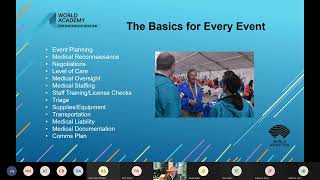
Planning an event like this is one you really have to know what the event is all about. That's the event planning, medical reconnaissance, and for Me, if I'm going to take on an event, I want to know the geographic layout of the start, the course, the finish line, and some of the nuances that may have with it. I put negotiations in here just to make sure, and again, I'll talk about this a little later as well, that when we're talking about this industry, the road race industry particularly, it's a big business, there's a lot of money involved here. We just did a race this past weekend that had roughly about 5,000 runners in it. They're being charged roughly on the low end, $85 to run in that event. So again, you could bring out your calculators and understand what kind of numbers that they're seeing as a business making proposition. So that needs to really be understood. Talked about level of care, oversight. Well, who is the oversight? As I said, I'm the medical coordinator, I'm not the medical director. So in each one of the events that I've listed, there is a physician, whether they be a cardiologist, an ed doc, not so much orthopedics, but mostly ed docs that are my medical directors. And what I do as a medical coordinator is make sure that everything that happens medically is done the way they want. I am basically, they're my direct report, not so much the event, but the physician so that it's done the way they want. And again, as you know, as physicians, you don't have time to put all this together. So that's where someone like me comes into play. Medical staffing. I'll talk a little bit about that, how we secure that staffing, but what about the training of that staff and license checks and making sure that whoever you're bringing in to your medical tents are involved in this, are the appropriate people. And again, as I said before, they've got to be trained. What are our triage protocols? Again, Dr. Tevi mentioned, At Falmouth, we had roughly 100 people come into that medical tent, the finish line medical tent, in a two hour period of time. So triage and understanding the flow and how to manage that comes into play. We bring in a large amount of equipment and supplies to be able to handle that kind of surge capacity, transportation. Again, it comes into a number of different factors, whether it be on the course or how you're transporting your volunteers and other situations. Liability, again, it's a major piece. I mean, you look at all the people that we asked to come in as volunteers. In all of our events, we're providing a level of medical liability coverage because if I was asked to volunteer for event. And you're not providing that? I am not volunteering. We do a lot in the way of documentation, and that would be medical records, HIPAA release forms, refusal of care forms, and a variety of other things to make sure that we've got written documentation and actually starting to make inroads towards electronic medical records and medical tracking electronically. But that's a whole other discussion. And then, you know, the comms plan, I've got another slide on this. But again, communications is vital for all aspects of an event that we put together. So, you know, I look at the industry and again, I've done a lot of different talks all over the area in the world. And we need to really make sure that we're doing a better job of coordinating, coordinating with our race directors and different race organizations, making sure that what we're doing is also scalable and affordable. I mean, look, I freely admit being the medical coordinator of the Boston Marathon, I have a very large budget, but that's not always the case. So whatever I'm able to design for Boston has to be scalable for other small events, no matter where they are. We talked about education, reporting. All of these different things come into play in regards to just industry standards. And I mentioned earlier, this is big business.
So, you know, I've always looked at the coverage of a road race to be some. But I'd say in the last five years really started to do some research in regards to event medicine, mass participatory medicine, disaster medicine. And there's no question there are definite commonalities in all those different approaches. And we've started to work with some people in disaster medicine with us in Boston to kind of do some risk assessments and understanding things that can happen. And one of the things we're looking at, the reason I put these three photos up, is that we've not done, and I'll say this for Boston, not done a good job of understanding what crowd control and crowd crush injuries and basically some type of a situation that's going to get all these people moving in different directions. And I think we saw some of those issues happening, I think was it recently in Korea that, you know, are concerned and with that, all of these other pieces, whether it be weather, which is obviously a major concern for us across the board, but you know, terror alerts and terrorism, as I've experienced in Boston in 2013, are still major concerns for us in Boston even 10 years later. And they're not going away. And I think all events have to keep that in mind as they go through with their plan.
So one of the things that's difficult when I deal with my event directors in designing a plan is what is too much or what is enough. Really, you've got to understand what your surge capacities are and with those surge capacities, what can your volunteer group handle versus your EMS support, which should be a very strong partnership moving forward. Understanding Weather Fluctuations we just did an event in Cambridge, which is the other side of the river, in Boston on Sunday, 5,000 people and it was a very difficult day. It was warm but more humid than it was hot. And we probably ended up sending 14 people to the hospital. And during that period of time we had 12 or 13 exertional heat strokes, higher than I expected. Yes, but again, we were ready to handle it. But again, those weather fluctuations in November, having something that is a 70 degree day in Boston is just unheard of. But again, with climate change and the like, these are things that we've got to pay attention to. The course difficulty, again, those come into play. Every course is a little bit different, whether it be a loop course, a point to point. Again, how you lay out your coverage depends on that. We really, we like to do this a lot is we like to work with our public safety partners to use the event as a training exercise. We've done that consistently. Many years ago we brought in DMAT and HHS to use the Boston Marathon as part of that. They haven't done that in a while. But again, it's been a great partnership for us.
So appropriate medical coverage. This is how I look at it. I'll just use a simple number of 10,000 participants. And again, based on weather and every event that I cover, I'm always looking at and making a bit of a history on what are my weather fluctuations, what were the number of people we treated, the number of people we transported, all the encounters so that we could start to see trends and patterns throughout the year. So that when I talk to my medical people at the events, that we want to be able to handle 1 to 2% of the field size in our medical care. And again, that's us and public safety. If it gets above that 2 to 3%, then obviously that's a little bit more of a difficult day. And then there's going to be concerns about if we're getting above a 3% or more, can we handle it? And where does that then get into a public safety concern for everyone involved? And with that, when do we cancel the We've had discussions in Boston. We've never canceled the Boston Marathon but there have been some very strong discussions on it and one of the fears that we have with Boston is that if we did cancel knowing how many people are coming from out of town and how many people are training and we decide a day before that we're going to cancel that race and again understand there's 30,000 people we feel that a percentage 5, 6, 7, 8,000 people are going to drive out to Hopkinton and run the race regardless of what we do. So where does that put our public safety partners on the course in handling something when we step away? I just I'm not comfortable with doing that. So we've had to make some very difficult decisions about either go or no go and they're going to be more and more of these coming down the pipe. So some of the responsibilities that we have or I have or my medical director has on various different topics and again you can see the level and the depth in which we.
More from Peter




Melissa Olen MSN, FPN-C, CCRN: Sudden Cardiac Arrest Training in Schools (Project ADAM) 4/25/25



Pediatric Hospital Readiness: How Teamwork & CPR Metrics Drive Better Outcomes



Chelsea Kadish, MD & Kyle Goodknight, EMT-P, RT: Pediatric CPAP in EMS (3/14/25)