Christina Warren MSHS, MLS(ASCP)SBB: Blood Bank Meets EMS (1/17/25)
Christina Warren, blood bank manager at Atrium Health Wake Forest Baptist, runs a transfusion service that supplies prehospital blood programs across rural North Carolina. They use leukoreduced low-titer Group O whole blood and Group A liquid plasma, stored in active refrigerators and validated passive coolers for transport. The program coordinates with county EMS and helicopter services under FDA and AABB requirements.
Questions this video answers
About 13 years.
Prehospital programs began in 2016 with helicopters; whole blood was introduced in 2017.
About 480 units of whole blood (program totals since expansion noted).
Five transfusion reactions, a rate of less than 1%.
In 2025.
Chapters
So before we get started, first of all, welcome. Happy Friday, everybody. This is a Florida EMS webinar. Myself, Dr. Pepe Tanner, Smita. We're very grateful that you're all here. If you're making plans for your conferences this year, we really hope that you're going to be here in Florida in June. You can see it's called First Their First Care Gathering of Eagles. And the reason why this year is going to be really great is because we got like the OG Blood people coming. We're talking about Don Jenkins, we're talking about John Holcomb, talking about.
Randy Schaefer, we're talking about Phil Spinella, we're talking about John Kramer. And it's going to be. It's going to be really great. And then, of course, Paul is going to be putting on the big show with all those people involved. So this is going to be really an amazing first air, First Care Eagles. For those of you who don't know, it's two conferences combined into one. First air, first care is June 9th through 11th. Eagles is Thursday and Friday the 12th and the 13th. Beautiful hotel, great time of the year. Nice pools. Hopefully it won't rain.
Peter, while you're plugging it, I, I should say is that we're actually now entertaining that maybe on the. That's going to happen mostly on the afternoon of Wednesday, I think. But the. We were thinking also entertaining you having a whole thing on mass gathering medicine and the risk of terrorism and how to predict it, what happened. And we'll have people talking from the, you know, the super bowl shootings to the, the car attack in New Orleans. And I could go on and on, you know, the whole thing. So it just, it's got to be, it's got to be more extraordinary than ever before. So, anyways, thank you for letting me interrupt.
Cannot wait. We cannot wait. All right, so on to the main show today. We have an amazing guest. And if you remember, we had Jet. We in the past had Jeff Hinshaw from North Carolina talk about his rural blood program. And then afterwards, we were connecting and he says, you have to talk to Christina Warren. So, of course, I got on right away. And then we were very grateful that Christina said yes. She's a blood bank manager at Baptist, which is Atrium Health, Wake Forest Baptist. And I kind of titled it EMS Meet the Blood bank. Because people who say that EMS is gray know that the people in the blood bank are black and white. And we need to get to know who these folks are because they're such an important Part of the system and the collaboration is key and therefore this is the first time we're having, at least on the Florida EMS webinar, someone from the blood bank, Christina, if you want to go ahead and share your screen, if you want to make any further introductions. Welcome to the Florida Ms. Webinar. Thank you for joining. While you're on vacation, by the way, she's on vacation doing this for us, so really appreciate that.
Yeah, great to be here. Thanks for having me. Peter. So my name's Christina. I have been working in the blood bank at Baptist for about 13 years now. I've worked in almost every capacity and every shift that we have available. Luckily, I'm lucky enough now to manage that team and lead that team. And one of the passions that I have is for our pre hospital blood programs. I do want to talk a little bit first about who works in blood banks. Most blood banks are staffed with bachelor's degree graduates who have a degree in medical laboratory sciences. Then there is a board of certification exam to take by the American Society for Clinical Pathology to become a board certified medical laboratory scientist. After that there's specialist exams that you can take and the one for blood bank is called an SBB or a specialist in blood banking. So usually labs are staffed with generalists. So medical laboratory scientists who may rotate through hematology, microbiology, other kind of genetics labs and blood bank. I am lucky enough that in my blood Bank I have 30 dedicated transfusion medicine specialists that work with me only in blood banking. So our knowledge of blood banking is very, very strong. But do not ask us about micro or hematology or any other questions like that.
So blood banks also. An important thing to know is that as Peter said, we're black and white, right? We in my lab, we are regulated by the state, we're inspected by the state, fda, CLIA and cms, cap, which stands for the College of American Pathologists, and aabb, which is the association for the Advancement of Blood and Biotherapies. So all of that prehospital blood programs have really come out into the spotlight lately. And we'll discuss a little bit about why this poses a problem for our highly regulated mindsets of blood bankers. But I am excited to be here today and to talk to you about how we manage to support pre hospital blood programs in our area.
See if I can get this to advance. Okay? So who are we and where are we located? We are Baptist. That's what we've always been known as. But we are now part of atrium. So atrium Health Wake Forest Baptist and also part of Advocate Clinical Labs and on the campus of Wake Forest University Medical School. So Wake Forest gets thrown around a lot. But Wake Forest is actually a city in the eastern part of North Carolina and we are located in Winston Salem, North Carolina. So all the stories that went out about Hurricane Helene impacted part of our areas to the west a little bit. So we managed to escape any of that drama. So Winston Salem is known for tobacco mainly. We have R.J. reynolds Tobacco Company, so Camel cigarettes and we're often known as Camel City. We've got the Homa Krispy Kreme donuts, so you're welcome for that. And Texas Pete hot sauce. When you ask Jeff what his community is known for in a lot of the rural communities that we serve, he tells me moonshine and motorsports. So all of that combined really shows the health of the people in the areas that we serve here.
I was kind of surprised when I met Randy Shaffer, who was mentioned earlier, to know that North Carolina is one of the leaders in pre hospital blood programs. So a nice little map here showing current up to October. We might have a new version out there, but as of October of last year, this was current. All the red counties here currently have a blood program and the yellow counties have up and coming programs that are planned to start hopefully in the next year. We do have a North Carolina pre Hospital Regional Blood Coalition and a link here to join. We do post lots of information about programs and policies so that you can copy and paste and hopefully not recreate the wheel.
So a little history about the programs that we support. We actually started prehospital programs back in 2016 with our helicopters. We were using blood components at the time, red cells and plasma. We've now moved in in 2017. We brought in whole blood. About when we went with air care and our helicopters, we had a county up north of us, Surrey county, who was like, hey, we want blood. So we brought them on board in 2016, 2020, we brought in the county to their east, Stokes county and then Wilkes county in 2022. Once we onboarded Wilkes county and that's Jeff's team there, he kind of got the word out and things kind of snowballed after that. So 2022 is when we started to see a big increase in the demand for whole blood and lots of counties wanting this product. So you can see here the counties that we added in the subsequent years with Alexander Yadkin and then we're onboarding Catawba county, hopefully this year sometime. So one of the important things to notice about these counties that we serve, none of them besides one really has any hospitals in their areas. The only blood that is in that county is the blood that we have on the EMS trucks that we provide.
So a little bit about our volumes. We are not DC fire, we are not transfusing 200 units a year in the field. This is a rural program. So since 20, 20 and four years we support four counties, three helicopters and one hospital based ground transport program. We've transfused 400 units, 480 units of whole blood, 65 of those being for my county EMS teams, 88 units of red cells with four coming from EMS and 74 units of plasma. We have had five transfusion reactions which is a rate of less than 1%, which mirrors what we have with our in hospital transfusions as well. However, since we are a level one adult and pediatric trauma center per month as a blood bank, we transfuse about 200 units of whole blood. So the whole blood that is transfused in the field is just a minor part of the blood that is transfused from my department every month.
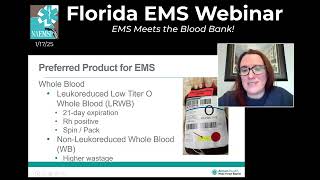
So for preferred products from ems we prefer to give whole blood. It's just everything all in one. You have places that still can only get packed cells and that is perfectly fine. I'm not here to argue the best products to give. There's still studies out there to try to support that data. But we prefer Leuca reduced low titer group O whole blood. We prefer Leuka reduced because it allows for me to exchange my inventory around more easily and prevent some wastage. We do use a product that currently has a 21 day expiration. We do give RH positive to all of my pre hospital blood programs. And when the products are old, we have the ability to bring them back into my house, put them in a refrigerated centrifuge, spin them down and pack them into the packed red blood cells. At that point they just become a leukarreduced packed red cell that I can give to anybody in the hospital. So greatly reduces wastage for our program.
So this does mean that women and children of childbearing age are receiving O positive whole blood. I'm not here to argue that point. There's great articles, especially from 2019 out of Pitt that calculates the statistics of anti D&HDN if you're worried about that. But the great article says that, you know, the HDN and death from hemorrhage is, you know, when you weigh that the risk of HDN is like 0.3% and the risk of death from hemorrhage anywhere from 8 to 20%. So by not giving O positive whole blood to females and women and children, even, you know, we're depriving them of a product that could potentially save their life because we're worried about a problem that might happen way down the road.
Christina, do me a favor. If you can explain the leuca reduced and non leuka reduced and why the higher wastage and maybe some of the controversies behind that. I know there's been some.
Yeah, sure. So leukoreduced products, take your leukocytrace or white blood cells and filter them out. So when you have a lot of white blood cells and products, you have a higher transfusion reactions. And really, as far as a blood bank perspective, we moved to universal leuk reduction as a blood supply over 10 years ago. So you're not going to find any non leuka reduced blood products out there. When we're talking to our doctors in house, they're really, most recently, they're like, we can't order leuka reduced blood anymore. And they're all worried about it. We're like, you don't, you don't have to. That's all. That's all we have now. Non leuka reduced whole blood, some say it's better because every single part of the whole blood is in there. You're not removing any platelets. When we use leukoreduced whole blood and it goes through that leukoreduction filter, even though we're using a platelet sparing leukoreduction filter, some platelets are lost in that filtering process. But the fact that we can spin and pack this product if we do not use it as whole blood and give it to anybody in our hospital center really means that we don't have any wastage. We do use some non leuka reduced whole blood. When we have a shortage of leuka reduced product, we will order non leuka reduced even from Texas. We'll get it in from wherever we can get it and stock it to make sure we have it for our trauma patients. But it is only used for trauma at our center. We do not further pack and process that and we're not able to distribute it to anybody outside of the trauma program.
So it's always important to also have backup products in mind. All of my agencies that we support know that if I'm running short on whole blood, they may end up with PAC cells and plasma in their coolers. We do try to provide one and one so they can keep a one to one ratio of red cells to plasma should they need it. And we do still give Rh positive red cells in those instances. One of the other things you may see out there is a controversy on plasma. What kind of plasma is available in your area? We use liquid plasma and we use group A liquid plasma. So you will find that a lot of trauma centers move to using group A as a universal plasma product because group AB is only about 6% of the overall population and the demand is just too high to give AB plasma, which is the true universal plasma, as trauma plasma. But if you're a gambler and you like to play the numbers, you have about 45% of the population, that's group O, another 40 something percent, that's group A. And all of those people, which is over 80% of your population, is going to be automatically compatible with group A plasma. When we've been giving group A plasma as trauma plasma in the hospital, we have not seen any contraindications even when we're giving it to B and AB patients. So deemed essentially perfectly safe for emergency transfusions with liquid plasma. It is not a leuka reduced product, so we choose to irradiate it. The only indication for irradiation is to prevent transfusion associated graft versus host disease. We do have lots of cancer center patients, et cetera, in our community. So over an abundance of caution we do choose to irradiate this product, but it is not a requirement.
So inventory management, this is really where our program shines and what makes everything work. So I have the inventory all at my hospital, on my shelves in my monitored refrigerators and I transfer it to whoever I think needs it. So we have a fairly sophisticated tracking system. Blood banks cannot use epic, which is the main medical record system used by hospitals. We have to use a third party system. Our systems have to be approved by the fda. And EPIC decided a long time ago it didn't want to have anything to do with that. So you'll find all different kinds of blood bank systems throughout the country that your blood banks will be using. We have special locations built into all of my blood bank LIS systems. So if I have units that I'm storing in the emergency department or the pediatric emergency department, a helicopter or an EMS location, I can actually change my inventory not just physically, but also in my computer system. So I know what is where.
We store our units based on expiration. So my short dated units are towards the front and they will get used first out of my blood bank or stored in my emergency department. And my fresher units are going to go out into the field and get cycled back to me at due time.
And then you'll see a picture down here just in case anybody wants to know what packing looks like. When they become short dated, which to me is about one to two days before they expire, we will centrifuge them and that pushes all of the red cells down into the bottom part of the bag and your plasma will be at the top. Then we hang the unit into this plasma expressor and kind of let go. And the plasma expressor forces all of the plasma up out of the top of the bag. So you can see in the right picture, you end up with a unit of packed red cells and, and then leftover plasma that just gets discarded.
So our inventory tracking system is, like I said, we do use our lis, but we also use a lot of paper. We do have issue slips that we keep segments from the units of blood. If you'll. When you're familiar with blood, you'll notice at the top there's these little sealed segments on the blood bags. Those little sealed segments we keep in these little acetate folders. As for who has what blood product, so I know that in this AirCare Lexington, I've written down the units that they have and I have segments from those units in that acetate bag. If they call and they say they transfused or they come back in and they don't have the blood product in their cooler, and I know it's presumed transfused, I fill out a tracking log that's pictured over here on the left. This alerts the management team that we need to expect a chart from the EMS within three days. It also pull the segments aside and it also alerts me that I have to save those segments. And when I get the patient into the hospital, I have to marry up the samples we get from the patient and cross match the units that the patient got in the field with the patient to ensure that they were compatible.
Communication. We have a very sophisticated communication with ems. As you can see here. It's very hard to understand what these mean. This is one of my teams that likes to communicate via text and emoji. And the information that these texts provide is just invaluable to me. So usually I get the very simple text message like the top here, ambulance, blood drop, blood drop. And I know they gave two units of blood in the field on the way to me, another one that's A little bit more confusing would be hospital blood drop. So a lot of the EMS guys that work in the field, they also have services at some of the local rural hospitals. So they know that there's blood and in the field on EMS that is not available in their hospital blood bank. They don't all have whole blood in the hospital blood banks. If they get a GSW dropped at their door and EMS is in the parking lot, they may choose to call EMS in and use the blood out of ems. And this helps me know that I might find documentation of that transfusion in my blood in the regular emr, but it came from my EMS agency. So any of these kind of communication ways that you can come up with to help the blood banks track the blood to the patient is invaluable. The one that I hate to see is the one at the bottom. Ambulance, blood drop, blood drop, helicopter, blood drop, blood drop. They use blood from everywhere that I have out there in the field. And now I'm going to have to piece together multiple charts to make sure the tracking of that is complete.
So we support two types of prehospital blood programs. One of them uses active systems, which are just refrigerators, and another one uses passive systems, which are prepackaged coolers.
So for my active systems, things that you have to think about are how are you going to keep the blood cold not just during storage, but also while you're getting the blood into that storage unit. Very few people want to carry a heavy refrigerator from the truck to the blood bank every single time they're switching out their blood products. So you do need to have a validated system that will keep your blood cold while it's being transported. There are laws that have to be followed from the FDA that tell you what the temperature of those products have to be. Again, we have a very sophisticated system for this, including a Ziploc bag and two cold packs that we validated to keep that blood cold for at least one hour while the blood is being transported and into the refrigerator. You also have to think about how is the blood getting into these refrigerators. We use multiple types of courier systems. Some of the counties come right to me and park in the EMS bay, walk up to the blood bank and get their products. Others, I courier blood to a smaller blood bank site and they go to that smaller blood bank site in exchange with them. Still others will use a third party courier system to achieve their products. It's all using a modified version of the same process so that my staff stays as least confused as Possible. You'll hear the word validating and validation a lot with blood bankers. We are highly regulated. Everything is black and white. You can't just buy a refrigerator and put blood in it. We have to prove that that refrigerator will keep the blood at the appropriate temperatures while it's sitting in an EMS bay and while it's out in a truck. So my validations of these refrigerators always start in my office. Everybody is required to bring me their refrigerator, and I validate it while it's sitting next to me. The second part of the validation includes putting those units on the trucks, making sure that the WI FI capabilities for temperature monitoring is working, and making sure that the refrigerators actually stay cold while the unit is out in the field. Once it's passed all of those products, then and only then is it approved to store actual blood products for use.
So our passive systems, again, the same thing with inventory switch out. You have to have a plan. Blood has to stay cold during transport as well as during storage. We use Pelican Credo coolers. This probably looks similar to a lot of you out there using coolers. We have multiple different sizes of these coolers. Some allow for two whole bloods, some allow for two whole bloods. One plasma and one PAC cell. Just depends on the needs of the county. The first thing I'm always asking an EMS agency is, well, what do you need? What kind of cases do you see? Can you have blood on a truck that stays on your truck, or do you need to be able to take that blood off the truck, put it on an ATV and go out into the backwoods to get your patient? You know, what do you typically see? So depending on their needs is why we have multiple systems set up all of our coolers. We validate every two years to make sure that they're still maintaining temperature for the appropriate amount of time. We have these coolers validated for four or five days, depending on the size of the cooler. And every single cooler has a temperature probe inside of it with a readout on the top so that the EMS agency or the helicopter can always tell what the temperature of the blood products inside are. If the temperature starts to get high, they call me and we switch them out and get them a new cooler.
Temperature monitoring. So this is something that is highly FDA regulated. You have to make sure the temperature is monitored either continuously or documented every four hours. Both is best. So for our coolers, we have these temperature monitors that are logging the temperature every 30 minutes and continuously downloading the data for our refrigerators. We have real time communication monitoring systems between the units that are in the cooler or refrigerators and it's uploaded into a cloud. My EMS agencies are responsible for responding to all of these alarms and letting me know if there's any issues. However, I do audit it on a multiple weekly basis where I call them all and ask them to send me their temperature data and I can make sure that they're responding to alarms appropriately. You also have to be prepared to follow any retention standards for documents. Whereas for blood bank you can think pretty much everything you have to keep for 10 years. So all of your temperature data you have to keep for 10 years. It's not just something you can do and not prove that you're doing. As for one last temperature monitoring that we use on all of our units, we have a, what we use as a safety view. The, the picture up here on the top right, if the unit is white on the center, that means that the blood has stayed cold. If it's speckled and you're starting to see that speckly red, the unit is still good. But it might have gone into that transport range of temperature, which is up to 10 degrees centigrade. And then if it's solid red, you know that that blood has gotten too warm and you do not want to transfuse it. So any safety views that go red, the teams have to call me and we have to exchange product and then that blood would be discarded.
So training for ems we do provide on site initial and annual training for our EMS partners. We cover training on storage and handling of blood products, blood inspection, how to chart transfusions per regulatory standards, and the need to get signed emergency release forms. We also go over just a little bit of science because we're science nerds and we wouldn't be doing justice if we didn't tell them just a little bit about blood products along the way. It's one of my favorite parts of the program, actually getting out into the field and actually meeting all the people that are doing the frontline work. We are nerds. We stay in the lab, we don't see patients, and it's really good for us to see on the flip side how you guys are using these products. And I may be a little stickler about one point in the regulations that's really hard to meet. So having these meetings with the teams and seeing their setups really helps us to be able to adapt what they're doing to the standards and come up with a plan so that we can make sure everybody is fulfilling everything. That we need to do.
Quality monitoring and improvement. This is probably the biggest piece that blood banks care about for us. What we choose to monitor. We do monitor every single transfusion for appropriateness. So every single chart that is is reviewed by me and then it's also reviewed by our dedicated transfusion medicine pathologist. We look for compliance with regulatory standards, documentation of what was given, and we also look for signs and symptoms of transfusion reactions should they have been prevalent with transfusion reactions. We also look at, you know, how are we going to manage this in the future? What is the transfusion reaction? All of the five transfusion reactions that we have found and detected have been what we call delayed transfusion reactions. When we're looking at a delayed reaction. These are reactions that are detected actually by my blood banks staff and not by people in the field. They're detected on subsequent blood sample workups from the patient. They were all transfusion reactions due to ABO or RH antibodies. When we're dealing with these reactions, we have to take into account is this a passive antibody or was it an antibody that the patient actually formed to the blood product? How many antigen positive units did the patient get? What is the potential for hemolysis in the future? We will contact the care teams and give them alerts. You guys need to be doing serial hemoglobins on this patient. They have the potential to hemolyze all 20 units they got, etc. We also perform an annual compliance audit. So every single year I will take whatever standards I can get my hands on and audit my EMS agencies and our programs. So from helicopters all the way down to EMS crews, currently there are no standards for pre hospital blood programs. But that doesn't mean that you're exempt from upholding standards. There are standards that apply, it's just that blood banks have to go through and figure out which standards those are. We do an annual refrigerator revalidation where we make sure that the units are still holding temperature per regulatory standards and biannual cooler vet revalidations that we talked about. I make all of my crews do quarterly alarm checks for, for high and low alarms on their temperature monitors, biannual agreement reviews. So every two years, blood banks are required to review all of their agreements with their suppliers. So any changes to programs, whether it's indications for transfusion, et cetera, have to be approved by the blood bank and the EMS agency. And then we talked about monthly temperature reviews. So the biggest question that I usually get is well, what do we have to follow and what should we follow? And so that's the difference between FDA regulations versus AABB standards. So the FDA has the code of federal regulations and the ones printed here are the ones that absolutely have to be followed. You do not have a choice. It's fda, follow them or you can't have blood. For the association for the Advancement of Blood and Biotherapies, the aabb, they establish standards that are met and they often exceed the FDA requirements, but they always meet the FDA requirements. These standards do not all have to be followed, but they are considered best practice in the blood banking world. And if you are trying to get a blood bank to work with you, following AABB standards is your best bet. Accreditation by the AABB is also not required. But again, it looks really good. If you're upholding AABB standards, a blood bank is going to trust you because you are inspected by the AABB and they know that you're upholding all of the FDA regulations that have to be followed. Exciting news is that the AABB will be publishing its first set of standards for prehospital programs in 2025. So soon we won't have to guess anymore which standards apply in the prehospital setting and which ones do not.
So that is just a brief, quick overall view of the blood banking side of things. I will turn it back over to Peter and he can go through questions, etc.
Amazing presentation, Christina. That's probably the best presentation I've seen as far as the depths of what is needed, what's required. But I think more importantly, this is, for the first time, I'm recognizing how integrated you are with your EMS systems. And now I recognize why North Carolina is so far ahead of the game. Because you're, you're actually like, like one. In other words, they're, they're bringing you the cooler for validation. You're going there, you're doing the training. And I wonder how many other people are doing that. I mean, the states are doing that. Because what I think is happening, that happened here with us is that we kind of like, try to figure out what they want and we just kind of figured it out on our own. But the fact that you've, like, so how did that happen? How did, how did you and Jeff meet and how did this whole thing happen? Did they ask you? Did you just do it yourself? Give us some, some information on that?
So I'm not a doctor. I can't, I cannot do anything without Dr. Fide. He is my transfusion medicine pathologist. He kind of just gives me the Green light to make these programs function. So really it's all on him. But he, we. He started these programs with the manager before me, with Air Care and Surrey county ems. When I started, Stokes called me and they're like, hey, we want to do this too. So I just kind of copy and pasted and I really didn't know what I was doing. I just went through standards and regulations and we're like, okay, this one applies and that one applies and that one applies. And it's just kind of been, you know, learn and evolve over time. When Jeff called me, he did just call me out of the blue and he said, hey, this is a crazy idea. I want blood. And he really lucked out because we had been supplying blood to Forsyth county, which is the county we're located in, and they had given their coolers back and said, we don't really want to do this. We're not set up for this. And so I feel like it's very. We have had programs that have failed and I think that's important because you do have to have buy in from the counties and the blood bank staff. You can't just run these programs by yourselves. Unless you want to take on all of these things and run them by yourself. They can run just fine.
So when Jeff called, I was able to say like, well, I have a bunch of coolers here I'm not using. So when do you want to start? They're already validated. So it was on him to really get his team educated and up and running first. So. But yeah, these programs are special to us. They're really our programs. When we started them, we did not trust EMS at all to do anything the way that we want it to be done. So that's why the programs are really managed from a blood bank perspective here as opposed to like a more EMS based program like DC Fire or San Antonio. Have.
Let me, let me bring in Jeff Hinshaw first because I want you to make some comments. I'm going to bring Dr. Kramer and then Tanner, I'm going to go to you. But Jeff, go ahead and make, I want to hear your comments of what Christina just mentioned.
You're on mute.
No, you're still on mute. I don't know why that's happening. Okay, there you go.
Do you have me now? Yeah, sorry. I'm in the. I'm in the mountains of the. In the Blue Ridge Mountains with snow behind me, so fingers are kind of cold. So what was your question, Peter? I'm sorry.
No, I just want you to comment on the relationship because I think and, and Dr. Kramer mentioned that, that Christina has established a gold standard system. You're an EMS guy. Talk to the rest of us and explain to us how do we make this happen in our communities.
I think we're a unicorn type system. And I got to give the credit to everybody who came before us. The guys at Surry EMS who wanted to start this program to begin with, again, they transitioned to a local hospital. It was the right time and the right place. I champion EMS agencies to look at your call volume. What does the data tell you that you need? I gotta give props to our quality management folks at Wilk cms, Bryant Reed, then Jason Revis and the team. We looked and saw that there was a need. We had people with unique shock indexes. We had vital signs. We're a rural county. We're the 13th largest county in North Carolina. And sometimes over two hours to a trauma center by ground. So then again, it was a reach out. And literally Christina's right. It was a cold call. We didn't know each other even. We worked under the same footprint at the hospital for years together. And we met, they had the equipment, and again, it's been a mutually beneficial relationship. I've gone and done continuing education for her blood bank staff and to watch them see the light bulb come on that, hey, this program that we're running really does impact from traumatic arrest that is now home and now highly functioning to where we had our first entrapment administration just a couple of weeks ago, where the patient was resuscitated with blood products while entrapped in a vehicle to the point where they needed to be sedated because they had gone essentially from dead to awake. Again, another tremendously positive impact of our blood program.
Awesome. Thank you so much for that. Dr. Kramer, you're leading whole blood from a number of fronts with a national coalition and you've been very impactful with leading us into getting some CMS modifications and then the AABB standards. And I wonder if you wouldn't mind just mentioning making a few comments and also mentioning about the AABB and just this topic in general.
Well, first of all, Christina, again, a phenomenal presentation and you have established a very operationally functioned functional system. You know, you mentioned the blood bank community seeing things in black and white. No question. The EMS community typically sees things in gray. I think one of the perspectives that I picked up is that even though there was concern on the part of the blood bank community about EMS agencies being able to successfully do this The EMS agencies really have stepped up and proven that they can do it and do it very cooperatively with the blood bank community. There are a lot of things going on. We currently have about 210 programs around the country. The AAB standards, as you alluded to, will be coming. I heard a rumor last week, maybe as early as within the next month or two.
It's important for folks in the EMS community to understand that there will be an accompanying EMS guidance to help agencies get their programs up with still being able to meet all of the compliance requirements. That guidance is being developed by with a lot of input from EMS clinicians as well as the blood bank community. So you know what? Several years ago were two groups.
With significantly differing perspectives now being able to come together and realize that we can do these programs very effectively.
Great comment. I'm going to go to Tanner Smith and my co host. Tanner, go ahead with your comments.
Yeah, thanks again for the, for the excellent presentation. And it certainly sounds like with your system having a blood bank that's so enthusiastic, already having equipment ready to go, your system does not have the problem that most systems have where they're forced to kind of go and beg their blood banks for buy in and kind of worship at the altar of the blood bank. And so my question to you in relation to that would be for all of these kind of stringent standards, whether that's from the FDA or for the aabb, things like having records of continuously monitored temperature data, if there are EMS agencies out there that are wasting blood or aren't complying with with some of these standards, not providing some of that data to their blood banks, can that negatively impact the way that that blood bank is viewed by some of these organizations, impact their certification status? Or you know, from the regulatory side, can having an EMS system that does something wrong, so to speak, can that impact you in any way?
Sure. So I would say for me, yes, because I've taken ownership of these programs. It is my responsibility to follow all the guidelines. We have been inspected by FDA and aabb. We've been doing these programs for a long time.
More from Peter




Melissa Olen MSN, FPN-C, CCRN: Sudden Cardiac Arrest Training in Schools (Project ADAM) 4/25/25



Pediatric Hospital Readiness: How Teamwork & CPR Metrics Drive Better Outcomes



Chelsea Kadish, MD & Kyle Goodknight, EMT-P, RT: Pediatric CPAP in EMS (3/14/25)