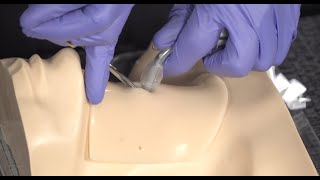
Troy Duchard, EMS captain with Palm Beach County Fire Rescue, demonstrates surgical cricothyrotomy for adults using the Quick Fix kit. The procedure involves a vertical incision through the cricothyroid membrane, inserting a cuffed tube, and inflating it with 10 mL of air. He also covers pediatric needle cricothyrotomy and when to use each technique: failed airway management, facial or neck trauma, or upper airway obstruction.
Chapters
Well, hello, my name is Troy duchard, EMS captain with Palm Beach County Fire Rescue. I work out of the 2nd Battalion on C shift. Today I'm going to do a quick little training tutorial on the surgical cricothyrotomy as it relates to an adult patient. And we'll touch just briefly on pediatric patients at the end of the scenario when we're doing a surgical crike or cricothyrotomy. We want to do these on patients where we can't manage their airway or ventilate them by any other means. We can't place an ET tube or an Igel or even our BLS airways as far as just a BVM with oral and nasal airways are ineffective with properly ventilating the patients. A lot of these patients that we would do this on are going to have severe facial injuries or injuries to their neck or throat, some laryngeal trauma or possibly an upper airway obstruction where we would have to make the cut lower than the obstruction to bypass the upper airway. What we use at Palm Beach County Fire Rescue, we use the Quick Fix cricothyrotomy kit. This is for adults age 13 and greater or with signs of puberty. And for pediatric patients 12 years and under, we have the Quick Fix Junior.
Inside. The Quick Fix kit has everything that you need to perform the skill. You have your cut down shiley tube which has a stylet. It's a little bit smaller than your ET tube, but it does have a cuff on the end so that you can inflate that. You have that. Also in the kit comes a pair of hemostats that would be useful for opening up the trachea once we make the cut. And of course your scalpel and 10 milliliter syringe to attach to the cuff of the shilet tube. So we'll go ahead and start the skill. As always, when you're performing this procedure, any type of advanced airway procedure, you should be wearing a minimum of PPE of gloves and eye protection for this procedure. Oftentimes it could become messy. I recommend wearing trauma sleeves as well as full facial protection. For bsi.
We would have all of our equipment assembled, we would have our patient properly positioned and we would prepare them adequately per protocol with any sedation and pre medications that would need to be given.
Once we've decided that we need to perform a surgical cricothyrotomy, the procedure itself should move fairly quickly. I would recommend having an assistant, more than one person, to assist you with this. This should be a two person job. However, we always train, and for the purpose of this training session here, it will just be. Will be just me. Okay, so once we're, we're ready to begin the scale, we need to make sure that our patient has been properly positioned. And we have all of our equipment assembled that will include our suction. And we're going to note and try to find our landmarks. The landmarks commonly taught are hill, valley, hill in the center of the throat. And our goal will be to cut that cricothyroid membrane which is in the valley between the two hills. Once we've noted our landmarks, we're going to go ahead and hold the skin taut to hold it in place and prevent any missed cuts. And then we're going to sterilize the skin with our alcohol swabs or Betadine solution. Once those are done, it's very important that we not.
Continue to touch the site and contaminate it further. As we begin the skill, we're going to go ahead and take our scalpel and in our dominant hand, make a series of vertical incisions.
Until we've punctured through the cricothyroid membrane. Once we do this, you can anticipate some bleeding. You take your scalpel and secure it, and with your assistant ready, you should have aggressive and continuous suctioning with this skill just to help aid you in clearing the secretions. Once your scalpel is secured, your assistant will give you your hemostats, which are used to help open up the trachea. And then once you've got your landmark, you'll quickly insert your shiley tube, your crike tube, into the trachea until it buries to the hub.
Injecting 10 milliliters of air into the trachea to, to cure it into the cuff. Pulling this out now, we need to confirm our placement as we would any other advanced airway by attaching your end tidal CO2 filter line set as well as a HEPA filter and ventilating the patient with a BVM. We're going to listen for lung sounds and confirm that we have equal lung sounds as well as a visible chest rise. And then our gold standard is also noting that we have an end tidal CO2 reading with a box like waveform. Once we have confirmed that the Krike tube is in fact in the trachea, we're going to go ahead and secure it with our bands that come with the Krike tube. We're going to go around the neck and secure it, keeping in mind not to tie it too tightly, that it cuts off any circulation to the neck. And then we would ventilate our patient per protocol, of course, following the sequence of the dsi, this patient would call for post intubation or post airway management sedation as well.
Being mindful not to leave any of that out. The only thing that would be different here if this was a pediatric patient, the equipment is slightly different. We would perform a needle cricothyrotomy, which is done with the Quick Fix Junior Kit. Inside the kit comes a 14 gauge needle, and that needle is inserted in a downward direction in the exact same locations as the adult Hill Valley Hill through the cricothyroid membrane. And then we would ventilate the patient through the 14 gauge needle. Again, that's for pediatric patients 12 years old and younger. That's cricothyrotomies and needle cricothyrotomies in a nutshell. Thank you so much for watching. My name is Troy duchard, EMS captain with Palm Beach County Fire Rescue.