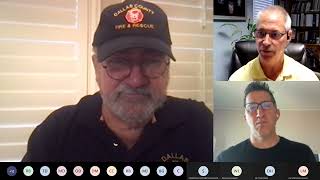
This is a recorded YouTube conversation (9/20/2022) between Peter Antevy and David Long about implementing Whole Blood in the prehospital EMS setting in Virginia's Tidewater region. Peter frames David as the Tidewater EMS regional executive who methodically rolled out Whole Blood across multiple agencies; he cites Broward County (BSO) as an earlier large adopter that faced logistics, facility interfacing, trauma surgeon reluctance, data collection, and cost questions. David notes that prehospital Whole Blood initiatives began circa 2017 and that programs now have roughly five years of data; he also reports his team spent about six to eight months researching and socializing the program locally before launch.
Questions this video answers
September 20, 2022
2017
About five years
Approximately six to eight months
Chapters
There we go.
I'm just finishing up my last one, Peter, but it should be going.
Okay. Thank you. Appreciate you.
Peter. Did you know if you sent out a notice earlier today? I didn't get one. That's why I was wondering if we would get more people if we had the notice out. You know. You know what? Let me. Let me. Let me see if that didn't go out. If not, I'll just add it in right now to get people on.
I got one to my email.
One second.
Right. Okay. Yeah, that. So that one did go out, but let me. Let me just put it on the other one.
Virginia. And then I'll. I'll just. Let me just put the link for people so in case they.
Copy that.
And then we just delete all this.
Okay. Sorry, David, just give us 30 seconds while we get through all these things. Okay, I sent out the link. Okay, there. The link is there now. Plus, we are recording this, and we get many, many more views on the recording than we do on the actual call itself. But just as a setup, what I would like to do is just. This is also, David, for your benefit, so you understand where we are. We've been very blessed that we've had.
One very large agency in Broward county bso, initiate Whole Blood over a year ago, and we went through some growing pains, and they really put a lot of hard work in. Dr. Jim Roach, Chief Heath Clark, with respect to the contracting with Whole Blood, with respect to interfacing with the facilities, namely the trauma facilities and the trauma surgeons and their reluctance, you know, initially.
Data collection, which we now have a process in place, which I think I've spoken to you about in the past.
Logistics, what is the true cost? What are the true ongoing costs? And I think that someone like you, and so just as an intro for those people who don't know, David is the executive director of the Tidewater EMS region in Virginia.
Which is in Chesapeake area. And he does an incredible job of really getting a number of agencies in the region on board with so many things, including protocols, and just making sure that everyone's doing the same thing and doing it very well, very robust, CQI, etc. When I heard that David was rolling out Whole Blood in his region, I said, there's no doubt that he's going to be doing it in a very methodical way with all the details, all the data. That's really why I wanted to bring you on so you can give us a little bit of background and how you made this come about. And if you can and then I'm sure we'll have lots of questions for you. But David, thanks for joining us and I'll turn it over to you.
Absolutely. Thanks Doc, for having me. And you know, talk about blessings, I am certainly blessed to be sitting in the position I am with the ability to reach out to pioneers that kind of blaze this trail. So I don't think it's a surprise to anybody that the Whole Blood initiative as far as providing whole blood outside the confines of a hospital, so in that, you know, pre hospital environment started back in 2017, so we, you know, we've got five years now worth of data from agencies that have essentially prepared for and launched programs. And it's one of the rare instances where the similarities between programs hold probably to that 70, 80%, you know, of the agencies are doing things similarly you know, to the point of we'll talk about like transfusion criteria. So it is nice that EMS finally found something that they could coalesce around and do similarly, you know, across across the country. And then I think there, you know, from, from there it's back to the research going, you know, probably as far back as the Civil War, knowing that the concept of transfusion and the role of whole blood is again a concept that's not new, but due to some, you know, local issues, you know, and challenges right around the Vietnam era when we started getting into blood shortages and we started looking at things like what can we do from a component therapy perspective? And we'll try that, you know, the role of crystalloids, you know, just due to cost, you know, in the absence of true research and data that support use of large volume crystalloids. So I think people taking their time to do deep dive, you know, on the research and information that's out there and available to us certainly helps to ensure that we stay within, you know, the I would the constraints of, you know, providing this type of capability, you know, in our communities.
So we probably spent the better part of six to eight months just in researching and socializing, you know, our program in the community. And so I'll just do a quick kind of define for what community.