Did PALS Get It Right?
Peter Antevy, Patrick Navarro, Hilary Gates, and Mark Peel discuss whether PALS guidelines get pediatric emergency care right. The panel examines how EMS applies these protocols in the field, focusing on gaps in trauma and cardiac arrest care for children.
Chapters
Thank you everyone, for joining us today. My name is Patrick Navarro. I'm the Vice President of Business Development here at the Hand Tevy Company. On the call with us today, you'll see we have quite a few panelists with us. Hilary gates, Peter Anteve, Dr. Mark Peel, James Decomenti, and myself. But I wanted to introduce a great friend and colleague of mine. Her name is Hillary Gates. Hilary is the senior editorial and program director at Emess World. I've known Hillary for years from her time working at the City of Alexandria Fire there in Virginia. And so I wanted to pass it over to Hillary now to say hello to everybody and get us going with today's session.
Awesome. Thanks, Patrick. Just a clarification. Recently departed from EMS World, but yes, that's where Patrick and I forged a fabulous relationship. No problem, folks. I'm honored today to be able to introduce two of my really good friends, Mark Peel and Peter Antevi. You are really in for a treat. These are two physicians who are what I think of as titans of our industry, and they live and breathe their missions every single day, which is really important. Mark Peel is a pediatric intensivist at WakeMed in Raleigh, North Carolina. He he is the assistant medical director with WakeMed Mobile Critical Care Transport, and he served recently as medical director of the WakeMed Children's Hospital and director of pediatrics at WakeMed Physician Practices. Mark has faculty appointments in the departments of pediatrics at the University of North Carolina and Duke University. He is founder of the Samaritan Health Center, a clinic for homeless and uninsured patients. And he's also founder and chief medical officer of 410 Medical Innovation, a company focused on improving resuscitation in shock and in sepsis. Peter is a pediatric emergency medicine physician and EMS physician, and he is CMO and founder of Hand Heavy, a pediatric system to help treat critical patients on scene, quickly, effectively, and with confidence. He serves as the medical director for a number of agencies in Florida. Davie Fire Rescue, Coral Springs, Parkland Fire Rescue, Southwest Ranches Fire Rescue, and he is associate Medical Director for Palm Beach County Fire Rescue. Peter is also a member and the lead pediatric EMS specialist for the highly influential Metropolitan EMS Medical Directors Coalition, also known as the Eagles. Mark and Peter are truly affecting change in our practice to positively impact patient outcomes. And I don't think either ever intended to start a business and be entrepreneurs, but they are both to be commended for walking the walk instead of merely sitting back and disagreeing with the status quo from afar. Make sure you check out Peter's article that was recently published in EMS World about pediatric resuscitation, which includes a thoughtful response from the AHA.
To set up this webinar. It's important that we all think about EMS as its own beast and sort of a subspecialty when it comes to treating patients. EMS really is a different animal. We see patients with different presentations than we do in other scenarios like the hospital. They have different signs and symptoms than, say, an ICU clinician might see. All of us, as we're watching today, should keep this in mind as you listen to these two docs. Present the science and the research. Be sure to evaluate the information for yourself, be informed, and make a fully informed decision to do what is right for our kids. Peter and Mark, I'll hand it over to you.
Wow, Hilary, thank you so much. Patrick, thank you very, very much. Hilary, you've been, in my opinion, a titan. You've allowed us to express our voices in a society where sometimes those expressions are not welcomed. And we thank you greatly and we wish you success in all your future endeavors. So thank you so much, Olivia.
Pleasure. Have fun, you guys.
Thank you. I know you're going to give a lecture right now, so thanks for coming in and popping in. You're the best. Good luck with that. And Mark, welcome. Thanks. Peter, how are you doing, buddy? Great, great.
Thanks for inviting me.
Oh, absolutely. Well, you know, Hillary talked about, you know, the gamut of pre hospital into the emergency department, into the icu. And one of the biggest reasons that, you know, you and I connect so well is because we cover that gamut. We see all three phases of that, and we clearly understand that they're. They're not the same. Right. And so I wanted to just start off by explaining to everybody that first of all, thank you guys for joining today. And we're going to present you the science. We're going to present you what's really under the hood. And just like Hilary said, we would like you to listen, digest, and then we'll give you all the resources you need, all the papers we talk about, anything that you need. But please go back and then do your own investigation, make your own decisions. We're not here to prescribe anything or to force anything upon you. The folks who have written these guidelines are true titans. They put the hard work in, they meet frequently, they do the writing. Let's not diminish what they've done. Mark and I know many of the people who are involved with this, but I think that we still have the ability to have that back and forth when we think that there are some things that have to be looked at and discussed. Let's start. Mark, if you don't mind, we'll start with our disclosures. Yep. And so I'll start by saying, you heard that I'm, you know, I founded Hentavi. You're not going to hear about Hentavi today. And Mark, same.
I'm founder and CMO410 Medical, but we won't be discussing either of our relationships there on this talk.
Awesome. Okay. All right, let's get started. First, you all see James D. Clemente. You see his photo there? He's another person who just. It's been incredibly great. We've been grateful to know and to get to know and to collaborate with. Many of you now know Prodigy EMS from the Refresh 2021. They've hosted it for free. And I called James a few weeks ago and I said, hey, a lot of people asking for CEUs. He said, no problem. And thanks to James and Prodigy. All of you today will get one and a half CEUs for joining us today. We greatly appreciate that. And James, we appreciate you and your team. Thank you very much.
Okay, so. So let's start with this, which is why are kids so scary? Actually, Mark, this is your neck of the woods. This is wake ems. What's your thoughts on this? Yeah, sure.
And just a disclaimer. I can't claim to be the EMS expert that Peter is or that other folks on this call are, but I have a great interest in what happens out in the field. Love teaching pre hospital professionals. I have the almost unfair position of being able to be in a icu, in an ER with lots of resources, a lot of people around me, and certainly take care of a lot of kids that are brought in by our EMS folks and friends and respect what you guys do with less resources and less help out there in the field every day. And so I've taken an interest in trying to help disseminate some of what I'm learning, what I've continued to learn about the care of critically ill kids in the hospital out to folks who are the first folks to encounter many of these children in the field. So the question is, why do kids scare us? And that's. I don't say just EMS professionals. All of us sometimes are confronted with a critically ill kid and they can be scary. But in EMS in particular, why do they? Because it's seldom. Seldom. It's a. It's an infrequent encounter. So less than 10% of all pre hospital encounters are what you guys see out in the field, and you are then confronted with high risk and low frequency conditions like cardiac arrest or airway compromise. In one survey that was done about 10 years ago.
Less than a third of providers surveyed said they felt comfortable with kids, and even fewer in particular felt comfortable with medication dosing. So opportunities for improvement there in the way we educate folks who take care of kids out in the field.
Awesome. Mark, I know you're not giving yourself enough credit there, but I know that if there's any ICU doctor in the world or someone in the ER to have at the bedside, it would be you. And I think that what you've done in the field.
With the prehospital folks and the education you've given throughout the years has been phenomenal. So thank you very much.
Let's start off with the initial slide to kind of talk about the highlights we're going to be talking about today that matter and they matter to all of us who treat kids initially, who treat kids right where we find them in the poolside, in the living room, in a, you know, let's say a massive motor vehicle accident with severe trauma. There are some guidelines that came out in October in circulation. I know many of you have read it or read about it, and this is really what we're highlighting today. And instead of just showing you the actual recommendation, we're going to go into a deeper dive so that you understand how these recommendations came about and then make a decision on your end at your agency, with your chiefs, with your medical director, or at your hospital on what to do next. Let's start with the first. This was the big one. The ventilation rate was for everyone. 10 breaths per minute, 1 breath every 6 seconds in cardiac arrest across the board. We know that in 2020, in October, they came out with something that said, we're going to increase that from 10 to 20 to 30 breaths per minute. And of course now all the PALS teachings are going to be moving towards that. But I think it's worth to pause to look into where that data came from. What data do we have to lean on from the past and then make an educated decision as to how to move forward? So that's number one.
Number two, symptomatic bradycardia, as many of you know, is the only protocol that differentiates pals from ACLs. And when I say only, I mean when I'm talking about the algorithm. Where in the algorithm for kids, if a child has symptomatic bradycardia, meaning you're doing chest compressions, they're altered and they have a low heart rate. They want you to give a cardiac arrest dose of epinephrine. Right. Whereas in the adult population it's never been the case. There was an opportunity for them to change it this time around and they didn't. And that's the second item we're going to be talking about today.
Thirdly, in 2015.
There was a recommendation that caused a lot of people to call me because the recommendation said consider strongly if you want to give fluids to a child in shock, meaning that think about it before you do it. And I thought that was inappropriate. And in 2015 I was very vocal about it. And now, only now in 2015 has the task force agreed to reevaluate what, what they said in 2015. And here we are now six years later, and they're thinking about making a change. And they will, and they should. And Mark will talk a lot about that since he's really the expert on fluids. Number four, using cuffed ET tubes. That's been around for a while. We're going to talk about intubation in children. We'll talk about the cuff tube as well. So we'll make sure we focus on that for a few minutes. But then also, this is the first time the guidelines talk about hemorrhagic shock and actually giving blood. However they talk about giving component therapy, give the red cells, give the ffp, give the platelets, and basically give all those in three separate components. Whereas as many of you know, in EMS we're using whole blood and we think that's the future. So let's start and get into this and we'll go through one by one, we'll take a deep dive into the science. And then as we're going through, if you have questions, comments, we, you know, listen, we want to learn, we want to be better. We are not committed to saying we're doing this no matter what. If there's evidence to the contrary, we will be the first people to raise our hands and say we understand now. But you'll see that in some of these, we don't think the evidence is there just yet. Mark, go ahead.
All right, so I said, why are we scared of kids in the pre hospital.
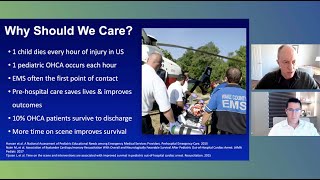
Environment? And the second question is, well, why should we care? Why should we expend resources in sometimes resource constrained world of EMS on improving the way we care for kids? And I'll give you a few data points that highlight it other than it's just the right thing to do. So the biggest killer of kids in the US Is trauma, and one child dies every hour of some type of injury in the US So not only is trauma the most important killer of kids, it kills more kids than all other diagnoses combined. So it's something that we ought to focus on intensely.
A cardiac arrest in children occurs out of hospital over once per hour. So while it may not be a high frequency event for your own agency, it's high frequency in our nation. And EMS professionals are most often the first point of contact with either of these types of illnesses or injuries. We know that better pre hospital care saves lives. There's a massive opportunity in both of these conditions for EMS providers to improve outcomes and save kids lives.
It's sad that around 10% of out of hospital cardiac arrest patients survived a discharge. We'll show you some data from an agency where they've been able to drastically improve upon that number. And it's probably true that more time on scene, providing the correct interventions improve survival rather than a pure scoop and run approach. So that's just setting up the question, why does this whole topic matter to us in the prehospital world?
Right? And Mark, I agree with you. And really that's why the AHA exists, right? The whole purpose is to make those numbers better, to improve outcomes, to make lives better. And really that's why we exist and that's why everyone who's watching exists. We are the front line to make this happen. So I wanted to kind of expand on what Mark was just saying. And this comes right out of the guidelines from 2020 that there's 20,000 pediatric arrests per year, 7,000 of which are out of hospital. But look at that pie chart. 11.4% survive to discharge. However, only half of those, and it comes up to about 5.3% have a favorable neurologic outcome, meaning that they're running around playing soccer. Still, these numbers haven't changed for decades, right? Not last year and five years ago. These out of hospital and you can see this is the graphic that I kind of keep with me in my brain all the time. That blue line there is really the favorable neurologic outcome curve for children since the 80s. Look at the red line in hospital has done much better, but out of hospital we haven't done better. And this also shows that the children who are having an arrest in the hospital and those having an arrest out of the hospital are not the same two different populations. And we're going to talk about that here in a minute. I wanted to kind of show you this because as we go through the guidelines there is a strength and quality of evidence. Now the writing is small and you see I have to have reading glasses on so I'm going to make it a little bigger here. Okay. On the left hand side this is just kind of a table showing how do we qualify or quantify the evidence that we're reading. You can see that on the left hand side is the strength of the evidence and it goes 1, 2A or 2B. Once you're into 3, you're in no benefit. And then there's class 3 harm. Now the best evidence of strength is on the left is a class one. Now what about the quality of evidence that looks at what type of studies have been done and you can see that the level A, those are the RCTs, the randomized controlled trials. So having a 1A is like the Bible, it's the law and we all would agree to it. Then you go to B randomized. Then you go to B non random. Then you go to level C which is limited data or level C expert opinion. So as you're going through these guidelines you'll start to see a lot of to be's, a lot of level Cs. So weak strength, limited or expert opinion on the quality. So we are going to point that out as we go along. But as an example, can any of you guess how many 1A recommendations are in the PALS guidelines altogether? Just kind of keep that number in your mind. And I only need 1/4 of a slide because there's only one and it's here. The only one a recommendation that exists is after is basically saying the continuous measurement of core temperature during targeted temperature management, which Mark does in his ICU is A1A. Basically make sure you manage, you monitor the temperature. Let me give you another example to show you where some other ones fit in because this is a good example. This is a 2B level C expert opinion which says that.
If the manual defibrillator or the AED doesn't have a pediatric attenuator, use the AED like an adult AED on the kid. And we've known.
More from Peter




Melissa Olen MSN, FPN-C, CCRN: Sudden Cardiac Arrest Training in Schools (Project ADAM) 4/25/25



Pediatric Hospital Readiness: How Teamwork & CPR Metrics Drive Better Outcomes



Chelsea Kadish, MD & Kyle Goodknight, EMT-P, RT: Pediatric CPAP in EMS (3/14/25)