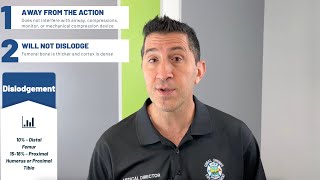
Short video by Dr. Peter Antevy summarizing a peer-reviewed study (reported in Resuscitation, San Antonio Fire Department) that evaluated intraosseous (IO) access sites in adult cardiac arrest after a 2016 protocol change allowing proximal humerus, distal femur, or proximal tibia. The presenters reviewed 2017–2018 data covering 2,016 IO placements: distal femur and proximal humerus had the highest success (~95%) versus proximal tibia (~87%). Measured flow rates were similar (~100–105 cc/min). Distal femoral IOs had fewer dislodgements (~10%) compared with ~15–16% for humerus/tibia. The video also demonstrates the distal femoral IO technique (landmark: midline, two finger-breadths above patella; perpendicular insertion) and highlights advantages: away from chest compressions/airway, less snagging, and greater cortical thickness.
Questions this video answers
2017–2018
2,016 IO placements
Proximal humerus, distal femur, proximal tibia
About 95% success
About 87% success
Chapters
Hey, everyone, this is Dr. Peter Rentevi for another edition of the Henteve Minute. Now, you know how much we love the distal femoral I.O. in pediatric cardiac arrest. But now there's an amazing new study just published in Resuscitation by San Antonio Fire Department that shows it's just as good in adults. So what did the study Show? Starting in 2016, they changed their protocol, allowing paramedics to use one of three sites. Proximal humerus, distal femur, or proximal tibia. They ended up looking at the data from only 2017 and 2018. There were 2016 iOS placed along those three sites. And interestingly, the success rate was highest in the distal femur and the proximal humerus. That's a 95% success rate compared to only 87% success in the proximal tibia. Okay, so for adult cardiac arrest, we know that many of you prefer the proximal humerus. Let's compare the two. Let's compare the fact that the proximal humerus and the distal femur both have equal flow rates at 100 to 105 ccmin. But what's the advantage of the distal femur? Number one? It's away from the action. The distal femur does not get in the way of chest compressions. It does not get in the way of any automated CPR device, and it doesn't affect anyone up at the airway. That distal femoral IO will not get snagged, and then it will not get dislodged. The femoral bone is thicker. That cortex will allow that IO to stay in. And that's evidenced by the fact that there were only 10% dislodgements compared to 15 or 16% dislodgements of the proximal humerus, the proximal tibia. So you're probably wondering, how do I place a distal femoral IO in the adult? Well, it's relatively simple. And we're very fortunate to have a video from Dr. David Miramantes and Scotty Bolater from San Antonio. So it's two finger breaths above the patella at the midline, and it's perpendicular right down into the bone. Let's take a look at this video.
So that's two fingers above the top of the patella. You're finding your spot in the midline.
Okay.
Find your mark. Now make sure you're perpendicular of that bone. Gently push down until you touch the bone.
Got it.
So you're a little bit. So now, here's the thing. You have to be mindful of the position of your patient's leg because you see the way her foot is. Yeah, I'm going to straighten him up just a little bit. That is perpendicular. But if she were posturing, see, I have to change your angle. You always have to be perpendicular with the bone. So now you're perpendicular. So now all he's going to do is just squeeze the trigger. And when he feels it fall in, he's going to take his finger off the trigger.
Go ahead.
Beautifully done. Beautifully. Stabilize this right here and lift straight off of that driver. Three counterclockwise turns and that stylet comes out.
Okay.
Grab that.
Move that hand completely. Remember, it was designed to be applied with one hand.
Okay.
Give yourself some slack. Go ahead and aspirate.
Just a little bit of tension.
Okay, so that was an excellent video. What did you notice there? Did you notice how that femoral IO was spinning for a while before it got into the bone? That's excellent. And that's because the femoral bone is thicker. And now we know that that needle will have a much harder time of dislodging. That's what we want. All right, so what are the takeaways here? We now know that we have a peer reviewed study that demonstrates we can use the distal femur for the adult and cardiac arrest to get easy, rapid access. That's going to stick. It's not going to dislodge with flow rates that are just as good as the proximal humerus. We want to thank the folks at San Antonio. Let's keep this going. If you have any questions, please let us know. This has been Dr. Peter Hantevi for another edition of the Hantevi Minute.