Doug Wolfberg, Esq. - Anticipation of the Elijah McLain Verdict (12/22/23)
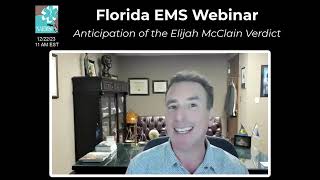
This webinar (Dec 22, 2023) features attorney Doug Wolfberg discussing the imminent verdict in the Elijah McClain case and its implications for EMS. Major points: prosecutors charged two paramedics with reckless manslaughter/criminally negligent homicide and alleged deviations from EMS protocols (including ketamine use) amounted to criminal conduct; the case blurs civil negligence and criminal liability for medical protocol deviations; concerns about EMS’ relationship with law enforcement and scene control; the need to address implicit bias and disparities in EMS care; and whether protocols or medical directors could face scrutiny or liability. The recording includes audience questions about ketamine dosing and contributions of law enforcement restraint to the death.
Chapters
All right, welcome, everybody. It is getting towards the end of the year. It is December 22, and we weren't going to have a podcast today, but then I got on the phone with Doug and I literally begged him to come on. Many of you know that the Elijah McLean verdict is said to be produced here at any moment. So without any further ado, this impacts all of us in ems. It impacts you as a leader, as a medical director, as a paramedic on the street. So without any further ado, Doug, let me pass it over to you, and thank you so much for joining us.
Yeah, thanks, Peter, for inviting me. And thanks to everybody for joining in here, especially so close to the holidays. As Peter said, we are literally, literally waiting for the verdict. The jury is out. They've been charged. They're deliberating. And there are charges of reckless manslaughter, criminally negligent homicide, and assault against two paramedics. There have been other criminal charges against paramedics for drug diversion, vehicular cases. This is the first one we're aware of that relates directly to provision of patient care. What is most significant about this case is that the lines between negligence and criminal conduct are completely blurred. The prosecution's theory is that deviations from clinical protocols regarding the excited delirium, which is, of course, a diagnosis that has fallen out of use, and the administration of ketamine, that. That deviated from the protocols and the medical standards of care and constituted homicide or manslaughter. So the fact that deviation from medical protocols was. Were attempted to be criminalized in this case, that is really the huge issue here. Every time we have deviations from medical standards of care, we call that malpractice negligence. The worst that can happen is a civil suit with a payment. Right. Usually by an insurance carrier. There was that in this case, by the way. In 2021, the city of Aurora settled with the McLean family for $15 million, which included both police and fire, because they're both within the same city government. So we've had the civil settlement, but then, you know, after some political involvement, the state Attorney general's office filed these charges. And really the essence of their theory was that the deviations from the medical standards of care constituted homicide or negligent homicide in this case. So the. The blurred lines between negligence and criminal activity or criminal conduct is really the. The huge takeaway from this case. You know, we are waiting for this verdict. As I said, the jury deliberated all day yesterday. I think most of us expect that the jury will want to render A verdict either way today by the end of the day, because they're not going to want to come back after the Christmas holiday. Who knows? You know, we're not in the jury room. I've watched most of the trial in real time, and I can tell you that I think, having given this a lot of thought, the verdict is going to be very personal to the two paramedics and to the McLean family. But the lessons belong to all of us. And I think the lesson, relax. Just as I don't think a conviction means that paramedics and medical directors everywhere should be in despair. I think what we need to do is we need, like, any evidence, whether it's in research or that comes from court. Right. We need to take that and glean the lessons from it and incorporate it into our practice. And we could talk in, you know, for hours on each individual issue of patient assessment. Where you park the vehicle? Do you bring the monitor to the patient? It's a lot easier said than done, especially in cases involving law enforcement. One of the principal allegations here is that the medics did nothing more than assist law enforcement with detaining Mr. McClain. He was not under arrest, by the way. This was a stop of a person walking down the street wearing a ski mask in the summer. And, you know, somebody called 911 alleging it was suspicious. And it de. Escalated from there. I should say escalated from there. It became a, you know, what it. What it was. But the point is, is that the central allegation is that the paramedics basically did what the police asked them or directed them to do, which is to hit this guy with ketamine, right, to assist us in restraining him. Anytime that decisions are made regarding any intervention, and here we can talk particularly about restraint and sedation. Anytime those interventions are done, they have to be in service of patient care, not in service of law enforcement. So I think that is probably one of the biggest takeaways from the case. The second one that I see is the relationship on a broader scale between EMS and law enforcement. And what I mean by that is there were allegations in this case that paramedics did not have full access to Mr. McClain and that police refused to release the handcuffs until Mr. McClain was moved to the stretcher. And first response, the paramedic engine was there well before the ambulance, and it was those paramedics that ended up getting charged. You know, when does a law enforcement incident become a medical situation, Right? When should law enforcement stand down and when should EMS speak up? If there would have been Clips or, or sound bites on that video where the medics would say things like, hey, he's ours now. We got them. Release the cuffs. We need access to the patient. We need to be able to assess them. Right. None of which was on the tapes in this case. I think that would have been very powerful evidence for the paramedics in their defense, instead just showing up and within 90 seconds of arrival, giving the patient ketamine without a full or detailed assessment, no cardiac monitor nearby. I think that's what created, you know, a big chunk of the prosecution's case here. So, you know, we need clearer guidelines for when a law enforcement incident becomes a medical scene or, or an EMS situation. And medics need to be assertive and speak up to, to basically take control of patients so that they can provide necessary clinical care. And that's much harder to do than it is to sit here and say, because the people with the badges and guns do tend to be very dominating when it comes to control of a scene.
Third, and there's no, and let me, let me be very clear, there was no express evidence that came up in the McLean case about what I'm about to talk about. But you know, these cases, Whether it's the McClain case in Colorado, the Earl Moore case, which is a first degree murder case against two EMTs, I'm sure we'll talk about that in a future webinar that's not come to trial yet. Whether it's the Eric Garner case, the George Floyd case, the Tyre Nichols case. You know, by and large, these involve white EMS providers and black patients. And even though there was no overt suggestion or evidence in the McLean case, EMS needs to talk about its role in social justice. Implicit bias.
Disparities in care, which are well documented in the clinical literature for underserved populations, all of those things need to be part of the EMS conversation. And then fourth, and finally, I think is this idea that, you know, deviations from medical standards of care and from EMS protocols can be criminalized. Will this lead to introduction of legislation that prohibits prosecutors from, you know, applying criminal statutes to alleged protocol deviations for EMS providers? You know, I don't know. We don't know what the legislative, the legal, you know, the policy implications of this case will be. But the fact that these t. And I said this right at the beginning, but the fact that deviations from medical protocols can be criminalized. And I'll tell you that in the defense's closing, their argument was basically, look, these, there may have been problems in EMS care in 2019, how we looked at excited delirium and how the police stopped and detained people. This is pre. George Floyd. You know, this was prior to all of that, that the pro. They were, they were really attacking the protocols. Right. Which I think as medical directors, many of you will go, well, isn't that interesting, right? Because, you know, so the defense was saying, look, these protocols may have had their problems, but it was what the paramedics had to follow at the time of this incident. So the appropriateness of protocols themselves was really a subtextual issue in the McLean case. Right now, the medical director was not a party in the case. He was not named as a defendant. He did come into court to testify about the protocol and the compliance with the protocol. But the subtext of the case and was expressly stated by the defense. This maybe wasn't the world's best protocol either. So it. We're not too far from the next step where the, you know, can protocols themselves be on trial? Right. Can a protocol be negligent? You know, it's one. It's almost like the Nuremberg defense. Well, we had to follow the protocol. Yeah, but that was the wrong. It was a, you know, it was an improper protocol to begin with. So that, that was a subtext of, of the McLean case. So just, you know, those are really briefly what we see as the big issues. Like I said, I have, I have all the alerts set up on my phone here. We might literally be getting a verdict any minute. We've been sort of blogging about this case on LinkedIn. So I would say quickest way to find out what's happening is just to connect with me on LinkedIn on my, my profile or my firms. Paige, Wolfberg and Wirth. We already have our, our posts on this pretty much ready to go awaiting the final verdict. So as soon as that comes out, which could be today, we'll push that information out. So I wanted to leave a few remaining minutes for comments or questions, if folks have any.
I'll start, and I would love for other people to jump in. Doug, I've been listening as well, and I didn't hear anything about the fact that this, this person, Elijah McClain, may have died because of the chokehold, if you will. They're putting a lot of the blame on the ketamine. They're putting the spotlight on it. They gave him 500 milligrams. It was a little bit more than his weight based dose, if you had his actual body weight. We know that ketamine can be given in a Tenfold overdose and still be safe. Why is the other half of that not coming up in this trial?
You mean that the law enforcement role, you know, like the carotid hold and that kind of stuff?
Right. In other words, asphyxia as the real reason for his death, instead of what the coroner put. Which was the cause of death was ketamine, which I don't believe.
Well, yeah, I mean, look, I think everybody on this call understands that the difference between a 500 milligram and a 420 or even 300 milligram dose of ketamine is not toxic. Right. And there was significant testimony because in many ways, ketamine was on trial in this case. I think the overwhelming evidence suggested that the ketamine. That ketamine itself was one of the charges was assault with a deadly weapon. The prosecution alleged that ketamine was a deadly weapon. The judge, very importantly, ruled that ketamine was not a deadly weapon. All right, so that. That is a vital ruling that came out in the middle of this case. The defense did raise the application of the carotid hold by the police officers. And more importantly, they raised the fact that this information had been withheld from the paramedics. I think the defense made a very effective argument in closing that the paramedics. You know, now everybody looks at the body cam and sees the hours of footage and all the expert testimony. But at the time the paramedics came, they were given a limited snapshot of information. Law enforcement specifically did not inform them that they had applied a carotid hold. I would note that three police officers were also criminally charged. Their trials are over. One of the three was convicted. The other two were acquitted.
Interesting. Interesting. Okay. Great explanation. Let's go to Dr. Matt Levy from Johns Hopkins. Matt, please go ahead and live.
We cannot hear you for some reason.
All right, let's.
Yeah, Here you go.
All right. Hey, good morning. Hey, Doug. Thank you. That was always very impactful and thoughtful. Yeah, I think we're all waiting with bated breath to see how this plays out for the reasons you said. You know, the discussion about ketamine and the criminalization of a drug is something that we'll be studying and talking about for years after this, no matter how this goes. My question for you and for the other thought leaders on the call is. Is very simply.
We like any other ALS intervention, we know that with any therapeutic intervention, there's risks and there's benefits, and I think we need to slow the role. Whatever happens here, however this outcome is, we need to slow the role to think about being about just changing the way we approach als. Education, training and readiness to focus on being ready for whatever's going to happen next just like we would in airway evolution, just like wouldn't anything else like that. So I think if we can look for the silver lining in this crowd, in this cloud, it's really to take that, that mantra and say, hey, we just have to do a better job. And you said it. And this is what I wanted to reiterate Doug, is you said this point about being very focused on what we're saying on body worn camera so people can hear, okay, he's mine now. He's our patient now we need to do X, Y and Z. We need your help to treat our patients. I think we will see and hopefully experience more scripted or more very intentional statements like that so we can slow the roll. My last comment is where we seem to get into trouble is when we break roll when medics try to be cops and cops try to be medics. As the medical director for multiple law enforcement agencies and someone with a law enforcement.
More from Peter




Melissa Olen MSN, FPN-C, CCRN: Sudden Cardiac Arrest Training in Schools (Project ADAM) 4/25/25



Pediatric Hospital Readiness: How Teamwork & CPR Metrics Drive Better Outcomes



Chelsea Kadish, MD & Kyle Goodknight, EMT-P, RT: Pediatric CPAP in EMS (3/14/25)