Dr. Bjorn Peterson: RAMP Triage (9/27/2022)
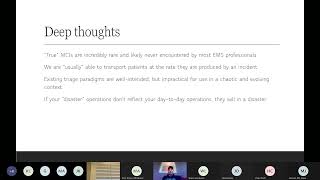
Webinar (9/27/2022) on RAMP triage led by Dr. Bjorn Peterson (Minneapolis) hosted by Peter Antevy. Speakers (Dr. Peterson, Julie Downey, Paul Pepe, Randy Katz, Juan Cardona and others) discuss why their Twin Cities EMS system adopted RAMP (simpler triage: two clinical checks—ability to follow commands and palpable radial pulse—eliminates a separate “yellow/delayed” category), implementation approach (rolled out across agencies while retaining START/JUMPSTART/SALT references), training and change-management considerations, and operational lessons for MCIs including law-enforcement-integrated drills (Three Echo/rescue task force) and NFPA 3000 standards. Presenters emphasize simplicity, realistic multi-agency drills, hospital liaison roles, and adapting training to incident type (active shooter, collapse, medical MCIs).
Chapters
Okay.
So it's 1101, so we have the recording going. Thank you so much, Angus, for doing that. Welcome everybody. This is another edition of the Tuesday Florida EMS webinar where we try to bring this incredible guest speakers to bring us kind of the latest and greatest what's going on in their region or with specific papers that they're publishing. And today really, we're really excited to have Dr. Bjorn Petersen, who hails from Minneapolis. He is attending at Minneapolis in Regents Hospital. He is our EMS medical director. And a few weeks ago we had a big discussion about triage solve, start, jumpstart, et cetera. And people kept saying, what about ramp? And when I heard Bjorn was doing ramp in Minneapolis, I said, hey, you mind joining us? So Bjorn, thank you for joining us and I'll let you take it away.
Yeah, sounds good. Thanks for, for inviting me. So just a point of clarification here, let me go to my next slide. So part of the Twin Cities up here in Minnesota. So Minneapolis is what we call the west metro. I'm actually on the St. Paul side or the east metro side. So I work for agency called Health Partners Health Plan Care delivery system. We have several hospitals where I work in the er, but we have an EMS office, office of the medical director out of our flagship hospital, regions Hospital in St. Paul. And we contract for medical direction and education to a number of agencies in the east metro area here of Minneapolis St. Paul. What's unique about the east metro versus the west metro, and this is just background information, is we're predominantly fire based ems, as you can see from the list here, the one at the bottom there, Lakeview EMS is a, we own that as a healthcare system. They are critical care ALS, 911 and inter facility, but the rest of them are all fire department based ALS contrasted to the Minneapolis side which is predominantly healthcare based EMS with only one or two fire departments. So politics are different. And just a little bit of background as we kind of talk about why we made this change to ramp and how we did it. So population area here in the Twin cities is about 3 and a half to 4 million, depending on which counties you include. You see the river that kind of runs right through the blue box here, that's the St. Croix river and that divides Minnesota on the left to Wisconsin on the right. So we do, our EMS system does cross over into Wisconsin, which is a much different state from a legal standpoint than Minnesota.
So our background on this, it kind of came up during our regular CME cycle for the trauma triage NCCP core requirement. So our educators kind of came to the group of medical directors and said, hey, we heard about this, and I don't even know, I think someone went to a conference, maybe heard Brad Keating speak. I think he was the one of the guys that did a lot of the initial publicity for this out of Colorado.
And so we historically had used the START triage system as well as the jump start for pediatrics. But as many of you are probably aware, the model Uniform Core Criteria Initiative came up with the SALT algorithm.
As well as the muck can be. You can apply any triage algorithm as long as meets the core requirements of the. Of the muck. So the SALT is the one that, that the, the task force ended up coming up with. But just looking at these slides, if you just glance at this screen right here, it's busy, right? And I don't even remember the initial conversation we had about why we wanted to make the switch, but somebody threw this up in front of me and said, hey, what about this? This is pretty straightforward. And I looked at him like, really? This is how we're going to triage mcis? It just seems too straightforward. But again, going back.
Unless you study this day in and day out, you know, our frontline providers are not going to remember most of this unless we really do some, you know, aggressive and repetitive training on it. And I would argue that we maybe have other things that would be better uses of our training time. So what you'll notice right away, the RAMP triage model, if you're not familiar with it, it eliminates the yellow category. Basically says there are people who are delayed, can be transported or treated later. There are people who are urgent who probably should go now. And then there are the expectant deceased categories. And all it basically does is can you follow commands and do you have a palpable radial pulse? Both of which are proxies for other physiologic markers. Gcs. You know, the initial GCS does predict hospital outcome, but rather than have somebody calculate a GCS for each patient involved in the, in the incident, we're just going to ask them to follow some commands or ask them a simple question and see if they give us a, you know, reasonable answer. Which means that they probably have intact, you know, neurologic function, perfusion, and then the palpable radial pulse, you know, proxy for probably a systolic of around 80 or 90. As we know, hypotension in a trauma situation is also not a good prognostic indicator. So if they can follow commands and you can feel a radial pulse. Let's focus on the other people first. If you don't feel a radial pulse, you're concerned there may be hypotensive. So they need to go because they probably have some ongoing blood loss that we need to deal with. And if they're not following commands at all, but they have adequate blood pressure to generate a radial pulse, then they probably need to go as well. But if you can't, even if they're hypotensive and they have some sort of a significant TBI where they can't follow commands, if we're truly in a situation where we need to dole out our resources, then those are the people that are probably the least likely to survive. So we're going to focus on other patients. Obviously there's life saving interventions that you can do and this is for us. I'll be honest here. We, I don't, this isn't necessarily a hill that I'm going to die on. What we actually let me just go through my points here and we can talk about this too. I'm going to try to keep this brief and we can just take some questions too. But this is how we had to present this to our agencies. And again, remember, most of them are fire department based agencies, so very much in the, you know, ICS incident command kind of model. And so they want some sort of a formula to follow when they're in an mci. And this is a caveat that I am in an urban environment here. So true MCIs, you know, really what is the true MCI? It's truly where your resources are overwhelmed by the number of patients that are generated by the incident. And you know, to be honest, that just so rarely happens. I mean, I know, you know, Peter, you know, some of the shootings and stuff, yeah, those maybe do come up from time to time. But honestly for most pre hospital providers it's not something that they're probably even likely to encounter in their career where there's an incident that truly overwhelms the availability of local resources. And the fact is that we are usually able to transport patients at the rate at which they are produced by an incident. Even in an urban area we can go to a pretty close hospital. And the Twin Cities is not a large area compared to a lot of other metro areas. So you know, at any point within the Metro we're only 15, 20 minutes from a hospital and then we can cycle that truck back out if we need to. So we've, you know, rarely are we going to encounter a situation where we truly have to decide who goes and who stays and who gets the resources and who doesn't.
Like I started to allude to before, existing triage paradigms are very well intended, obviously, but they're very impractical. And you know, these are situations that are very chaotic and evolving. Lots of adrenaline. The IQ goes down as the adrenaline goes up in some of these cases. And so it's just hard to expect our providers to follow these algorithms and remember all the numbers that are in them. And then I think this is just common sense. And this is what I heard from the Eagles survey that was put out about who uses what type of triage system in their metro area. If your disaster operations don't reflect your day to day operations, then forget about your disaster ops because your day to day operations are just going to basically take over and adapt to your disaster operations. So I don't know if I said that right, but I think you understand what I mean there.
What we also know is that really in the best of circumstances, if you take your most experienced clinician and put them in charge of triaging and let them use whatever intuition and assessment skills they want to use, they're probably going to do just as good a job in some cases, even better than some of these algorithms that you might expect some of your newer or less experienced clinicians to follow. So another thing to maybe keep in mind, and a lot of these from a pre hospital standpoint are trying to answer the question who should be transported next or first? Or who do we provide care to first? And while that is an important question to ask, like I mentioned previously, in most urban settings we are able to transport patients pretty much at the rate at which they are generated for 99% of our incidents. And so in this research rich urban environment, sometimes the bigger question is where should we transport these patients, not when should we transport them? Do you go to the level one trauma center? Do you go to the level three trauma center? Do you go to the community hospital that happens to have a neurosurgeon? Or maybe this one has orthopedic coverage, this one doesn't. What kinds of injuries are you seeing and where could these patients be treated, knowing that they can't all be treated at the preferred, maybe level one trauma center in the area? And I think honestly for us as EMS medical directors, if we get called to an incident like this, this is probably one of the best roles that we can play. We have plenty of people generally that can provide hands on patient Care, but I know the lay of the land. I know the hospital side of things better than my pre hospital clinicians do. So I know where some of these patients can go and where they should not go. And I can help distribute some of that patient load across different facilities based on the resources I know that are available there. So we did this basically just by rolling it out. We just did it. And our official party line is that we want each of our agencies to utilize a validated evidence based triage system. Whether it's start, jump start, salt, but we are teaching ramp and we actually include all of them in our protocol guideline handbook just as a reference point. But we, we teach and we focus on ramp and we just emphasize the points that boy, these MCIs, you know, most of what we would call an MCI that have happened in the last 10 years here in the Twin Cities really probably weren't true mcis. They were just large scale incidents that probably didn't need a triage system. You know, you have a patient, you transport them, another patient, you transport them. We didn't need to decide who gets transported and who needs to wait. So one is that we're just not using these, we aren't using these tools very often at all, if at all. And two, just the complexity of some of the tools, the things that you have to memorize and remember and regurgitate and calculations you have to do in a chaotic evolving environment just aren't realistically going to happen. You can train on it, you can expect it all you want, but most likely what's going to happen is it's going to devolve into just gut intuition based on the pre hospital clinicians that are, that are on the scene. So that's we did this probably, this was well before COVID probably 2017, 2018 maybe. We haven't had an incident where we've had to utilize any triage systems since then. We have not had any pushback on this. We've had people say, yeah, this makes a lot of sense. You know, patient follows commands, we can feel a radial pulse. All right, we're moving on to the next patient. If we are truly in a situation where we have to pick and choose who gets to be transported first.
That'S in a nutshell what we did. Not very complicated. Some of this is probably more change management philosophy and psychology than anything else. But that's why we made the decision. That's how we did it. Open any questions or discussion.
Perfect. Awesome. Bjorn, that was amazing.
We've been kind of debating this for quite a while. We're very fortunate. One of the chiefs that. Who got me into ems, who has been an amazing mentor for me. Chief Downey is on the call today. And so I asked Chief last night to send me the updated.
START.
Kind of.
Graphic, if you will. And what I'll do is I'll put it up on the screen because I would love for her to.
Just discuss her thoughts about why START made a modification to kind of go towards what you're mentioning, which is something that's. That's a little easier, that does not require many numbers. So that's topic number one I want to bring up. And then the second topic would be how it. How we would address the pediatric population. So let me see on my screen here, you could see hopefully that.
The two models. Chief Downey, are you able to come on and just give your thoughts about this?
Yeah, yeah, I'm on. And I agree with a lot of things that you said. If you look at the original START flow chart, it's all over the place. And that's why it was modified, really. We changed it here around 10 years ago, and we worked with START and Jumpstart. And so this is the Start that we've been using for probably 10 years. It's been put onto our MCI cards distributed by DMS that's been going out to every agency in the state of Florida for at least 10 years as well. So I think when you're looking at the different models that you want to compare them against, I think you should be using the most up to date versions that there are. I did work with Start on this. They know that this change is done, and it really was changed. So that was consistent to what we were teaching. We were never sitting there counting respirations up to 30. It was a guideline, but it's really. It's respiratory distress. And we wanted to make sure that we added in that controlled bleeding with your severe hemorrhage in there so that you can get that tourniquet on. So we modified Start, and then I worked with Dr. Romeg, we modified Jump Start to make it just as simple. And then you have these badge buddies. That's what that is. And the EMSC through the state of Florida has already distributed over 7,000 of these cards throughout all the agencies. And if anyone on the call needs more EMSC through peedReady would be happy to send more cards out. So I agree with you. It's got to be really simple, easy to understand, and that's why we modified it. You know, years ago to have this very simple, simple. Really what we're looking to find is the red and then tag the red or dead. It's really that simple. And we are in a very resource rich area as well. So a lot of times we're not going to need a treatment area. Identify who's the red victim, get them out, get them transported. That's the model to get them out as fast as we can. That's kind of it in a nutshell. I just wanted to make sure everybody's using the right version, especially in the state of Florida, that we've been using this for a very long time and have distributed it with our MCI tags with the ribbons and just trying to get the information out there.
Yeah. And I think the reality too is that even by putting something out there, that's not necessarily what the clinicians are going to be doing. If you see somebody like I'm just looking really, these are very similar.
Exactly.
You have the respiratory distress factor. And I would be hard pressed to say that I'm going to have a paramedic that's going to see somebody in respiratory distress but can follow commands and has a palpable radial pulse that would still triage them as delayed. You know, there's still gonna be some adaptation and intuition that goes in with this. If you look at the research, you know, there's obviously more research done on some of start and salt and jump start just because they've been around a little bit longer. But if you take some tabletop exercises and put the patients through it, you're going to find that all of these triage systems generally perform very similarly. So it's really just picking one, sticking with it, training with it, making sure that your frontline people are very familiar with it.
Let me pose this question to both of you then and I would love for anyone else to jump in on this.
The types of MCIs that we're worried about are the shootings, right? Obviously it's not. I mean, yes, the bus accident like Bjorn, you mentioned is maybe a little different. Right. But it's the shootings that there's someone bleeding out inside that building. And.
Our experience at Parkland was just that you mentioned, which was a lot of the actions that were done, these life saving interventions were done by police officers and swat. And then they were brought out to a very experienced clinician in ems Chief Juan Cardona, who just said, I'm making a decision on you're going to go here, you're going to go there. That's what hospital you're going to. So it was almost done in a very, it was done in a very different way than how we train where you walk in and there's someone on the floor and you're like, you look at the tag and so forth. So my question is, should we be adapting our training towards this type of kind of the MCI that's a shooter, a shooting versus another type of mci?
Yeah, I mean that unfortunately is probably where we're going to see. I'm thinking like what generates a lot of victims. It's going to be those mass shootings and it's going to be something like a structure collapse or a hurricane unfortunately, coming up to you guys here in the next few days.
So. And then there's medical situations I think about, you know, we just came out of the Minnesota State Fair which always has the potential to generate, you know, with heat related issues.
We used to have more of a rash of the electronic music festivals that would generate lots of drug overdoses and those generally became medical MCIs. So I don't know. So you're asking do we train more on intuition? I think that's what you're getting into then is.
If any of you have read the book Sources of Power by Gary Klein, written in 70s or the 80s and he looked at how do military commanders make decisions in the heat of the moment and how can we train other people to make good decisions in the heat of a moment just like this. And he developed, you know, it's kind of Daniel Kahneman's counterpart, System 1, System 2. It's, it's recognition prime decision making. And really the core of that in a nutshell is that you have to have a huge library of experiences in your past that you can prototype your current situation to to come up with a plan that's most likely, most likely to succeed. So that's where I think having the most experienced or a, an experienced clinician doing some of that triage is what makes the most sense. And I don't know how you train for that specifically other than just running calls, you know, seeing sick people and not sick people day in, day out and being able to make that distinction.
Excellent, excellent point. I see Dr. Pepe has joined us end of summer. Yes, it was the end of summer.
Dr. Pepe, welcome. And I know we have to mention the CME code, but I also wanted anyone who's on the call, there's a lot of very experienced people on this call. I would like to hear people's comments. Dr. Pepe let's start with you.
Well, first of all, yeah, the CME code for today is 1 5.
And if you're calling from outside the United States, it's country code one. So anyways, nobody response. Is that what you just heard from Bjorn? Which is like really on target? Because it really is better having someone who's had a lot of experience doing this out there. But you have to still start with something to give someone an idea. But the things that are critical are obviously just. It's actually very simple in some respects, whether it is a multiple shooting. I mean, when I was in Houston for 15 years, we literally had several MCIs per night by other people's definitions. But I would say once a month we had what he said was important, where you're suddenly overwhelmed because there were numbers. There will be explosions that will do it. There will. Even in town, you know, there will be transportational accidents that are like trains or buses or whatever. And in the shootings, the shootings do change things, I have to admit, because you ought to see a thing called 11 minutes that's going to come out in Paramount. I'm a good friend of some of the people that were on stage at Las Vegas in the i91 event and that kind of changed things. And that's a whole different lecture that I can come back and give. But bottom line is, is that get if it's still under fire or if there is other, let's say, hazards, your chemicals or whatever, you do need to clear the people out who are going to be able to survive longer out of there. But otherwise, I think the point being is that that keeping it as simple as possible is. It's just right after everything you said, I thought was just right on target. The but is that we have to start with someone to give young champions something to guide them along. And then we need to, you know, that kind of thing. I don't know if that helps or not, but I just wanted to say I pretty much agree with everything Chief Downey said and what Bjorn said to begin with.
Excellent. Thank you. I see. Randy Katz. Dr. Katz, go ahead. Thanks, Paul.
Hey, Peter. Yeah, I mean, this was a great discussion. I think, you know, many times we try and approach these things with a one size fits all mentality. And I think what I've learned, I've been involved with a few MCIs and you know, the one that, you know, really strikes a chord with me was nursing home evacuation with 150 demented patients in a heat exhaust and heat environment. And Peter, you were at the, you know, parkland shooting. So I think the reality is every one of these MCIs, and I think Warren said this earlier, that they're all different, they have challenges. And I think more important than, you know, trying to come up with some system, I think it's more important to go through drills with different scenarios. I don't think we do that enough. You know, what is a drill? Heat exhaustion, building collapse look like and what does an active shooter drill look like and what are the challenges? Because they all have so many different variables. Logistics, types of injuries, what you need at the hospital. And I just don't think we do enough practice. Regardless of what tool we use. At the end of the day, it's more about practice than the tool we use.
Hey, Peter, can make a comment about what Randy said. I like the idea. I used to always think early on that drills were a waste of time because they weren't realistic. I could actually have a real mci, you know, like, like a half an hour after we did our drill. And it was so much, we perform much better. But the point is, I've learned over the years that when you get a lot of people together when you run scenarios, don't just run one scenario, run multiple, with different agencies having the lead on it. Whether like for example, it's an uncontrolled situation, so police are in charge, or it's a wreck, you know, so you have to learn how to work with the other agencies within that drill. And that's I think one of the more important aspects of it. And like I said, we'll have to have a separate discussion. But you know, like I said, Las Vegas shootings kind of changed the rules in many respects. You know, that's a different conversation.
Let me ask you a question, Paul and Bjorn. Randy, Julie is my question for you is this, is that, you know, and Chief Downey has done so many drills and she's really the guru in the space when we do drills as obviously a big police set.
Police segment to the drill. Right. We did a drill here recently where yeah, there are patients, but the police have to go through and do all their motions and check every room and.
Blah blah, blah, all that kind of stuff.
And those drills end up taking, you know, they take a couple of hours. So Paul, am I hearing you're saying to try and do multiple kind of like rapid acting drills?
Yes.
At the same time.
Yeah, But I think one of the best things I ever saw was the way the, the Clark County Sheriff's office handled the thing when they're preparing for the electric Daisy car. Well, they've had a lot of experience with it and what they'll run drills with where the transportation situation is all screwed up. So we see how other people come into that, how the police act in there, how EMS and you get to know who the players are. That's what's most important, I think. And then the same thing, then you run a thing that, where it's more police oriented, then you have one that's more EMS oriented or what other. Other organizations, just a nice red cross or whatever it may be. But that's all I'm saying about that, is that the drills are important for the point of view, from my point of view is you get to know the people who are going to be there on scene with you, you know what their job is.
Yeah. And I think like you said, these are law enforcement heavy incidents too, that especially the Las Vegas one. Do you guys do a Three Echo or rescue task force or any paradigm like that in Florida? Yeah, we do Three Echo here in Minnesota. Enter, evaluate, evacuate. So we drill with law enforcement and we actually have like an old nursing home that we've been able to use to go through with pellet guns and smoke and loud noises and stuff where we get volunteer paramedic students to be victims and we go in with the law enforcement and practice creating the corridor, the safe corridor where you can drag people back so you're not waiting for the whole facility to be cleared or a whole wing of the building to be cleared. You're going in and pulling people out as they are generated. Because yeah, that's, that's the issue then with those situations sometimes is, you know, law enforcement does their thing and we end up waiting a while. And so those drills take, take a while to evolve.
Well, the other things is, you know, like what Randy was talking about, a classic thing is when there's a fire going on or smoke alarm in a 12 story nursing home or condo and they have to shut down all the elevators, they have to do that. So that's something we really should be working on a lot. You know how we're going to be doing things like that that don't seem as, I don't know, exciting in a sense. For me, that's real exciting when you're saving a whole bunch of old people. So there's many things. But I think they could be done in a quicker manner though. Bjorn is what we're getting at. And I think that, you know, whatever, that's enough for me.
Let me, I'm going to bring in Chief Downey to just a comment on training and MCI training. Chief Downey, you might make a couple comments and then we'll give Dr. Peterson the last word. After you. After you go.
Yeah. Well, I think we need to look at some of the national standards for our training and for what some of this discussion is. And we have a guideline that can assist us with that. The national fire Protection Agency, NFPA 3000 active shooter, hostile event, has all of the information on a rescue task force, you know, and what that concept is with the integrated response and I think that's what we should be basing our training on is a standard that is out there. And I agree all the training and even small incidents have to be done jointly with our law enforcement. We really have a breakdown in communication and training with our law enforcement partners. And any type of hostile event obviously is going to involve our law enforcement partners. And we need to be building that relationship way ahead of an incident. And every, you know, incident that has several fire EMS units and a several cops should have a unified command. And it's that simple as to get every single call that we have to say who's in charge on this scene from the law enforcement side and join with them. Don't ever wait for them to invite you to their command post because that's never going to happen. That's not in their nature. So we have to seek that out. I think there's a lot of things that we can do ahead of time. We have a document that can help us and it's in revisions. If there's anything that we want to have added in there, public comments are going to be open very soon that can get added into that. But right now we have this document and that's what we should be using to assist us in the training.
And Chief Johnny, I think you've already pointed out how important is it people are going to keep referring back to some standard, you know, that you're supposed to be following.
Good point. Right. And obviously working with Alert, who put out the AAR on that, and working with the International Police Chiefs association, you know, we need to do a better job on the NFPA 3000 that there is a standard and that we are all going to be held against a standard when an event happens. Law enforcement doesn't like this standard because they don't follow any standards. So there's a lot of police agencies that are on the committee for nfpa. But the needs more and the word has to get out more to law enforcement again through alert. We have FBI, doj, all of those are on the committee. But it needs to get out more with the. The word needs to get out.
I agree and really thank you for your leadership on that. I'll send that out to everybody, but I want to move over to Dr. Pepe's webinar by Dr. Mossi in a second. But Bjorn, take us away. Give us your final thoughts. And again, thank you so much for joining us. This was an incredible conversation.
Yeah, no, I agree with Chief Downey 100%.
Yeah.
I think then also working on the private EMS side too, we need to make sure that that standard is communicated and get input from some of the healthcare based or private EMS agencies as well. So it's not just seen as a fire, you know, standard. And that even though it should apply to everyone else, so. But 100% agree.
Yep.
I also like your comments on the fact that as the EMS physician who has the really more deeper knowledge of the. How the hospitals work is that we also have to understand how to utilize your resources in a more efficient way. Remember at Parkland, they would like to. I was on the scene. There was a couple other ER docs on scene, but then someone called another ER doc and said, hey, just go to the hospital and be our segue there. And Chief Cardona, who's on the call today, did an incredible job kind of organizing all of that within that mayhem.
I think that's one of the.
Sorry, that's just one thing I would certainly add to every agency to do. If you have an incident, send a hospital liaison. We've incorporated that into all of our plans. That is definitely something that needs to happen.
Amen. Go ahead, B. What are you going to say?
That's that I. Yep, I agree. Thanks for the discussion, everyone. This was fun.
Yeah. There he is. Hey, Chief Cardona, I'll give you 30 seconds. You want to make any comments? You were there. You were the guy.
I don't have to repeat with what Chief Donna just said, but that definitely worked. And whenever I speak about Douglas, I always bring up Chief Villar's name, Louis Villar. One of the best phone calls I got that day. When he says to me, I know you have probably everything you need at the scene. I'm in my office. What can I do for you? I go, you're closer to the hospital. Head to North Broward and just be my eyes and ears there. I'll send you stuff and you feel back. Just fill in the blanks and give me back all the information we need at the end of the day to wrap up the accountability part of the of the event in terms of patients. And, you know, that worked out awesome.
And by the way, just everyone knows I plan on having the Ready Ops CEO come on and give us a overview. So I have an email and a thread with him going right now. So, Dr. Peterson, thank you so much for your generosity today. Love the conversation. You're the best. Thank you so much.
Thanks, guys.
All right, so everyone hang in there. Let's see if Angus is doing many different things, so I'm going to try and restream. Let me see here. Just hang on tight. And I'm going to get the Eagles up for everybody.
Take off my head. Going on on the other side.
Recording.
More from Peter




Melissa Olen MSN, FPN-C, CCRN: Sudden Cardiac Arrest Training in Schools (Project ADAM) 4/25/25



Pediatric Hospital Readiness: How Teamwork & CPR Metrics Drive Better Outcomes



Chelsea Kadish, MD & Kyle Goodknight, EMT-P, RT: Pediatric CPAP in EMS (3/14/25)